SPOT THE BEAST 3 – REVEALED

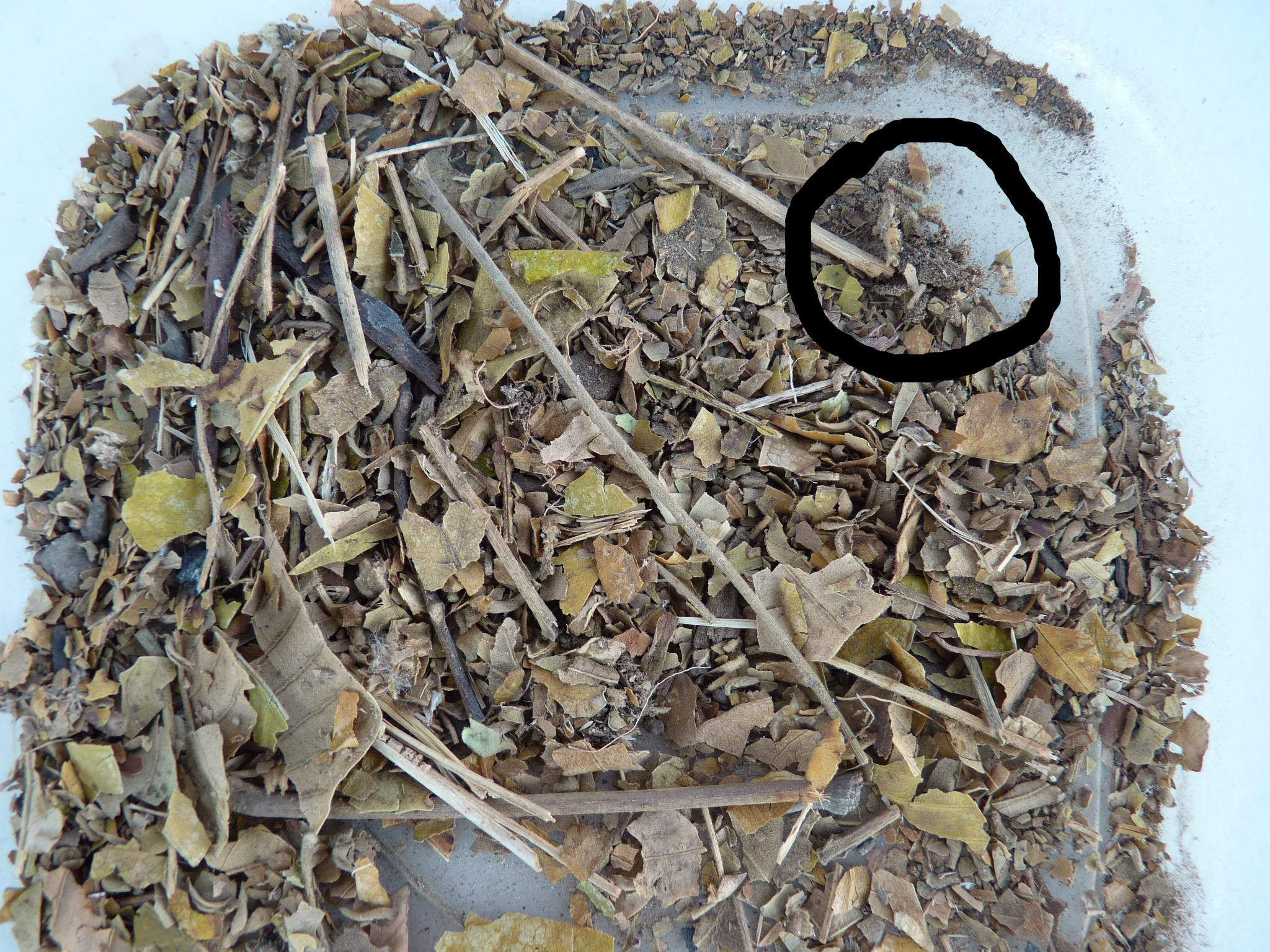
Spot the beast 3 1 circled


spot the beast 3 2

the beast isolated small

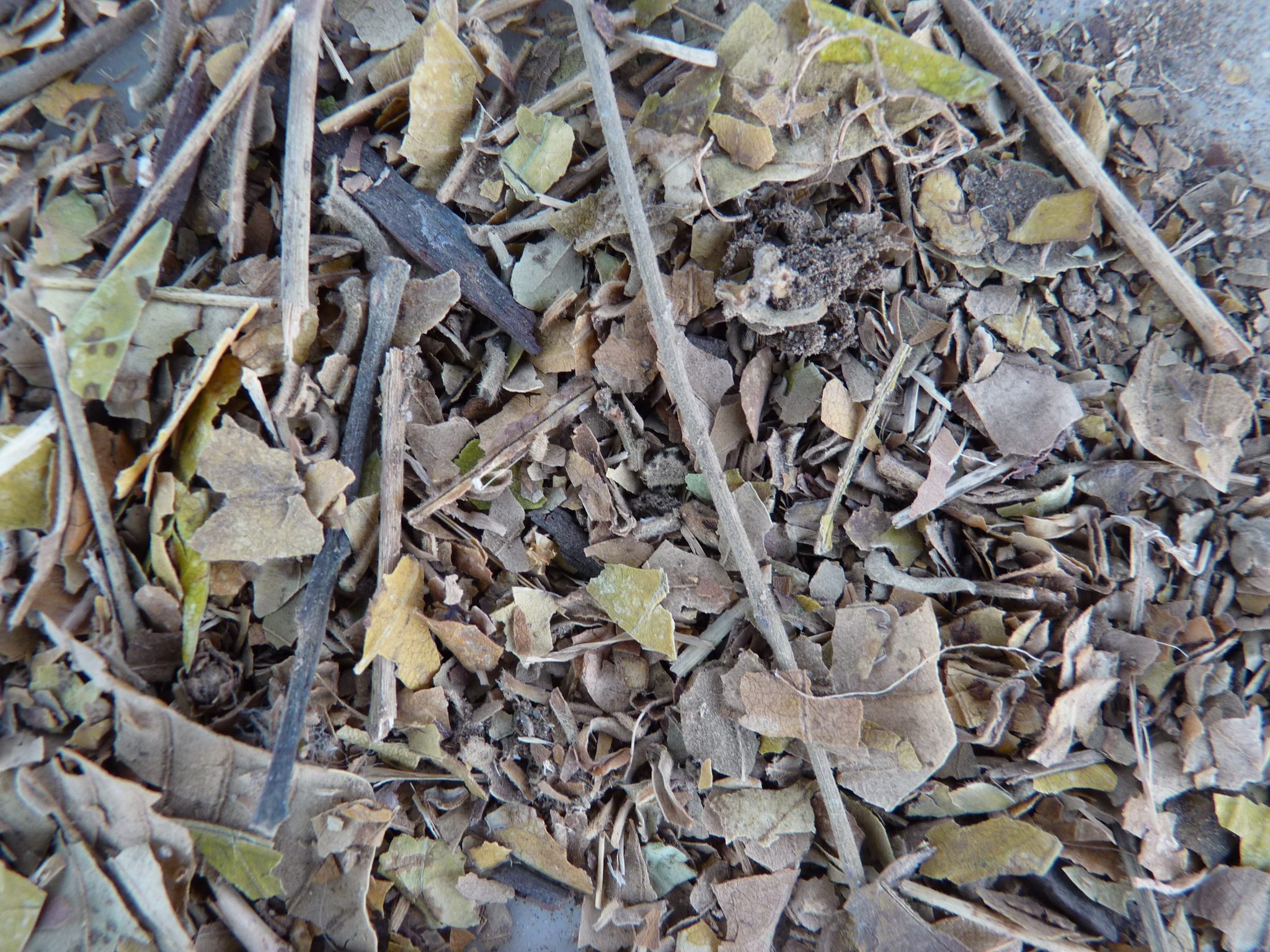
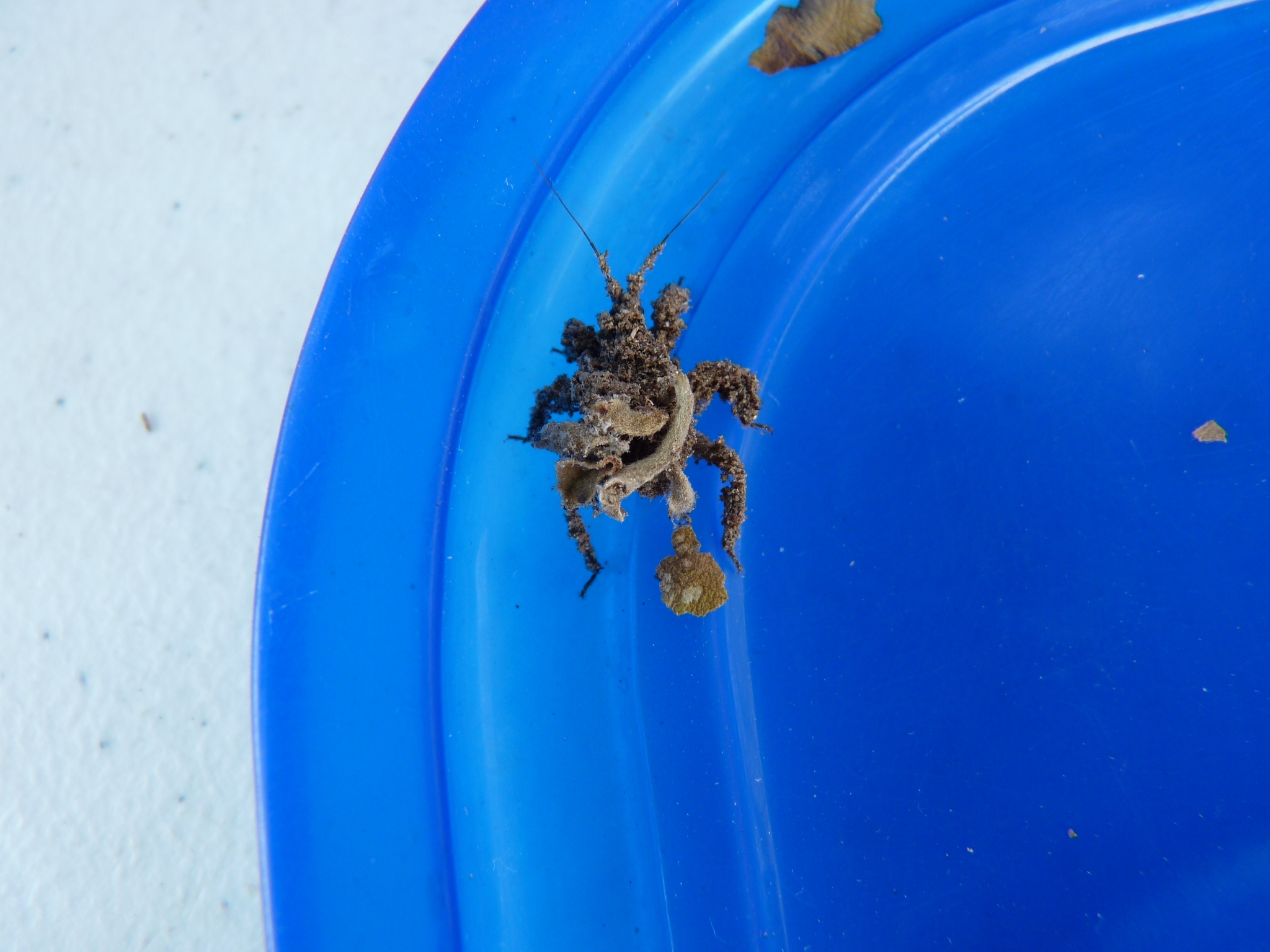
OK, there it is. It was the best camouflage trick I have seen. It seems that the said “beast”, an insect as it has six legs… covers itself with debris through some mechanism that I imagine it to be like an insect version of Velcro although it could also be a sticky secretion on its body where the debris gets glued! Nature surprises us all the time with large and small things!!!

I have also discovered that it is very difficult to know what it is as -I am sure- it changes according to the surroundings! However, I will continue looking for it and keep you informed.

The Bushsnob

Spot the Beast 3

Spot the beast 3 1

Back from Hwange and Mana Pools National Parks where several interesting things happened that I will tell about in future posts. As we returned only yesterday afternoon, to gain time, I post this picture for you to find the creature. Not surprisingly my wife found it while packing up our tent in Mana Pools!

I took the picture in the bush by placing a handful of debris from the area it was found in a plastic box with the beast itself and then I let it go. When looking at it with friends yesterday evening, we had difficulties finding it but it is there, lurking somewhere!

Good luck and I will “reveal” it tomorrow. No prizes for the finders yet (until this blog attracts sufficient publicity that I start making money!!! Then it will be a different story…).

The Bushsnob


WE ARE OFF AGAIN…

Dear followers,

I tried to post a last entry today but there was no power in Harare.

We are off to Hwange National Park where we will camp for 7 nights at Shumba Camp. We will keep notes and observations to be shared with you, together with the usual bad pictures.

See you!

The Bushsnob

Locking of horns

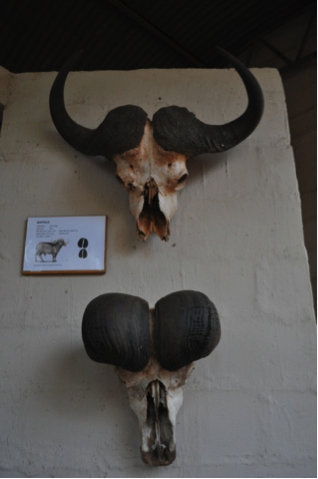
While staying at Mlilwane Wildlife Sanctuary in Swaziland in June 2012, we came across something oddly called a Wildlife “Interpretorium” and Training Centre. It was a nicely set up combination of animal exhibits with good working space for training purposes. I am sure that it is put to good use in educating the youngsters in Swaziland. Two things came to my attention there. The first was a bull buffalo skull of normal size but that has a perfectly developed boss[1] but totally lacking the actual horns (Fig. 1, bottom skull). Its apparent perfect symmetry suggests that it was a freakish genetic mishap and not the result of trauma or wear and tear. I imagine this to be a rare occurrence but that is only speculation. Clearly it was an adult male buffalo but we will never know if this malformation had any impact on its life, particularly regarding its sparring and fights with other bulls with the aim of reproduction.

Fig. 1. A normal buffalo skull above and the malformation below. (© Leonor Fernandez)

A normal buffalo skull above and the malformation below. (Picture: Leonor Fernandez)

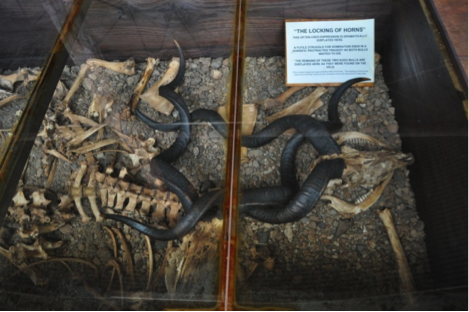
What I do know is that next to this exhibit there was a much more dramatic one showing what can happen when normally developed horns are locked (Fig.2). Clearly the two fully developed kudu bulls were engaged in a serious quarrel when the accident happened. According to the notice that accompanies the two skulls, their horns’ whacking could be heard from the camp for quite a while until it suddenly stopped. Only a couple of days later it became clear of what had taken place when their carcasses were found. Their horns had become inextricably jammed and their heads were twisted in such a way that their bodies, pointing in the same direction became parallel to each other. No one can live long in such a situation and, unable to separate, the stress, fatigue and lack of water rapidly put an end to their lives in what we can only imagine was a rather protracted agony. One can only hope that such magnificent animals had a chance to pass on their genes before this incident took their lives at their prime.

Fig 2. The display showing the locked kudu horns. (© Leonor Fernandez)

The display showing the locked kudu horns. (Picture; Leonor Fernandez)

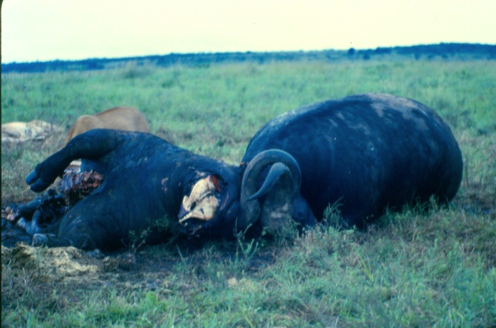
The kudu incident brought to mind a finding we came across in the Nairobi National Park, Kenya in the 80’s.  While on a game drive in that magnificent park, our attention was caught by a couple of lionesses on a small hill and we went there to have a look. From the distance, it was clear that they were feeding on a large animal. At close quarters we could see that they were busy with a buffalo carcass that, when we got closer, became two buffaloes and, like the kudu in Swaziland, they had locked their horns (Fig. 3). In this case, however, they were facing each other.

Fig 3. Buffalo with locked horns in Nairobi National Park. The back of a lioness is visible over the buffalo on the left. (© Julio de Castro)

The buffalo with locked horns in Nairobi National Park. The back of a lioness is visible over the one on the left.

Considering the shape of buffalo horns it is difficult to imagine that they can be locked but these two bulls managed it and ended their lives as a consequence. The knoll where the carcasses lay appeared ploughed, no doubt because of the titanic struggle that took place prior to their deaths. How they died will remain another mystery of nature but I would not be surprised that their violent confrontation attracted the lions and they may have had something to do with its ending.

I am sure that this is one risk that the “hornless” freak displayed at the Wildlife “Interpretorium” and Training Centre of Mlilwane did not face.

[1] An adult bull’s horns are fused at the base and this continuous bone structure is known as the “boss”.


Verreaux’s Eagle Owl and Thick-billed Ravens

Looking for pictures of Giant Eagle Owls to illustrate the earlier post I found one I did not remember having! As usual it is bad! It was taken on film in a hurry and later scanned to an electronic file. It shows a raucous confrontation we witnessed while living at Bedele, Ethiopia in 1989. We recorded the event and only recently we published it in SCOPUS

The scan of the original article included explains what happened and it save me from re-writing it! Please note that the publication is reproduced with the kind permission of SCOPUS. (For easier reading, click on the pages and then again).

The only picture I have of the event. It is bad but it shows the action that took place!

Verreaux and ravens page 1 small

Verreaux and ravens page 2 small


An unlikely find at Kruger National Park

Owl tree no circle

A tree like any other?

I have already praised my wife’s eyesight in the post “Green eyes in the wild” and showed you the two pictures of the hiding lioness at Tsavo East National Park in Kenya.

This example of my wife’s superb eyesight took place at the Kruger National Park during our recent trip (see Kruger National Park Report).

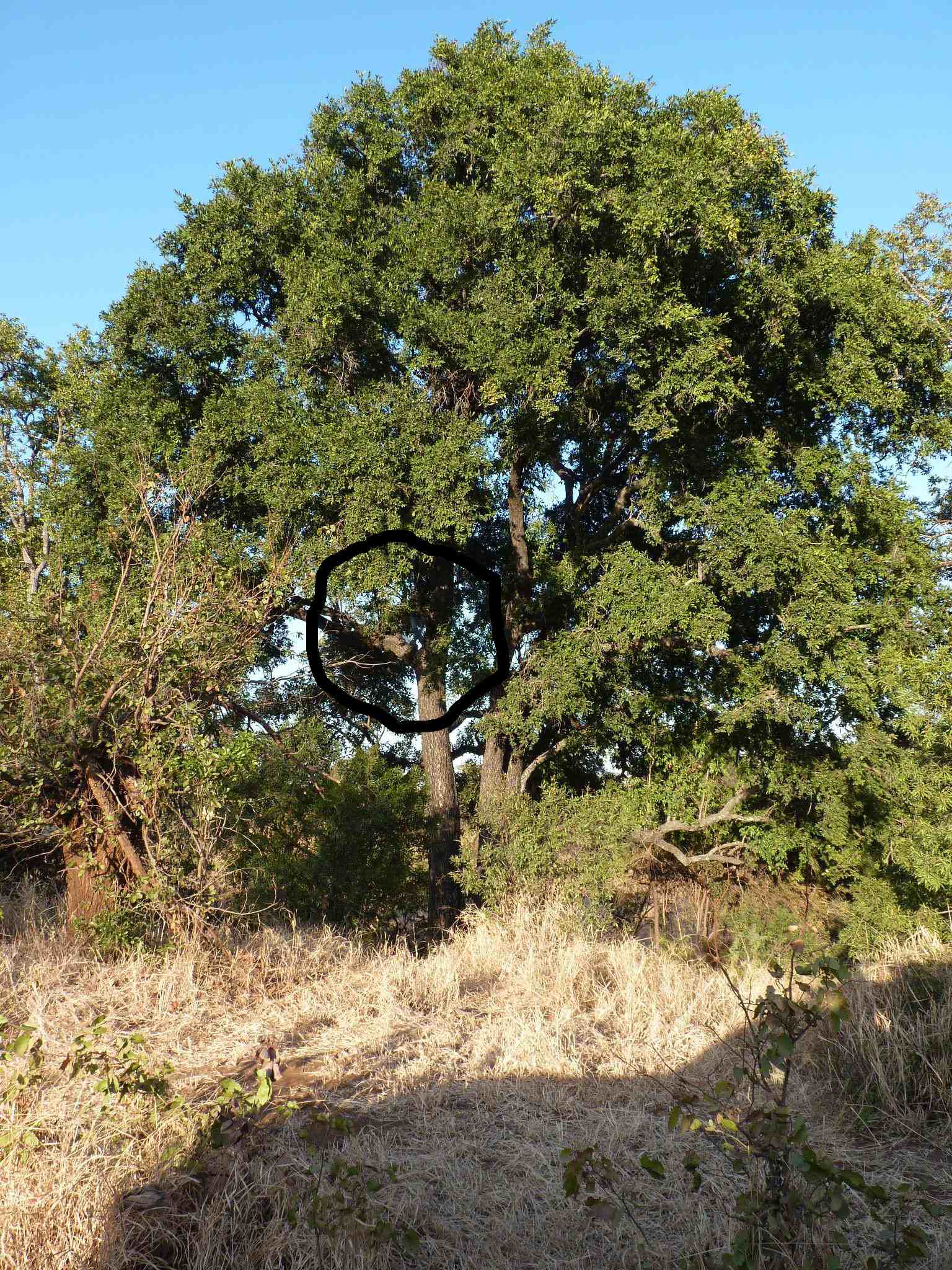
One early morning, while staying at Letaba Rest Camp, we were driving along the Letaba river looking for leopards and -as is normally the case- not finding any. Suddenly, my wife said “Stop, go back, go back!” so I did while she prepared herself to have a closer look with her binoculars. “What do you see there?” she asked me, thinking that I have her eyes! “Nothing” I replied, then added “where?”. “Use your binoculars”. “Do you see that large tree?” “Of course I see it” was my reply.

Owl tree with circle 1

After a while I could see the general area!

I must add that my binoculars are more powerful than hers, and I looked and saw a tiny red dot on one of the branches. “I see a kind of flower, is that it?” I ask. “It is not a flower, look at it again” she replied and I did.

It looked like a bit of meat as it had a pink centre and some brownish hairs. I moved the car a bit to get a different angle and then I could see the whole picture: the pink meat had been either a hare or a squirrel (maybe a rat). “Oh yes, I see it now!” I exclaimed “Do you think a leopard left it there?”

branch with red spot

After further car maneuver the red spot became visible!

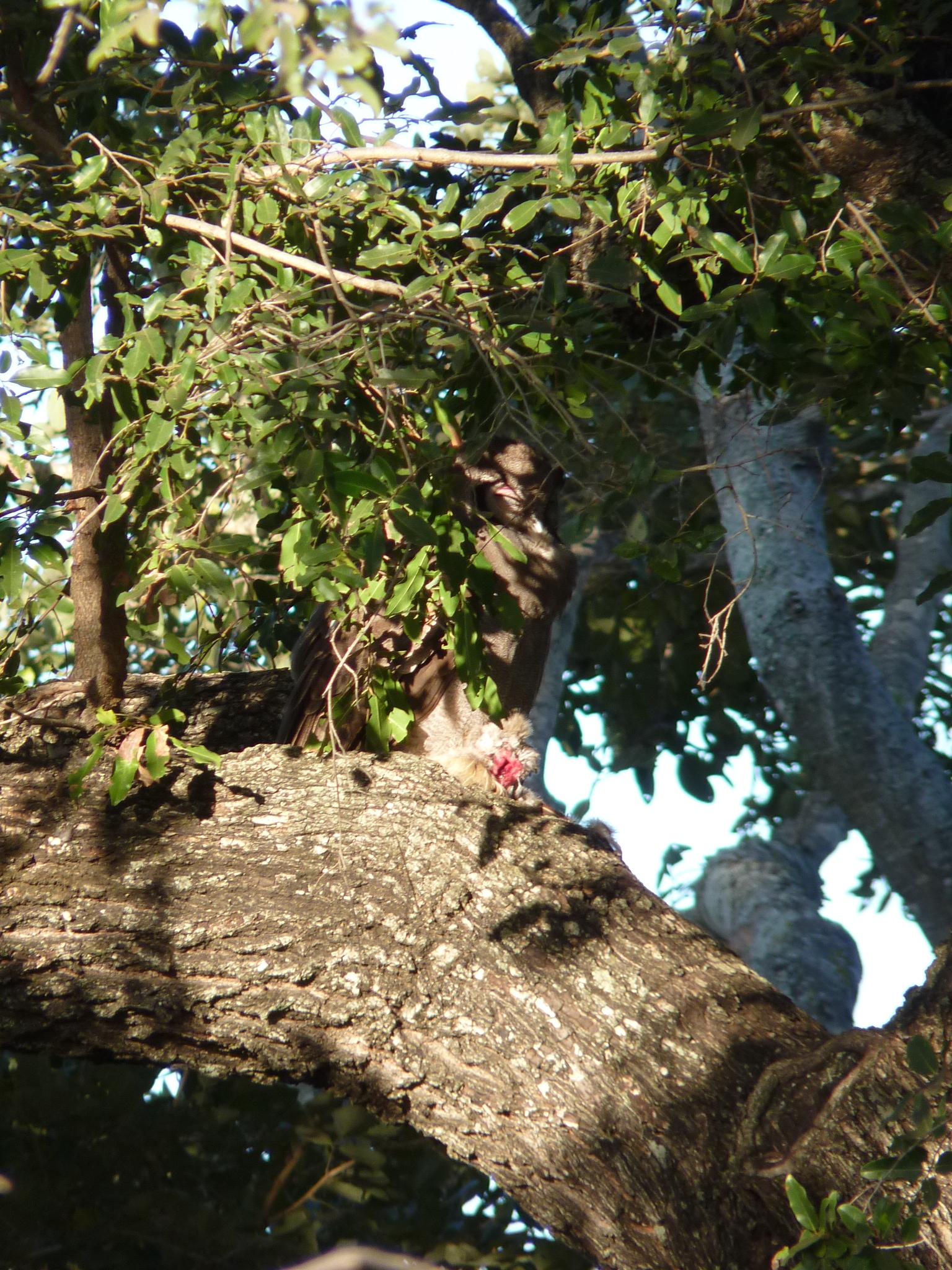
“No” she said, “There is a bird there as well,  move the car back” I did and then I really saw the whole picture! Perching on top of the animal remains -hidden from me until I moved the car- there was a bird with pink eyelids that could only be a Giant Eagle owl (Bubo lacteus) perched on a branch and holding its kill!

owl and prey cropped

More car maneuvers and finally I could see the owl!

The owl is described as being up to 66 cm tall and I still had difficulties spotting it. I did take rather poor pictures that I present to you but believe me, I could drive past one hundred times and never see it!

There is a great advantage in having a wife with such keen eyesight while looking for game on safari. However, there is a drawback. As my children and I know very well, it is difficult to hide from those eyes!

Spot the Beast 2 – Revealed

Spot the beast 2 In

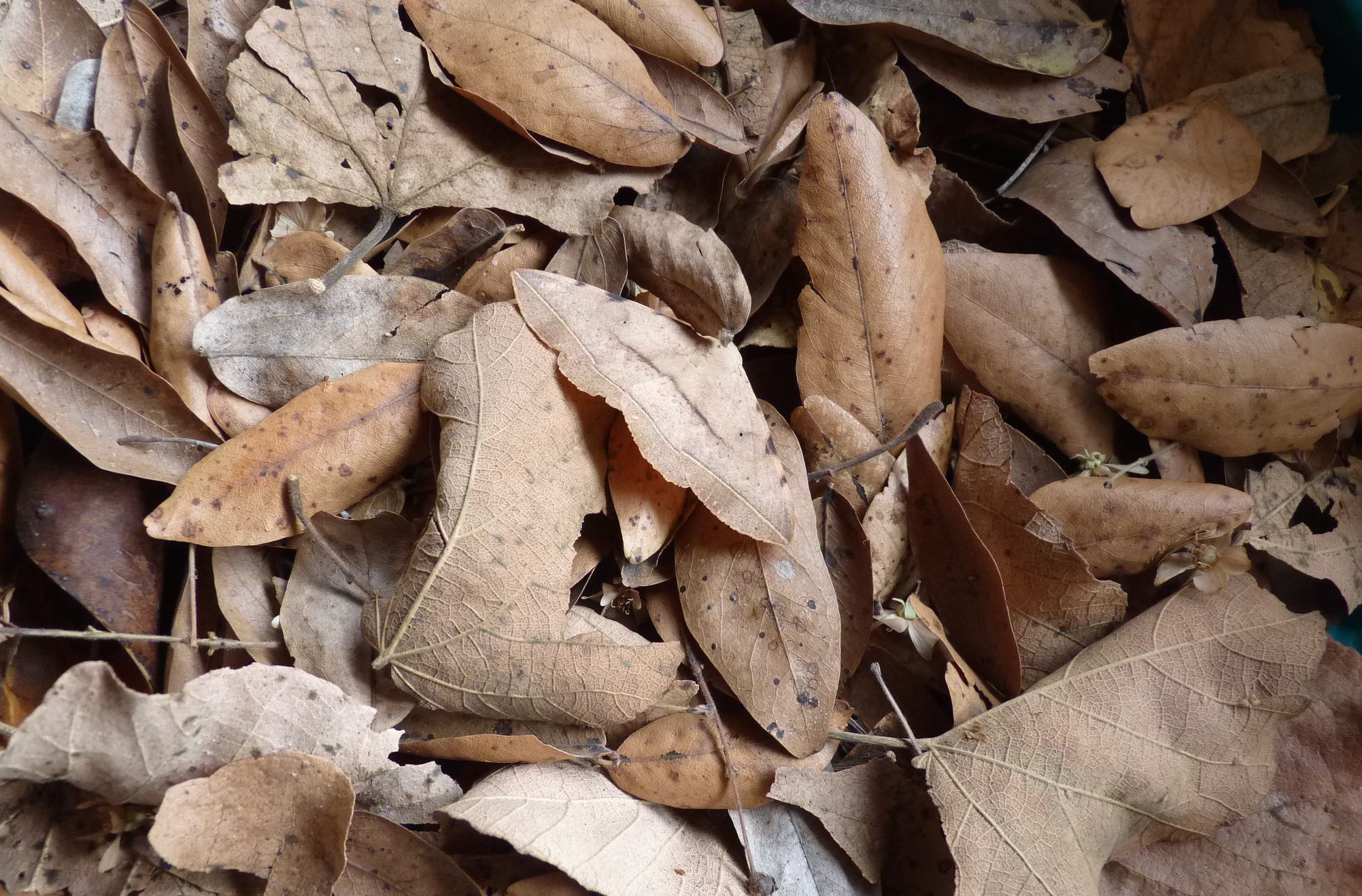
My wife found a “leaf” stuck on the fluorescent tube in the kitchen that flew off, flashing its orange-red under parts, when she tried to remove it.

I collected dry leaves from the garden and put the moth on them for the picture. I think it is a Red Tail moth (Hypopyra capensis). It is a rather common moth. Its larvae feed on Albizia spp. trees.

I am sure you all spotted it! In fact I realized, after I released it, that I had put it in the centre of the picture (not very clever!).

large moth

Africa! – Arrival

cropped-mt-kenya-way-to-shaba-1.jpg

This time I do remember boarding the Boeing 707 of Kenya Airways at Fiumicino airport, as it was like moving into another dimension. All passengers seemed exotic to me and there was an African crew! After dinner I read and re-read all the documents I was given in order to impress the people I would be working with. At dawn, the plane started to lose altitude and I was very excited when I saw an incredible green lake in the desert. The pilot explained that it was Lake Turkana and that we were close to landing in Nairobi.

The first area of Kenya I saw: Lake Turkana. The picture was taken a few years later during a safari there.

The first area of Kenya I saw: Lake Turkana or the “Jade Sea”. The picture was taken a few years later during a safari there.

Then I felt it. It was a light stitch of pain in my lower abdomen. I dismissed it at first as the consequence of lake Turkana´s beauty on my system, but when it repeated itself I knew that not only were the passengers on board colorful and exotic but also the food bacteria belonging to that category. As we had less than an hour until landing, I decided that I was going to manage by focusing my mind on my surroundings. In any case, the pre-landing queue for the plane’s toilet was such that I had no options left.

By the time we landed at Jomo Kenyatta International Airport I only had one thing in my mind: finding a toilet! I learnt that it is called choo in Kiswahili. This was my first and very necessary brush with the language. My obligatory gut-related pause took its time. When I was able to emerge, I was relieved all the passengers were already gone. Although it did not seem like it to me, it had taken quite a while! Luckily there were still immigration officers waiting and I entered Kenya after a careful and thorough examination of my exotic Uruguayan passport. Only my suitcase remained on the conveyor belt.

It was early morning in Nairobi when I left the airport building and started looking for the airport bus, as advised by my FAO colleagues in Rome, who were aware of the need to save my limited fellowship resources and my own meager capital. I looked up and down the front of the airport and found it empty. No FAO reception committee despite the information forwarded about my arrival! Eventually I found a bus and made my way slowly towards it. My suitcase was heavy and my cabin luggage probably heavier and its strap was cutting into my shoulder! Be aware that I packed for a two and a half year journey as I was well aware that I did not have the funds to return to Uruguay until the end of the fellowship.

I entered the empty bus (with my luggage as there was no haul), chose a seat near the front and prepared myself for a long wait. I was feeling good and looking forward to the future. My gut seemed settled by now. In those days there were no cell phones so I could not call anyone and I was on my own. I was about to have a catnap as I lacked sleep when movement between the trees caught my eye. My first impression was that I was dreaming but I was actually seeing the long spotted neck, at the end of which was the head of a giraffe that was busy browsing on a yellow-bark acacia just 10 metres away from the bus. Amazed, I discovered another one and, after my eye got used to it, about fifteen more animals, all sailing slowly across the airport parking area in search of fresh acacia shoots. They were very relaxed and, as the first rays of sunlight bathed their faces, I saw the most beautiful eyelashes ever created.

One of the giraffes browsing at the airport!

One of the giraffes browsing at the airport!

The sputtering and vibration of of the bus’ diesel engine interrupted my giraffe-induced rapture and forced me to focus on holding on. I considered myself very lucky to be the sole passenger on the bus. A choo stop has its advantages I thought… My joy was short-lived. To my surprise, the bus stopped a few blocks from the airport to pick up passengers. “This cannot be”, I thought, “the airport bus goes to the centre of town and it should not pick people up on the road!” Despite my mental opposition, the stops continued at regular intervals and the bus started to fill up. This was clearly no airport bus but a normal city bus, part of the Kenya Bus Services known as KBS buses and I had no idea of its route or destination! Now I also realized why it was so cheap! To put it mildly, I had a minor panic attack! But, as there was nothing I could do, I accepted my fate and waited for the outcome of my wrong choice.

I now need to elaborate on the concept of a full bus. In the countries I had lived in until then, a bus is full and stops picking up passengers when all seats are occupied and standing people are not able to move. Not in Kenya. I witnessed a new definition of bus “fullness”. The bus did not skip a single stop and people kept getting in, first to occupy the seats –I counted four bodies in mine in addition to myself. Throughout the bus, bodies filled all available spaces, maximizing every possible centimeter with unbelievable precision, as if accomplished by professional packers. First I lost physical contact with my luggage and soon afterwards I also lost visual contact. I regretted their likely loss with a sense of emptiness and not a little despair but what could I do? My immediate attention was focused on more vital activities: getting sufficient breathing air to be able to reach the final destination. Luckily, my earlier gut incident was still not showing signs of returning. At least something is going well; I though, while trying to position my nose in an air pocket between a shoulder and a face. I smiled but the face did not! Its eyes were closed in a sound sleep!

The passengers included primary and secondary students, mothers with babies, workers, police and even a Maasai warrior in full regalia trying to avoid impaling passengers with his spear and simi (long double edged knife). Despite the mass of bodies and apparent discomfort, laughter was frequent and this would continue during all the time I spent in Africa. Although I was looked at as an unusual passenger, I did not feel threatened or uncomfortable. Body odour mingled with the smell of baby talc, stale mothers’ milk, fresh fruit and exotic spices.

When I was starting to feel that my choice of bus may have been my last, I felt a slight slackening of bodies after one of the stops and then, gradually, the bus began to expel people and finally stopped at the end of its route. To my amazement, my bags were still there and seemingly intact! All doors opened and out went the few remaining passengers and I remained, like at the start of the journey, on my own. I asked the driver where we were and I seem to recall that he mentioned Eastleigh, a suburb of Nairobi, very far from my destination in the centre of town.

I am not sure what prompted the next act and it remains as another mystery of my lucky life in Africa. The Driver, clearly seeing the desolation showing in my face, asked where I was going. I explained to him that the Serena Hotel in the centre of Nairobi was my ultimate destination. “You are too far from there my friend”, he said. And then added, “this area is not safe as there are too many shiftas!” (rebels, outlaws) to end with a “you do not see wazungu (white people) walking here and there are no taxis either” This left me speechless and I was desperately trying to figure out my next move -clearly quasi suicidal- when the bus doors closed and it moved again

Before I could protest for him to let me leave it, he grinned and said: “I will take you there!” He said it twice as I asked him to repeat it for fear of having misheard him. So I was the sole passenger on a trip that ended when the bus entered the offloading area of the Serena Hotel where the doors were opened and I descended to the amazed look of the concierges! That was a gesture of human solidarity that not only moved me but started to prepare me for what I would find repeatedly in Africa.

He departed with a wave and I entered the Serena. My sense of elation evaporated the moment I learnt the prices of a room and decided that this was not for me and went back to the street. This is not a good or common thing to do when you are carrying the amount of luggage I was, but, as I did not know this then, my saving obsession got the best of me. It was even more unexpected for a mzungu (white person) to walk around carrying bags in the streets of Nairobi.

I began to ask people on the street for a cheap place to sleep that night and, as is normal in most of Africa, someone offered to accompany me to precisely such a place! Needless to say, my idea and the one of my Good Samaritan were quite different! After walking to two possible places, we parted amicably. Luckily, there was another passerby who took me to a hostel nearby that seemed clean so I settled for it, left my bags and went for an afternoon stroll to find my bearings and get my first feel for the place. (Note added on 8/10/14: The hostel was the C.P.K., now the Anglican Church of Kenya Guest House located in Bishop’s Road, off Ngong Road. The Guest House was used to accommodate missionaries from up country missions. See: http://www.ackguesthouses.or.ke/nairobi/index.html).

I returned to the hostel at dusk, very tired and ready for dinner and bed. The day had been long. Dinner was a modest affair served on a communal table. As I was very hungry I helped myself to an abundant helping of the only available dish: a meat stew that did not look too bad and there was also rice to go with it. I am a fast eater and this time I did not wait and got on with the job.

For the first 10 seconds the mouthful of meat behaved like any tough and seriously overcooked piece of Uruguayan beef. After that fleeting evaluation passed, a number of things started to happen, all new to me until then. In what I thought a miracle of chemistry, the half-chewed meat suddenly caught fire in my mouth and, hoping to be unnoticed but trying to smile –an impossible task while suffering third degree burns- I spat it out. “Uhmm very grrood” I muttered while looking for the nearest source of water and wondering about whether my vocal chords were still there. While my mouth and surrounding areas were being cauterized, I felt the hair on my head and neck rise, accompanied by copious sweating of my eyelids, something that hitherto had never taken place! As I had never cried with the outside of my eyes, I was clearly concerned but managed to wipe the sweaty tears and gulped a glass of water in a rush. I could not distract myself from focusing on the status of my already castigated pyloric region and hoped that would withstand this added and novel punishment.

Trying to appear normal and having recovered some of my speech function I muttered another positive comment about the food while I waited for the water to calm things down under the clearly amused look of my African table mates, too polite to laugh openly at my rather comic status. Thankfully, in nature all comes to an end, and to my relief the burning eased and slowly the affected organs started to respond again. I also learnt that I had just experienced my first encounter with a beef curry of the “mild” variety.

I was sure that I had locked my room to go for dinner so I was surprised and concerned when I found it open. “The only thing that I need now is a thief” I thought and walked in prepared to defend my meager possessions. To my surprise, my lamp was on and a man was lying on my bed! Confused but very tired I said good night and went to sleep in another place only to spot, among the clothes of my roommate a white priest collar. It all fell in place as I became aware that my cheap hostel find was a religious place were church personnel posted in the field coming to do business in Nairobi. So it is that, surrounded by sanctity, I had a very good night’s sleep and did not hear anyone else entering the room although it was full when I woke up to face another day. Clearly they were quite angelical in their movement.

The gardens at the Fairview Hotel.

The gardens at the Fairview Hotel.

The following morning, after a curry-free breakfast and happy to learn that all my body parts had healed, I managed to make contact with the local FAO office. Clearly unaware of my gut-rot related delay in arriving to the lobby, they were very concerned that I did not turn up at the airport and thought that I had missed my flight. They also gave me the address of the Fairview hotel where I should have been and the contacts of my future boss, a Scot with whom I met later the same morning.

But that is the beginning of another story!


Caput Mundi

Foro Romano cropped

Roman Forum.

It was July 1979. I was getting ready to travel to Armidale in Australia to join a team of scientists working on internal parasites of sheep to study for a PhD. My medical clearance, visa application and travel bookings for September were all advanced. I had been in Uruguay for a few months after getting an MSc in animal parasitology at the University of North Wales, UK and the PhD opportunity was the logical next step in my mind. I was very excited and looking forward to the challenge.

That is why the message from the Food and Agriculture Organization of the United Nations (FAO) in Montevideo informing me of the arrival of an urgent Foodagram (FAO telegrams then) addressed to me was a jolt. It was not unexpected, as months back while ending my studies -and still in the UK- I had applied to an FAO Andre Mayer Fellowship to study ticks in Africa. However, it was inopportune!

I returned the call as soon as I could and they confirmed that they were trying to contact me urgently. As there were no faxes or e-mail attachments in those days, we agreed that they could send the -still unopened- telegramme to me by the local bus. I arrived the following day and I read it with some trepidation. It said:

URGENT STOP TO MR. J. DE CASTRO, TEL CARMELO 567, C/O FAO URUGUAY STOP PLEASED TO OFFER AN ANDRE MAYER RESEARCH FELLOWSHIP STOP YOU WILL TRAVEL TO KENYA AND JOIN THE INTERNATIONAL CENTRE FOR INSECT PHYSIOLOGY AND ECOLOGY TO STUDY THE ECONOMIC IMPACT OF TICKS ON CATTLE STOP MORE INFORMATION FOLLOWS BY POUCH STOP URGENTLY REPLY TO MS. IRENE FIELD, FELLOWSHIPS DIVISION STOP KIND REGARDS STOP EDOUARD SAOUMA, FAO DG

After digesting the contents of the telegram and its potential implications, I contacted FAO in Montevideo again and we agreed that we would wait for the information that would come by pouch. It was easier said than done and I immediately started to think on the decision I needed to take as, although Australia was attractive, Africa -being totally exotic- possessed a strong allure.

Some days passed and, in view of the absence of news, I continued with the Australia arrangements, just in case.

A couple of weeks later, however, I got an envelope with the promised information and the written offer that awaited an urgent response. Through the enclosed documents I learnt that Professor Andre Mayer had been Chairman of the FAO Executive Committee in the early days of the organization and left a donation to FAO for young scientists to conduct research projects in relevant development issues. I also learnt that I was going to be based at Rusinga island and joining a team of tick and tick-borne disease experts in Kenya. Images of an Indian Ocean island with palm trees came to mind!

My interest in animals led to me becoming a veterinarian and what little information about the African continent that was available did nothing to discourage my interest. During my childhood my mother -a devout catholic- subscribed to “El Africanito”, a monthly publication from the work of the Catholic Church in Africa. I used to read this every month. Later on, the series “Daktari” with Clarence the cross-eyed lion and the movie “Hatari” with John Wayne were fascinating to me.

Later in life and while already working as a veterinarian, I read a publication on African cattle in the Hoechst Veterinary Blue Book which highlighted the enormous numbers of cattle per veterinarian in Africa as compared with Latin America and other continents. More recently, my appetite had been further wetted by hearing my lecturers in the UK talk of tsetse flies and ticks and related travel tales.

This was my opportunity! However, I was committed to Australia. After a lot of thought and not much sleep I took the bus to Montevideo to find out more from FAO Representative in person. By the time I left his office I had made up my mind and chosen Kenya and, although unaware of it then, our lives would change in a way we could not imagine.

Luckily, the Australians were very pragmatic and they gracefully allowed me to unravel my Australian attachment so that I could accept FAO´s offer. The greatest opposition to the decision came -probably justifiably- from family and friends as it was going against “the norm”. I still remember the reply from an old friend when I told him that I was going to Kenya. “Julio, you are crazy” and then added “You will leave your carcass in Africa!” What reply could I give to what seemed like common sense?

The identity of Rusinga island remained a mystery. The available atlas we checked failed to locate it and it was finally a geography professor who informed me of its location in Lake Victoria, a rather large body of water I had not taken into account until then.

Part of Rusinga Island seen from Mbita Point.

Part of Rusinga Island seen from Mbita Point.

I sent my acceptance and it was agreed that I would travel alone as I needed to pass through Rome for briefing on my way to Nairobi to join the work team. The plan was for my wife to join me later in Nairobi when I already had a clear idea of ​​what it all meant and had gotten my bearings!

I do not remember my departure from Uruguay to Rome, perhaps I was too worried and nervous, or may be my memory fails me now! I do not remember what airline I traveled with or how the trip was. I do recall arriving in Rome and getting to the Lancelot hotel where, by virtue of sharing the dinner table, met other FAO and World Food Programme colleagues that spoke about the wonders of Kenya.

The Trevi Fountain in the 80s. I did throw a coin then and returned!

The Trevi Fountain in the 80s. I did throw a coin then and returned!

I also remember being stunned by Rome’s beauty and being paralyzed in fear of its traffic. The walk to FAO from the Lancelot was memorable as there are a number of monuments nearby such as the Coliseum, the Arch of Titus but also some potentially lethal traffic traps in at least three places. The experience of witnessing a visitor trying to cross the street remains vivid in my mind. Stopping at a red light I noticed a tourist by my side talking to his wife in German. He was obviously agitated seeing that the Italian pedestrians continued to cross the street despite the red light. He waited patiently for the light to change to green and then he stepped onto the pavement. The moment he did so, a car running a red light zoomed past him at very close quarters and he lunged backwards, totally dumbfounded. He was still there, totally lost when I moved on. Welcome to Rome, I thought!

Once inside FAO I had a triumphant feeling and I thought “I am in the world’s cathedral of agricultural knowledge and it is offering me something, well done!” At that time, young and ambitious, I thought I touched the sky with my hands and I even took my picture behind a desk to show my “importance” to family and friends. The people I met and their quality, both human and technical, immediately brought me back to my humble situation of a young person at the very beginning of his career and I focused on my work as it was obvious that I had lots to learn!

jj en FAO cropped and small

At FAO, thinking that I had made it… I was to return to work to this office in the 90s! The telephone had changed by then!

My FAO colleagues prepared me technically but they also gave me lots of well-meaning advice: do not try to do too much, at ICIPE you will have a good boss, everything on ticks and tick-borne diseases is happening in Nairobi now, it is an expensive place but there is an airport bus to town and cheap hotels, be careful with malaria on the coast. These are some of the ones I still remember. After one week, I was ready to travel.

FAO Headquarters from the Palatine Forum.

FAO Headquarters from the Palatine Hill.

Next: AFRICA! – Arrival