Kruger National Park

Spot the beast 19

Back to Africa for a while while I develop another story from “Out of Africa”. Poor internet connection and farm work… are attempting against my productivity.

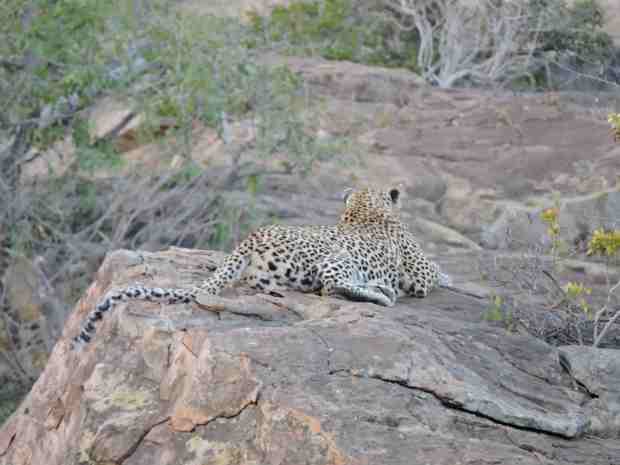
This is not a difficult “Spot the Beast” but I thought it is a nice situation to challenge your power of observation. I would be worried if you cannot find it within the first 10 seconds…

Here it is:

dscn9956-copy
?

?

?

?

?

?

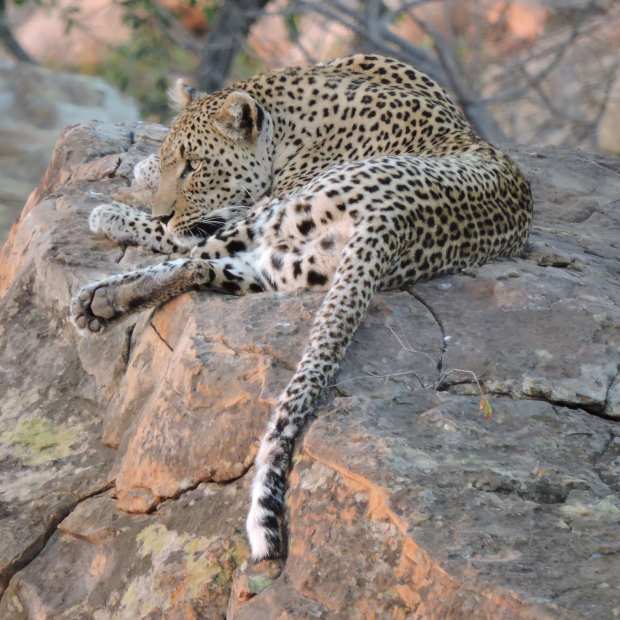
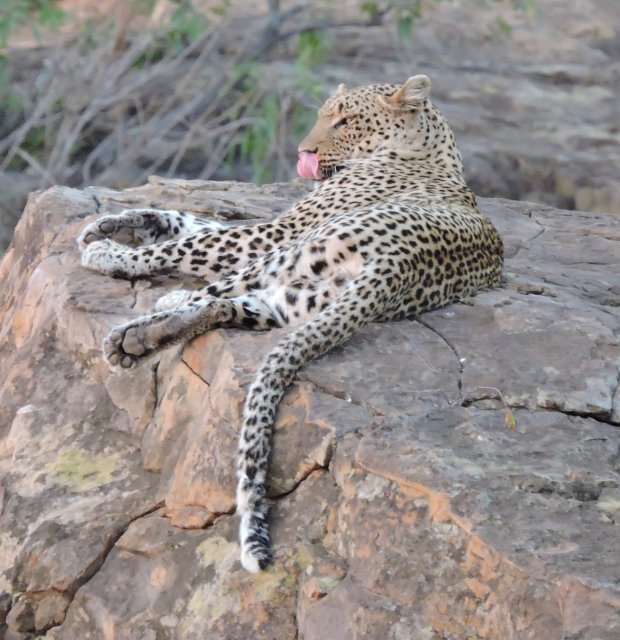
I hope you agree with me that she was not only beautiful but well placed to see what was happening!

dscn9954-copy

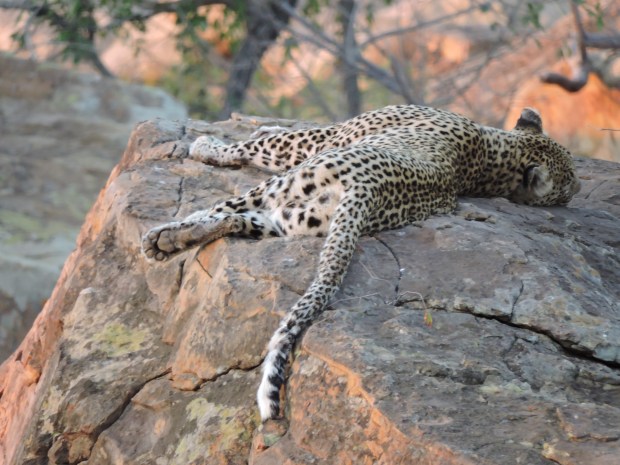
A few more pictures of her:

dscn9928-5-57-43-pm-9-25-00-am-copydscn9939-copy

dscn9924-10-09-30-am-3-33-32-pm-3-38-33-pmdscn9903-copy-8-55-16-am-8-58-58-am

Environment panacea?

While in Kruger National Park we stopped at the Nkhulu picnic site in the Southern part of the park to have a break and stretch our legs. The place is adjacent to a small river that was still having some water. This fact made the place attractive for birds and mammals alike.

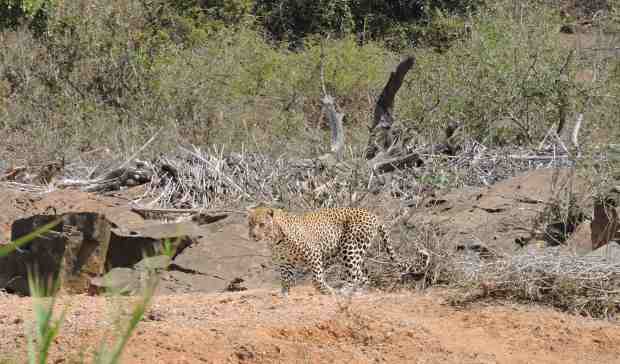
As soon as we walked in we noticed great excitement as people were congregated by the river edge watching the opposite margin. We soon discovered the reason for such a hoo-ha: a pair of leopards were having a stroll! We postponed our coffee for a while and watched the magnificent animals until they moved off into the thicket. Now, that is an arrival!

We did have our coffee among the excitement that gradually faded but that was somehow renewed every time we were raided by the baboons that were also numerous in the site and a pest throughout the park nowadays. After a while of fending off monkeys and with the image of the leopards still in our minds, it was time to resume our drive so we returned to the car park. Another surprise awaited us.

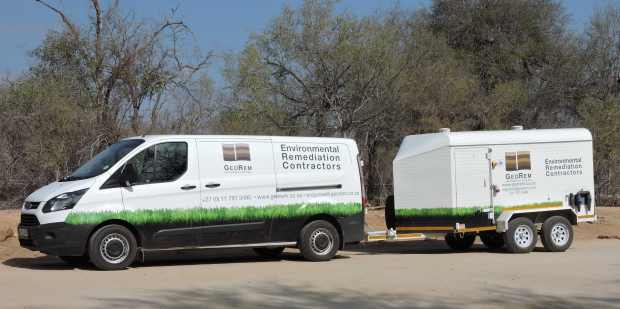
A car offering “Environmental Remediation” was parked near ours. My first thought was that the Park authorities had already sought a solution to prevent the future problems that the Park would face because of the drought. The knowledge that such an alternative existed made me also forget my concerns about the future of the world while realizing that I had been wrong all along!

dscn9944-6-59-52-pm-copy

Regrettably and almost immediately my common sense brought me down to earth on that to clean up the latter we need more than that! As I have seen septic tank-emptying tankers labeled under some weird names such as “Honey sucker” I thought that it was probably another one. In any case, I soon forgot about the unusual find!

Once at home, I Googled the company and, to set the record straight, they define their activities as: “… a specialist environmental contracting service, providing assistance to consultants and industry in the monitoring, management and remediation of contaminated land and water throughout the African Continent.”[1]

So, they would not be able to solve the earth’s environmental degradation but I am sure that they provide useful services in their field.


[1] See: http://www.georem.co.za/index.html


Predators’ Eden

Having stressed the negative consequences of a drought like the one the Kruger National Park is going through in the previous post (3/10/16) it is now the time to mention one of the positive aspects of this situation for the game-spotter.

The lack of grass transformed the thicket into a very dry wooded savannah. In addition, the riverine areas that usually offer some cover to herbivores were now denuded from a lot of the vegetation so there was a lot of visibility. Most animals were near the river as most need to drink regularly so most of the “action” took place there.

Even without the assistance of the existing apps[1] we were able to find lions and leopards in numbers that are usually unthinkable, even for my wife.  11 September 2016 will go down in our bush lore as the day of the cats! In the morning, during a 20 km drive we spotted three different groups of lions, two separate leopards on trees and two walking by the river! We almost did not stop when we found a hyena walking by the road! As if this would not have been enough, after (my) siesta time, we revisited the nearby causeway over the Lower Sabie River to see if anything remained of the zebra being fed on by crocodiles of the day before.[2]

We crossed the bridge but found no trace of the zebra. As usual, there were a few cars on the bridge so we decided to turn around and, after re-crossing the bridge, to do a short drive following the river to enjoy the evening. By the time I had turned the car around all other vehicles had gone and we were on the bridge on our own, a rare occurrence.

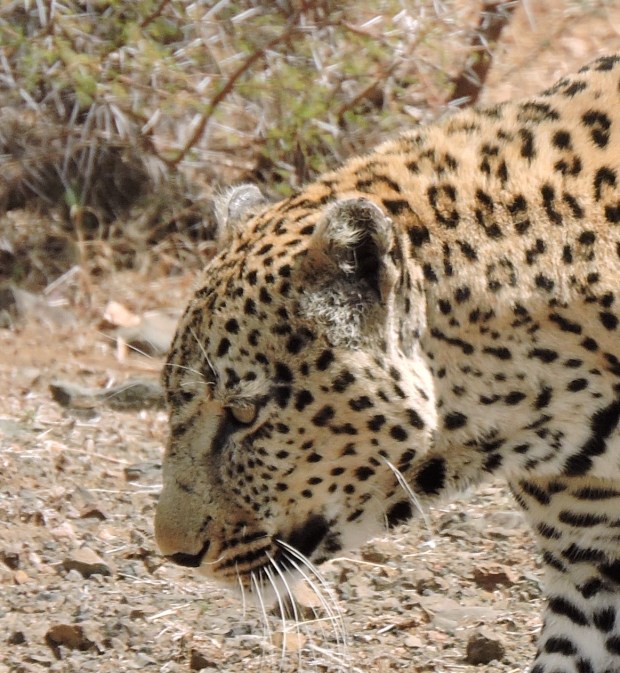
As the bridge is narrow, I was paying attention to my driving when, just before ending our crossing, I heard my wife saying, “Look!” A leopard had just appeared out of nowhere on the shore of the river. I switched off the engine and we both grabbed cameras and took the pictures we could as the animal did not stop much and never took notice of our presence while it crossed the bridge just in front of us!

dscn9899-copy

The first picture of the leopard.

It was a large male and its right hind leg was apparently painful as it was limping.

dscn9902-copy

The sighting did not last more than three minutes and, by the time a few vehicles arrived to the bridge (that we were totally blocking), the leopard had moved off and it was hardly visible, although it had been spotted by others! I decided to move on and “share” our find only to realize that the car was dead! Suspecting a disconnected battery terminal I got out of the car to fix it. Although it did not take much time to get the car running again, by the time we moved off, the leopard had already disappeared and I was probably the least popular driver in the park!

Although the 11th was our most productive day, over the next couple of days we continued to find predators. We also continued to have problems with our battery! So, when I needed to get out of the car to fix it next to a group of lions, we decided that it was time to take the car to Skukuza for a long-lasting solution! This we got from one the very helpful camp mechanics that, with the right spanner, tightened the nuts and ended the problem for good.

dscn9920-7-29-26-pm-copy

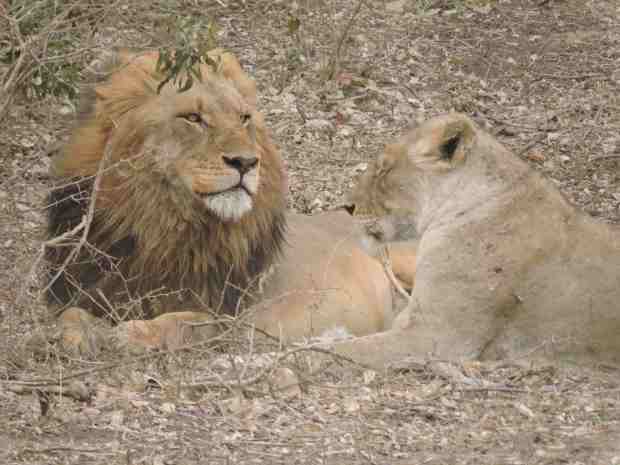
Luckily the lions were more interested in their romance than in the bushsnob fixing the battery!

Feeling now safer, on the way back to Lower Sabie Camp my wife (who else?), continued to excel and spotted more cats! The first sighting took place after we both noticed a few vultures on the ground by the Lower Sabie River. While I was watching them my wife noted that the cause was a buffalo kill where two magnificent male lions were feeding! Frankly, I would not have seen them.


As road speed limits and gate closing times in the park are very strict, we decided that we needed to start our journey back to arrive to our camp in time. Our planned timely arrival only lasted a few kilometres, until my wife spotted yet another leopard!

dscn9948-copy

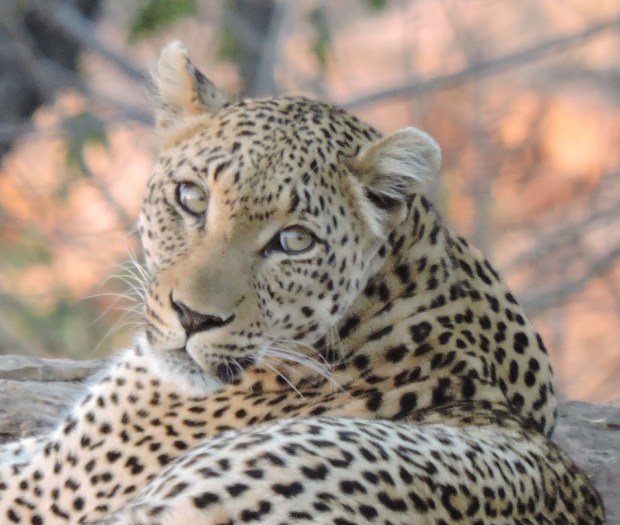
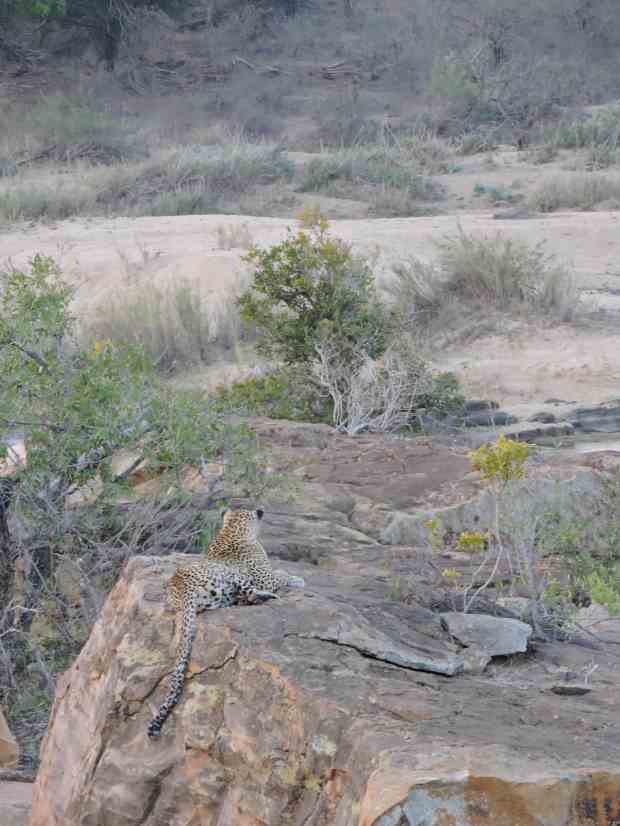
This time it was a female sunning itself on a rocky outcrop overlooking the river. A beautiful sight worth risking a fine from the park as we both agreed. It was beautiful to watch the animal with the evening light and we stayed there until it decided to move off and we lost it.

Aware that we were late, we prepared our usual excuse of engine malfunction (this time it was quite close to the truth!) and returned. Luckily we just managed to squeeze through as the gates were being shut!

That night, staying at one of Lower Sabie’s tents paid off. Despite the rather sad absence of hippo grunts, the elephants were noisily feeding nearby and they were very vocal. Later, several lions started roaring up and down river, their loud calls amplified at night and the chorus continued well into the night. At some stage, a leopard joined in with its own regular grunts ending in an amazing ensemble that we do not recall having heard before. We were late sleeping as did not wish to miss the wild concert!


[1] See the earlier post: https://bushsnobinafrica.wordpress.com/2016/09/30/animal-go/

[2] See: https://bushsnobinafrica.wordpress.com/2016/09/16/hungry-crocodiles/

Hippo drama

The drought that Southern Africa is experiencing this year was evident already during our visit to Mana Pools in September. Despite the Zambezi River providing sufficient water, grazing was the main issue as the riverine pastures were very low and the patches of green left were those that are inedible.

Browsers and grazer/browsers were still in good shape but large grazers such as hippos and buffalos were already walking longer distances to get to areas that still had grass cover and these were dwindling fast. The hippos’ normal timetable was visibly altered as we “bumped” on several walking far from the water during the mornings and afternoons when, during normal years, they are in the water or sunning themselves by it.

Despite the Mana Pools “warning” the situation we found in the Kruger National Park (KNP) -Lower Sabie and Satara areas- was worse than expected. According to Swemmer (2016)[1] rainfall at Phalaborwa, one of the KNP’s camps, during 2014-15 was 255mm (the long-term average being 533mm) and the 2015-16 figures are extremely low. Two consecutive years of very low rain, combined with very high temperatures is regarded as rare and extreme. It is even likely that this drought will be the most severe since records started to be collected in 1954!

Different views of a very dry KNP (pictures by Mabel de Castro).

The consequences are there for all to see!

In the dry season the park usually has reasonable grass cover. This year there was almost no grass to be seen! The consequences of this could be immediately seen as few live hippos remained in the Lower Sabie River and the nearby Sunset dam. The ones we found looked rather strange and rather long-legged as their normally bulging bellies had shrunk enhancing their legs’ length! In addition, their skin hanged in folds, a consequence of their loss in body condition.

I regret that some of the pictures are disturbing but I need to show what was taking place.

We also noticed that the hippos did not move much and grazed on whatever they would find near the water bodies. As grass was scanty, they would just gradually weaken and die. Buffalo were also having a rough time and we only saw small groups looking thin. Interestingly, in some areas, both hippos and buffalo were doing better.

It is clear that the drought will have a severe impact on the animal population of the park but also on the vegetation cover as we also saw dry or drying trees that were also damaged by elephants searching for their own food. The re-establishment of grass, shrubs and trees will probably take years. The same applies to the animal populations that may not reach previous levels if the observed drier conditions become the norm in the future. In addition the drought will also accelerate soil erosion and modify the watercourses and other water bodies. Interestingly and somehow alarmingly, this is the first time that no Mopane worms have been recorded since surveys began in 2009 (Swemmer, 2016).

Trying to be optimistic about the future, it is possible that the current dry spell will have some beneficial impact by fine-tunning the situation to a future drier climate by reducing the herbivore populations while allowing vegetation to recover and, in a longer term, prevent overgrazing and environmental degradation.

Independently of the various possible interpretations of the impact of the drought on the environment, it is clear that even if the rains would come now, more animals will surely die before food becomes available. These are the ways of Nature, again.


[1] Swemmer, T. (2016). The Lowveld’s worst drought in 33 years? Understanding the long-term impacts. Consulted on 2/10/16. http://www.saeon.ac.za/enewsletter/archives/2016/february2016/doc02


Animal GO

I guess that the use of apps in African game parks was unavoidable as I am sure these already exist in parks in the “developed” world. Well, they have now arrived to the delight of the bush snobs (please note the space between the words) and bush executives that, not happy with looking at the sighting boards in the South Africa’s National Parks lodges and camps, required something more efficient.

A couple of years back I got the first indication that times were changing when a friend gave me -for my birthday- the app for Roberts VII Multimedia Birds of Southern Africa iPad Edition, 2012-2013. Although I have misgivings about using a tablet for bird identification rather than my loyal Sassol guide, I tried it. The result is that the Sassol guide is collecting dust in a recess of the car!

img_2990-copy

I have to announce that the same did not happen with the newish apps that -like with Pokemons- show you where the animals are so that you do not waste your valuable time driving around and can go to the hot spots straight away while the normal (or now abnormal?) game viewing enthusiasts “sweat the fat drop” (as we say in Spanish) to find interesting animals!

On a previous visit to the Kruger National Park I had heard that visitors were communicating interesting finds among them through a cellphone system. So, this time I searched the apps store and found a few and even some free. I downloaded one that looked popular called “Kruger Sightings” before our visit to this park.

The app is very straightforward to use and its information comes from what the users themselves feed in. After entering the park you are visiting and the kind of animals you wish to see, the programme will give you live updates with details of what is being found, where and other details of the sighting. It reminded me of a similar app from Brazil where users enter information regarding the location of speed traps and Police check points so that motorists can avoid them!

We followed the information it provided and easily found several other people watching what was alleged to be there! A leopard was the animal to be watched at the time and, after a long wait, we managed to progress through the traffic jam until we saw some spots up a tree!

After that first experience, we switched off the app for the rest of the safari. However, many visitors seemed to be using this and/or another similar app. We observed them drive from sighting 1 to sighting 2 at the maximum allowed speed and, as with our first trial, we found them “en masse” at the different locations where animals were supposed to be! I imagine that they did not wish to waste their lunch or dinner times?

Luckily for us and other “purists”, every cloud has a silver lining! The producers of the apps had, unintentionally given the no users a great advantage. The app groups its followers around a few of the big five, mainly lion and leopard, leaving the rest of the park for us to drive around in relative solitude and being able to find animals without cars around them. Luckily, with patience, luck and good eyesight, we managed a few good sightings of our own. Of course, our they remained incognito!

I promised myself only to use this kind of apps the day I become so important that I need to jet to parks with a few hours to spare and wish to impress some important client. I think that there is no fear of this so our game spotting will continue to be done the hard way!

The future worries me though. Rocket science is not required to see the gradual decline in animal numbers that elaborate and costly surveys and studies will confirm three years from now, three years too late to take any meaningful action! I know this sounds negative but it is what we observe.

Regrettably, the present generations had not really seen how it was, as I did not see how it was either but I guess it was better than what I saw!


See also: https://bushsnobinafrica.wordpress.com/2016/08/08/pachyderm-go/


A new five

Kruger National Park in August was busy and we just managed to get a couple of cancellations that matched with our son’s visit as well as our annual medical check-up in Nelspruit, a hang up of our days at Maputo.

The park, even with low occupancy rates, is normally busy as it offers a large number of beds to the visitors in the various rest camps and other available facilities. For this reason, it is extremely difficult to find a corner where you can be on your own. Imagine how it was in August when the park is full!

It is interesting to note that visitors move a lot within the park and its roads are busy. Some entering or leaving the park, some moving from one camp to the next and most of them looking for animals, mainly for the big five! The consequence of the latter is that, once you find one of them, there will be a constant flow of cars that would watch the animal in question for a few minutes and then move off, in search of the next one! I have already covered this issue (see: https://bushsnobinafrica.wordpress.com/2014/08/07/kruger-national-park-report/)

We were aware of this situation and decided to leave the big five for the next visit and focus on exploring a few less used roads and to improve our bird watching skills. In this department, I am pleased to inform you that we managed 99 species, about one fifth of the total number of species of the park!

Fishing was not in our plans as this is forbidden in the park. However, we crossed many rivers where wildlife can be observed! Normally this includes water birds and other creatures that come to drink or nibble tender grass associated with water. So we always stop and watch at river crossings!

One of the best places is the bridge over the Letaba River on the H1-6 road where you are allowed to get out of the car and have a look around while stretching your legs.

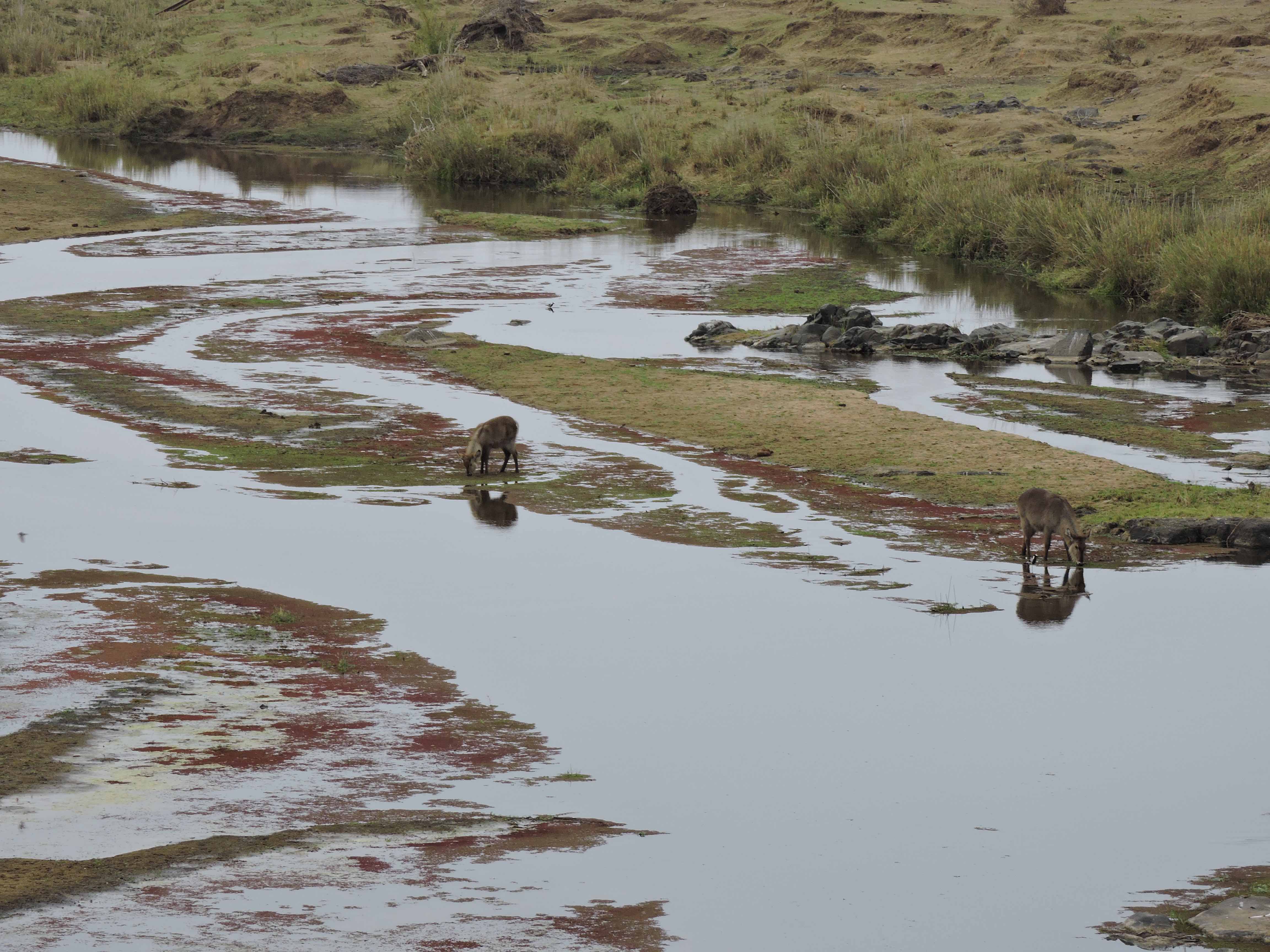
The Letaba River from the bridge.

Waterbucks drinking by the Letaba River bridge.

We have seen many interesting things in this place so it is an obligatory stop where we usually spend some time. You just need to be patient, unlike most motorists that drive past, some of them quite fast!

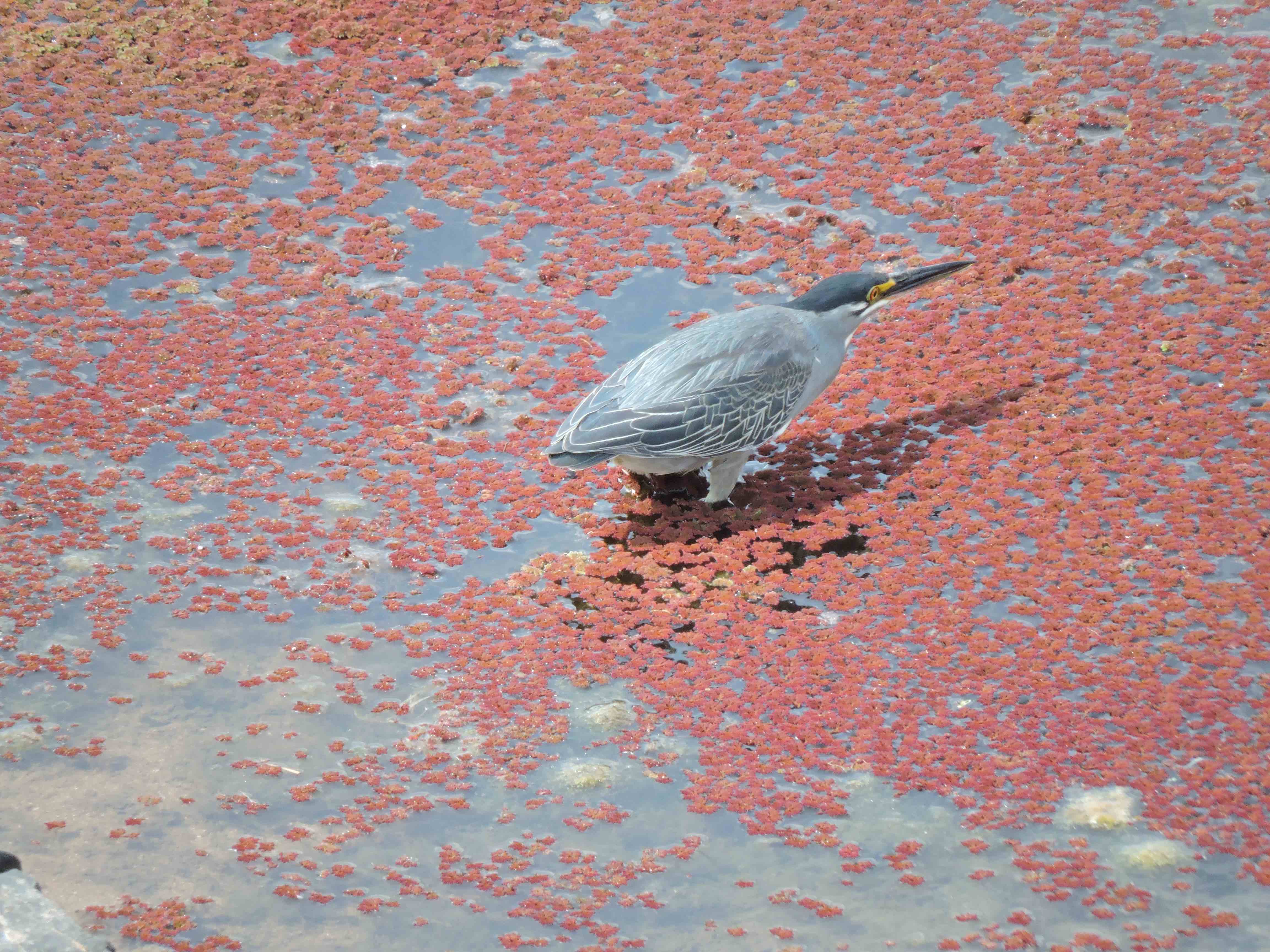
Green-backed heron fishing.

Green-backed heron fishing.

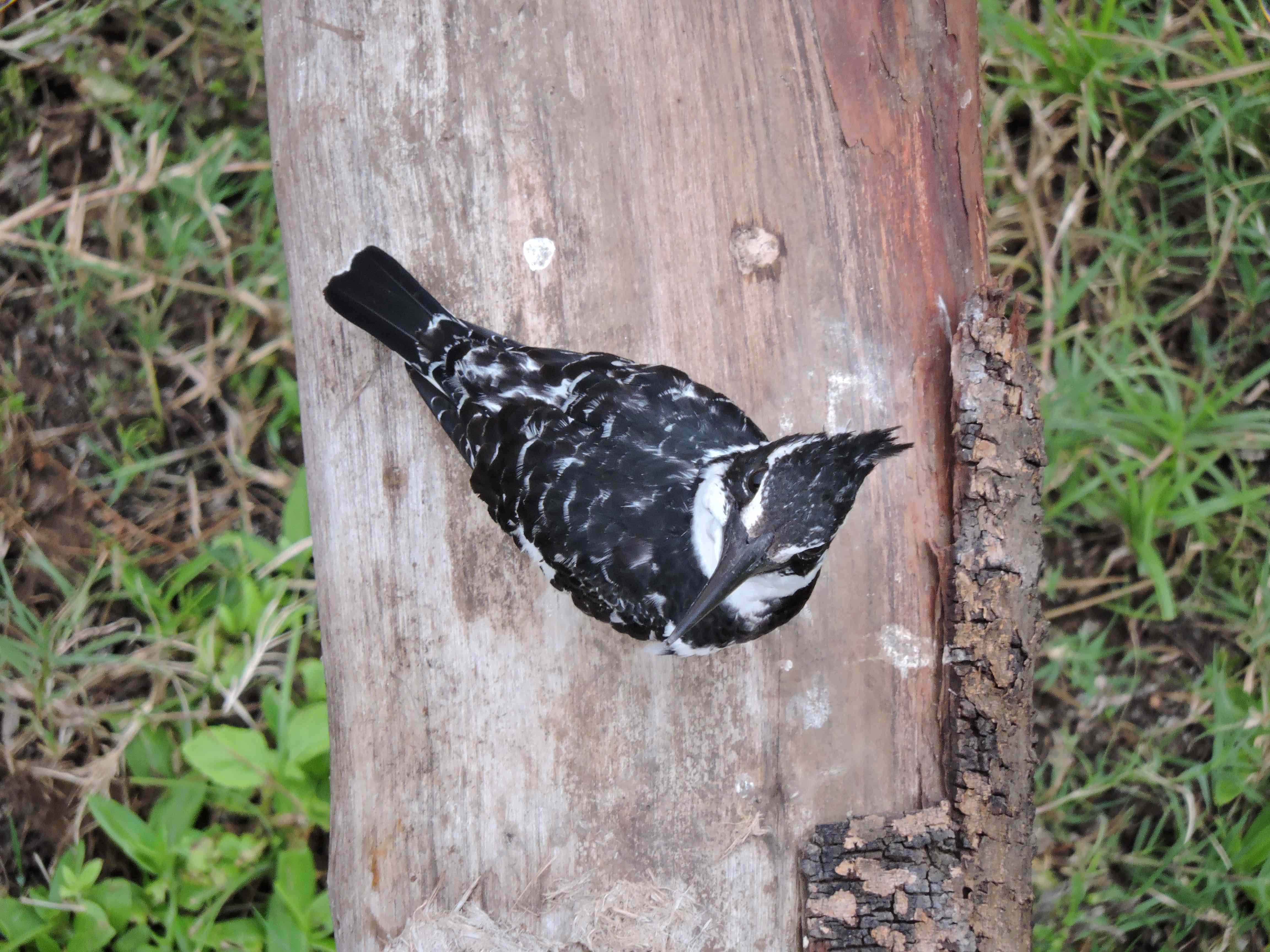
We surprised this pied kingfisher from the bridge.

We surprised this pied kingfisher from the bridge.

As soon as we got out we were literally hit by the pungent smell of bats, stronger than we remembered. The stink seemed to be emanating from the bridge’s cement joints, together with the bats’ high pitch calls. Although we tried hard, we failed to see them through the cracks so we investigated the outside of the bridge, also unsuccessfully. We were engaged on this task when we heard splashes in the shallow water so we forgot the bats that were not cooperating and went to look for the fish.

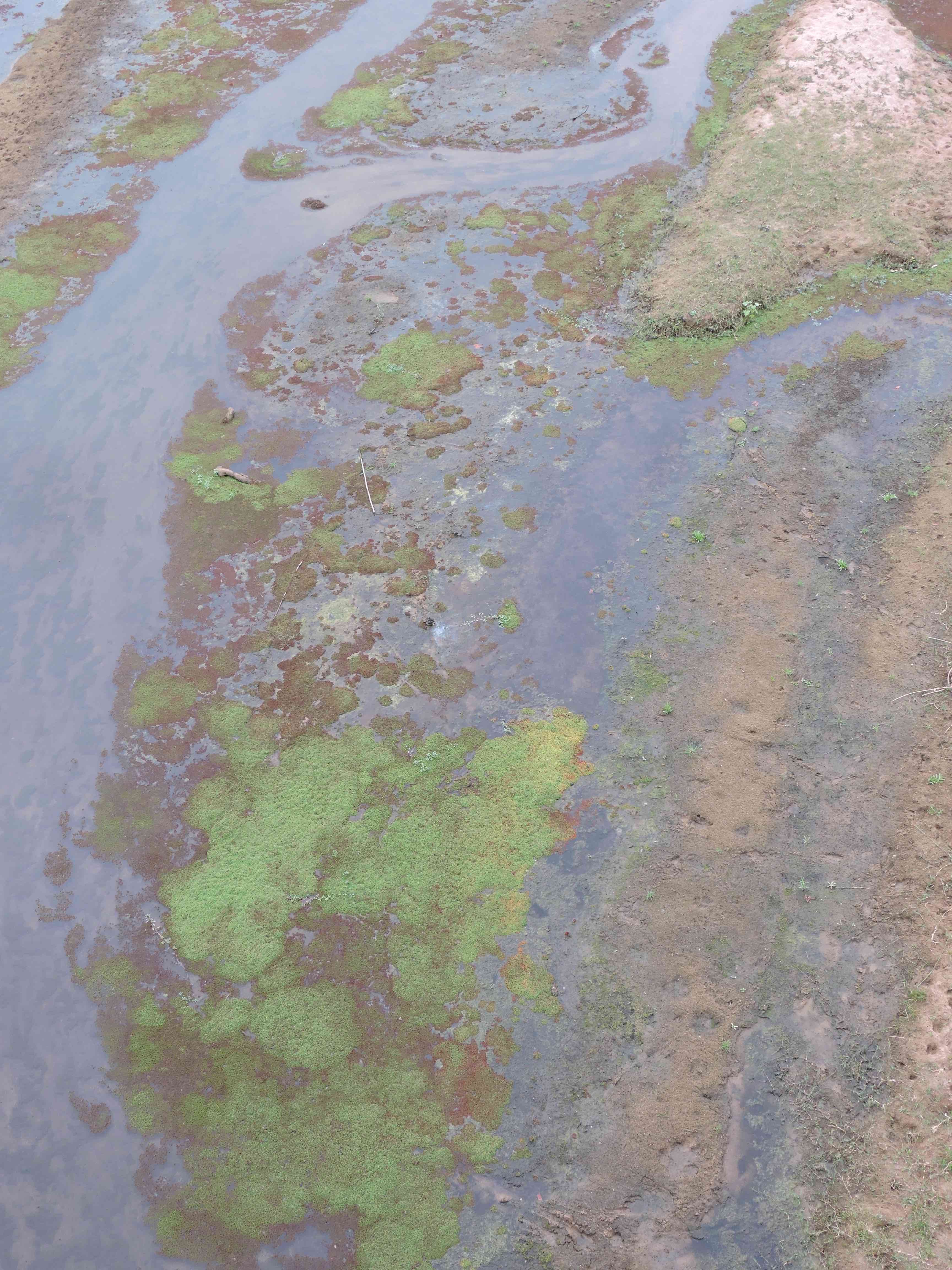
The area preferred by the fish.

The area preferred by the fish.

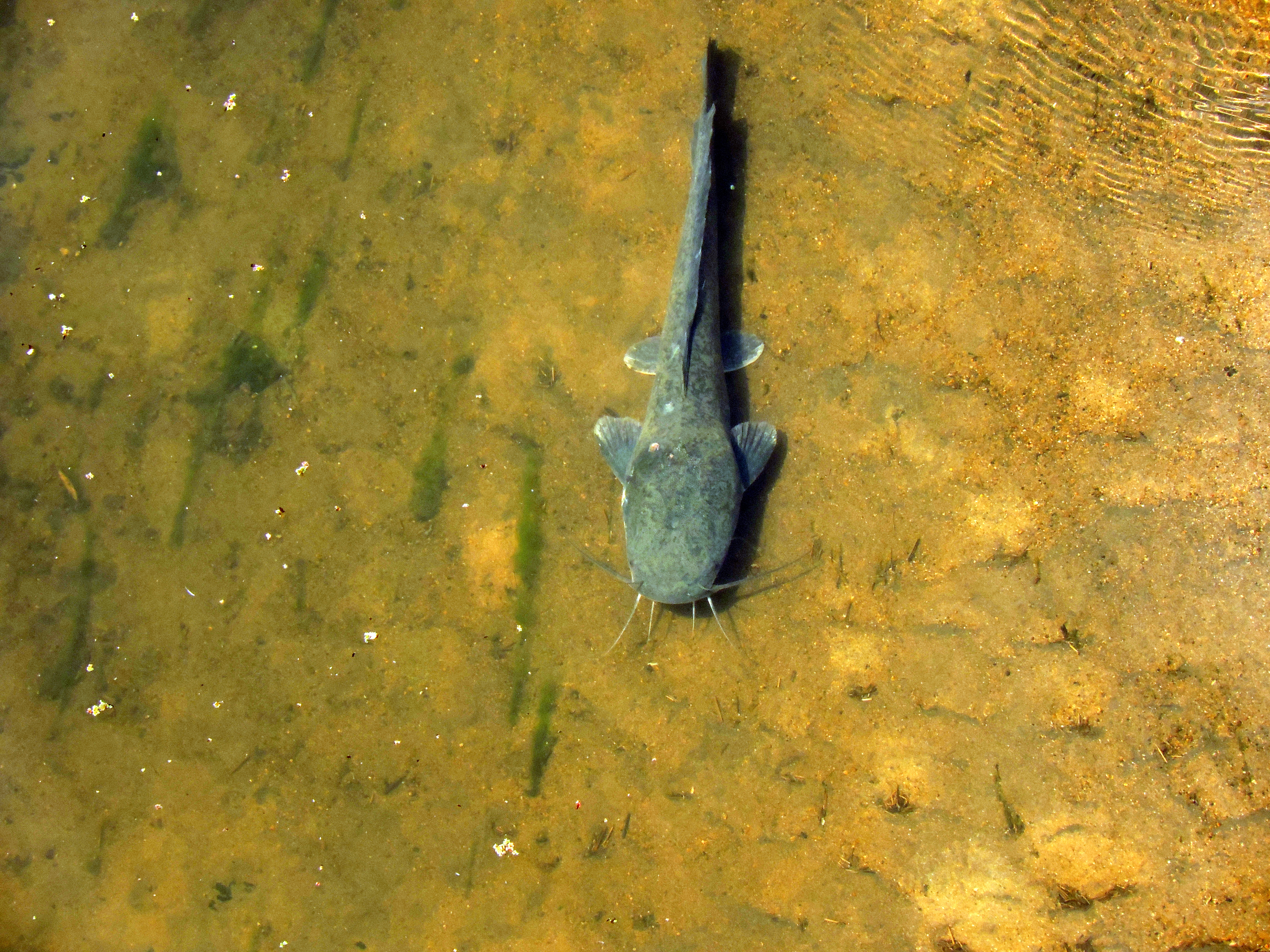
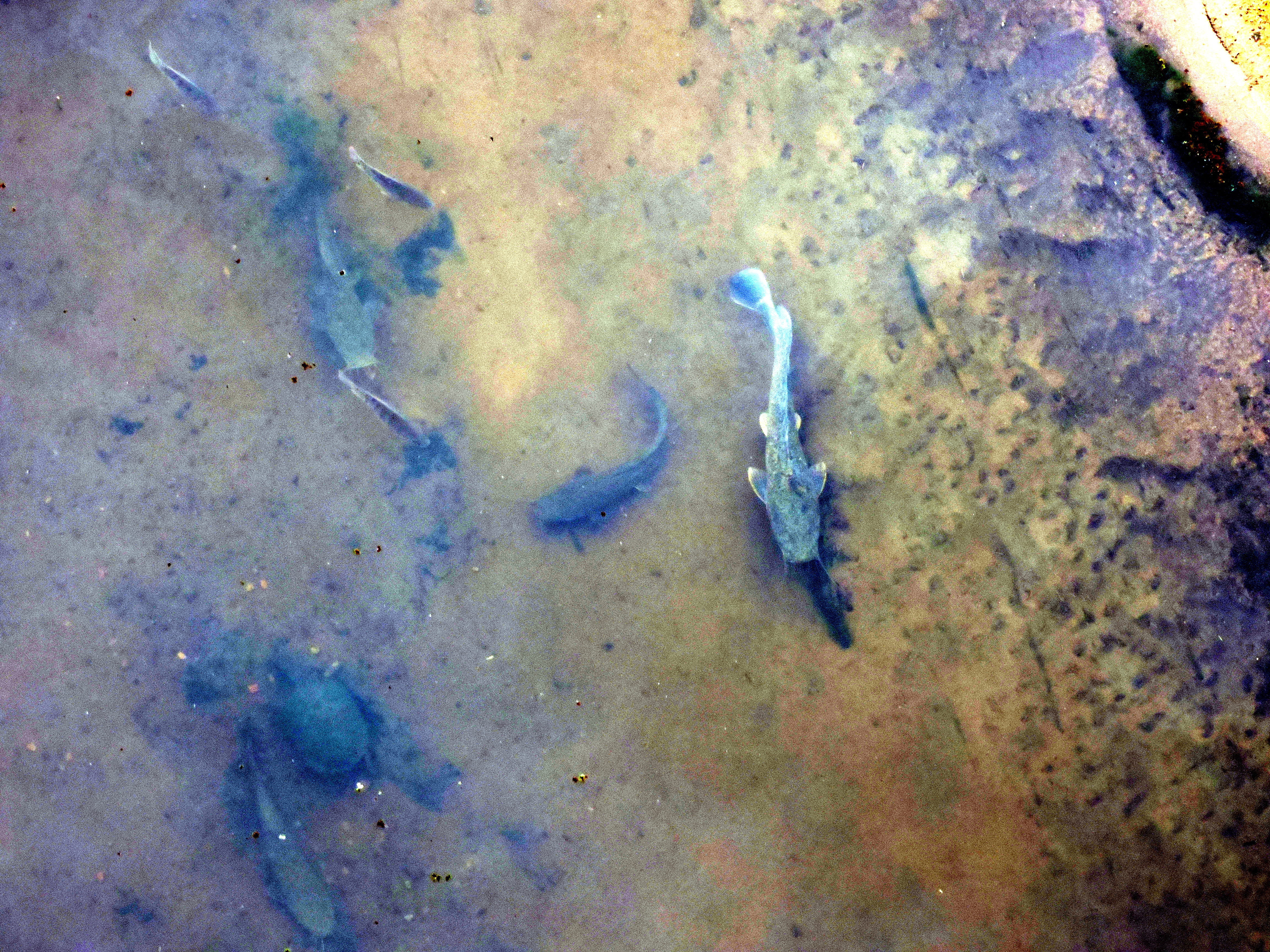
These were shoals of tilapia feeding on the water plants. There were many fish of various sizes. While watching the tilapia feeding we came across a lone and slender fish lying immobile a couple of metres away from the tilapia. It was a tiger fish sunning itself but clearly waiting for prey. Further watching revealed a few catfish as well. The latter were more abundant when we looked at the river on the other side of the bridge. There we saw several catfish of various sizes lying at the bottom of the river, all pointing in the direction of the current and being disturbed by the occasional terrapin passing by.

Interestingly, having polarized sunglasses helped me to see the fish clearly while my companions needed to strain their eyes until I decided to share my glasses with them (just before they tossed me over the rails!). Photography was, however, another matter as we did not have a polarizing filter and our attempts at taking pictures through my sunglasses proved fruitless!

Despite the bad results, we did take a few pictures that were forgotten in the memory card until we returned to Harare. Then, when sorting out the photos of the journey I saw a bunch of what appeared to be uniformly brown images. They were our “fish pictures” and the fish seemed to be immersed in murky water and only just visible! I tried a few of the options that Picasa offers and failed. I was about to delete them when I pressed the “I am feeling lucky” option and then as if by a miracle the fish became very clear as if the command would have sucked out the water!

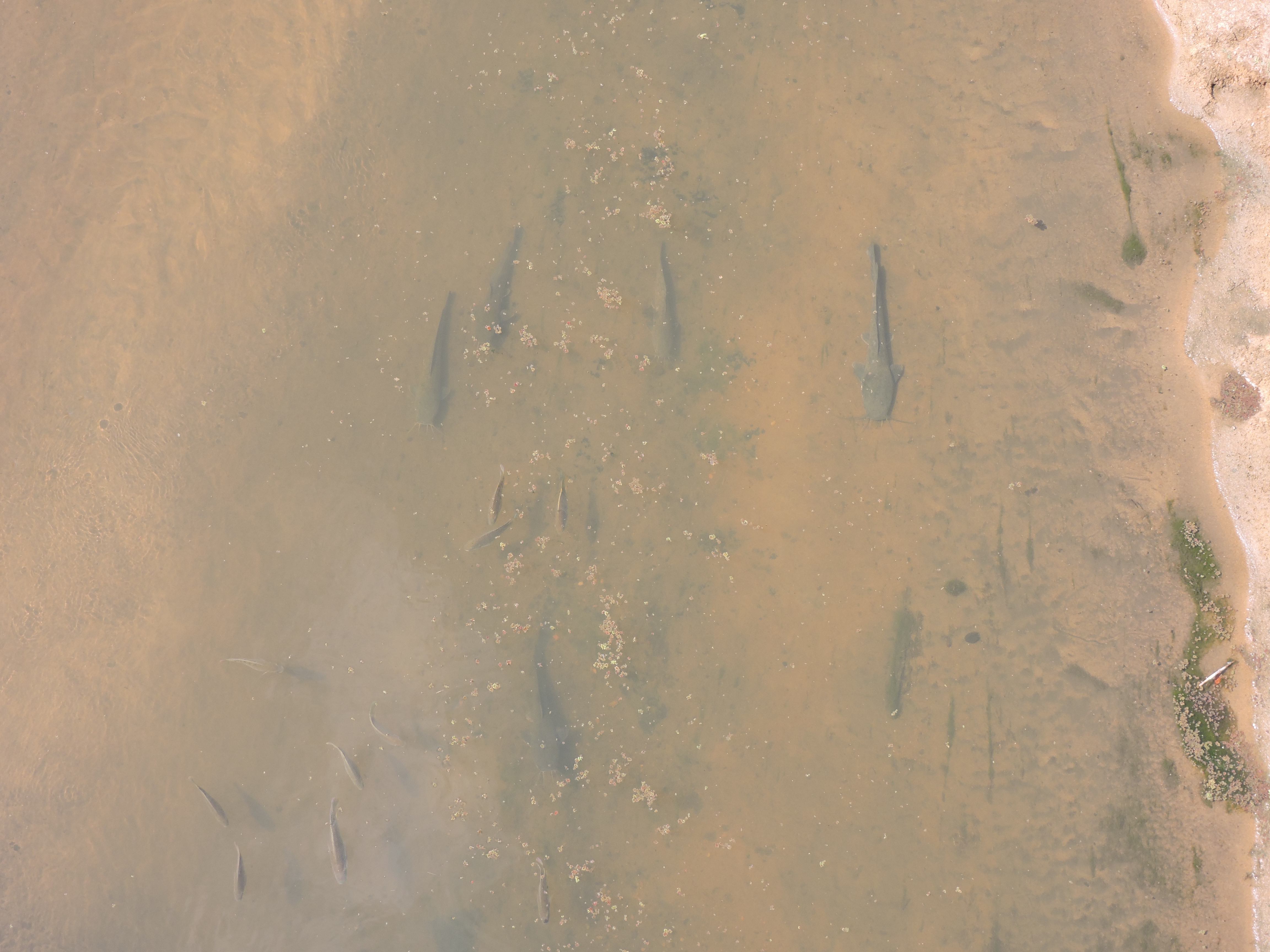
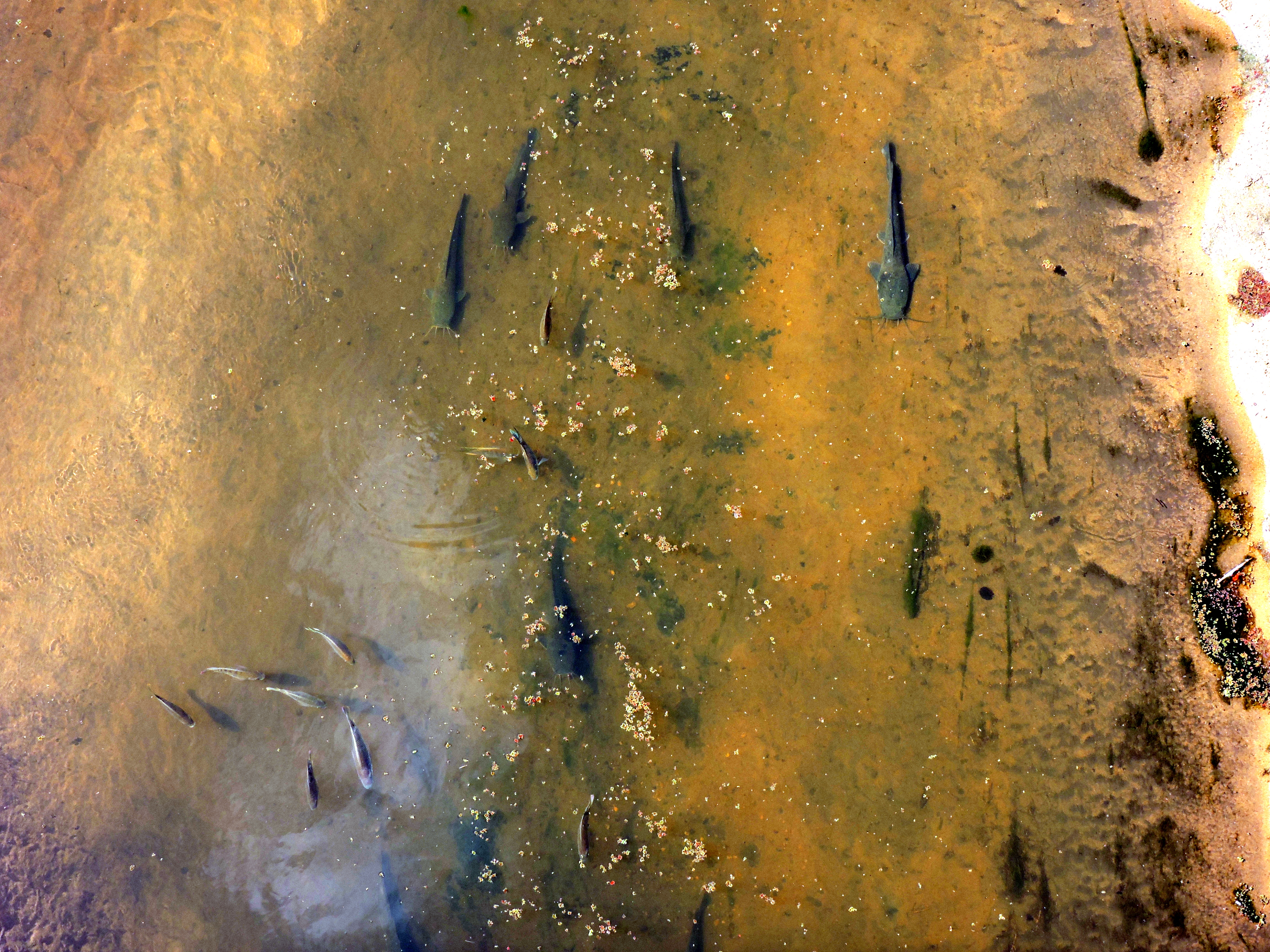
I present you with an example of a non processed cloudy picture to show you what they really looked like as well as some of the processed ones as I believe are worth viewing as they are a demonstration that not only the big five are worth watching.

The fish to the naked eye.

The fish to the naked eye.

The picture above after the "magic" of Picasa!

The picture above after the “magic” of Picasa! Catfish are seen at the top while the tilapia are on the bottom left.

A large catfish.

A large catfish.

Catfish disturbed by a terrapin.

Catfish disturbed by a terrapin.

The tiger fish stalking.

The tiger fish stalking.

Before I end this post I would like to propose a new group of animals to be seen in Africa: the “Slippery Five”. I propose the crocodile, the hippo, the python, the catfish and the terrapin as its members in an attempt at persuading visitors to pay more attention to the water courses and its inhabitants -both outside an inside the water- in the national parks!


An unlikely find at Kruger National Park

Owl tree no circle

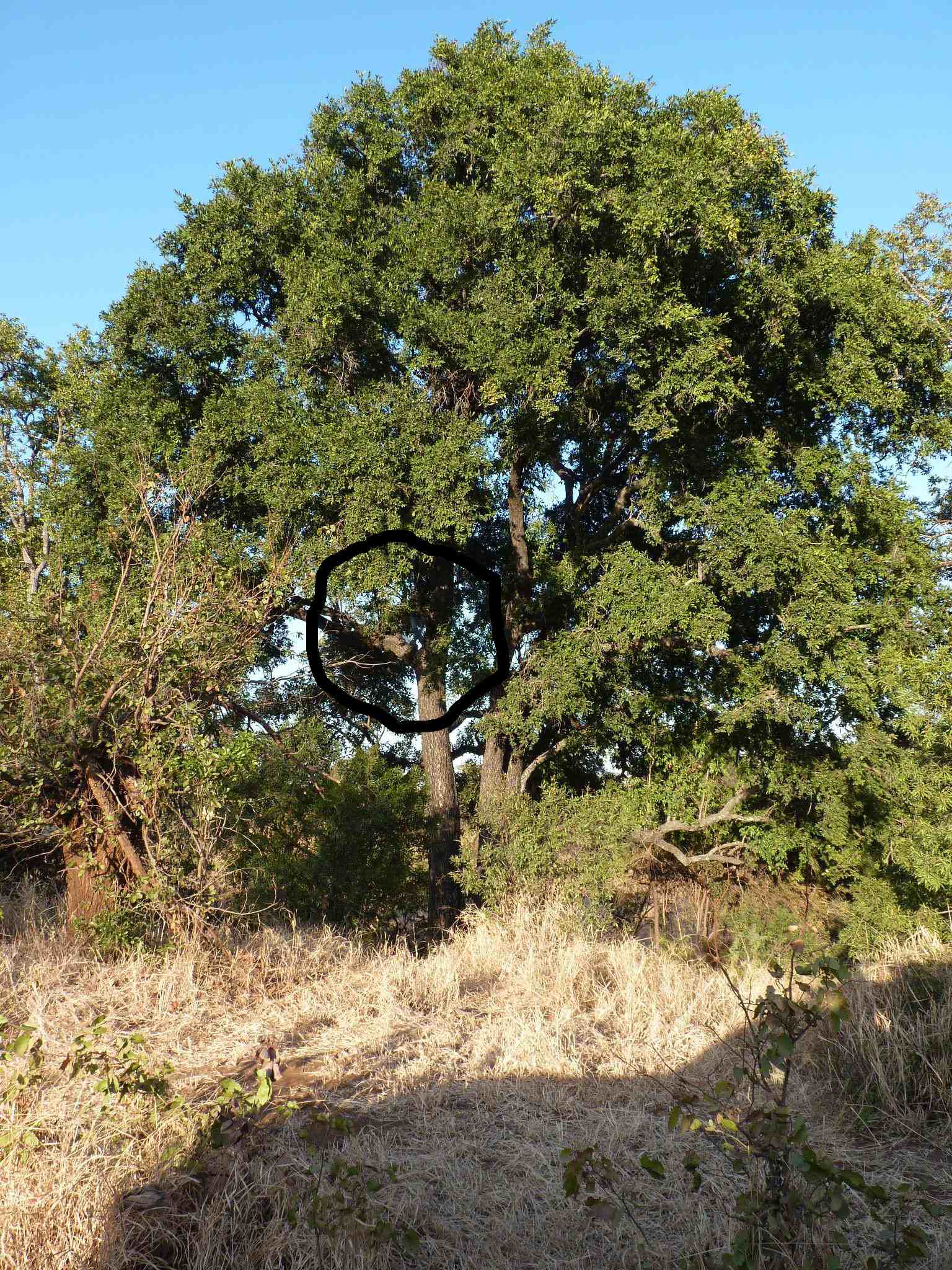
A tree like any other?

I have already praised my wife’s eyesight in the post “Green eyes in the wild” and showed you the two pictures of the hiding lioness at Tsavo East National Park in Kenya.

This example of my wife’s superb eyesight took place at the Kruger National Park during our recent trip (see Kruger National Park Report).

One early morning, while staying at Letaba Rest Camp, we were driving along the Letaba river looking for leopards and -as is normally the case- not finding any. Suddenly, my wife said “Stop, go back, go back!” so I did while she prepared herself to have a closer look with her binoculars. “What do you see there?” she asked me, thinking that I have her eyes! “Nothing” I replied, then added “where?”. “Use your binoculars”. “Do you see that large tree?” “Of course I see it” was my reply.

Owl tree with circle 1

After a while I could see the general area!

I must add that my binoculars are more powerful than hers, and I looked and saw a tiny red dot on one of the branches. “I see a kind of flower, is that it?” I ask. “It is not a flower, look at it again” she replied and I did.

It looked like a bit of meat as it had a pink centre and some brownish hairs. I moved the car a bit to get a different angle and then I could see the whole picture: the pink meat had been either a hare or a squirrel (maybe a rat). “Oh yes, I see it now!” I exclaimed “Do you think a leopard left it there?”

branch with red spot

After further car maneuver the red spot became visible!

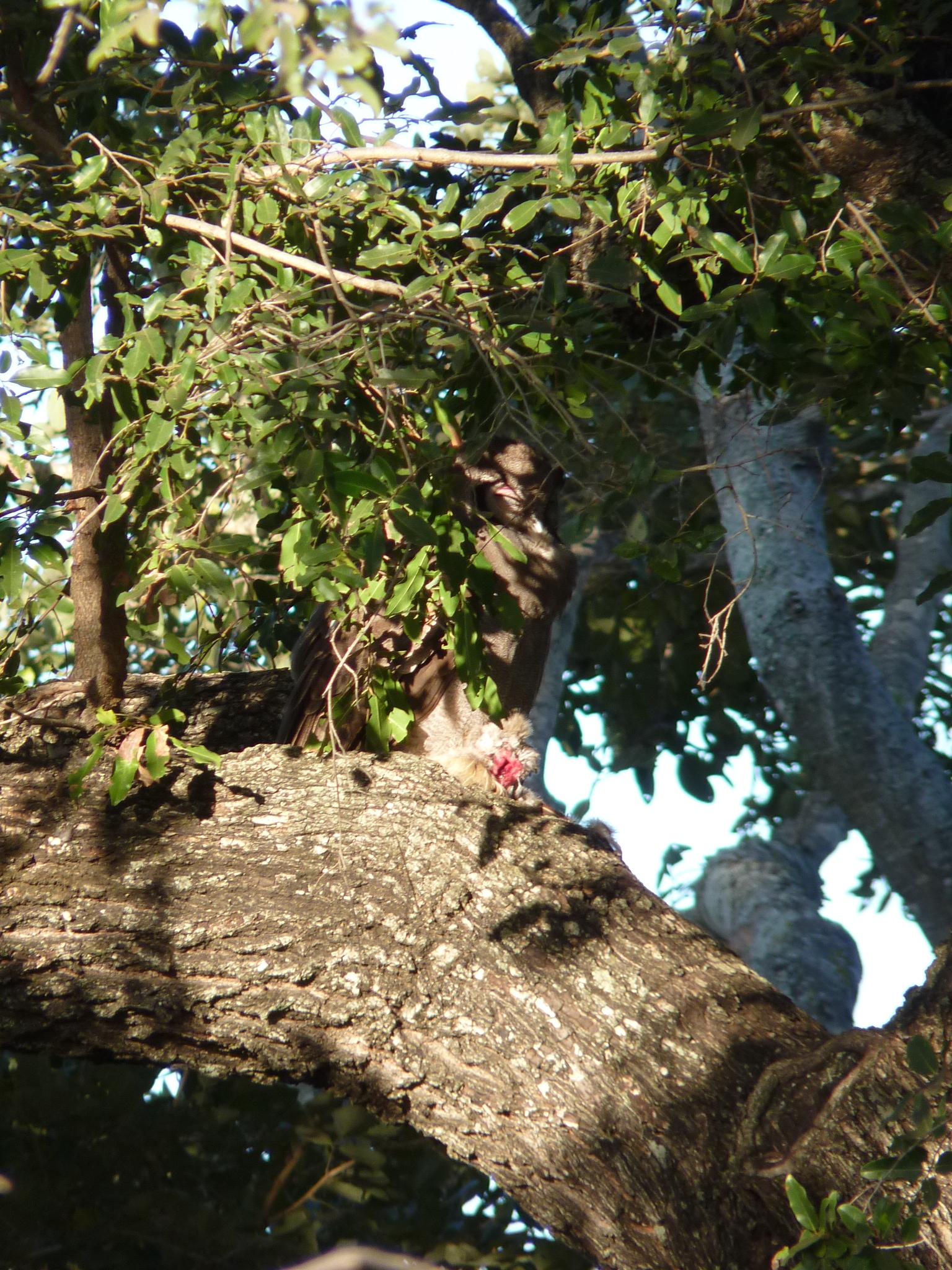
“No” she said, “There is a bird there as well,  move the car back” I did and then I really saw the whole picture! Perching on top of the animal remains -hidden from me until I moved the car- there was a bird with pink eyelids that could only be a Giant Eagle owl (Bubo lacteus) perched on a branch and holding its kill!

owl and prey cropped

More car maneuvers and finally I could see the owl!

The owl is described as being up to 66 cm tall and I still had difficulties spotting it. I did take rather poor pictures that I present to you but believe me, I could drive past one hundred times and never see it!

There is a great advantage in having a wife with such keen eyesight while looking for game on safari. However, there is a drawback. As my children and I know very well, it is difficult to hide from those eyes!

Unraveling the tusker mystery

The sighting of the large tusker described in “A tusk task” was the subject of an intense exchange of messages between the bushsnob and the Emerging Tuskers Project (ETP) of the Letaba Elephant Hall of Kruger National Park.

I supplied the ETP with all the pictures and a video of the elephant. I also reviewed the approximate location of the site where the animal was observed and corrected it to the area around Shingwedzi Rest Camp. This was done after revising our route on the day of the sighting, based on bookings and pictures (both their contents and times taken).

The ETP then studied all available information and compared the unknown tusker with their elephant database and came to the following conclusion, communicated to me on 15 September 2014:

“Thank you very much for sending the additional images and narrowing down the location it did help considerably, I did receive all 11 (pictures).

 In regards to your bull the answer is perhaps not one you were expecting but nonetheless very good news in that we have what appears to be a new tusker.

 This bull is definitely not Mavalanga* as neither the ear markings from the left ear that are prominent nor is what I call the “donut”, the thickening on the middle of the trunk present. I have looked in detail at the ear markings and having compared them along with the shape of the ivory with all the possible bulls that we are currently monitoring as well as the known bulls and they do not match. The location and side images you provided eliminated my only other suspected bull, so the only feasible conclusion is a new bull.

 Interestingly we received a second image from a guest who also suspected his sighting to be Mavalanga around the same time as your image was taken. We can see the ear markings clearly in this image so I am confident in my assessment.

 It never ceases to fascinate me how these bulls can go for so long without being noticed especially with ivory this substantial, it also highlights the value of guest submissions to the project as this is how we learn about these wonderful bulls.

 I have created a file for this bull and will definitely escalate him to the top of the list when the time for the naming review comes and hopefully at that time he will be confirmed as a new bull and named.

Kind Regards,

 ETP”

Of course the bushsnob and his wife are both very excited to have contributed to the ETP by spotting such a remarkable tusker and, hopefully, they will be kept in the loop regarding the future naming of the tusker by the ETP.

* (see: http://www.sanparks.org/parks/kruger/elephants/tuskers/emerging.php#mavalanga)

new tusker cropped

A frontal view.

A tusk task

First of all I must admit my culpability. Being a bushsnob I have always preferred to find and watch carnivores -read cats and more specifically lions- to the detriment of herbivores or browsers. This was my mind’s status quo until October last year when, accompanied by a friend -who happens to be a pachyderm specialist but who had nothing to do with what happened- we visited Hwange National Park. Well, perhaps my friend had something to do with it as he suggested that we stayed at Main Camp, a place we had always avoided in the past as we thought it would be too popular and “touristy”.

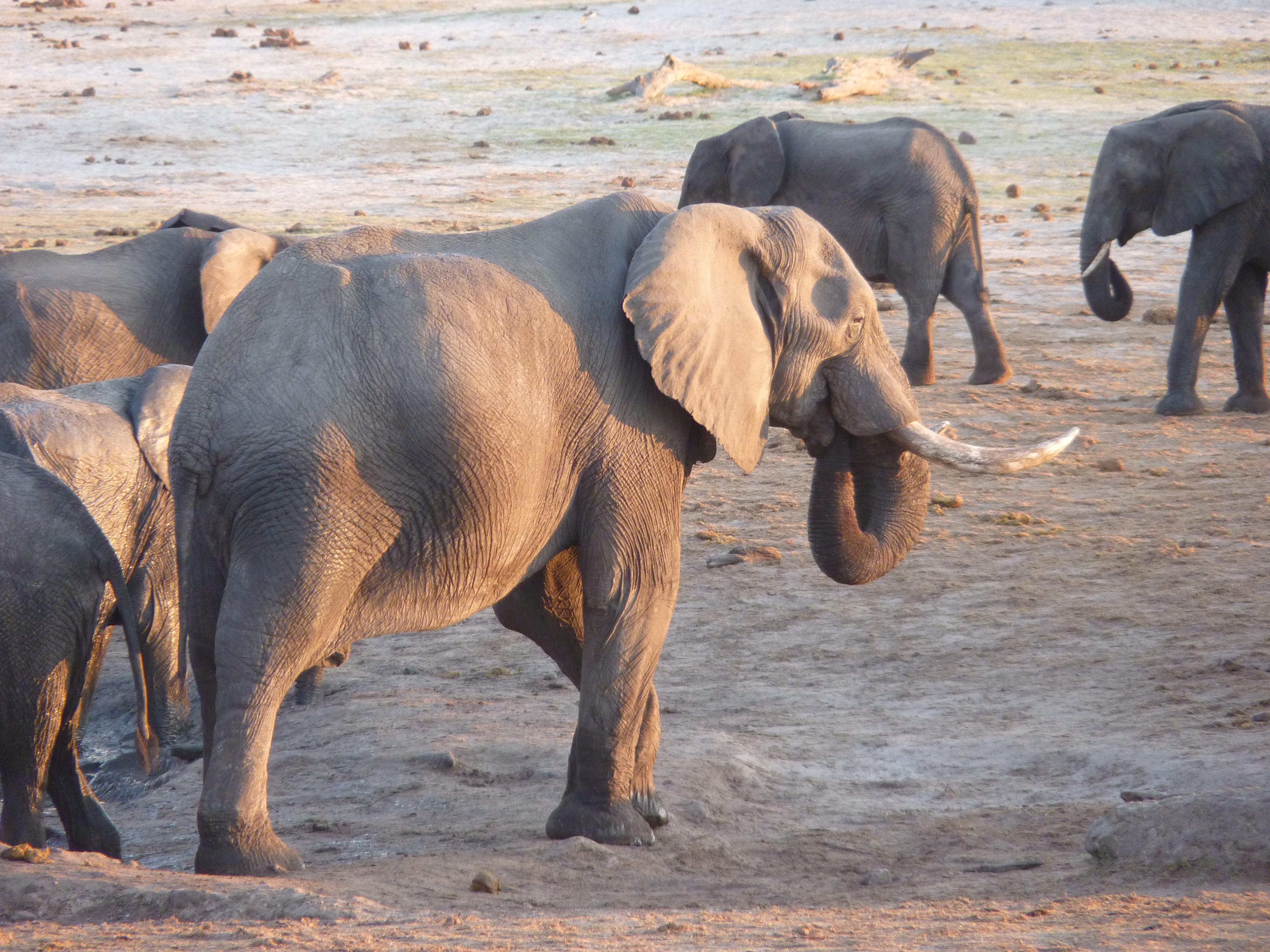
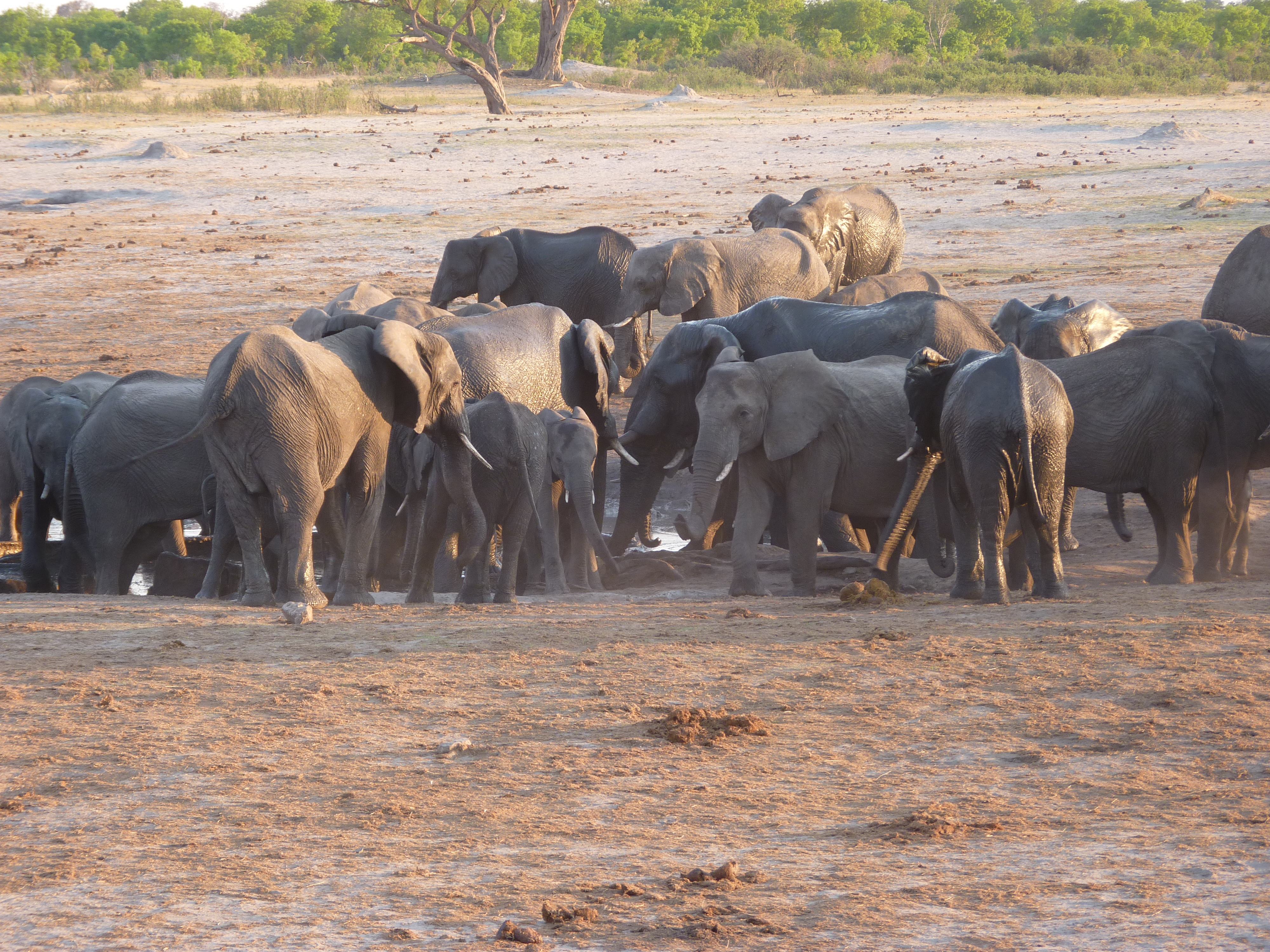
The reason for that visit was that my friend needed to better understand what had happened with a reported elephant poisoning at the Park but this is besides the point as we were only his “escort”. Taking advantage of the outing we visited several waterholes where water is pumped in for the animals, as the Park is extremely dry in October. No wonders then that elephants were there in large numbers, particularly in the afternoons. To give you an idea, on one of the days, from 16:00 to 17:00 hours we counted about 750 new elephants coming to the waterhole and they had been coming in and out from about 15:00 hours and continued until we left at sunset.

The family groups of up to 25 animals would appear from the mopane tree forest moving gently at first and gradually accelerating towards the water until some would break into a fast walk and even what could be defined as a run, in “elephantine” terms. They would get into the water and drink their fill, then go in and start to bathe and frolic about. Lost babies were particularly entertaining, as they would run around crying until they found their mothers again. Babies, again, would get stuck in mud or would not be able to climb out of a hole until they were embarrassingly pushed or lifted out by a helpful soul or managed to extricate themselves. Teenager equivalents would mock charge anything, including the people at the platform!

The bulls would come either alone or in groups of three or four and they kept their gravity and walked to the watering hole with determination, showing mutual respect and deference to the females. The need for water was probably stronger than any sexual drive at that particular time.
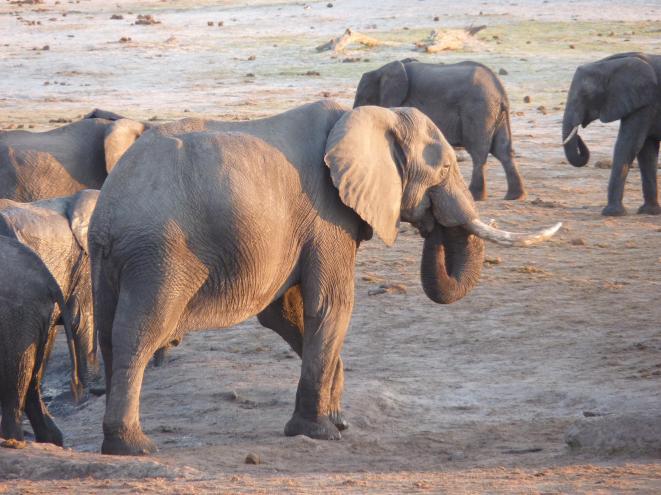
tusker wange waterhole

A bull after drinking its fill.

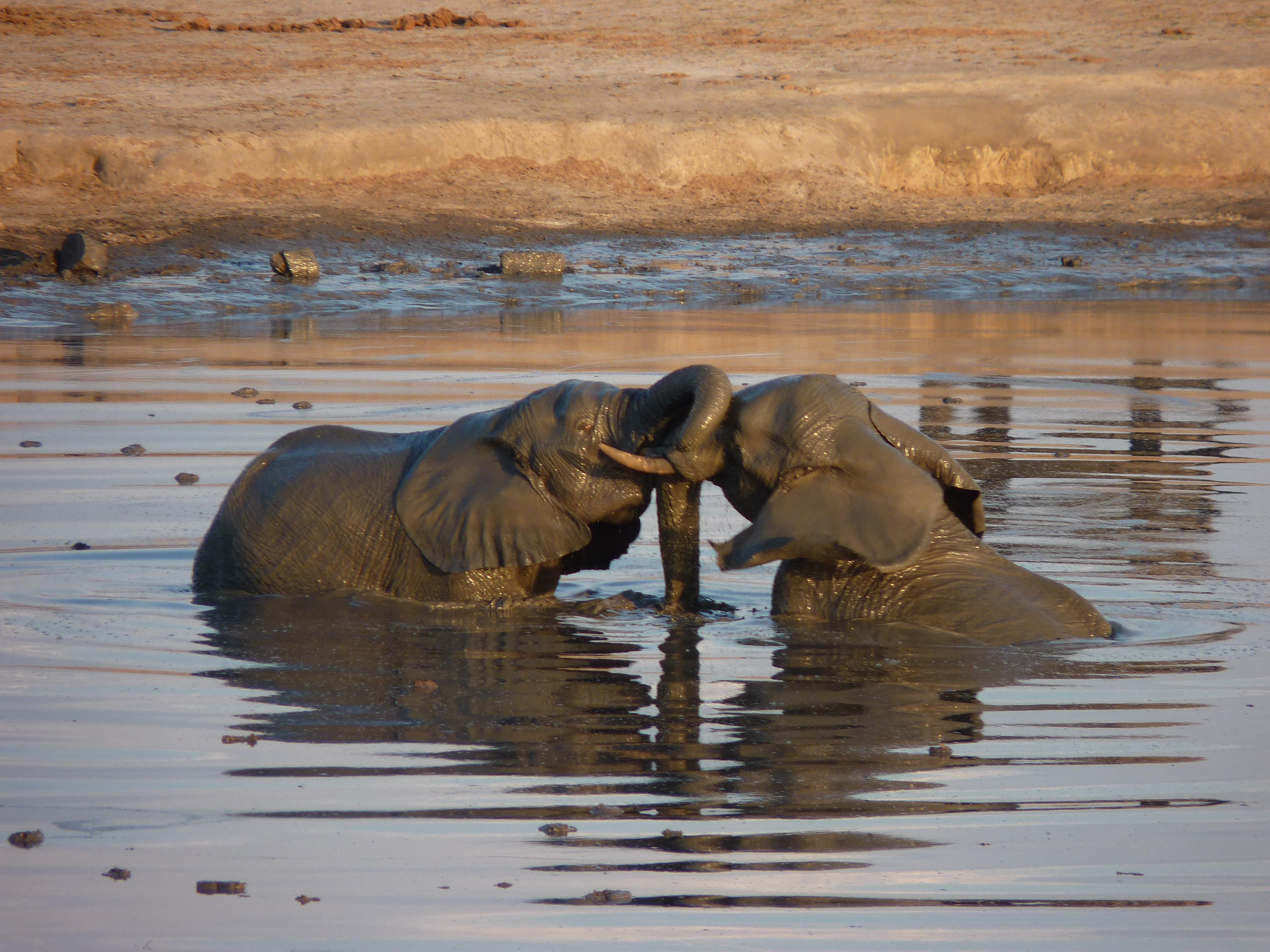
It was not only the numbers we saw but also the amusement they provided. The waterhole was muddy and there was elephant dung floating all over. After some time, we detected that at the centre of the pool there were two adult hippos and a baby that seemed to be “tolerated” by the pachyderms, with the exception of the curious elephant teenagers that would -I tend to believe deliberately- annoy them by getting close and mock charge them as well. The hippos, clearly outnumbered, took to this philosophically, probably because they clearly had no other position to adopt!

elephants palying hwange waterhole

Some rough games took place!


elephants playing hwange waterhole

And matching the youngsters’ strength.

Confronted with this “elephant water kingdom” all other game just stood by and watched, as they had no chance of getting close to the waterhole. This “happy hour” rendered even the presence of two large male lions obsolete and they had to console themselves drinking from the small pools created by leaking pipes.

As the pair of lions were close to where the cars were parked, careful calculations between human walking speed vs. lion charge speed took place before returning to our vehicles as the lions refused to move away! In addition to this, believing that several primates walking together looked more threatening, we bunched up together to return to the car. It worked!

The male lions drinking in the periphery.

The male lions drinking in the periphery.

The clean water inlet at the hole was where most adult elephants congregated to take advantage of the best water. There were clearly more bodies than the space could accommodate! Despite this and although there was pushing and some grunting, no loud trumpeting or fights broke out showing that the pecking order was well maintained. Of course the larger males had the “elephant share”…
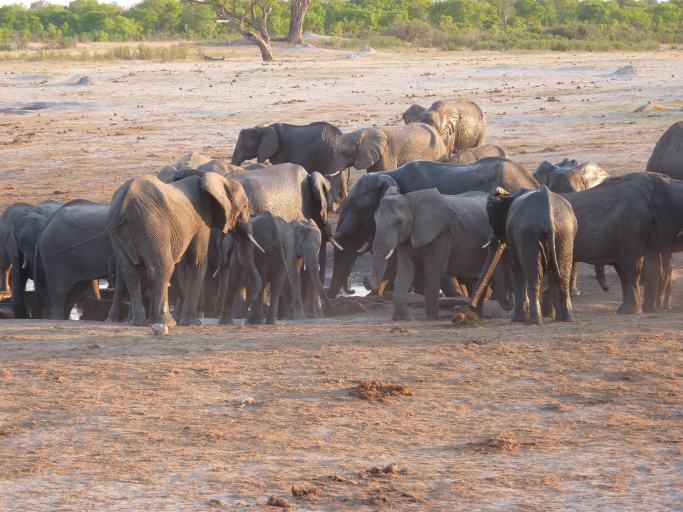
The most popular drinking place was where the fresh water entered the waterhole.

The most popular drinking place was where the fresh water entered the waterhole.

So, this “great show on earth” did somehow increased my interest in elephants and watching them, to the delight of both my wife and daughter who, as usual, saw the light long before I did! It was this “elephant loving” bushsnob who came to Kruger National Park at the end of July 2014. Here are the consequences of this new-found love!

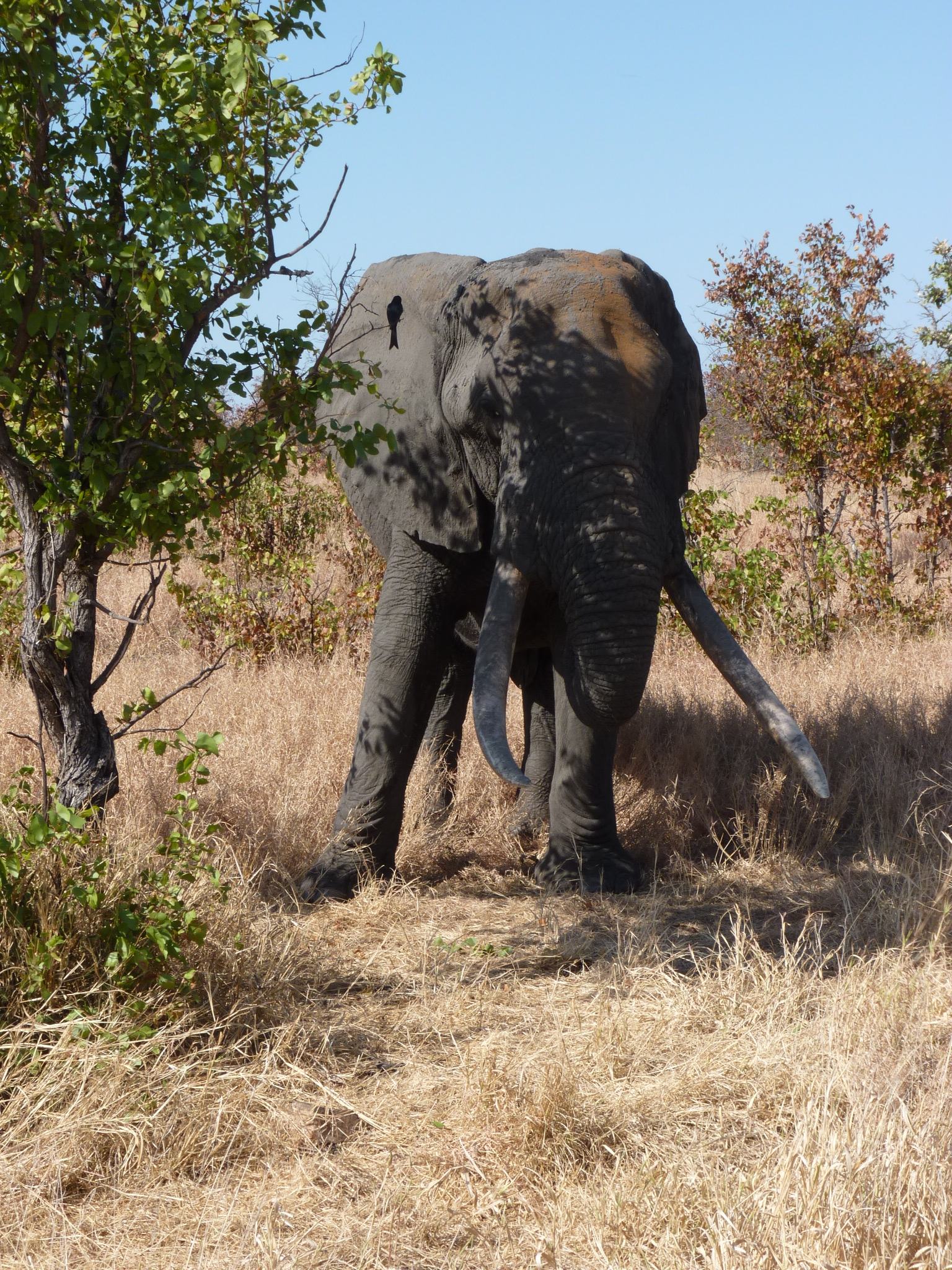
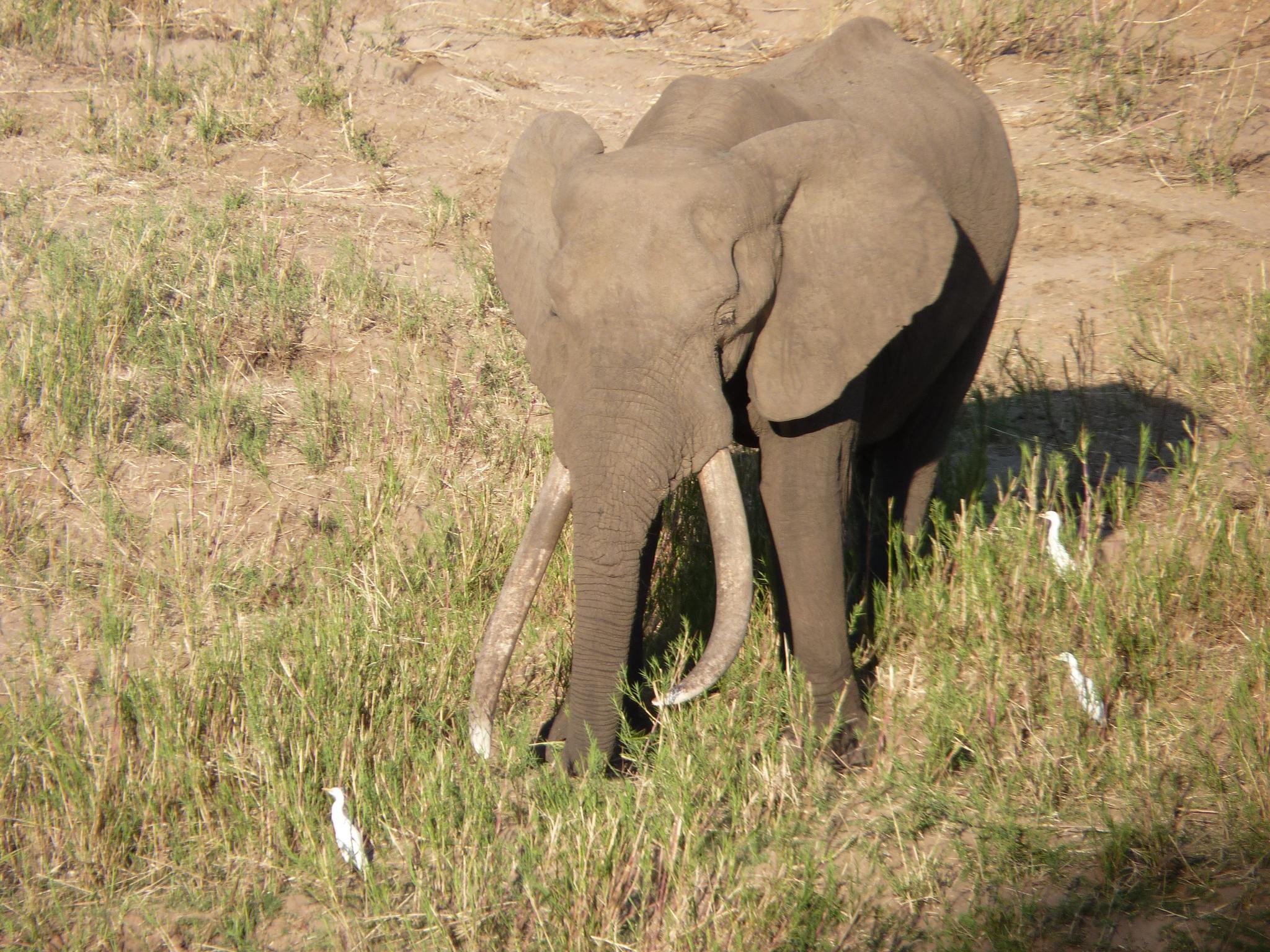
On our way to Letaba Rest Camp from Shimwini Bush Camp, in the proximity of the Babalala picnic site, we met a male elephant with the largest tusks we have seen. It was -for the weight of ivory it carried- a comparatively small animal. Despite its slow but steady retreat we managed to take a few pictures.
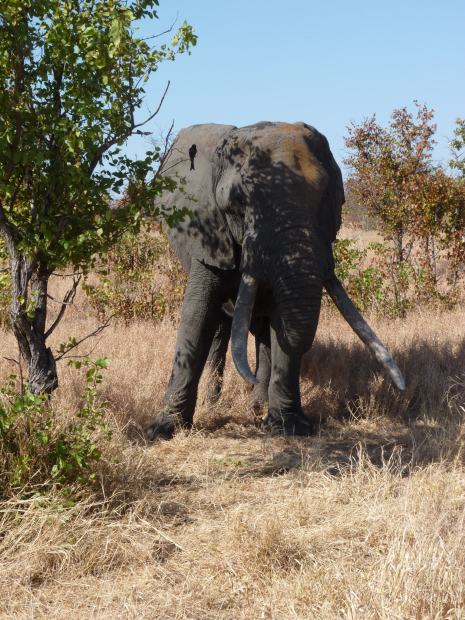
The Babalala tusker.

The “Babalala” tusker.

We talked about it during the rest of the journey and remembered Ahmed, the Marsabit tusker of mythical fame in Kenya that died in the seventies. Apparently his descendants are still deep into the forest!

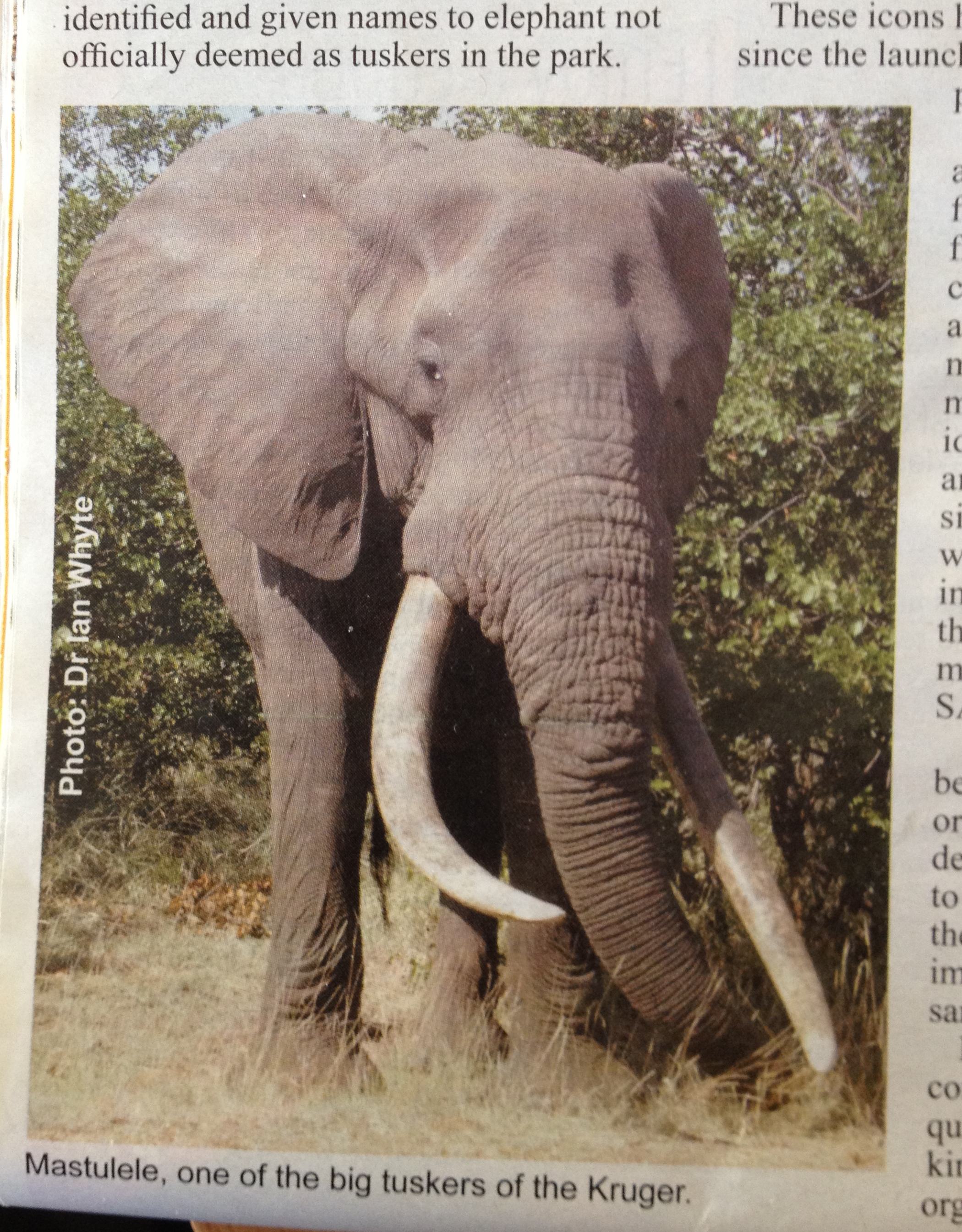
Once in Letaba, while shopping for dinner, I picked up a free copy of the SANParks Times of June 2014. Leafing through it a picture of a tusker called my attention. In my “tusker ignorance” it looked remarkably like the “Babalala” animal that we had seen earlier! Its name was Masthulele and the photo was part of an article on a tusker identification and naming initiative being carried out by the South African National Parks. The project is based in the Elephant Hall at Letaba. We visited the place on a previous trip and found it a great place to learn about elephants as it has amazing exhibits. I still remember that when time to leave came, a friend and my daughter hid in it to be able to spend more time looking at its beautiful display!

“Look at our elephant” I told my wife with some degree of puzzlement and enthusiasm at having found such an interesting animal. She agreed with me that they were very similar. I decided that a follow up was required and made a mental note to visit the Elephant Hall in the morning to seek more information. I went to sleep thinking about how privileged we were to have seen such a great animal…
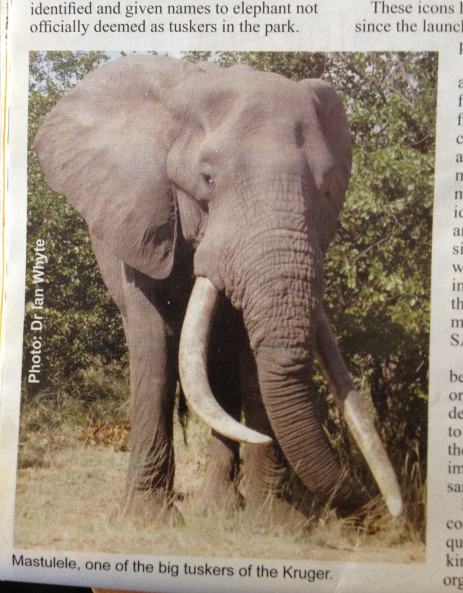
Masthulele depicted in the SANParks Times article.

Masthulele depicted in the SANParks Times article (my photo of the newspaper).

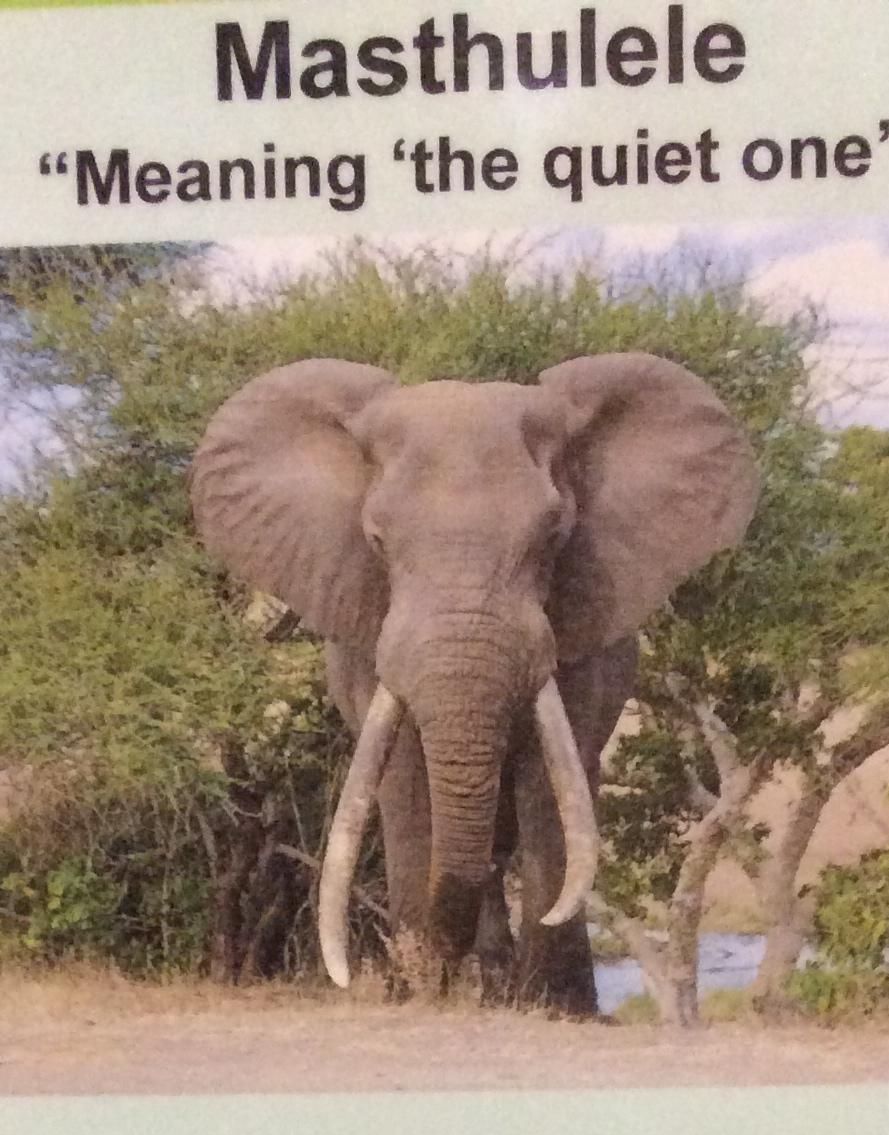
After our early morning game drive I went to the Hall. Unfortunately the person in charge of the “tuskers project”, Kirsty Redman, was on leave but I was directed to a board where the main living tuskers of the Kruger are shown with brief details about each animal. Of course Masthulele was among them. The name means “the quiet one” in Tsonga. It was named in recognition of Dr. Ian “Masthulele” Whyte, a retired Kruger researcher. Its home range was described as very large. The board also said that the elephant was often seen near Letaba Rest Camp. Regarding its special markings, it has “spotless” ears but it has a scarred trunk, product of some earlier squabbles with other males.

And then the surprise came! There were two “Masthuleles”, the one in the newspaper had a curved right tusk and the one at the Hall had a curved the left one! So, which one was Masthulele then?
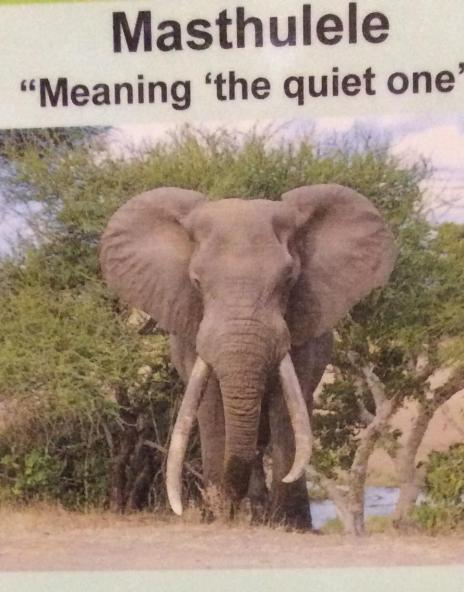
Masthulele as it appears in the Elephant Hall at Letaba (my picture).

Masthulele as it appears in the Elephant Hall at Letaba (my picture of the poster at the Elephant Hall).

Being confused and close to a nervous breakdown (well maybe I am being a bit too theatrical here and a bit too muh of the drama queen my daughter lovingly calls me…) and in the absence of advice I decided to go for the only practical solution at my disposal: buy a copy of the booklet “Kruger Legends-. Great Tuskers of the Kruger National Park” and check Masthulele’s information. The book indicated that Masthulele was probably the “largest known and named tusker in Kruger at present (2012)”. It reiterated the information about home range and scarred trunk. Then it got interesting: it said that the tusks are also distinctive, its left tusk curving above the right one and both are fairly symmetrical in length, as Kruger tuskers are. Furthermore, the picture in the newspaper was exactly the same as the one in the book (both credited to Dr. Whyte himself!) but the former was the mirror image!

I felt great relief when I managed to solve the “two Masthuleles mystery”. However, I still had the unidentified “Babalala” tusker that -this time truly- looked like a mirror image of the real Masthulele. It was alive and in my pictures! The “Babalala” tusker was -to us at least- a rather small animal with its right tusk curved and shorter and the left tusk long and somehow pointing down and outwards!

This was getting interesting and required careful examination of the living tuskers! However, as it was time for the afternoon game drive, the decision was postponed until the evening. The drive took us along the Letaba river and, after a few km we spotted a bull elephant feeding by the road. It had medium sized tusks of fairly equal size. It was clearly a younger animal and a “tusker in the making”.

As you can rightly guess, I was now very “tusk-aware”! When the bull decided to cross the road towards the river we spotted a hitherto unseen animal with large tusks. As it was feeding calmly I managed to take several pictures of it. While taking the pictures I realized that the elephant was in fact Masthulele itself! That, to me, settled the issue as the pictures I saw at the Hall and in the book and the live animal in front of us clearly matched and somehow confirmed the existence of its “mirror image”.
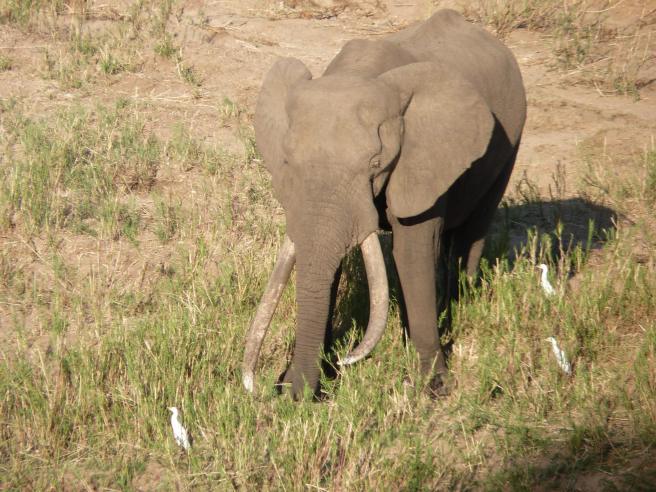
Masthulele seen at the Letaba river (my picture ).

Masthulele seen at the Letaba river two days later (my picture ).

In the evening I carefully checked all living tuskers depicted in the book against the pictures of the “Babalala” elephant and I could not find a match. I then gave the task to my wife and she could not either! So we had an unidentified tusker! However, I was sure that it was a known animal in view of its quiet disposition and very noticeable tusks!

Back in Harare I did an Internet search and found at least four bulls that at first sight look like the “Babalala” tusker according to http://www.tuskersofafrica.com/. These are: Manyeleti, Masasana, Mavalanga and Shabakhadzi. Not being an elephant identification expert, I am putting the case to the tuskers project to seek their views and an answer that I will communicate to you.

For the time being, the tusker mystery still stands!
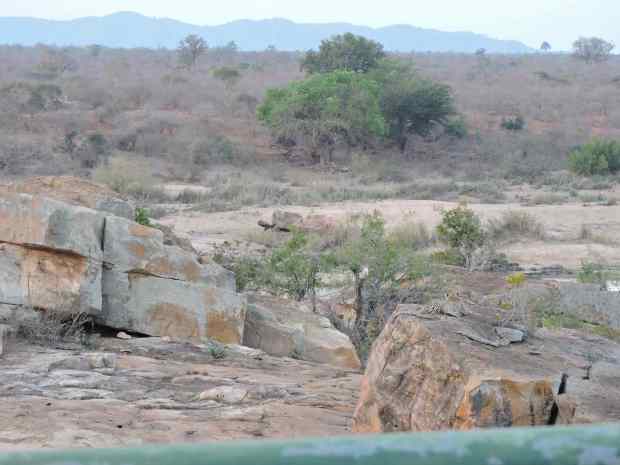
Kruger National Park Report

Nothing much to report on the journey from Louis Trichardt to the Kruger National Park (Kruger). On arrival at Punda Maria gate, a helicopter flying overhead brought home the reality of Kruger these days when special measures to curb rhino poaching are being taken. Despite this, a few hundreds have been killed this year. Let’s hope that the Park will get on top of the situation. Kruger is the last rhino (both black and white) stronghold left in the world.

Roads are good and we were in Sirheni Bushveld Camp with time to spare. The camp is small with no electricity but this time we knew about it beforehand! After spending a quiet night and enjoying the peace of the place, it was time to continue our trip. We left for Shimuwini Bushveld Camp where we had a great time on a previous trip with friends. There was more water this time so the animals were less concentrated in the riverine area. However, the hippos were still there and the birdlife good as usual.

In the morning we planned to do a drive along the Letaba river near the camp and to continue to a point where the river crosses the road, as it is an open expanse which apart from being beautiful, allows one to see far and spot interesting things. On the way there we could see a number of cars parked on both sides of the road in the distance indicating an interesting find.

When confronted with these situations in the Kruger, the bushsnob has a “car rule” to predict the situation and take appropriate action. It is as follows:


       CAR NUMBER            REASON

ACTION

1 (often parked sideways or in the middle of the road) birdwatcher Check bird being watched
1 (well parked, usually a small saloon or city SUV) first time visitors watching any animal they come across Drive past with eyes closed or looking the other way
2-5 (any type) buffalo, giraffe, zebra, etc. Check as it may be interesting and cars tend to depart after a few minutes
5-10 (any type) elephant, rhino Same as above
<10 (any type) lion kill, leopard Avoid the area by taking any available and legal measure and return at lunchtime or late afternoon
Sizeable queue or large number leopard kill, Parks or Police check point Check with binoculars, if Police present, continue, otherwise as above and return at lunchtime or late afternoon

In this particular instance there were more than 10 vehicles and lion kill “or above” was diagnosed. We joined the queue and, from where we were, we could see a buffalo carcass and at least one lion resting under the bushes. We were keen to see the kill as we knew that to bring a buffalo down normally takes the combined efforts of several lions. We waited patiently for the cars ahead of us to move -maintaining “strict bush etiquette”- but, as there was no movement we decided to move on to the rest of the park which was consequently less crowded!

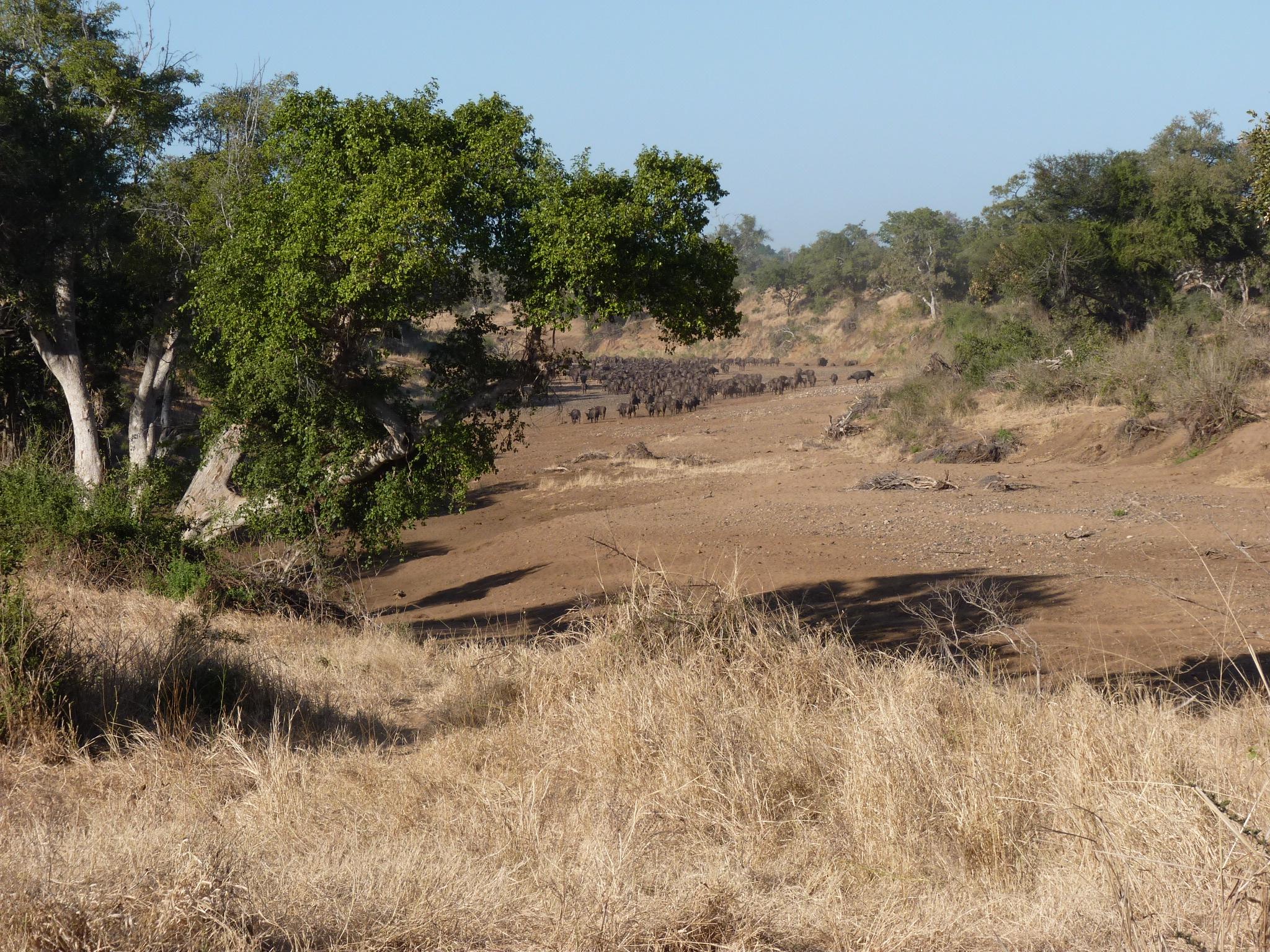
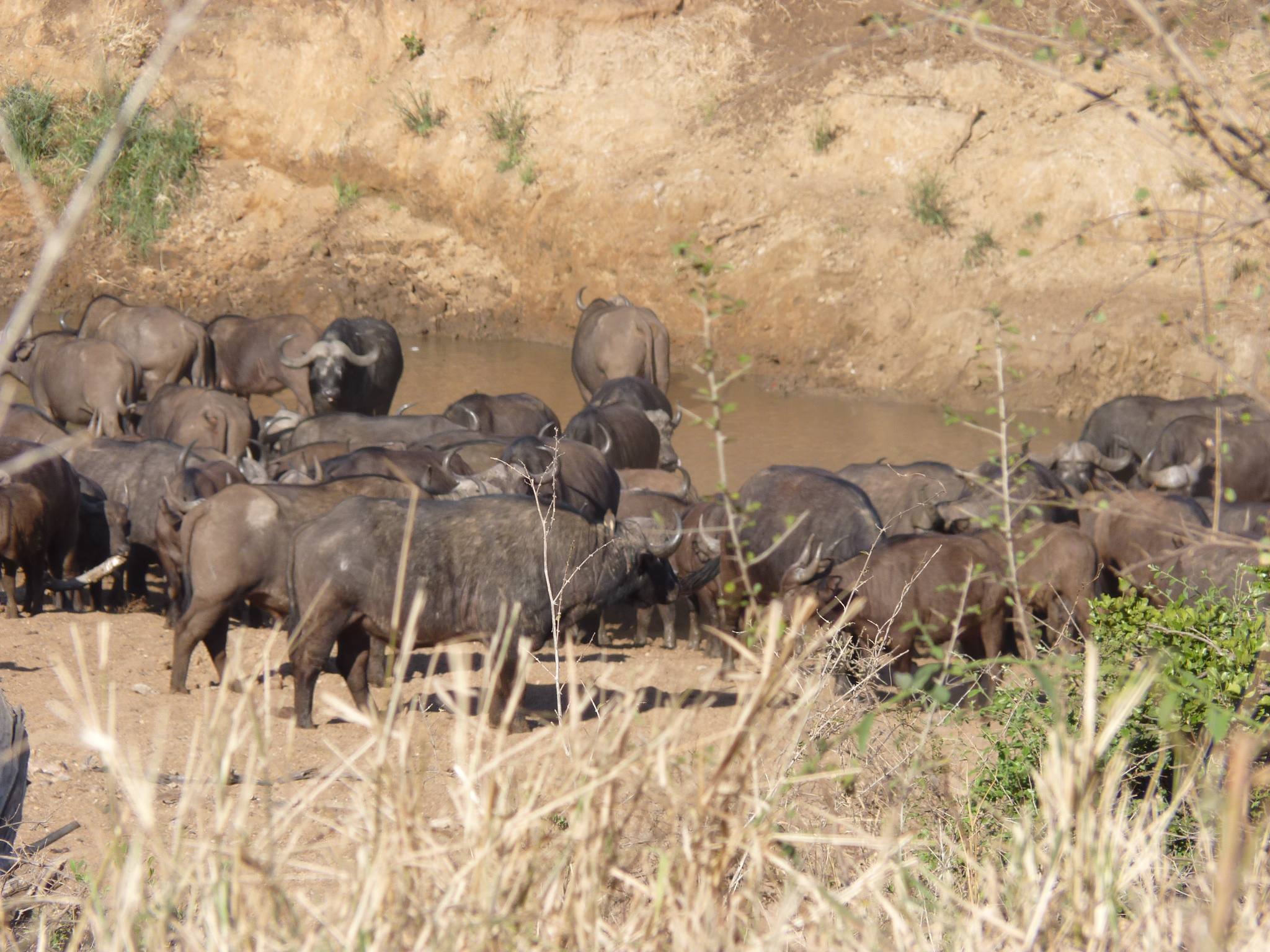
Our idea was rewarded when we came to a Letaba tributary where buffalo were going down to the riverbed. On arrival there may have been one hundred animals but they were still coming down. After about 20 minutes there were what I estimate to have been over one thousand and the number kept increasing for a few minutes. It was one of the largest herds we have seen.

A large herd of buffalo while moving on the river bed.

A large herd of buffalo while moving on the river bed.

Part of the herd while drinking.

Part of the herd while drinking.

Although rather bovine in their behaviour, buffalo transmit a sense of wildness and power that, to me, no other herbivore does. Although I have not yet seen them confronting lions, I have seen them in close proximity while helping a friend to dart them for his research and they were dangerous!

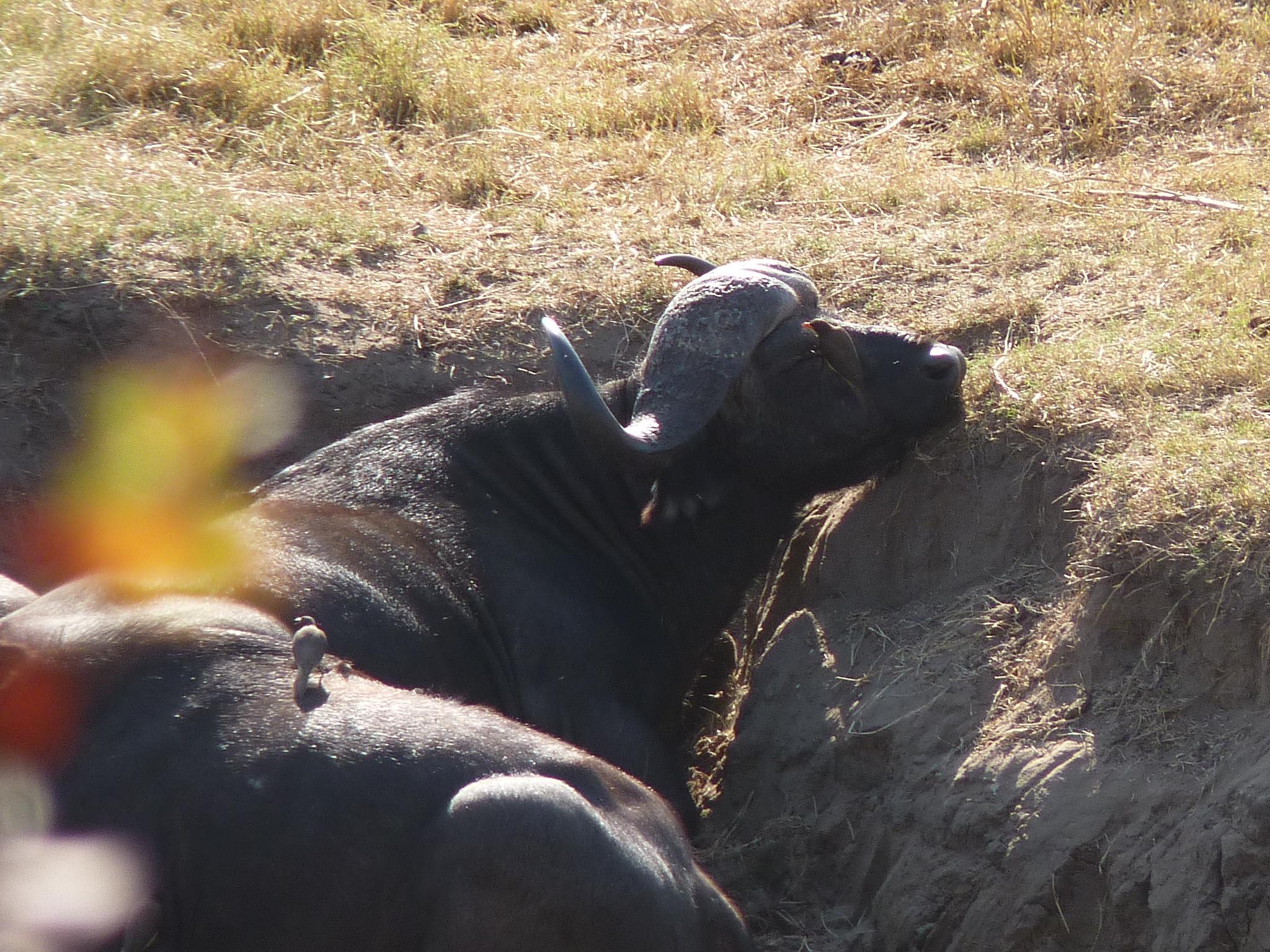
This buffalo was having a comfortable "siesta" while the oxpeckers did their job!

This buffalo was having a comfortable “siesta” while the oxpeckers did their job!

Seeing buffalo always brings back the story of a colleague working on tsetse flies in Kenya. One day he was checking his tsetse traps in the Nguruman escarpment and a lone male suddenly charged him from nowhere, forcing him up a tree to save himself. He was lucky on two accounts: there was a “climbable” tree nearby and the buffalo did not wait for him to fall down in order to trample him to death. It was a hairy moment and what was most interesting was that he said that the rush of adrenalin allowed him to climb and stay up in the tree without problem despite not being the fittest guy in Kenya. What was really tough was getting back down, as the tree was very thorny!

Later in the morning we hoped to see the kill again on our way back to camp but, unbelievably, there were still a lot of cars so we just had a look while driving by and not much had changed. We decided not to bother and try again in the evening as the proximity of our camp would enable us to stay just a bit longer than the others… By the time we were ready to return to the kill the famous tire had totally deflated… Not being part of the Ferrari F1 team, it took us a few laps to change the wheel and we were late! We still left as we estimated we had about 15 min of watching time!

We got to the kill and there were still cars! “Do not worry, none of the cars belong to our camp so they must leave by 17:00 hs to get back in time for the gate closing time of 17:30 hs”. We waited and waited and no one was moving by 17.20 hrs! The usual “these people know something we do not” was pronounced by one of us and we decided to re-check the gate closing times again and it clearly said “July: 17.30 hs” and then we realized that it was 1 August and closing time was now 18:00 hs. By the time we realized this, cars had started to depart and we did get our 20 minutes or so of “only the lions and us” where some observation took place and pictures were taken!

The young lion feeding on the buffalo.

The young lion feeding on the buffalo.

A closer view of the lion feeding.

A closer view of the lion feeding.

What did we see? The carcass was half eaten and one youngish male was inside it tearing pieces off. Another male was resting under the shade, together with 3 lionesses and 2 cubs. One of the lionesses looked uncomfortable and decided to go for a walk towards the river, surely to drink and soon a second one followed her. A few vultures were waiting patiently up in a nearby tree. And then it was also time for us to abandon the spot to get to our camp in good time.

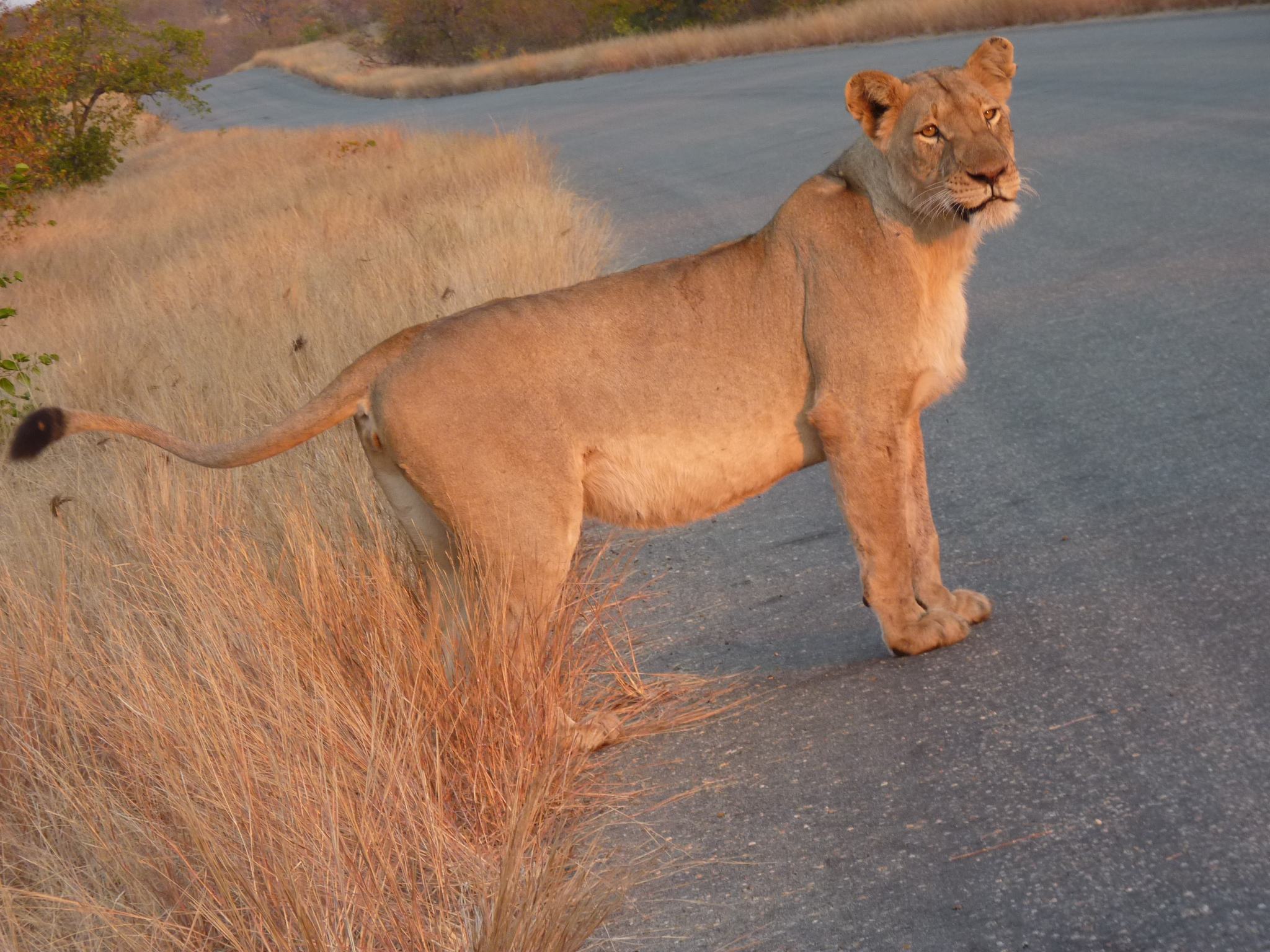
One of the lionesses with a full belly on her way to the river.

At dusk, one of the lionesses -with a full belly- decided to go to the nearby river for a drink.

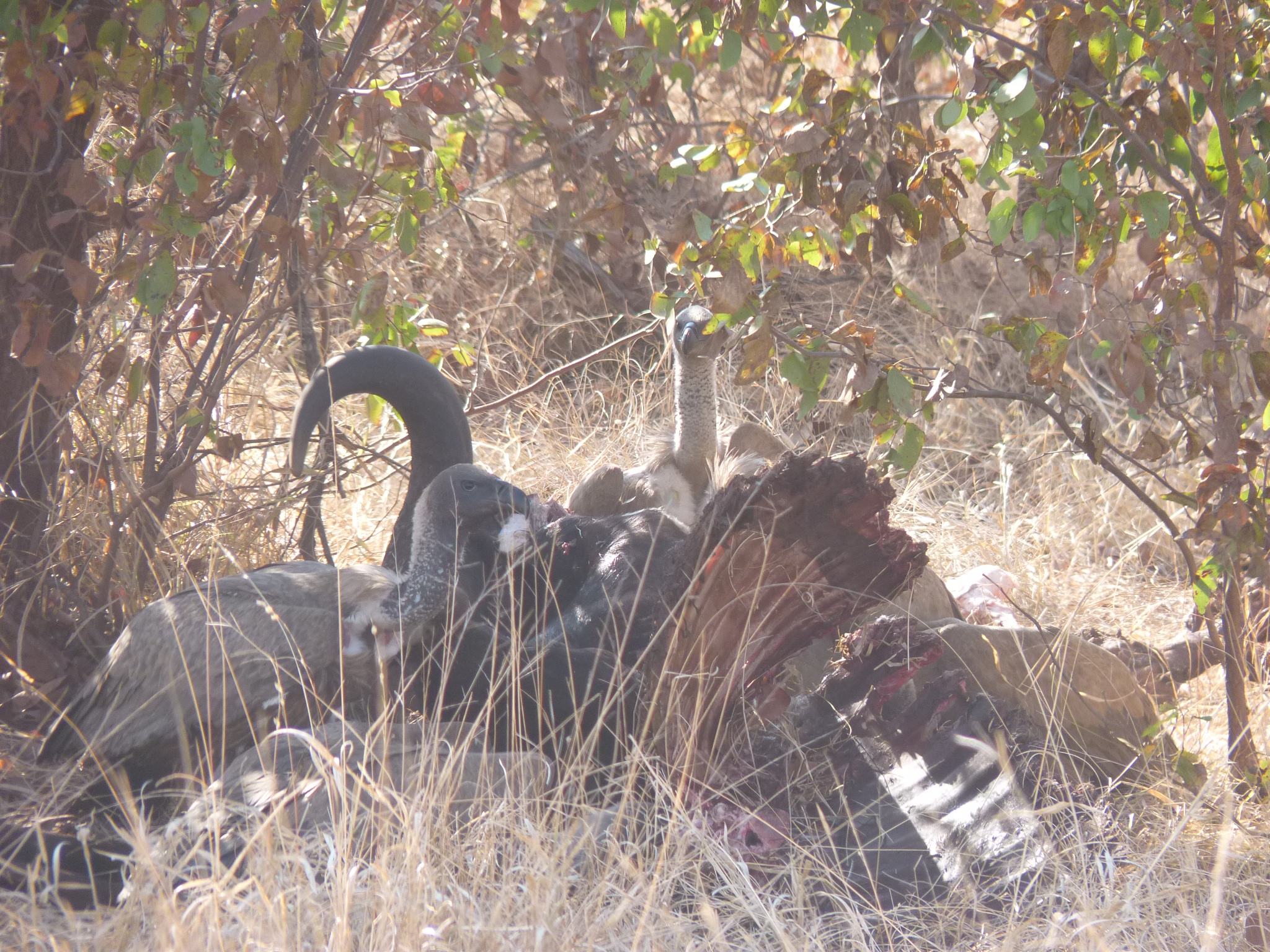
The following morning, en route to Letaba, the only carcass visitors were vultures and no lions were seen. Yes, you guessed right ours was the only car so we parked it sideways blocking the road and watched the birds!

Only the vultures remained the following morning.

Only the vultures remained the following morning.