Bush stories and anecdotes

The heart of the blog, where I present observations, accounts, funny stories, etc.

Jumping lichen

Grasshoppers and/or locusts -I cannot tell them apart- are also plentiful in our farm and surrounding area. Dazzled with more colourful critters we tend to overlook them as they normally jump off and they are gone into the grass, quite far away from the observer to enable it to re-discover them. In addition, they immediately seek further shelter under the leaves.

Sometimes, however, we do find some, either because they are still young and prefer to stick together rather than use their strong legs or because they make the error of entering the house or the car or, who knows? maybe because they are lazy.

P1130552 copy

Being attractive creatures I present you with a couple of pictures as an introduction to the subject that let’s me tell you about one particular grasshopper I “discovered” yesterday.

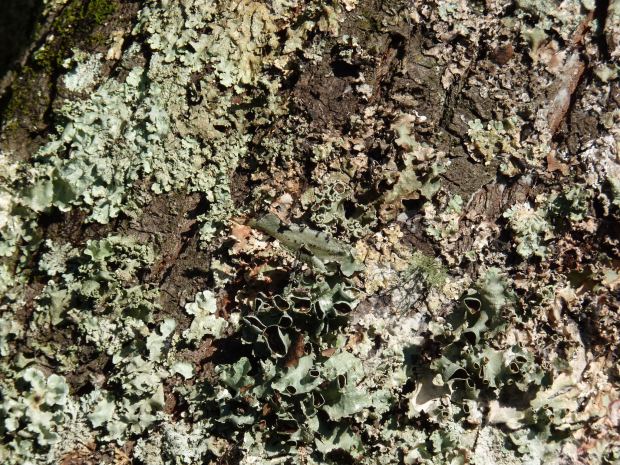
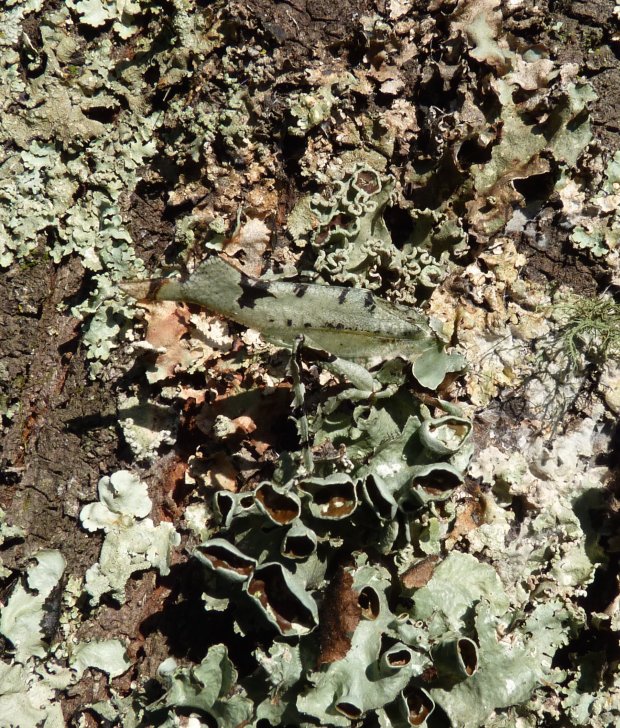
I was in one of my insect-watching sorties, focusing on moths the morning after to take a few pictures for my “collection” when a greenish flying insect caught my eye. Luckily I saw it landing and went for a look. Its flight took it to a pine tree trunk, covered with lichen and moss. I spent a few minutes searching the landing spot and I only detected the insect as it shifted its position slightly and moved some lichen that caught my eye.

P1140969 copy

When I focused on the movement I realized that the lichen had not moved but it was in fact the creature shifting position! It is the most perfect example of camouflage I have seen so far (well, perhaps of green camouflage…) and I prefer to show it rather than trying to explain how it looked. It was about 3-4 cm long

P1140968 copy

P1140966 copy

P1140964 copy

P1140963 copy

P1140962 copy

A series of pictures showing the very well camouflaged “hopper”. I could not believe how well its head mimics some of the “leaves” from the lichen around it!

Unfortunately while I was busy taking the pictures it jumped off and I am still trying to find it again…


NB: I found a younger brother that I managed to keep until I can get some more pictures of it to show you!


Mutant moth!

I have spent three years photographing butterflies and moths at our farm located in the phytogeographic area of the Yungas that belongs to the Neo-tropical Amazonian domain. Its warm and humid climate acts as a true insect incubator that I find extremely interesting and entertaining.

Most butterflies are pictured while walking on the access road where they abound in certain areas while the moths are attracted by a while light left on overnight. I can guarantee that both walks and light offer new discoveries almost daily. The problem is to be able to take the necessary pictures, often with poor light and with moving and flying subjects as the only dead ones come from “road kills”.

Very often I doubt if I am looking at a butterfly or a moth as the division is not as clear as between bats and birds! Broadly I considered that butterflies were diurnal, colourful insects that fold their wings vertically while the opposite applied to moths: rather dull, nocturnal and with horizontally-placed wings.

To be sure, I consulted the only butterfly guide I have handy[1] that confirmed my views adding that there are also differences in the shape of their antennae as well as an academic difference regarding humeral lobes and frenula that is beyond me dealing with live insects.

What I also learnt is that there are some exceptions to this general rules, as usual!

What the book did not tell me is that some moths further complicate the budding lepidopterist’s life by pretending to be butterflies and vice-versa!

What I did not know was that confusion would also be possible while identifying one individual moth, depending on the wing you look at! I came across this example of a bicolor moth that I did not know it could happen.

No doubt this has been observed before but I thought it worth reporting it while I follow this issue up with the “experts”.

DSCN4120.JPG

The “mutant”…


[1] Williams, J.G. (1969). A field guide to the butterflies of Africa. Collins. 238p.

See-through

After finding the 80 zig-zag we thought that the day was done and I was telling my wife that there was another “special” one that I really wished to find. It was what I called the “flying skeleton”, a “see-through” butterfly that I had seen in reference books and believed to have spotted a couple of times in past years. However, it was always flying high and never stopped for a possibility of a photo.

We walked another few metres and she interrupted my story saying: “Do you mean something like that?” My now “frozen” wife was pointing at the road in front of her A quick look was enough to confirm that one of my most “Wanted” butterflies was just there, waiting for me to get the camera!

P1130885 copy

Still somehow amazed by our luck and thinking “who else but her could spot such an insect in the middle of the road at the right time?” I managed to get the camera in time and photograph it.


Luckily, it was very tolerant and I managed to photograph it before it disappeared into the bush. It was the Yungas vitreous (Methona confusa).

While in the issue of translucent butterflies, I take the opportunity to show you a couple of pictures of Rothschildia maurus, a very large moth that comes very occasionally to our verandah light. The first one came in 2014 and we did not see another one until another (smaller one) turned up a couple of days ago. We observed some differences in the wing pattern of the various specimens seen and we need to consult an expert to determine its possible meaning.

I trust that you will agree with me that these are something really special!

Finally, other butterflies also show “windows” in their wings and I could not see any logical explanation for them. However, Nature has its ways!


80 zig-zag

We are back at the foot of the Andes, in our small farm in Salta where we will spend a couple of months. It is warm and humid and, although there are numerous creatures, at the moment the butterflies rule!

I have already described a few in an earlier post[1] but I need to do them justice so I will present you with a few more observations as we find them. Some of them exist in abundance while others are rare.

The 80 zig-zag (eighty zig-zag) (Callicore sorana) is one of them. I had spotted it before but invariably it flew up and into the woodlands as soon as I tried to approach it. I was beginning to think that I would not get a picture of it… until now.

For some reason, one of them showed some patience towards the bushsnob and I managed a few shots that, not only justify its name but show it in all its beautiful tones. This butterfly sits with its wings closed and flashes them open every few seconds showing its “true colours”. As my finger in the trigger was invariably slower than the insect, I took about 100 pictures until I got the few ones that show it with its wings open.

Under sunlight the colours were really outrageous and I hope the pictures can show this unique insect!

This slideshow requires JavaScript.


[1] See: https://bushsnobinafrica.wordpress.com/2015/02/27/flying-gems/

Help for a widower…?

At the end of the post “Toilet and Tortoises”[1] I expressed our disappointment with the setting and management of Camp Kwando and surrounding area. There was however an area by the jetty that yielded some interesting sightings and observations.

A large Common cluster fig tree (Ficus sycomorus) acted as a giant umbrella, providing good shade. Its fruits were intensively consumed by a number of birds among which we saw Grey go-away bird, Green pigeon, Black-collared barbet and a Squirrel among others. They offered some good photography that I present below, including a nice shot of a Brown-hooded kingfisher that was taking advantage of the insects attracted by the shade.

DSCN9995 8.33.22 PM 10.04.12 PM copy

DSCN9932 8.33.21 PM copy

Brown-hooded kingfisher.

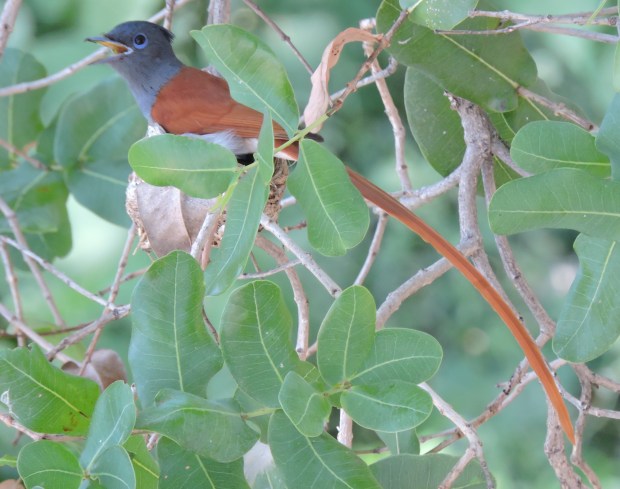
In addition to the birds-fig tree interaction, we (rather my wife again!) spotted a male Paradise flycatcher (Terpsiphone viridis) sitting at a nest within easy photographic reach. I took advantage of the nest’s location and took several pictures at different times during the first day of our visit. During that time, while the male was absent, we noted that there was at least one egg.

0742hs 26-11-15 adult copy

Adult Paradise flycatcher male.

In the evening, as usual, I checked the pictures to select only the best ones to save space in the camera’s memory card. It was while doing this that I noted that all my pictures were of a male bird and, although I re-checked all pictures I confirmed that there was no female! The male bird had the lovely pale blue beak, cere and peri-orbital markings although these were not visible in some of the pictures. I then realized that there were two male birds sharing the task of sitting on the nest: one adult (bright colours) and a sub-adult (duller).

1308hs 25-11-15 young3 copy

The immature Paradise flycatcher sitting on the nest.

As soon as I could I checked the available literature to find out more about what we saw. I confirmed that “cooperative breeding” or when sub-adults assist adults incubating the eggs. This behaviour is quite common among several species of birds[2].

In the case of the Paradise flycatcher, it is believed that the female does most of the night sitting on the eggs and cooperative breeding although “possible” it was still unconfirmed and not been seen![3] Things were getting really interesting now and at that point we decided that the observations were worth reporting to a wider audience.

After some enquiries with bird experts we found an on-line journal in South Africa known as Ornithological Observations where we submitted a short paper that they agreed to publish on 23 February 2016. [4]

Although this could be taken as an isolated observation and a rather anecdotic one, it unequivocally shows the involvement of a second male, showing unequivocally that cooperative breeding in the African Paradise Flycatcher takes place as suspected. It is possible that the young male was from the previous year and assisting the adult male.

No female was observed during the time the observations were carried out. Weather it was alive or not would remain a mystery. However, it cannot be excluded that it could have been at the nest during periods when we were not there or taking care of the incubating during the night.


[1] https://bushsnobinafrica.wordpress.com/2016/01/26/toilets-and-tortoises/

[2] Stacey, P. B. and Koenig, W. D. (1990). Cooperative Breeding in Birds: Long Term

Studies of Ecology and Behaviour. Cambridge University Press. p.636.

[3] Roberts VII Multimedia Birds of Southern Africa iPad Edition, 2012-2013.

[4] http://bo.adu.org.za/content.php?id=202

Not just dinner

Kenya became independent on 12 December 1963 when Kenyatta became its first President and Odinga the Vice President. Not surprisingly, in 1965 Kenyatta and Odinga fell out, and Murumbi (Joe) was named Kenya’s second Vice-President for a few months until he resigned in December 1966[1].

As described before, I became involved with Joe through the work we did with Alan Young on tick and tick-borne diseases. He wholeheartedly supported our work. As with all scientific work, a substantial amount of time was spent writing research proposals in order to get the funds to continue with the research. Once the funding is secured, donors visit your field sites to see for themselves the activities being performed with their funds, the conditions of work, applications, progress, etc. These visits are critical for the future of your investigations and that was the way that they were also understood at the institute I was with. This meant that all should go smoothly and a good performance was expected.

I had several such visits but none as important as the final evaluation of our tick programme in the mid 80’s. Laboratory and field work came under the magnifying glass and, as it is quite normal our results were mixed. My part of the bargain was going well as we had good collaborators and achievable goals. Our partner with the highest profile was of course Joe and, in addition, nature was a great partner. Soon the donors knew that Intona ranch and its surrounding area -including the Maasai Mara- were beautiful areas worth a visit and this was good for us and we used it to our advantage!

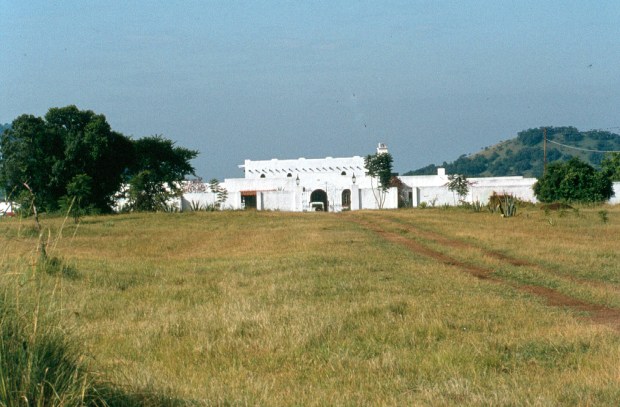
The organization of a “high level” visit needed lot of work as guests would usually fly to the Maasai Mara where I would meet them and look after them until the following morning when we would climb the Oloololo escarpment and drive about three hours to Intona, hoping that the rains were light and we did not get stuck in the various tricky spots we needed to cross and spoil our trip! Usually our journey would take us to the manyatta (Maasai dwelling) of the Maasai Chief to inform him of our visit and to our GTZ collaborators, if applicable. The visit would last two days during which our work was shown and presented and future prospects discussed in detail. We were of course very fortunate that Joe and Sheila (his wife) allowed us to put them up in their magnificent house.
t mara intona ranch j murumbi 1

Joe and Sheila’s house at Intona ranch, Transmara, Kenya

During this particular visit Joe and Sheila were at Intona. They normally flew directly to the ranch, together with their dogs! Aware of the importance of the occasion they kindly offered to organize a dinner for our guests. This was not an everyday event, but I had joined them for dinner a few times before and I knew that it would be a formal occasion with excellent hospitality and very good food.

The day of the visit arrived and I collected our visitors from Kichwa Tembo Camp, located close to the Oloololo escarpment and, after a game drive that they thoroughly enjoyed in the surrounding area of the Maasai Mara
m mara small cropped

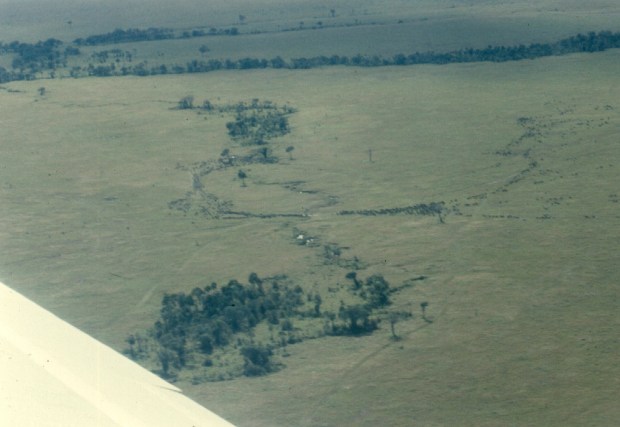
The Wildebeest moving through the reserve.

-that I knew very well- we spent the night there to leave early morning for Intona. The road was good and, once there, we devoted the rest of the day to visit our field activities. They seemed pleased with what they saw. I was also pleased and looking forward to the dinner to close a long day.

The Intona area is under the influence of the near lake Victoria and it frequently rains for a short spell in the afternoons. As a consequence the sun sets in a cloudy sky resulting in the most glorious and colourful sunsets. Aware of this Joe positioned the house in such a way to be able to make the most of them by having a wide west veranda where we congregated often to talk and have a drink before dinner. That day it was no exception and we joined Sheila and Joe for sun downers and polite conversation until Sheila, the perfect hostess and a very experienced one, announced that dinner was ready. While walking to the dining room she came close and whispered: “Julio, we have a new cook that came with us from Nairobi, I hope it will perform as he has excellent recommendations”. Knowing her standards I had no doubts and told her so.
trans mara

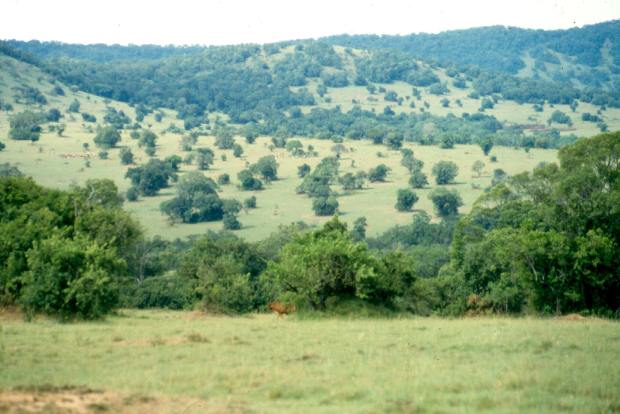
A view of Intona ranch in the Transmara parkland.

The dining room had a door to the kitchen and another one to the enormous and beautifully decorated sitting room. It had the most exquisite antique wooden table and chairs and antique rugs, most probably of Afghan origin, covered its floor. I knew from past dinners that under the rags at the place where Sheila sat there was a bell that she will press in order to call for assistance from the staff. This was her “secret weapon” that enabled her to coordinate things so perfectly that the guests would be amazed. Needless to say that it was a candlelight affair with lots of silverware and crystal!

When the first course came, brought by staff dressed in white with purple fezzes, it was a brownish coloured soup that looked rather disappointing. Trying it did not improve its look: it had a strong curry flavour and it was chilled! “I hope you like our Mulligatawny soup” said Sheila while she gave an approving look to the new cook that was overseeing the dinner from a discreet distance. Your concerns about the soup dissipated the moment your spoon found some submerged resistance that transformed itself in a spoon tip full of cranberry jam. The combination was simply amazing!

After our praise of the soup ended, the staff came back to collect our plates and this time the new cook looked happy and smiley, “the success with the soap was a boost for him” I thought while noting a serious-looking Sheila. By the time the roast beef with Yorkshire pudding and roast potatoes was brought in, the cook was definitely too happy and talking loudly to the visible embarrassment of our hosts. Sheila, used to deal with the highest-ranking world figures, ask to be excused and went to the kitchen, an unusual event. In the meantime, we enjoyed our roast that was really excellent.

Soon, Sheila came back announcing that all was well although she could not hide her concerned expression. We understood her fears the moment the cook opened the door of the kitchen when the staff came to collect the plates. The cook proffered, rather loudly, his hopes that we enjoyed the main course while trying to keep steady. By then we could not help noticing the strong alcohol whiff and knew that the worse had taken place! The spirit meant to go into the cooking had been “diverted”!

Although the guests and Joe were rather amused, Sheila was visibly upset! She excused herself again and went to the kitchen. We could not help overhearing a loud argument or rather Sheila’s shouts! There was a door banged and the sounds of a scuffle. She came back; her usual cool almost lost and red on her face. As an experienced host, she re-gained her composure fast and invited us to move next door to the sitting room for coffee and liquor. I stayed back with her as the guests and Joe moved out and Sheila -unseen by the guests- looked at me as if asking for support and understanding. I made my best “do not worry” gesture and moved to the sitting room together with the guests. She remained behind.

Intona sitting room copy

We all sat in the ornate sitting room and overlooked the cook’s episode, listening to Joe. Although soft spoken, he was a great host and a very engaging story teller with great tales and anecdotes from his many years in politics. We listened for quite a while until more noises coming from the kitchen area hinted that all was still not well and then Sheila reappeared –now with a grimace- to announce that the cook would like to say good bye to the guests! “Oh, no”, I thought, “is the situation that bad!”

The cook appeared escorted by the night watchman and a couple of staff and boisterously said “bye-bye!!!” but did not move and tried to say something but what came was a rather loud burp followed by another “bye-bye!!!” After this performance he was immediately manhandled out of the room, still saying “bye-bye!!!” and waving at us until the door was closed behind the group. I still vividly remember his final wave just before the door was shut! Confronted with this final act, even Joe was briefly embarrassed while the guests and I were quite amused!

The following morning Sheila and Joe were leaving for Nairobi and, as usual, I escorted them to the plane to assist them with their luggage, dogs and other items that they needed to take with them. They were sorry for what had happened. I felt very bad to have put them in this situation and explained them that I was very grateful for their hospitality and, to their obvious relief, I also told them that the donors were very pleased with the work and also very proud to have had the opportunity to have met them and enjoyed their hospitality, including the cook incident.

Before closing the door of the plane I spotted the cook. He was seated at the very back, looking penitent. I could not decide if his rather sombre looks were a consequence of his hangover, Sheila’s morning sermons or a combination of both!

The next time I was invited for dinner at Intona there was a new cook!


[1] See: https://bushsnobinafrica.wordpress.com/joseph-zuzarte-murumbi-1911-1990/ and https://bushsnobinafrica.wordpress.com/2015/06/22/joe-1/ in this blog.

Monkey-ladder

This post was meant to be part of the previous “Up the patience ladder”. However, in my literary incapacity, I failed to link the two in a convincing way. However, I think that the issue of the present post is worth it as my attempt at expanding it enabled me to learn more about Nature and I wish to share it with you!

I am not sure that all of you know about the Monkey-ladder, a vine called Entada gigas, found in Central America, the Caribbean, northern South America, and Africa.

P1130019 copy

A bunch of seeds of the Sea heart, Entada gigas with a wallnut as a comparison.

We first came across its seeds in the Kenya coast where, in the eighties, we collected a couple of these rather interesting kernels among a few stones. They remained stacked away while we stayed in Kenya and Ethiopia, only to resurface in Zambia, after the birth of our daughter. It was a frightening re-discovery.

Somehow our daughter, a toddler at the time, unearthened one of the pods and placed it in her mouth! We thought that her choking was certain but, somehow, we persuaded her -to our relief- to give it back to us. At that time we realized that its size was such that it was impossible either to choke with it or to swallow it! The seeds range in size but they are normally about six centimetres in diameter and about two centimetres thick, far larger than my own throat! So the seed was forgotten and became the favourite teething aid for both of our children! If the seeds are impressive, the pods are even more as they are truly humongous, reaching up to two metres long and twelve centimetres across!

P1130022 copy

The pods are large. Please note that each floor tile is 25cm long. The wallnut also serves as a comparison.

Once out of the pods, the seeds that reach the water are able to float as they have an air bubble inside. They eventually find their way to the oceans and are able to drift very long distance on ocean currents turning up in far off places where they can germinate even when they are two years old!

Our “teething aids” were forgotten and lost again after our children grew up and they would have joined other facts and objects in the recesses of our minds (and house!) if we would not have re-found them again in the beaches of the Maputo Special Reserve, Mozambique, in 2011. There were many and came in different sizes and shapes. Of course, we duly collected a few more! Subsequently we found the actual vine in Maputo and were able to appreciate the pods in situ. Do I need to add that we also collected a couple of pods too?

P1130024 copy

A segment of the pod once it released the seeds that I -before this post- thought gave the name to the plant as they looked like a ladder.

Now we come to the new part of the story. I thought that the name Monkey ladder came from the look of the pods once they release the seeds. However, when looking for an explanation of the name I found another vine known as Monkey ladder! This is Bauhinia guianensis a different plant named in such a way as its flat trunk resembles a true ladder going up to the trees above.

Having found the “true” Monkey ladder, I haste to add that this post has now the wrong title! Entaba gigas should really be known by its other names of Sea bean, Cœur de la Mer or Sea Heart. I prefer the latter as some of the seeds (about fiver per cent) are heart-shaped. In addition, it gives a dreamy touch to the name!


More info:

http://waynesword.palomar.edu/plmay97.htm

https://books.google.co.zw/books?id=8FqmWCAwdsIC&pg=PT602&lpg=PT602&dq=Bauhinia+guianensis+vs+entada+gigas&source=bl&ots=kKUrYFusQG&sig=edrUmPk7P_-RU12paLhUj8kECL0&hl=en&sa=X&ved=0ahUKEwiukqbAyOPKAhUE7B4KHYf4CL8Q6AEIGjAA#v=onepage&q=Bauhinia%20guianensis%20vs%20entada%20gigas&f=false (Please note that you need to scroll down the pages of this book to find the two vines together).


Up the patience ladder

Our acquittance with Vervet monkeys in Harare started with friends telling us that they were lucky to have the frequent visit of a troop of vervets in their garden that they enjoyed very much. We felt mild envy but there was not much we could do. Their house is about one km from ours and located in a less populated and wooded area.

We forgot about monkeys until one day last year when, to our delight, a monkey was spotted in our garden. The original sighting was done by Stephen, our caretaker, and we were soon searching for the primates up our trees.

DSCN8218 copy

Our very first picture of a Vervet monkey in our garden!

DSCN8219 copy

A close-up of the intruder.

Of course, we found them eating our passion fruits, behind our backs! They had climbed the first step of the ladder!

We forgave their sins as they were nice to watch! However, as often happens, soon they reached the second step that consisted of opening dozens of seven-year bean pods only to eat a few of them. This produced a change of mood among the humans of the household and instructions were passed around (by my wife, the serious gardener) that the monkeys should be “discouraged” from being in the garden! The method to be used was left often and it fell on Stephen to decide. As he is, I am afraid, is softer than my wife, I imagine that he only shouted and ran after them!

The monkey caught with the camera trap.

Despite the soft methods employed to keep them at bay, a period of relative calm ensued and we were all happy sharing the garden in harmony. Soon, however, with the progress of the dry season, the monkeys accelerated their climb up the ladder going through the avocados, the guavas and even the tomatoes! This was the situation when we left Harare in late January but we believed that the advent of the rains had re-established acceptable human-monkey interactions but, as usual, we were off the mark…

Yesterday (5 February 2016) we learnt that the “status quo” was broken and that the monkeys had reached the very top of the ladder: they had destroyed the weaver nests killing the fledgelings and they were taking bites from Stephen’s butternuts. The weavers had just moved into the garden this year and the butternuts are highly appreciated for our pasta sauce! This was indeed a very serious escalation and, during the phone conversation between my wife and Stephen I could not help overhearing the exchange of unusually strong adjectives as well as one name: catapult!

I trust that a new equilibrium will be found before there is bloodshed…


Muy Interesante! (Very Interesting!)

I am very pleased and proud as well as most grateful to the “Muy Interesante” publication of Spain that printed a spot on my blog in the Issue printed on 20 January 2016!

To María Victoria Gonzalez Rodríguez, Coordinadora de Contenidos y Comunidad Muyinteresante.es, Coordinadora de Contenidos y Comunidad MuyHistoria.es and
Redactora Mundo-geo.es as well as other colleagues of the “Muy Interesante” printed magazine, many thanks!

blog note en Muy Interesante 20 Jan 2016

Muy only blog.jpg

Translation to English (by Bushsnob).

Julio de Castro, a veterinary parasitologist, former employee of the FAO of the United Nations and traveler, is the author of the blog bushsnobinafrica.wordpress.com. He has lived many years in Africa and now from his retirement in Zimbabwe he has a lot of curious things on his blog, illustrated with nature photos that he himself takes during his excursions.

Among the reasons for having undertaken writing the blog, de Castro cites sharing his knowledge, acquired after many years of working and visiting places of Eastern and Southern Africa, and to know their landscapes, wild nature and people. No reader who likes to dig into these issues should miss this miscellany that brings together memories of past activities, business trips or fun and curious facts about various fields. As a sample it is worth mentioning two recent entries: a family trip to the Mozambique’s coast and a post on the custom of hippos’ group defecation.

***

NB. I can hear (some of) my friends and (both my) children saying “how typical of him” when referring to the end of the spot! Please do not pay any attention and keep reading the blog…

Spot the door…

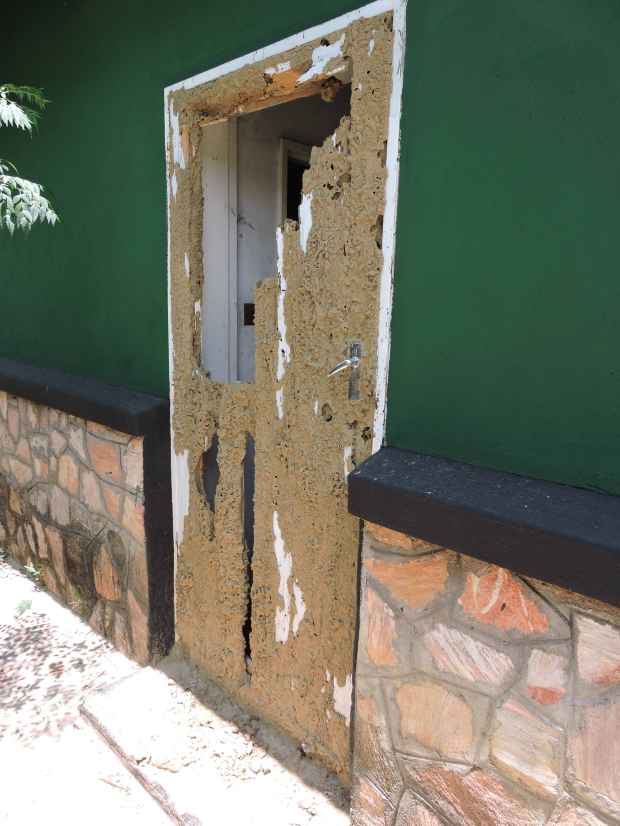
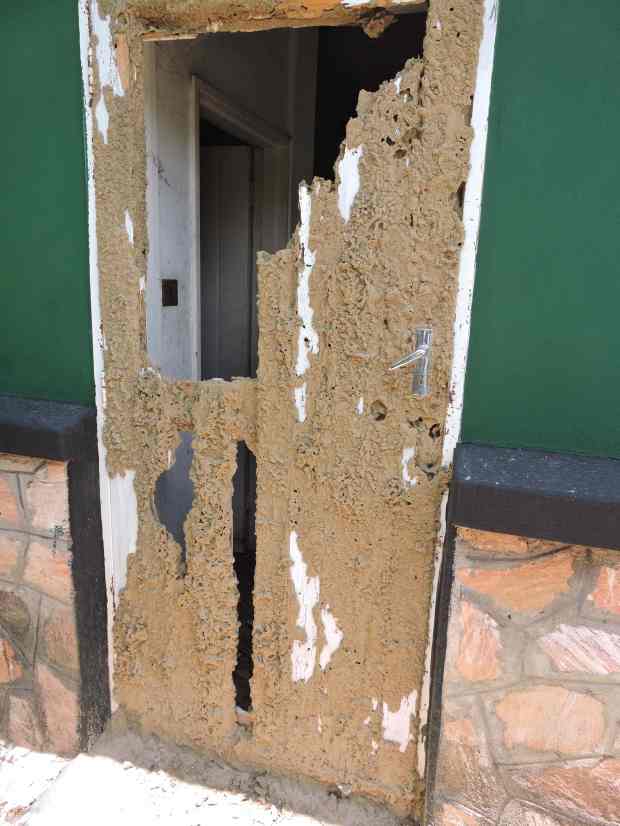
While at Main Camp in Hwange National Park last January, we repeatedly drove through the accommodation exit gate and in front of the door without detecting it until a walk around the camp brought us behind a hedge that was hiding it from “public” view.

An important and well known benefit of termites is that they break down tough vegetable matter, burying dead and decaying trees into new soil. While doing this, they dig tunnels and in so doing they not only bring down wood material but also aerate the soil, increasing soil fertility.

Aware that the door’s days were clearly counted and that it will never open again, I decided that it was worth taking a picture of before the termites finish their job.

You may agree with me that the metal handle is the only sign that behind the really thorough termite work, a door used to be there!

DSCN9977 9.07.07 PM copy

The location of the door made picture-taking difficult so perhaps I am not able to show its real condition.

DSCN9976 9.07.07 PM copy

An attempt at a close-up.