Safari

Bug get together

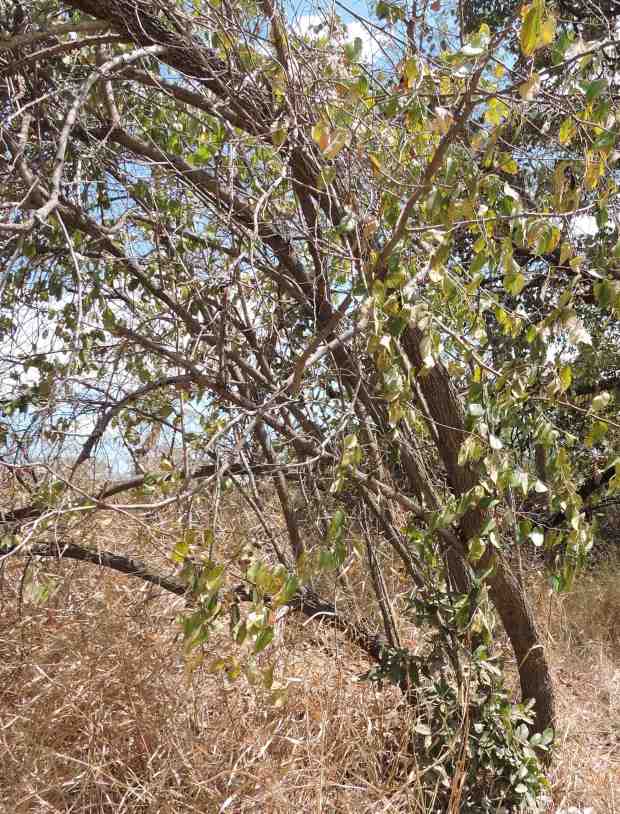
It was during a “pit stop” while returning from Mana Pools National Park to Harare in August when we found an interesting beetle aggregation. As usual, it was my wife who detected the “funny-coloured leaves” on the tree.
dscn9993-4-47-19-pm-copy

The tree where the bug meeting was taking place. The bugs are the darker spots on the right.

We had a good look at the tree and took a few leaves and fruits from it to see if we could identify it. We also took pictures and videos of the insects as it was a really interesting find. Later, after some time we decided that the tree was a Buffalo-thorn, Ziziphus mucronata. Thinking that the finding was interesting, I followed it up and consulted the experts.

I sent pictures to the Biosystematics Division of the Agriculture Research Council-Plant Protection Research Institute in South Africa from where I got a very helpful response the following day! Luckily, they agreed with our tree identification and clarified that the beetle was in fact a bug of the Plataspidae family and not a beetle.

As expected, to positively identify a bug through photographs is not really possible. However, the creatures’ identity was narrowed down to either Brachyplatya testudonigra or B. rubromaculatus. However, more important than the identification was the fact that the bugs were swarming, not a common phenomenon.

Things then turned a bit more scientific when I tried to get more information on swarming and learnt that Sithole and Oelofse (no date) described the rather unusual swarming of the green stink bug, Piezodorus purus. The latter was observed in several areas of the Kruger National Park but their aggregation reached large numbers at the Mooiplaas area where the bugs became a nuisance for the park personnel living there.

I also learnt that there is actually a stink bug considered to be a delicacy! This beast, aptly named the edible stink bug (Encosternum delegorguei) found in northern South Africa and Zimbabwe, does swarm during years that the conditions for such event are right (Stiller, personal communication). If interested, Nelwamondo (2015) gives very interesting information on this species.

Sisterson (no date) mentions insect aggregation in general as a phenomenon that obeys to three main reasons:

  • environment: e.g. low temperature and/or low humidity forcing the bugs to migrate searching for better conditions,
  • mating strategy: it seems that although swarming could be positive by allowing weak females (after debilitating winters) to be able to mate with multiple males, it can also create confusion among active seeking males that would spend energy chasing each other in addition to the females) and,
  • defensive strategy: aposematic[1] insects aggregate. It is believed that they do so to become more obvious and, in this way, better deter predators.

The aggregation pheromone is responsible for this behaviour that, although it can be used in pest control it can also have deleterious effects on some attractive insects such as butterflies as their aggregation sites get degraded with the risk of their number diminishing below critical levels.

The behaviour observed in the Green Milkweed locusts (Phymateus viridipes) reported earlier in this blog[2] was probably migratory as they were not feeding on the cacti. However, feeding is another reason for insect aggregation. Stiller (personal communication) mentioned that he has observed leafhoppers swarm on the trunks of trees, that are probably their feeding plants and the pest Bagrada hilaris, can occur in very large numbers on feeding plants.

The introduction of the bean plataspid, Megacopta cribraria, into the United States in October 2009 has attracted considerable research on this bug as it has become a pest of soybean in Georgia and South Carolina (Poplin and Hodges, 2015). These researchers mention the overwintering congregation of the bugs on buildings as a possible nuisance, a similar situation as the one described above that took place in the Kruger National Park.

It is interesting how a rather casual observation of a cup of coffee stop during a road trip could develop into a motivating investigation on the aggregation behaviour of insects. Of course, after all the reading and writing, I still do not know the exact nature of the bug but I learnt something about the biology of the plataspids, a group of insects I totally ignored.

Acknowledgements.

The assistance of Elizabeth Grobbelaar and Michael Stiller of the Agriculture Research Council-Plant Protection Research Institute of South Africa was critical in checking the identity of the bugs.

References

Nelwamondo, V. (2015). Edible stinkbug. SANBI – Zoology systematics. Accessed on 15 October 2016. http://www.sanbi.org/creature/edible-stinkbug

Poplin, A. and Hodges, A. (2015) Bean Plataspid: Megacopta cribraria (Fabricius) (Insecta: Hemiptera: Heteroptera: Plataspidae). Document EENY527, Department of Entomology and Nematology; UF/IFAS Extension, USA.

Sithole, H. and Oelofse, J. (no date). Accessed on 15 October 2016. https://www.sanparks.org/docs/parks_kruger/conservation/scientific/interesting_facts/mooiplaas_insect_oubreaks_2006.pdf)

Sisterson, M. (no date). Insect Aggregations; The Phenomena Itself, Why It Occurs, And Its Implications To Us. Accessed: 15 Oct 2016. http://www.earthlife.net/insects/aggregat.html


[1] brightly coloured and/or toxic insects

[2] https://bushsnobinafrica.wordpress.com/2016/01/31/spot-the-beasts/
Doomed bug

In the evening, after returning from a game drive, the traditional endeavor is to have a shower, taking advantage of the excellent facilities that exist in all camps at the Kruger National Park. I, as usual the gentleman, let my wife go first while I kept busy selecting the best pictures to free some valuable memory card space in the always full camera.

That evening at Satara Rest Camp my wife praised the shower quality so, as soon as I was done with the pictures, I hastily took my turn. It was an experience I was not ready for. No amount of tap opening would produce hot water and a cold shower has never been in my agenda, not even in the hottest deserts! Swearing at the new solar power water-heating technology, I aborted the mission and put back my dirty clothes. As usual, my wife overlooked this hazard while -I am sure- suppressing yet another chuckle…

Those who had shared safaris with me would not be fussed about this kind of event taking place. “I have had a good dust shower during the game drive and, after all, animals roll themselves in the dust for a reason!” I was reasoning with myself when my wife called me for dinner. Confronted with her usually outstanding delicacies, I soon forgot about my dusty condition and, after enjoying the meal, my frustration rapidly faded and soon it was time to sleep.

Without thinking clearly, the following morning I went straight into the shower convinced that the (solar!) water heater should have recovered during the night. After a while of running cold water I remembered that the night sun only shines much further North and only at certain times of the year! Hearing my resumed loud protestations my wife intervened and informed me, rather casually, that for some reason in this shower the hot water tap was on the right hand side!

Feeling rather stupid I tried opening the other tap and hot water immediately gushed out and I had a great shower during which I voiced all my conceivable praise for solar water heaters…

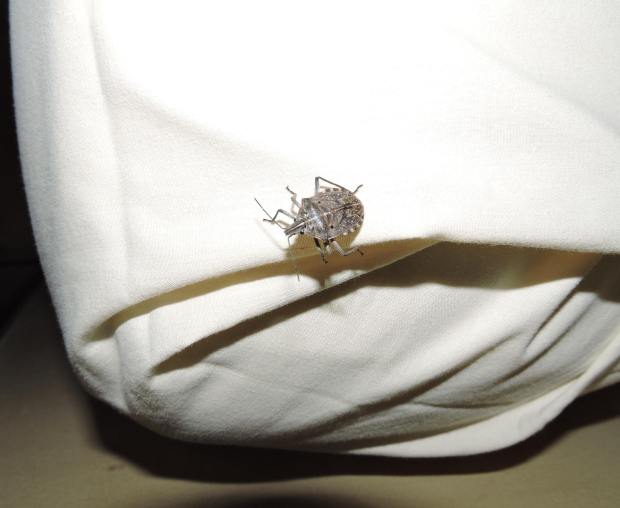
The story, however, does not end there. Before leaving the bed to go into the shower, I smelled something really unpleasant in my bed. Thinking that it was probably the residual effect of my unwashed status, I did not know the truth until I returned to the bedroom to dress up, and spotted a rather large stink bug crawling out of the sheets!

dscn9929-copy

First sighting of the bug.

Although I do not know what took place during the night while I shared my sleep with the invertebrate, the latter was in poor condition and it sadly died a few minutes later! Luckily I managed to record its last living minutes so that I can show them to you.

There was no doubt in my mind that overnighting with me in my “showerless” status had taken care of it!

img_2261-copy

Unfazed by the temporary bug relationship, the bushsnob, sporting at least a clean shirt continued with his activities.

Environment panacea?

While in Kruger National Park we stopped at the Nkhulu picnic site in the Southern part of the park to have a break and stretch our legs. The place is adjacent to a small river that was still having some water. This fact made the place attractive for birds and mammals alike.

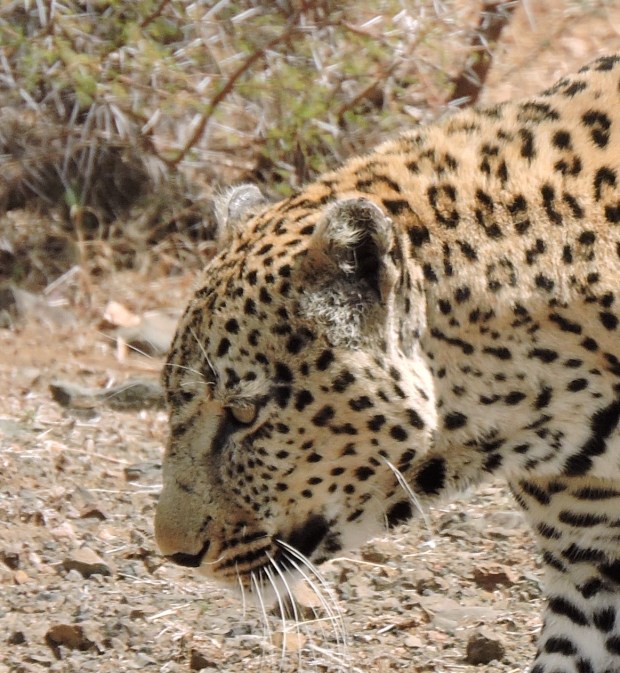
As soon as we walked in we noticed great excitement as people were congregated by the river edge watching the opposite margin. We soon discovered the reason for such a hoo-ha: a pair of leopards were having a stroll! We postponed our coffee for a while and watched the magnificent animals until they moved off into the thicket. Now, that is an arrival!

We did have our coffee among the excitement that gradually faded but that was somehow renewed every time we were raided by the baboons that were also numerous in the site and a pest throughout the park nowadays. After a while of fending off monkeys and with the image of the leopards still in our minds, it was time to resume our drive so we returned to the car park. Another surprise awaited us.

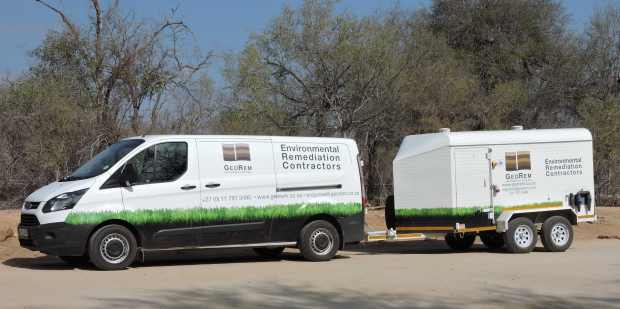
A car offering “Environmental Remediation” was parked near ours. My first thought was that the Park authorities had already sought a solution to prevent the future problems that the Park would face because of the drought. The knowledge that such an alternative existed made me also forget my concerns about the future of the world while realizing that I had been wrong all along!

dscn9944-6-59-52-pm-copy

Regrettably and almost immediately my common sense brought me down to earth on that to clean up the latter we need more than that! As I have seen septic tank-emptying tankers labeled under some weird names such as “Honey sucker” I thought that it was probably another one. In any case, I soon forgot about the unusual find!

Once at home, I Googled the company and, to set the record straight, they define their activities as: “… a specialist environmental contracting service, providing assistance to consultants and industry in the monitoring, management and remediation of contaminated land and water throughout the African Continent.”[1]

So, they would not be able to solve the earth’s environmental degradation but I am sure that they provide useful services in their field.


[1] See: http://www.georem.co.za/index.html


Spot the beast 12

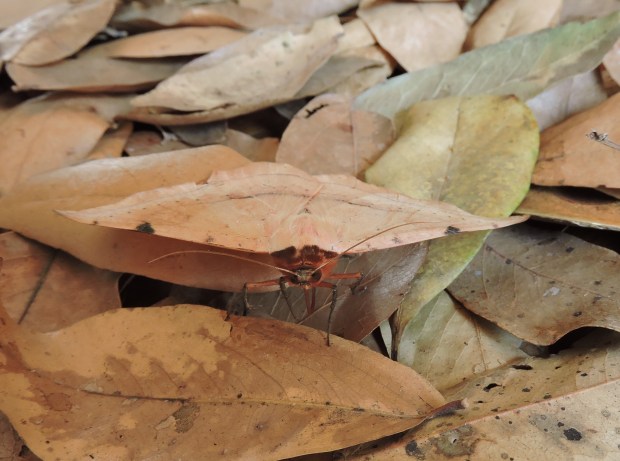
I was not planning to blog today, Sunday. However, there are no rest days for Nature so I found this creature in the garden and took a picture for you to find it. This time it is not very difficult…

scn9945-copy-2I am sure that you spotted it but, just in case I give you a close-up.
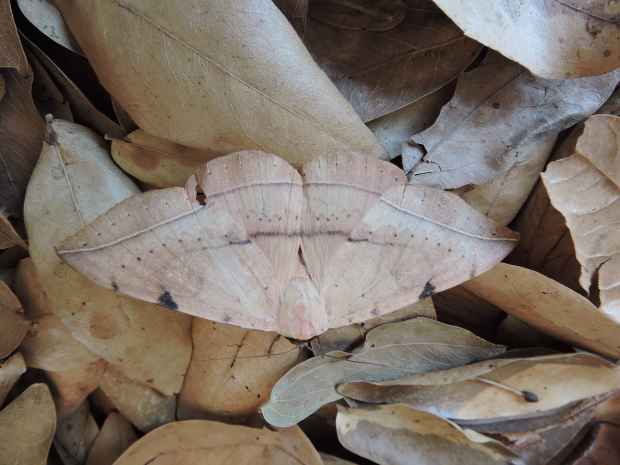
scn9948-copyIt is (I believe) a Red Tail moth (Hypopyra capensis), a common moth of Southern Africa that has a cryptic upperside that blends very well with dead leaves this time of the year.
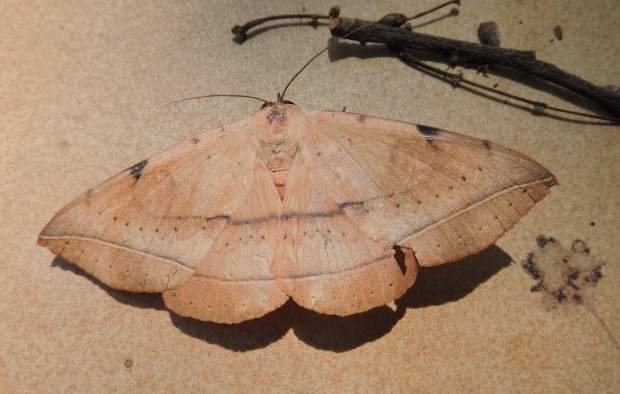
Its under-wings and abdomen, however, are bright orange-red hence its common name.

scn9944-copy

As I try not to handle them, I thought I would not able to show you its underside as it flew away. Luckily it decided to land on the floor of the patio for a while where I could photograph it under direct sunshine and the underside colour can be seen, even from above!

scn9951-copy

The larvae of this beautiful large moth of about 70mm wingspan feed on false-thorn (Albizia) and its range goes up to equatorial Africa.[1]


[1] Picker, M., Griffiths, C., and Weaving, A. (2004). Field Guide to Insects of South Africa. Struik Nature. pp366.


Predators’ Eden

Having stressed the negative consequences of a drought like the one the Kruger National Park is going through in the previous post (3/10/16) it is now the time to mention one of the positive aspects of this situation for the game-spotter.

The lack of grass transformed the thicket into a very dry wooded savannah. In addition, the riverine areas that usually offer some cover to herbivores were now denuded from a lot of the vegetation so there was a lot of visibility. Most animals were near the river as most need to drink regularly so most of the “action” took place there.

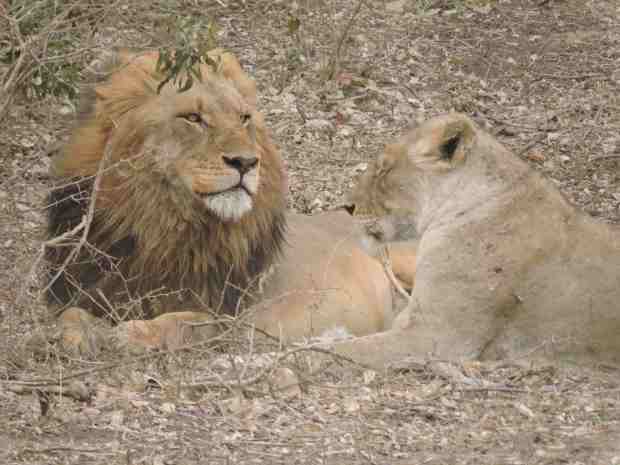
Even without the assistance of the existing apps[1] we were able to find lions and leopards in numbers that are usually unthinkable, even for my wife.  11 September 2016 will go down in our bush lore as the day of the cats! In the morning, during a 20 km drive we spotted three different groups of lions, two separate leopards on trees and two walking by the river! We almost did not stop when we found a hyena walking by the road! As if this would not have been enough, after (my) siesta time, we revisited the nearby causeway over the Lower Sabie River to see if anything remained of the zebra being fed on by crocodiles of the day before.[2]

We crossed the bridge but found no trace of the zebra. As usual, there were a few cars on the bridge so we decided to turn around and, after re-crossing the bridge, to do a short drive following the river to enjoy the evening. By the time I had turned the car around all other vehicles had gone and we were on the bridge on our own, a rare occurrence.

As the bridge is narrow, I was paying attention to my driving when, just before ending our crossing, I heard my wife saying, “Look!” A leopard had just appeared out of nowhere on the shore of the river. I switched off the engine and we both grabbed cameras and took the pictures we could as the animal did not stop much and never took notice of our presence while it crossed the bridge just in front of us!

dscn9899-copy

The first picture of the leopard.

It was a large male and its right hind leg was apparently painful as it was limping.

dscn9902-copy

The sighting did not last more than three minutes and, by the time a few vehicles arrived to the bridge (that we were totally blocking), the leopard had moved off and it was hardly visible, although it had been spotted by others! I decided to move on and “share” our find only to realize that the car was dead! Suspecting a disconnected battery terminal I got out of the car to fix it. Although it did not take much time to get the car running again, by the time we moved off, the leopard had already disappeared and I was probably the least popular driver in the park!

Although the 11th was our most productive day, over the next couple of days we continued to find predators. We also continued to have problems with our battery! So, when I needed to get out of the car to fix it next to a group of lions, we decided that it was time to take the car to Skukuza for a long-lasting solution! This we got from one the very helpful camp mechanics that, with the right spanner, tightened the nuts and ended the problem for good.

dscn9920-7-29-26-pm-copy

Luckily the lions were more interested in their romance than in the bushsnob fixing the battery!

Feeling now safer, on the way back to Lower Sabie Camp my wife (who else?), continued to excel and spotted more cats! The first sighting took place after we both noticed a few vultures on the ground by the Lower Sabie River. While I was watching them my wife noted that the cause was a buffalo kill where two magnificent male lions were feeding! Frankly, I would not have seen them.


As road speed limits and gate closing times in the park are very strict, we decided that we needed to start our journey back to arrive to our camp in time. Our planned timely arrival only lasted a few kilometres, until my wife spotted yet another leopard!

dscn9948-copy

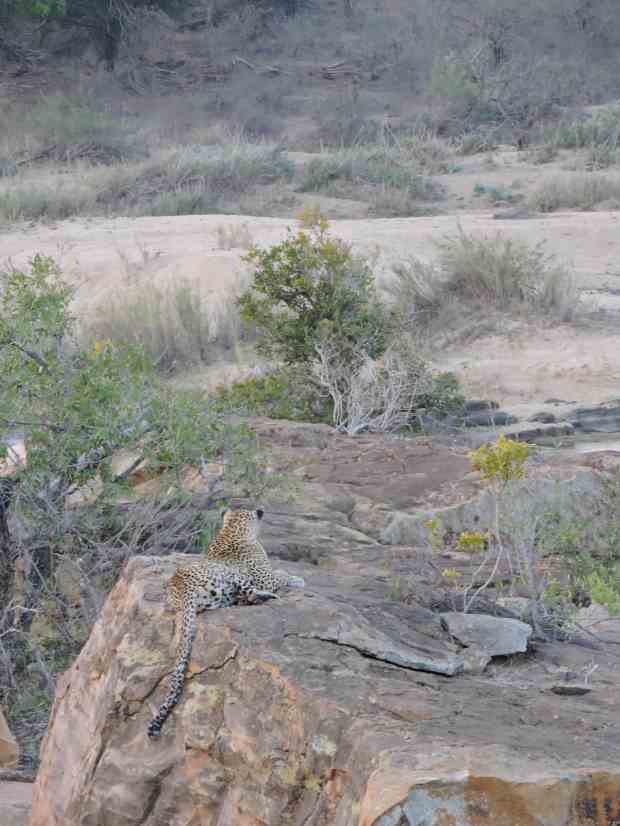
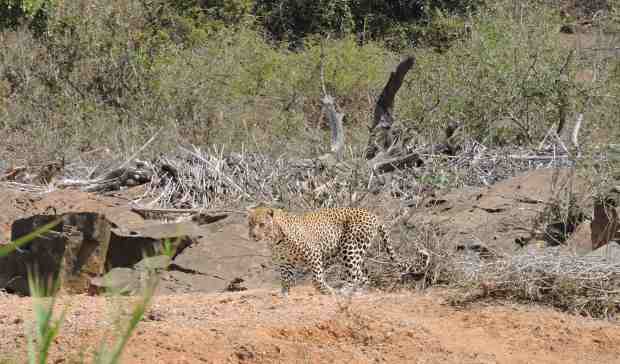
This time it was a female sunning itself on a rocky outcrop overlooking the river. A beautiful sight worth risking a fine from the park as we both agreed. It was beautiful to watch the animal with the evening light and we stayed there until it decided to move off and we lost it.

Aware that we were late, we prepared our usual excuse of engine malfunction (this time it was quite close to the truth!) and returned. Luckily we just managed to squeeze through as the gates were being shut!

That night, staying at one of Lower Sabie’s tents paid off. Despite the rather sad absence of hippo grunts, the elephants were noisily feeding nearby and they were very vocal. Later, several lions started roaring up and down river, their loud calls amplified at night and the chorus continued well into the night. At some stage, a leopard joined in with its own regular grunts ending in an amazing ensemble that we do not recall having heard before. We were late sleeping as did not wish to miss the wild concert!


[1] See the earlier post: https://bushsnobinafrica.wordpress.com/2016/09/30/animal-go/

[2] See: https://bushsnobinafrica.wordpress.com/2016/09/16/hungry-crocodiles/

Hippo drama

The drought that Southern Africa is experiencing this year was evident already during our visit to Mana Pools in September. Despite the Zambezi River providing sufficient water, grazing was the main issue as the riverine pastures were very low and the patches of green left were those that are inedible.

Browsers and grazer/browsers were still in good shape but large grazers such as hippos and buffalos were already walking longer distances to get to areas that still had grass cover and these were dwindling fast. The hippos’ normal timetable was visibly altered as we “bumped” on several walking far from the water during the mornings and afternoons when, during normal years, they are in the water or sunning themselves by it.

Despite the Mana Pools “warning” the situation we found in the Kruger National Park (KNP) -Lower Sabie and Satara areas- was worse than expected. According to Swemmer (2016)[1] rainfall at Phalaborwa, one of the KNP’s camps, during 2014-15 was 255mm (the long-term average being 533mm) and the 2015-16 figures are extremely low. Two consecutive years of very low rain, combined with very high temperatures is regarded as rare and extreme. It is even likely that this drought will be the most severe since records started to be collected in 1954!

Different views of a very dry KNP (pictures by Mabel de Castro).

The consequences are there for all to see!

In the dry season the park usually has reasonable grass cover. This year there was almost no grass to be seen! The consequences of this could be immediately seen as few live hippos remained in the Lower Sabie River and the nearby Sunset dam. The ones we found looked rather strange and rather long-legged as their normally bulging bellies had shrunk enhancing their legs’ length! In addition, their skin hanged in folds, a consequence of their loss in body condition.

I regret that some of the pictures are disturbing but I need to show what was taking place.

We also noticed that the hippos did not move much and grazed on whatever they would find near the water bodies. As grass was scanty, they would just gradually weaken and die. Buffalo were also having a rough time and we only saw small groups looking thin. Interestingly, in some areas, both hippos and buffalo were doing better.

It is clear that the drought will have a severe impact on the animal population of the park but also on the vegetation cover as we also saw dry or drying trees that were also damaged by elephants searching for their own food. The re-establishment of grass, shrubs and trees will probably take years. The same applies to the animal populations that may not reach previous levels if the observed drier conditions become the norm in the future. In addition the drought will also accelerate soil erosion and modify the watercourses and other water bodies. Interestingly and somehow alarmingly, this is the first time that no Mopane worms have been recorded since surveys began in 2009 (Swemmer, 2016).

Trying to be optimistic about the future, it is possible that the current dry spell will have some beneficial impact by fine-tunning the situation to a future drier climate by reducing the herbivore populations while allowing vegetation to recover and, in a longer term, prevent overgrazing and environmental degradation.

Independently of the various possible interpretations of the impact of the drought on the environment, it is clear that even if the rains would come now, more animals will surely die before food becomes available. These are the ways of Nature, again.


[1] Swemmer, T. (2016). The Lowveld’s worst drought in 33 years? Understanding the long-term impacts. Consulted on 2/10/16. http://www.saeon.ac.za/enewsletter/archives/2016/february2016/doc02


Animal GO

I guess that the use of apps in African game parks was unavoidable as I am sure these already exist in parks in the “developed” world. Well, they have now arrived to the delight of the bush snobs (please note the space between the words) and bush executives that, not happy with looking at the sighting boards in the South Africa’s National Parks lodges and camps, required something more efficient.

A couple of years back I got the first indication that times were changing when a friend gave me -for my birthday- the app for Roberts VII Multimedia Birds of Southern Africa iPad Edition, 2012-2013. Although I have misgivings about using a tablet for bird identification rather than my loyal Sassol guide, I tried it. The result is that the Sassol guide is collecting dust in a recess of the car!

img_2990-copy

I have to announce that the same did not happen with the newish apps that -like with Pokemons- show you where the animals are so that you do not waste your valuable time driving around and can go to the hot spots straight away while the normal (or now abnormal?) game viewing enthusiasts “sweat the fat drop” (as we say in Spanish) to find interesting animals!

On a previous visit to the Kruger National Park I had heard that visitors were communicating interesting finds among them through a cellphone system. So, this time I searched the apps store and found a few and even some free. I downloaded one that looked popular called “Kruger Sightings” before our visit to this park.

The app is very straightforward to use and its information comes from what the users themselves feed in. After entering the park you are visiting and the kind of animals you wish to see, the programme will give you live updates with details of what is being found, where and other details of the sighting. It reminded me of a similar app from Brazil where users enter information regarding the location of speed traps and Police check points so that motorists can avoid them!

We followed the information it provided and easily found several other people watching what was alleged to be there! A leopard was the animal to be watched at the time and, after a long wait, we managed to progress through the traffic jam until we saw some spots up a tree!

After that first experience, we switched off the app for the rest of the safari. However, many visitors seemed to be using this and/or another similar app. We observed them drive from sighting 1 to sighting 2 at the maximum allowed speed and, as with our first trial, we found them “en masse” at the different locations where animals were supposed to be! I imagine that they did not wish to waste their lunch or dinner times?

Luckily for us and other “purists”, every cloud has a silver lining! The producers of the apps had, unintentionally given the no users a great advantage. The app groups its followers around a few of the big five, mainly lion and leopard, leaving the rest of the park for us to drive around in relative solitude and being able to find animals without cars around them. Luckily, with patience, luck and good eyesight, we managed a few good sightings of our own. Of course, our they remained incognito!

I promised myself only to use this kind of apps the day I become so important that I need to jet to parks with a few hours to spare and wish to impress some important client. I think that there is no fear of this so our game spotting will continue to be done the hard way!

The future worries me though. Rocket science is not required to see the gradual decline in animal numbers that elaborate and costly surveys and studies will confirm three years from now, three years too late to take any meaningful action! I know this sounds negative but it is what we observe.

Regrettably, the present generations had not really seen how it was, as I did not see how it was either but I guess it was better than what I saw!


See also: https://bushsnobinafrica.wordpress.com/2016/08/08/pachyderm-go/


Daring parents

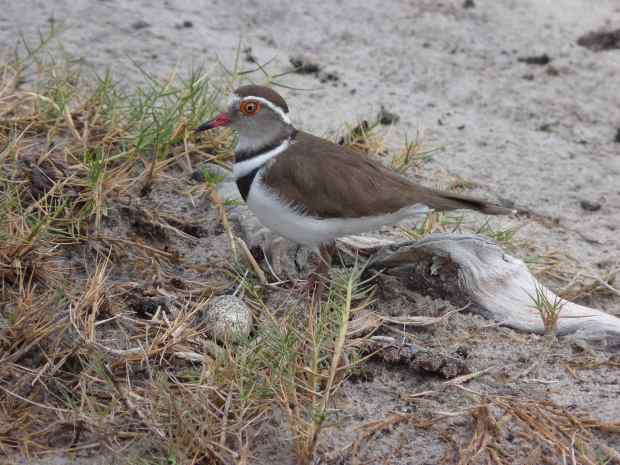
It seems that the Three-banded plover (Charadrius tricollaris) has a knack for living dangerously or rather incubating dangerously.

I rarely find ground birds’ nests. In fact, I have only found two so far and both belong to this little plover!

The first nest I found was at the Maputo Special Reserve in 2011 near Milibangalala while driving through a stretch of road between the woodlands and one of the swampy areas. There, by the shore and almost on the road, we noted the nest as the bird stayed on its eggs up to the last minute until we almost drove upon it and only then it moved a couple of meters to wait for the danger to pass so that it could return.

p1010653-three-banded-plover-11-10-37-am-copy

The first nest in Mozambique.

We spotted two eggs (the normal number) rather large for the bird’s size that looked very much like round pebbles and melted very well with the ashy background.

We found our second nesting bird at Mana Pools this past August and I have already given an advance of it at an earlier post[1]. This time the nest was about one kilometre from the Zambezi River but probably nearer some of the pools. As with the nest in Mozambique, the bird would run off a couple of metres away when we drove past and return to the nest soon afterwards.

Again, there was no nest to speak of and the two dark grey eggs had been laid on the ground in a small area of about 7-8 cm across, among some stones at the very edge of the road. After watching the nest for a while we noted that there were two birds taking turns to sit on it. As soon as its shift was over, the relieved bird did not stay and flew off, probably to feed and drink although we did not see where it went.

Although the birds sat on the eggs, they were also seen standing over them as if shading them from the direct solar heat. At some stage we observed the absence of both birds for a few hours and became concerned that we or other cars passing had disturbed them. The following day we saw them back. In the absence of the birds the eggs are extremely difficult to spot among all the small stones.

It appears unlikely that such a seemingly unsafe choice of nesting site would be successful as the eggs were completely exposed in the absence of the birds. Further, the birds themselves do not seem to offer much protection to the many predators, scaly, feathered and hairy that roam around the area, not to mention the stones thrown by passing cars. Despite these apparently large odds against them, the strategy must work as they are fairly common!

As a note of interest, searching the web I found an account of this bird’s nesting habits in Eritrea written by Stephanie Tyler while she and her husband -Lindsay- were kidnapped by guerrillas in the north-east of the country [2]. Her interest on the birds and the observations she made while being held captive are remarkable. She also stresses the bird’s tolerance to the approach of humans, their failures with the incubation and rearing of the chicks as well as the first observation that the Three-banded plovers are multiple brooded or able to raise more than one brood of young in quick succession. We can say that Three-banded plovers are tough parents!

A video that shows the nesting behaviour of the birds and the “change over” their nesting duties.


[1] See: https://bushsnobinafrica.wordpress.com/2016/09/09/spot-the-beast-12/

[2] Tyler, S. (1978). Observations on the nesting of the three-banded plover Charadrius tricollaris. Scopus 2, 39-41. If interested on the details, the original communication is here: https://archive.org/stream/scopus2197east/scopus2197east_djvu.txt 


Nature’s design fault?

Last year, we noted that one of our calves in Salta, Argentina, was grazing on its knees. So I -being a veterinarian- was asked what was wrong with it. I had no clue so I diagnosed it as suffering from the “Warthog Syndrome” as it reminded me of the African pigs. It was only a few days later that my wife realized the origin of the “condition”. The calf got used to kneel down to be able to graze further while tied to a stake! It soon recovered but by then the warthogs’ feeding technique had already sparked my curiosity.

dscn9994-copy

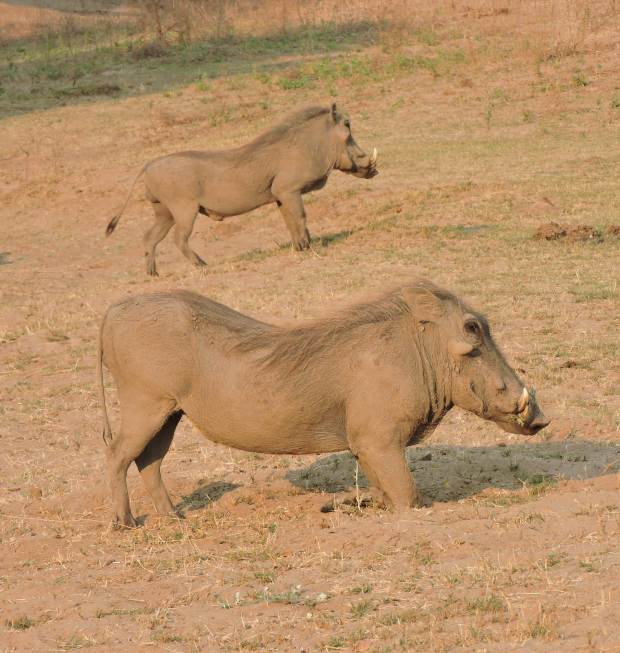
After some thought I decided that warthogs suffer from a rare Nature’s design fault: their neck is too short to reach the ground hence the need to genuflect to feed! As this was a rather strong conclusion, I decided to follow up and “Google” it.

I read that warthogs graze but also dig bulbs and tubers during the dry season. They do this on its calloused and padded knees using its snout and tusks. They have extremely short necks and their limbs are somewhat long so, assuming this position helps them root and graze more efficiently. However, warthogs are often more susceptible to predator attacks when they adopt these vulnerable feeding stances!

Still unconvinced I dug deeper and consulted the well known and knowledgeable zoologist Jonathan Kingdom[1]. He explains that warthogs have rather long legs that enables them to run faster than other pig species and this increased the distance of the mouth to the ground hence the need for kneeling to feed as it has not evolved an elongated snout! I quote: “Kneeling is an in-born behaviour pattern as even new-born piglets kneel to feed. However, it is not only the behaviour that is in-born, because the callosities characteristic of the carpal joints of the warthog’s forelegs are present on embryos”.

I was now confused as I could not understand the difference between having a short neck or longer than needed legs! Further, it appears that warthogs evolved longer legs to run fast but compromised their safety by feeding on their knees running the risk of not seeing their predators!

Desperate to find an explanation, I looked into the African wisdom and found a traditional Zulu story on the subject. It says that at some stage the warthog was inside its burrow when a lion approached it and, when the latter roared, the trembling warthog knelt down to beg the lion not to eat it! The lion had already fed and forgave the warthog. However, it told the pig to stay on its knees forever. That is the reason that it eats with its bottom up and its nose in the dust!

So, having checked general information, science and folklore I am still convinced that the warthog is the casualty of a design fault by Mother Nature!


[1] Kingdom, J. (1982). East African Mammals: An Atlas of Evolution in Africa, Vol. 3, Part B. The University of Chicago Press.

Spot the beast 11

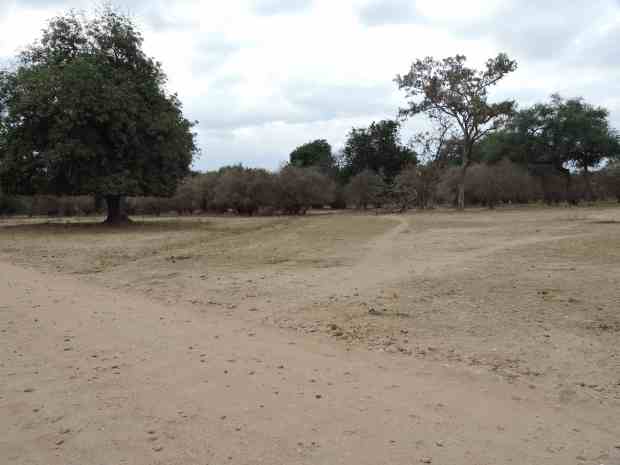
dscn9951-copyI know, this is a difficult one. I give you a closer view below to see if you can spot it…
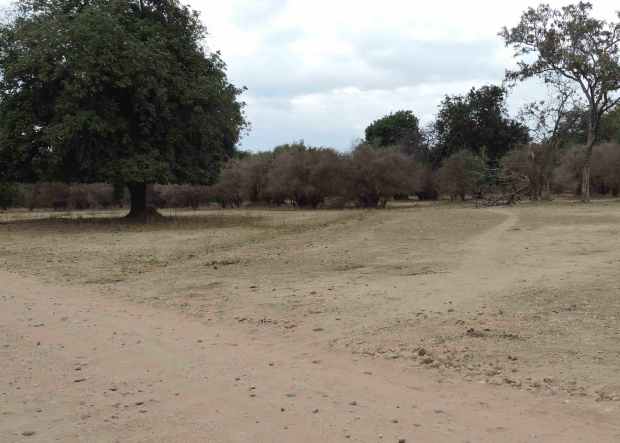
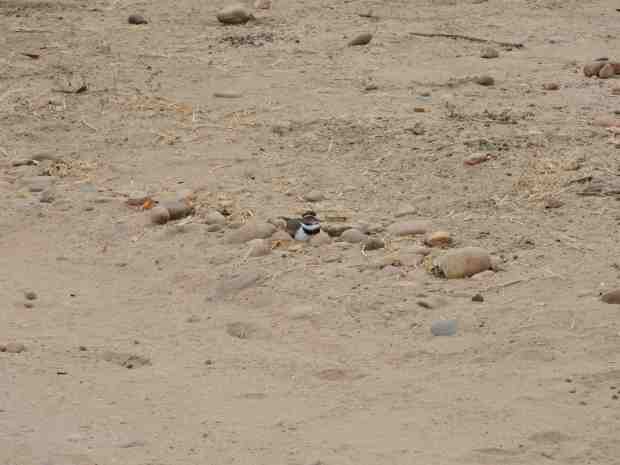
dscn9951-copy-3Still, all you can see are the two bush tracks joining , dust and trees? What about below?
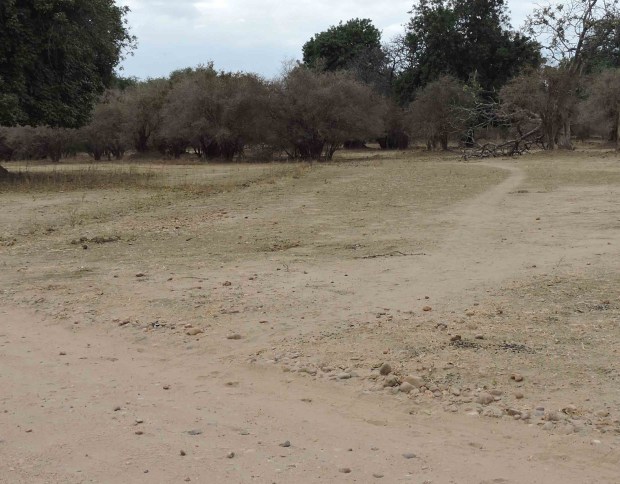
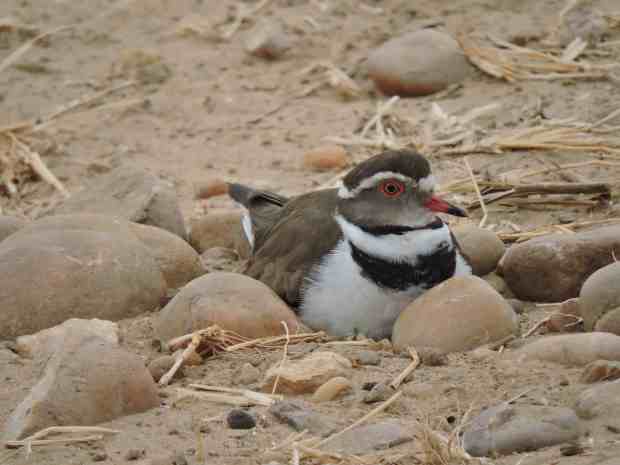
dscn9951-copy-2You should be able to spot it but here it is:
dscn9952-copy

dscn9950-copy

A Three-banded lapwing (plover) sitting on its nest and quite well camouflaged. I will expand on this finding on a future post.