Butterflies

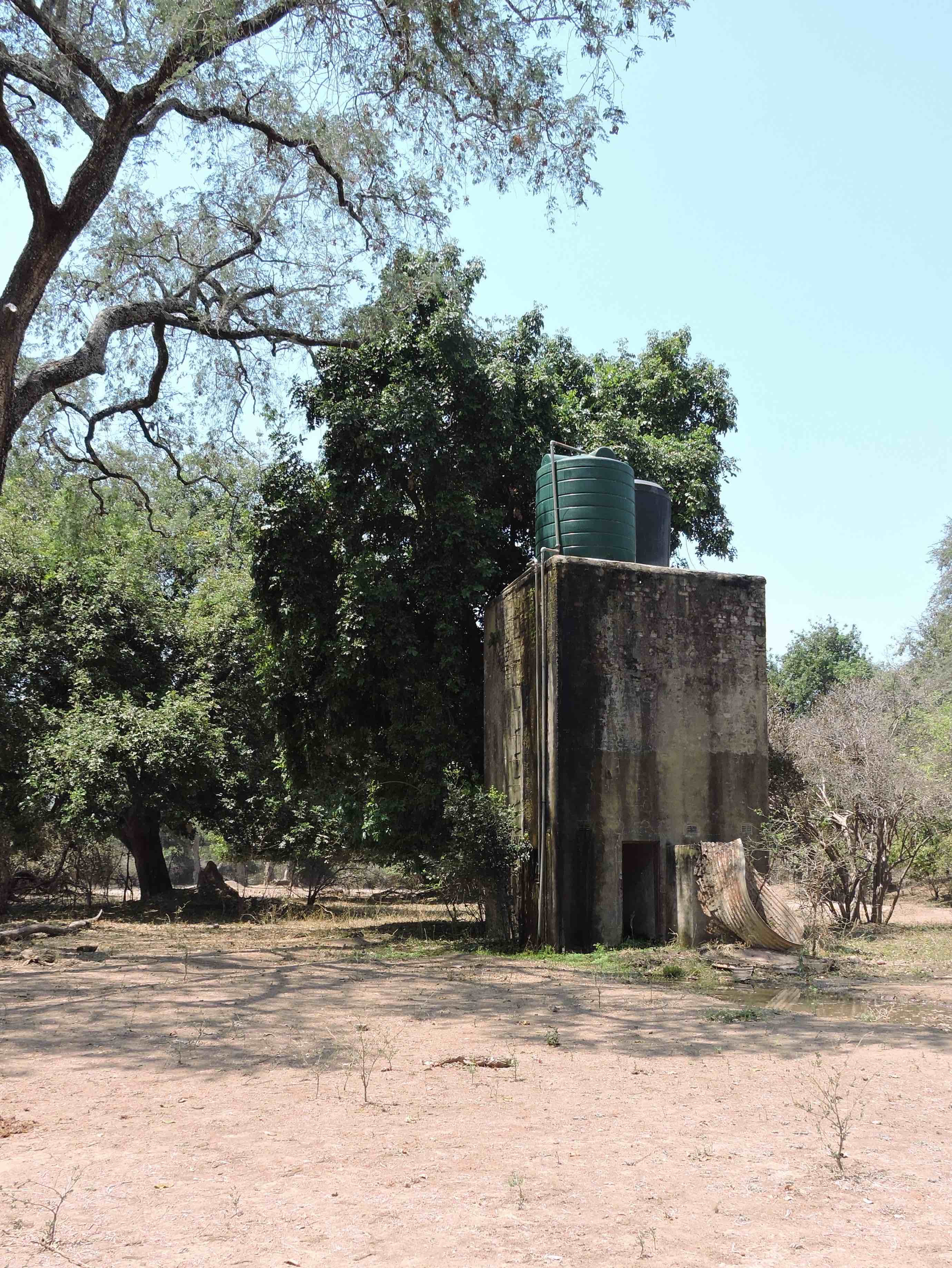
During our previous visit to Mana Pools in September[1] we stayed at Gwaya camp. In one of the walks around camp I found a rather derelict water tower that still supplied us with this important liquid. A leaking water tank sat over a square and now door less room. The latter and the surrounding area were very damp on account of the long-term water leakages that run down its walls ending up feeding a number of puddles where animals came for a drink. The area was a green blotch on an otherwise bone dry landscape.

The water tower.

The water tower.

It was near to this spot that my hidden camera trap almost remained secret for good as buffalo and lions moved in[2]. At that time, with my attention focused on recovering the camera I had a brief look inside the base of the tower expecting to find bats. I found butterflies instead but did not spend time there, as I was more concerned about avoiding lions and/or buffaloes!

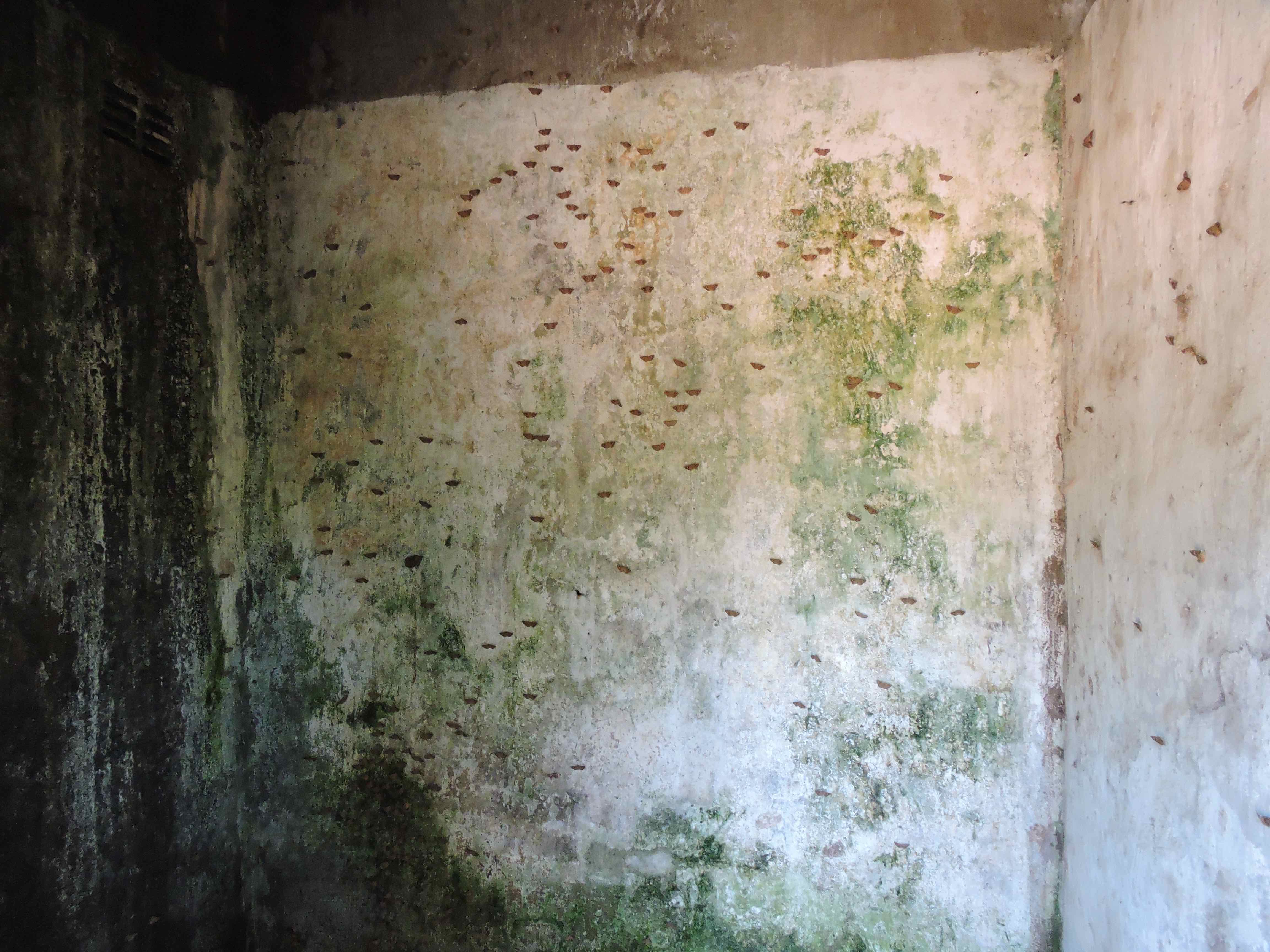
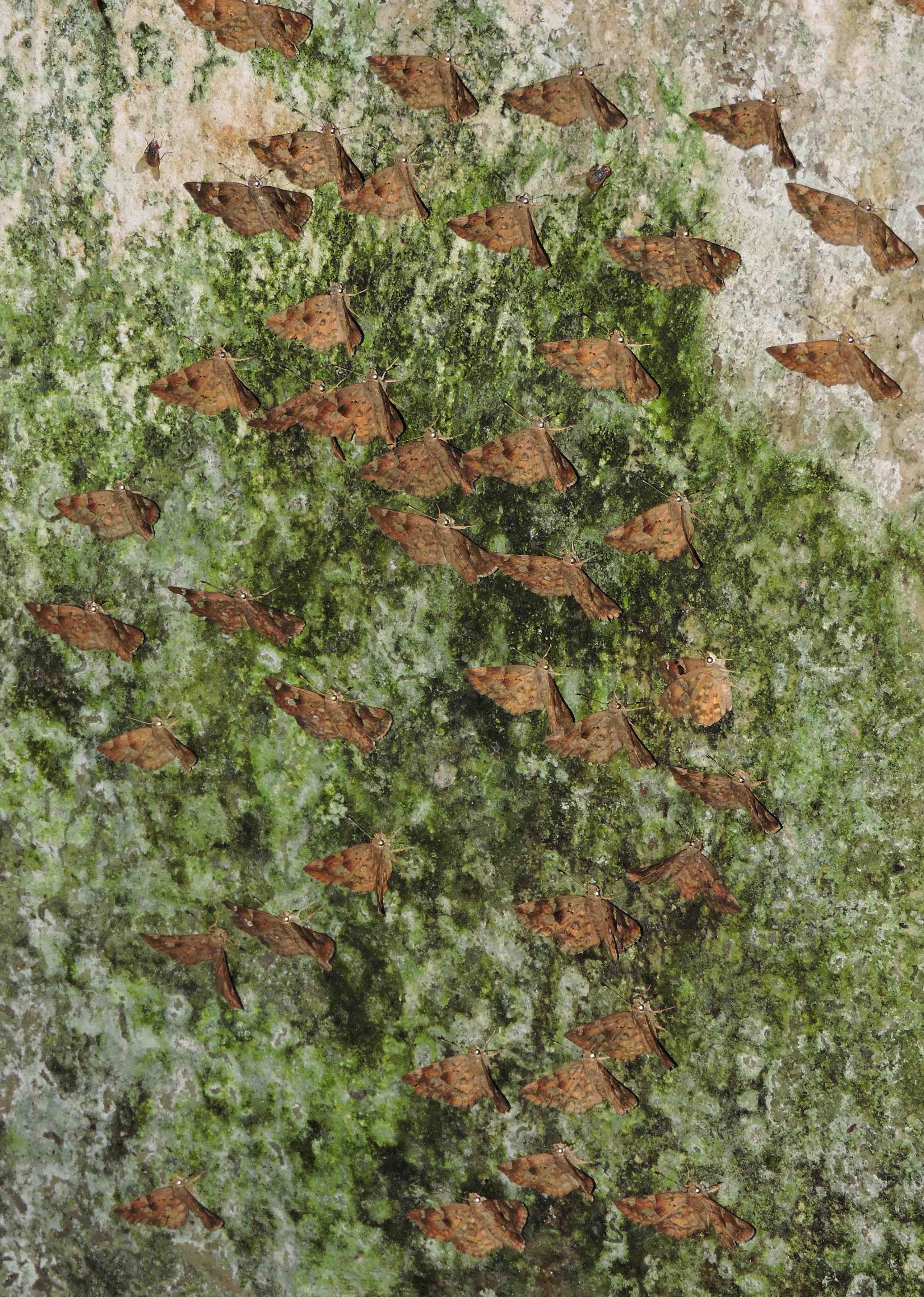
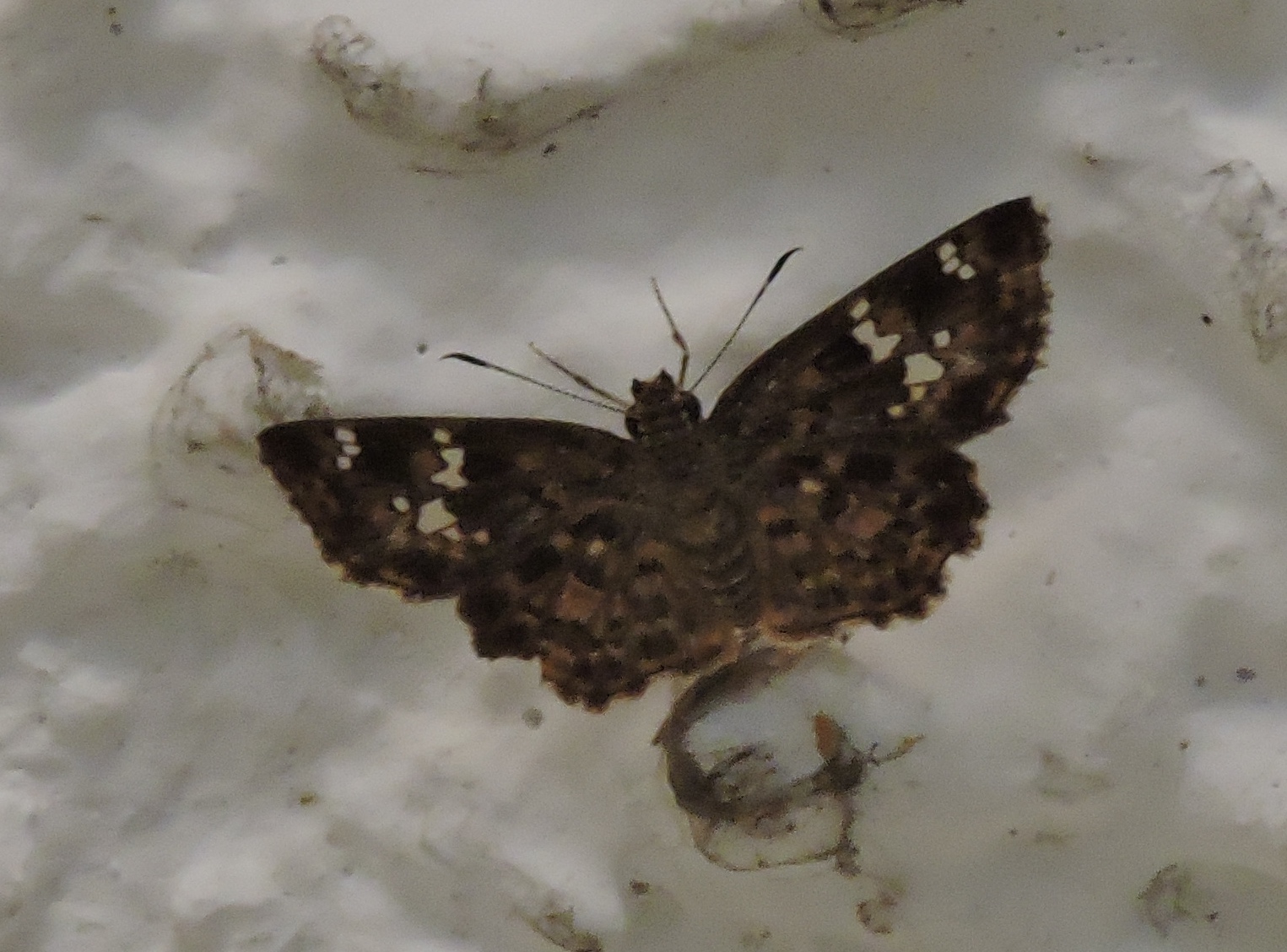
During the last visit in October 2015, we noted that Gwaya was deserted from both campers and dangerous animals, so we went back to the water tower to have a better look, hoping that the butterflies were still there. There were! This time I managed to enter the room although its floor was waterlogged as water was also filtering in the inside of the tower. The combination of intense heat and abundant water had created a tropical microhabitat that was still home to hundreds of small butterflies, settled on the walls.

The view from the door.

The view from the door.

A closer view of the butterflies.

A closer view of the butterflies.

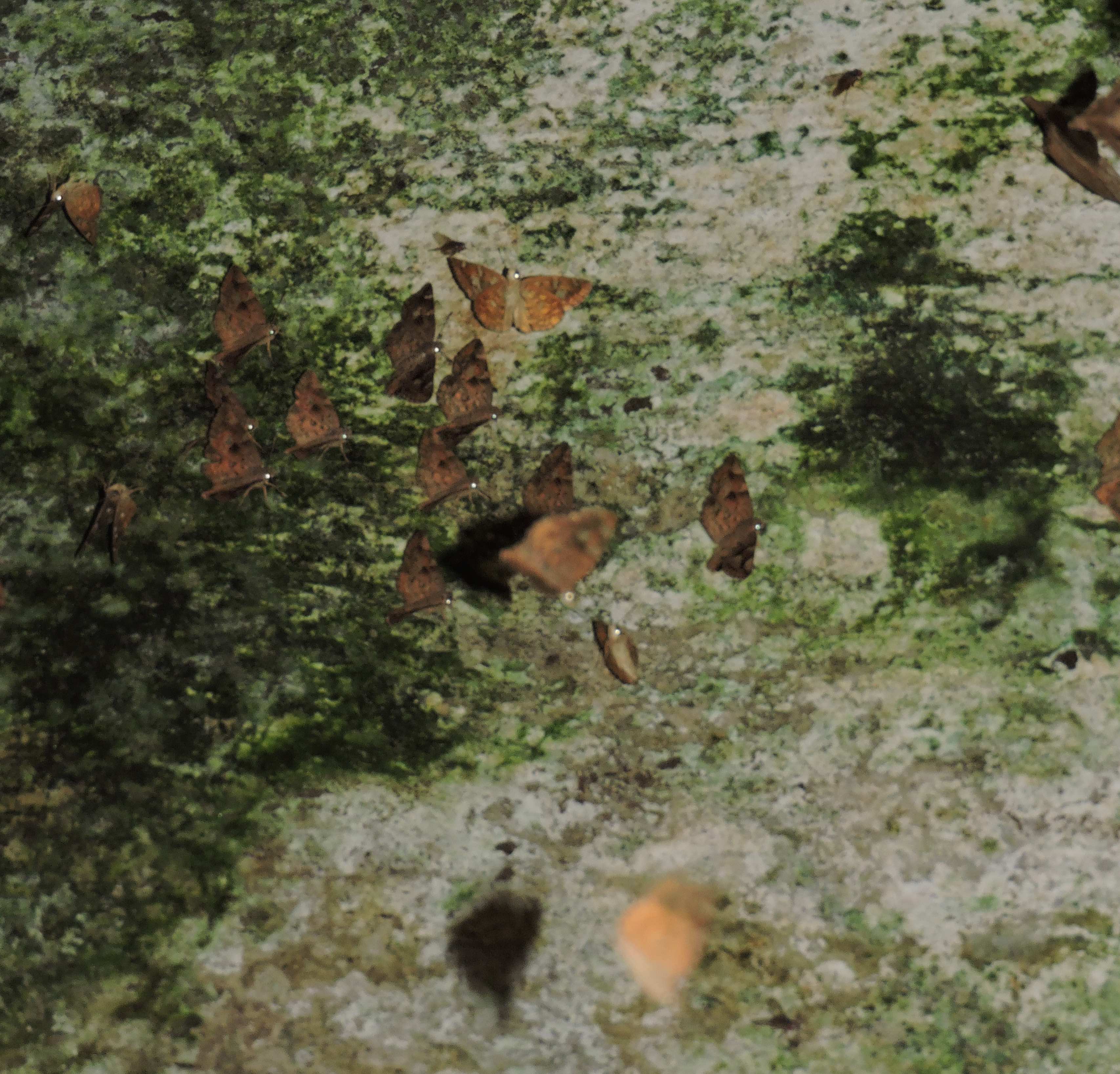
My entrance disturbed them and they took off all at once. As they did not wish to leave the dark damp area, a large cloud of them formed and flew around my head. For a while I felt like Mauricio Babilonia of Macondo[3] with the difference that these butterflies were brown and not yellow! Eventually they settled down again and I managed to take the pictures that illustrate this post.

They took off when I entered.

They took off when I entered.

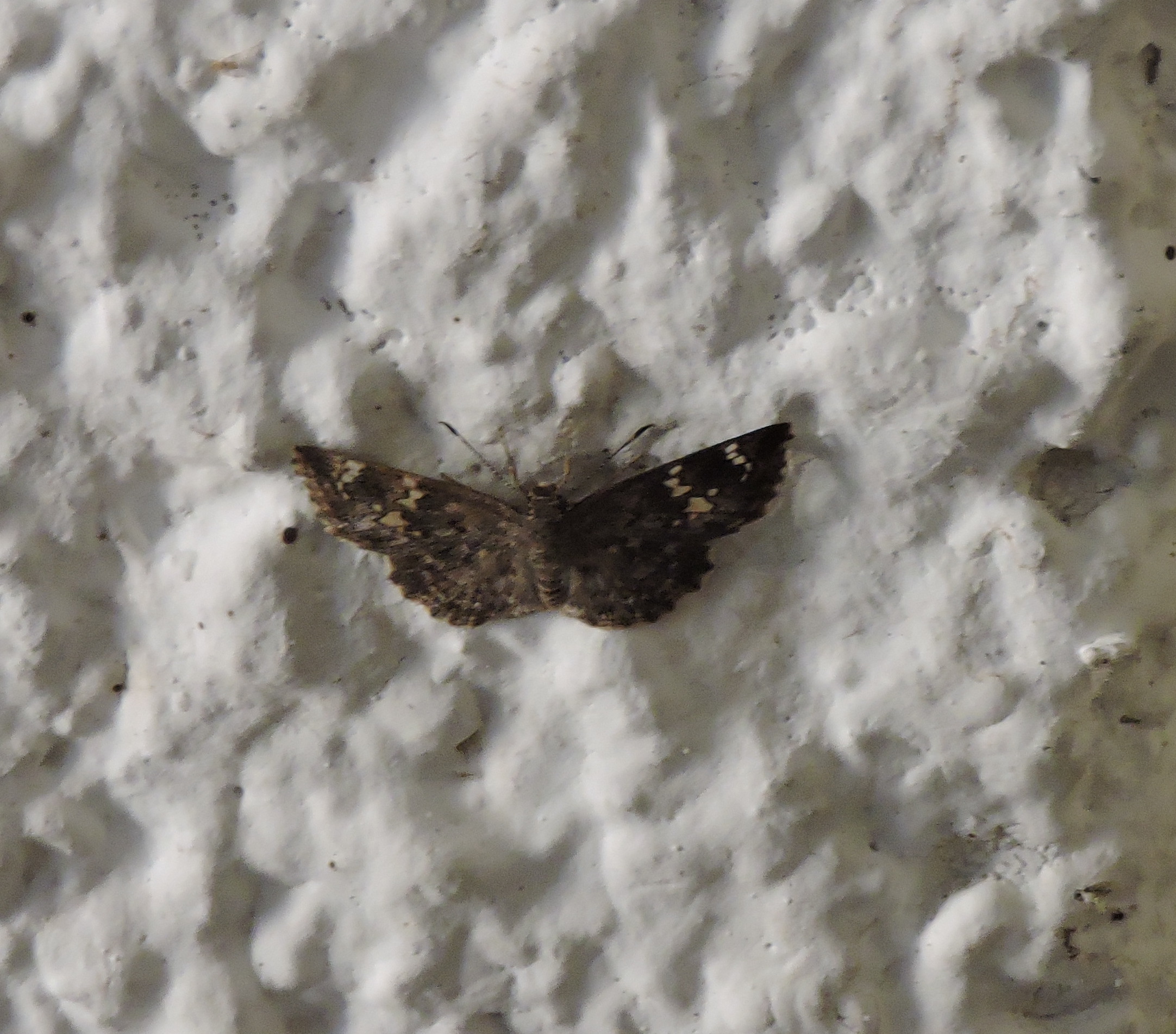
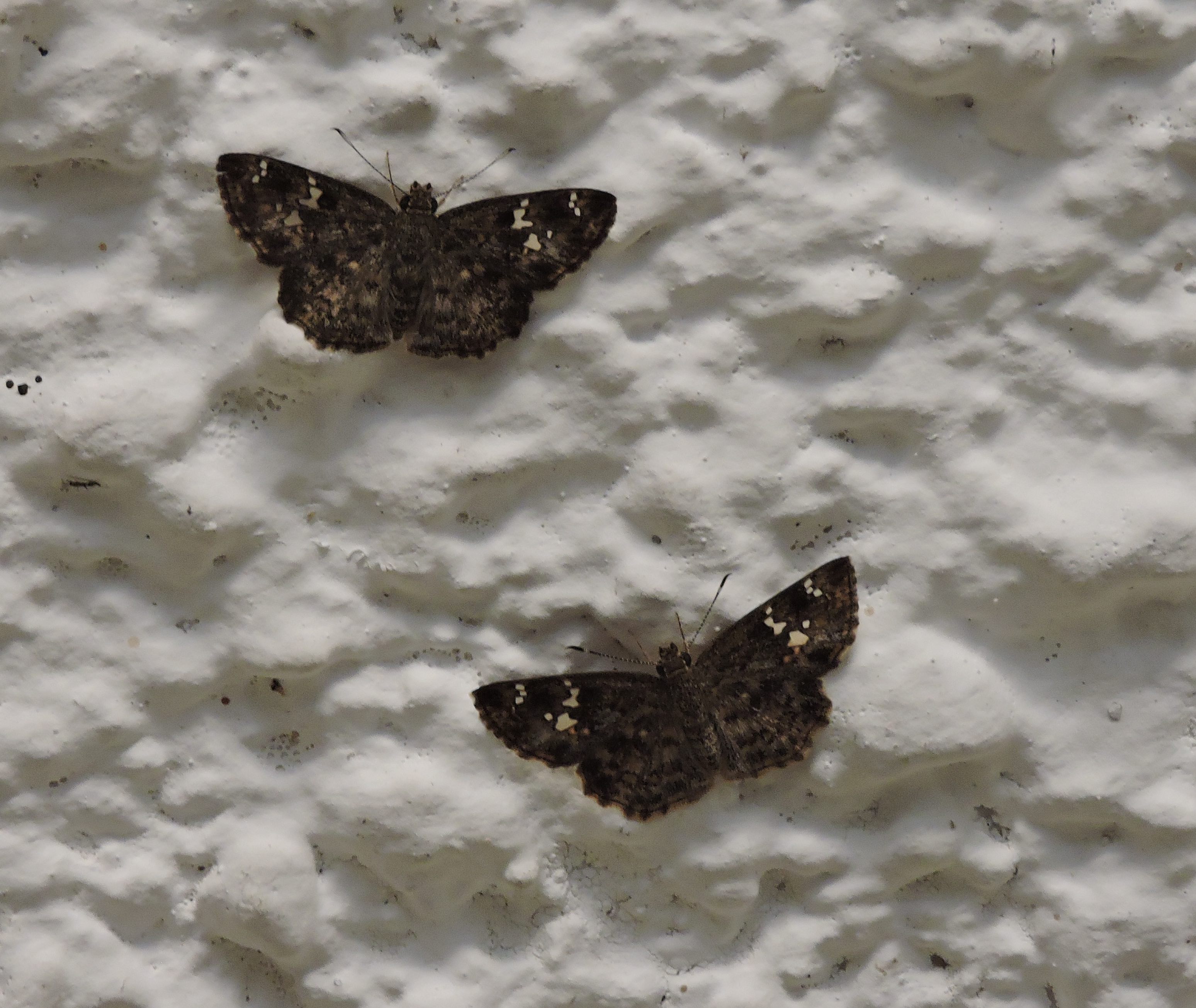
I believe that they were Elfin Skippers (Sarangesa motozi) that Migdoll’s Field Guide to the Butterflies of Southern Africa describes as an uncommon species found mainly in rain-forests in the region where it feeds on Barleria, Justicia and Perithrophe, members of the Acanthaceae flowering plants.

DSCN8683 copy

DSCN8682 copy

DSCN8684 copy

A lone and rather bloated gecko also resided in the room, his condition revealing that it did not know what hunger is!

I am sure that this resident colony of butterflies would offer a thrilling study to a lepidopterist! Not being one, I left them thinking on how much I enjoyed reading García Marquez’s magic realism and that I should revisit his work.

Muchichiri lodge, Mana Pools, October 2015.

[1] See: https://bushsnobinafrica.wordpress.com/2015/09/23/mana1-pools-safari/

[2] See: https://bushsnobinafrica.wordpress.com/2015/10/06/camera-recovered/

[3] Interestingly, to get to Mana Pools you cross the Makonde District!!!

Hot nights

We confirmed once again that Mana Pools in October is hot, really hot, specially from 12:00 to 16:30 hours. During that spell all you can do is to find a shady spot and sit it out whilst hoping that the Zambezi breeze continues to blow removing the warm air that your body generates. Frequent applications of water help as the evaporation refreshes you, at least for a few minutes. Luckily the air humidity is very low so at least you are not soaked wet.

IMG_0273 copy

The bushsnob enduring the heat while enjoying the view.

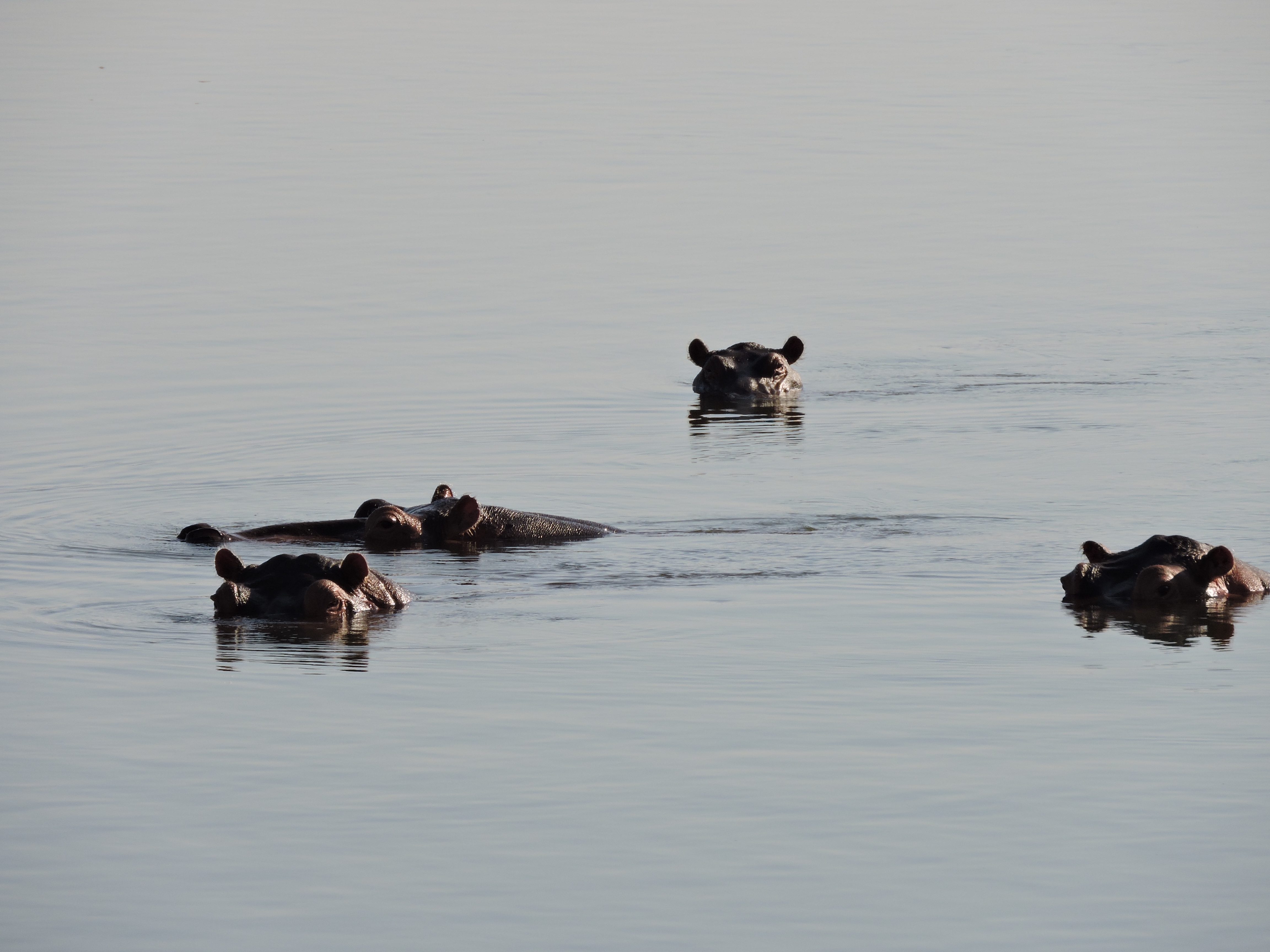
To have the sight of a beautiful but “out of bounds” river with clean water running a few metres from you is really counter productive! To make matters worse, when the hippos look at you with their exaggerated mouths, they seem to smile while enjoying the cool water!

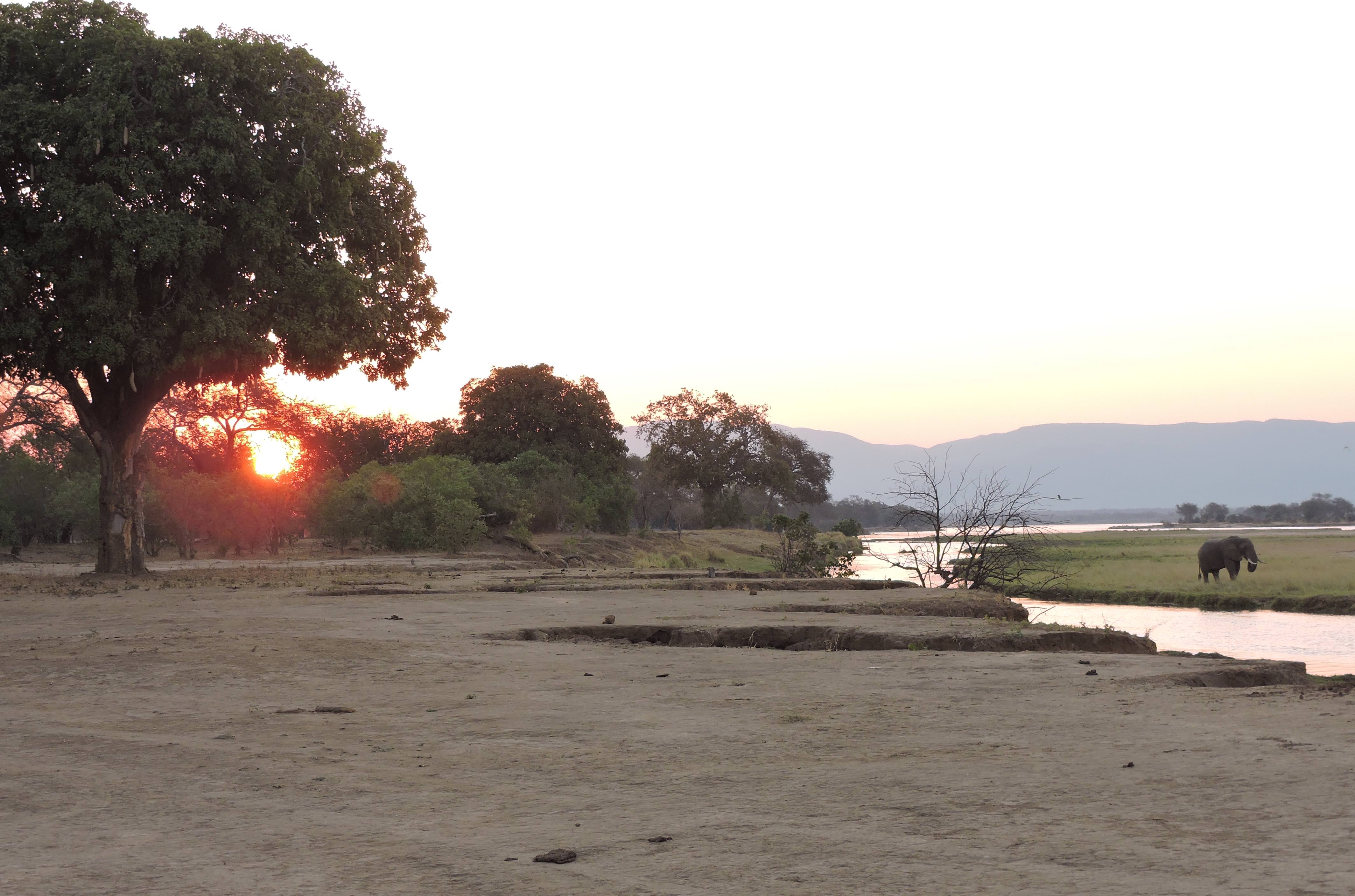
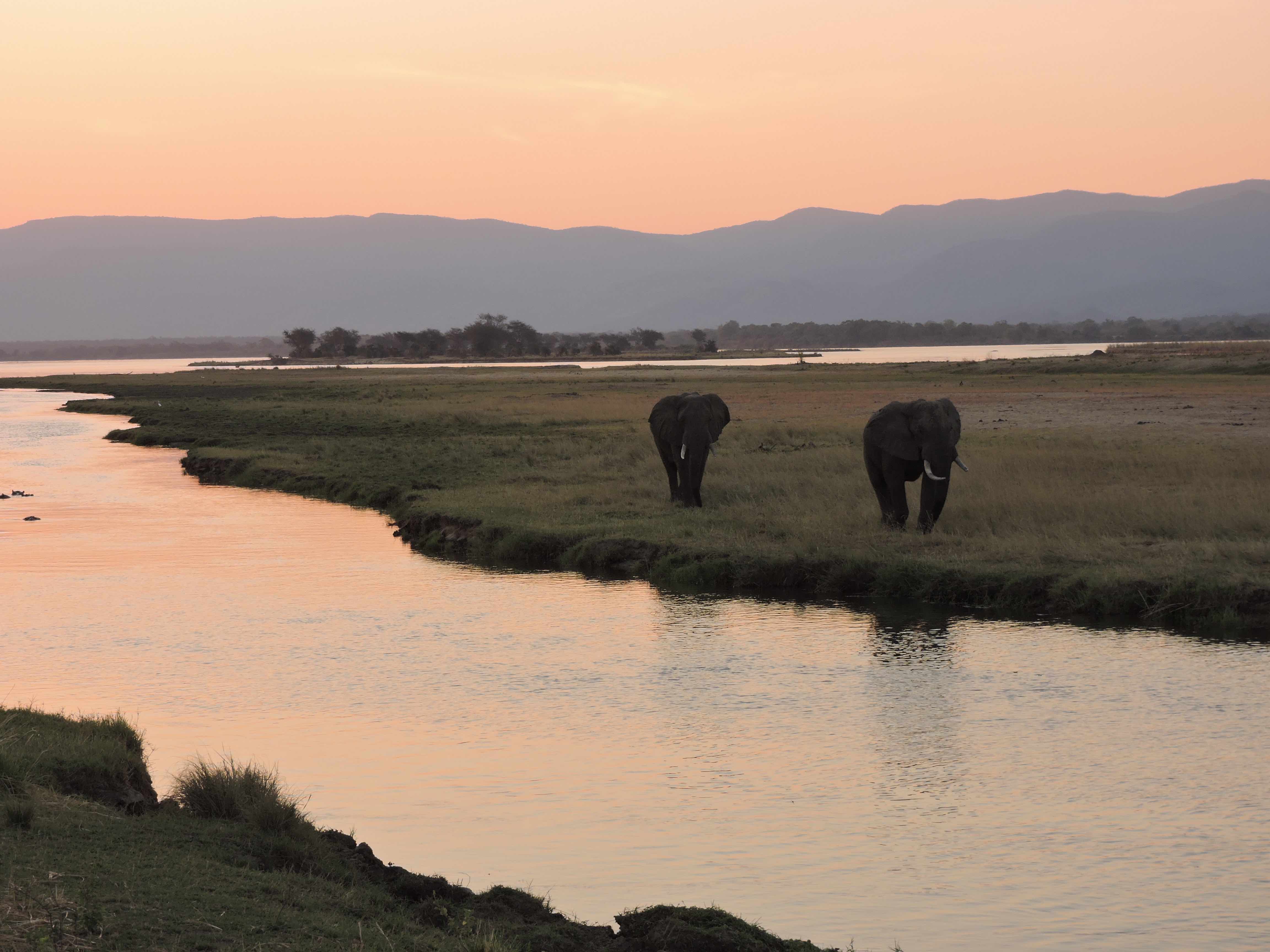
Zambezi dusk.

Zambezi dusk.

DSCN8571 copy

Hippos enjoying the coolness of the river seem to be smiling at you.

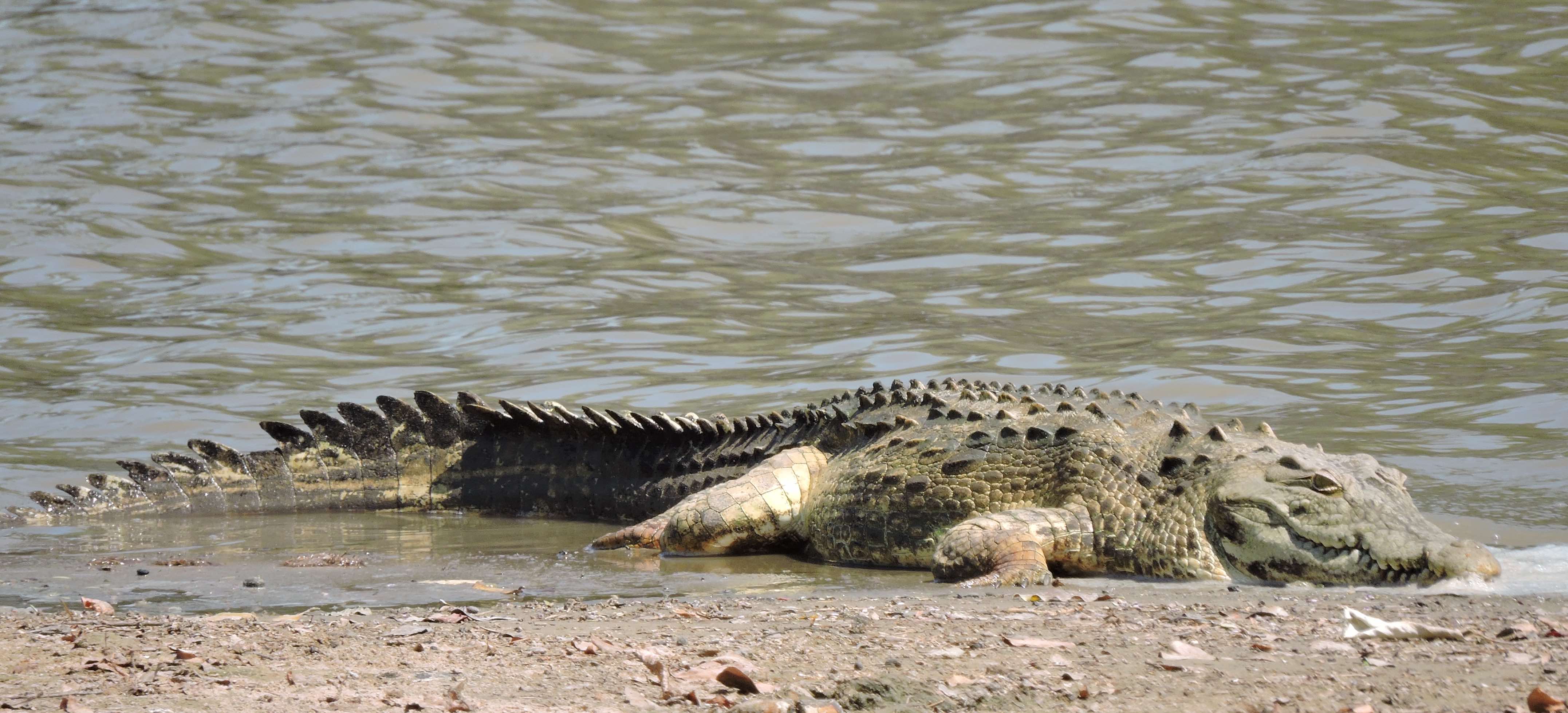
Although the Zambezi offers nice sandy banks and beaches, you will enter its waters at your own risk. The latter is rather high as, if you are lucky to remain undetected by the numerous and some really huge crocodiles, you may pick up the invisible but equally bad Bilharzia parasites.

A Zambezi hazard.

A Zambezi hazard in wait.

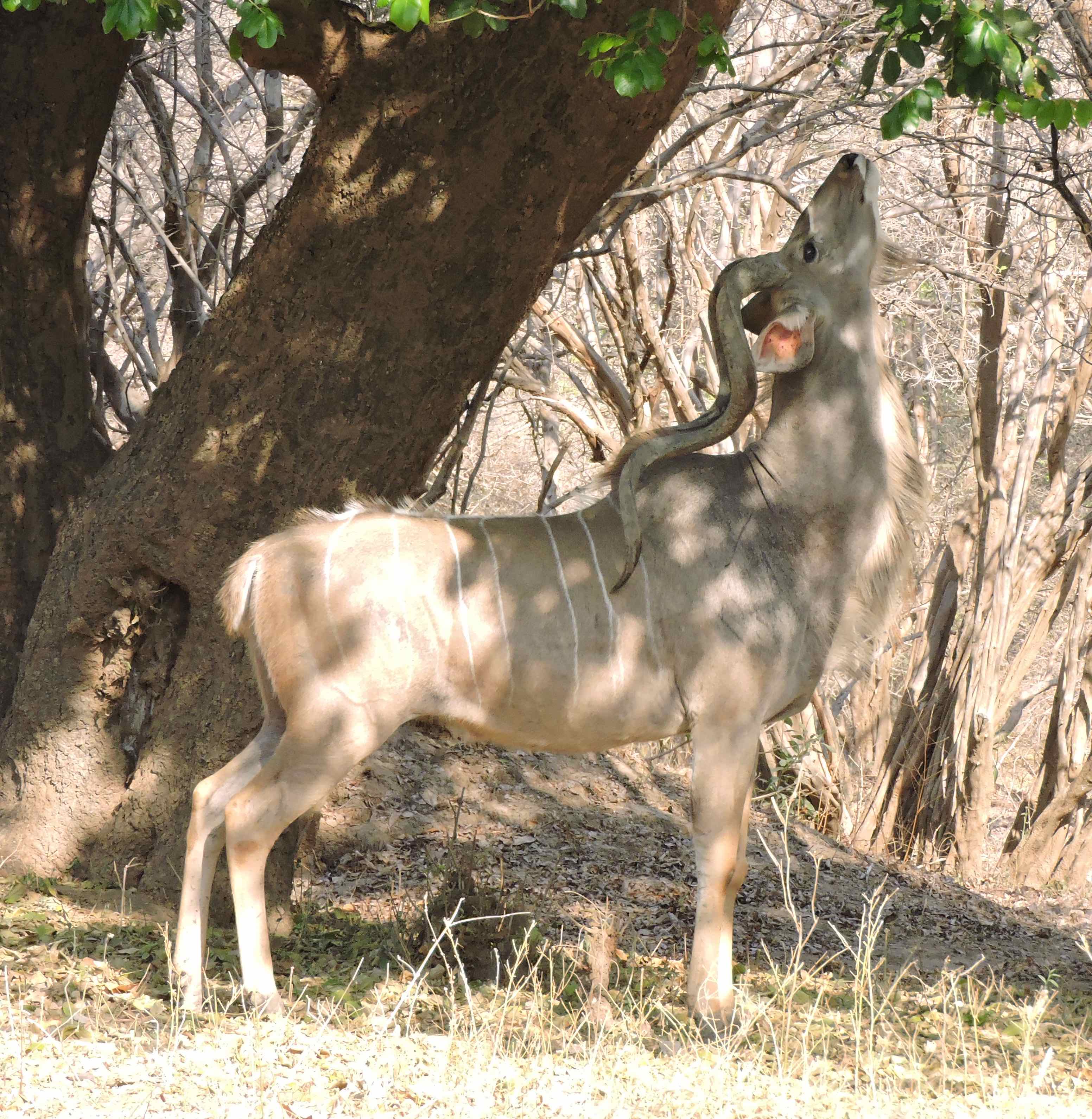
The heat affects all and for the game is a tough time. The inland pans are dry and the last blade of desiccated grass has been consumed, transforming the Zambezi terraces in the proverbial dust bowl. Luckily the park has many trees that provide shelter to the animals that remain there from the blistering sun, mainly the greater kudu that still manage to find nourishment by browsing.

Greater kudu browsing under the shade.

Greater kudu browsing under the shade.

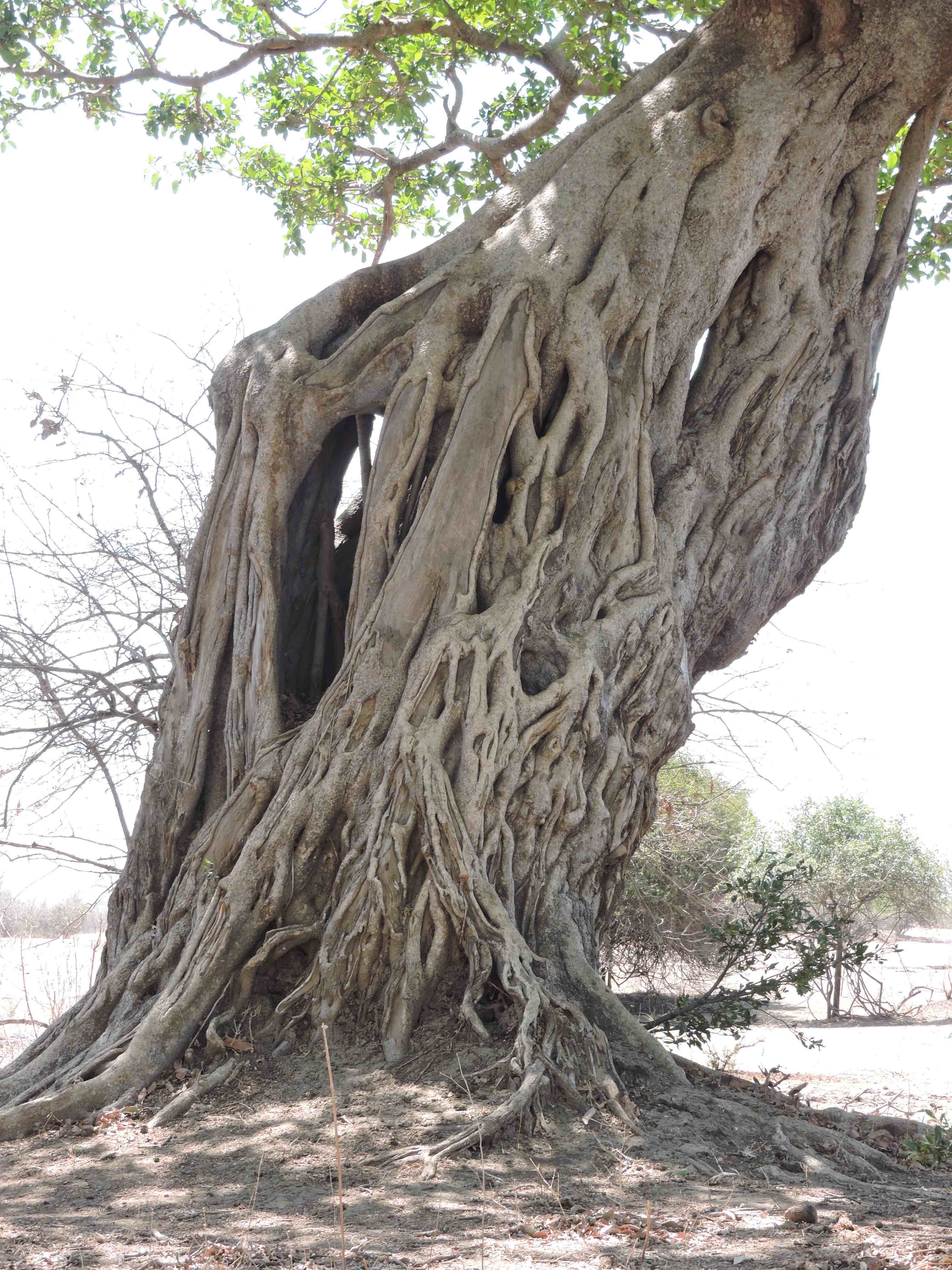
Although the trees offer good shade, their fruits are by now almost exhausted. The pods and flowers from the apple ring acacias and sausage trees respectively are very few now and the amount available does not justify the effort the animals require to collect sufficient to live upon. The fruits from the sycamore fig trees are ripening fast but they are being quickly consumed by birds and monkeys alike so that they hardly hit the ground!

DSCN8441 copy

A fig tree showing its beautiful trunk.

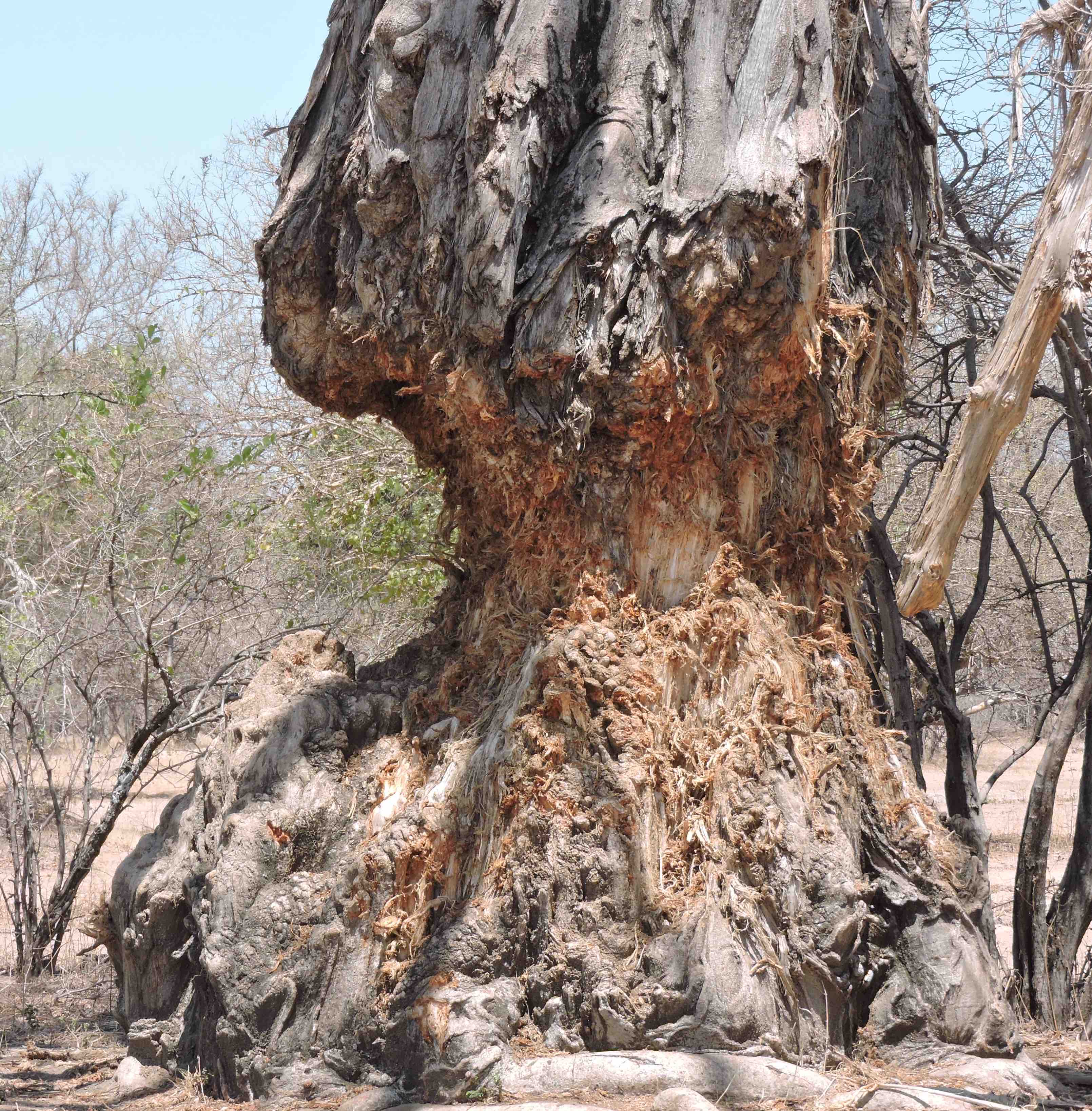
Even the apparently dry baobabs are being consumed, mainly by elephants!

The elephant bite!

The elephant bite!

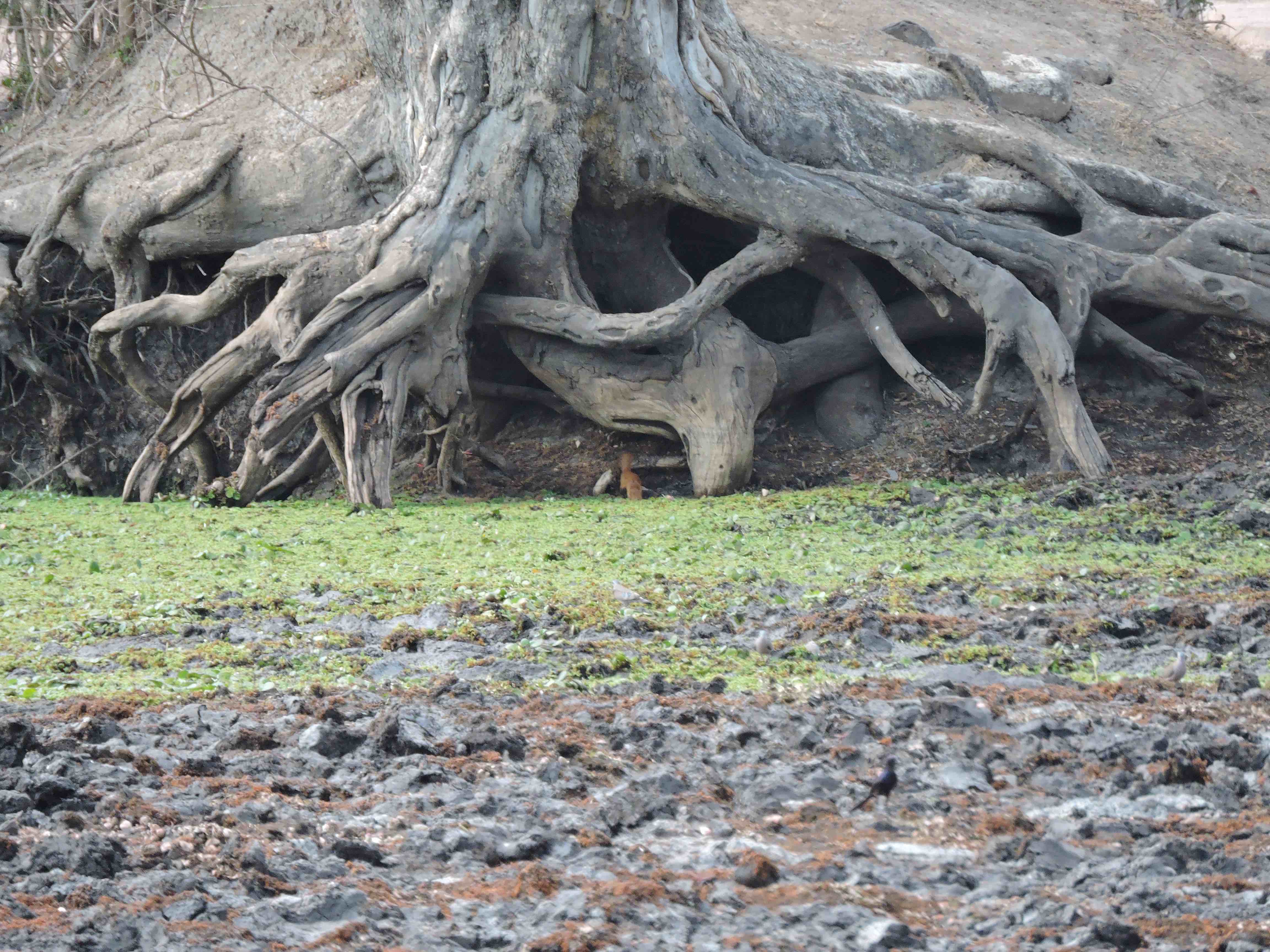
Both Chisasiko and Long pools still  have lots of water but it is brackish and not liked by all. Although we have seen impala and waterbuck drinking there, we are yet to see an elephant! Chine pool, now just a green ribbon, attracts plains game as it seems to be fed by a fresh water spring. We did not see how Green pool was but I suspect that it is also getting dry[1].

A rather dry Chine pool with a slender mongoose in the tree roots at the back.

A rather dry Chine pool with a slender mongoose in the tree roots at the back.

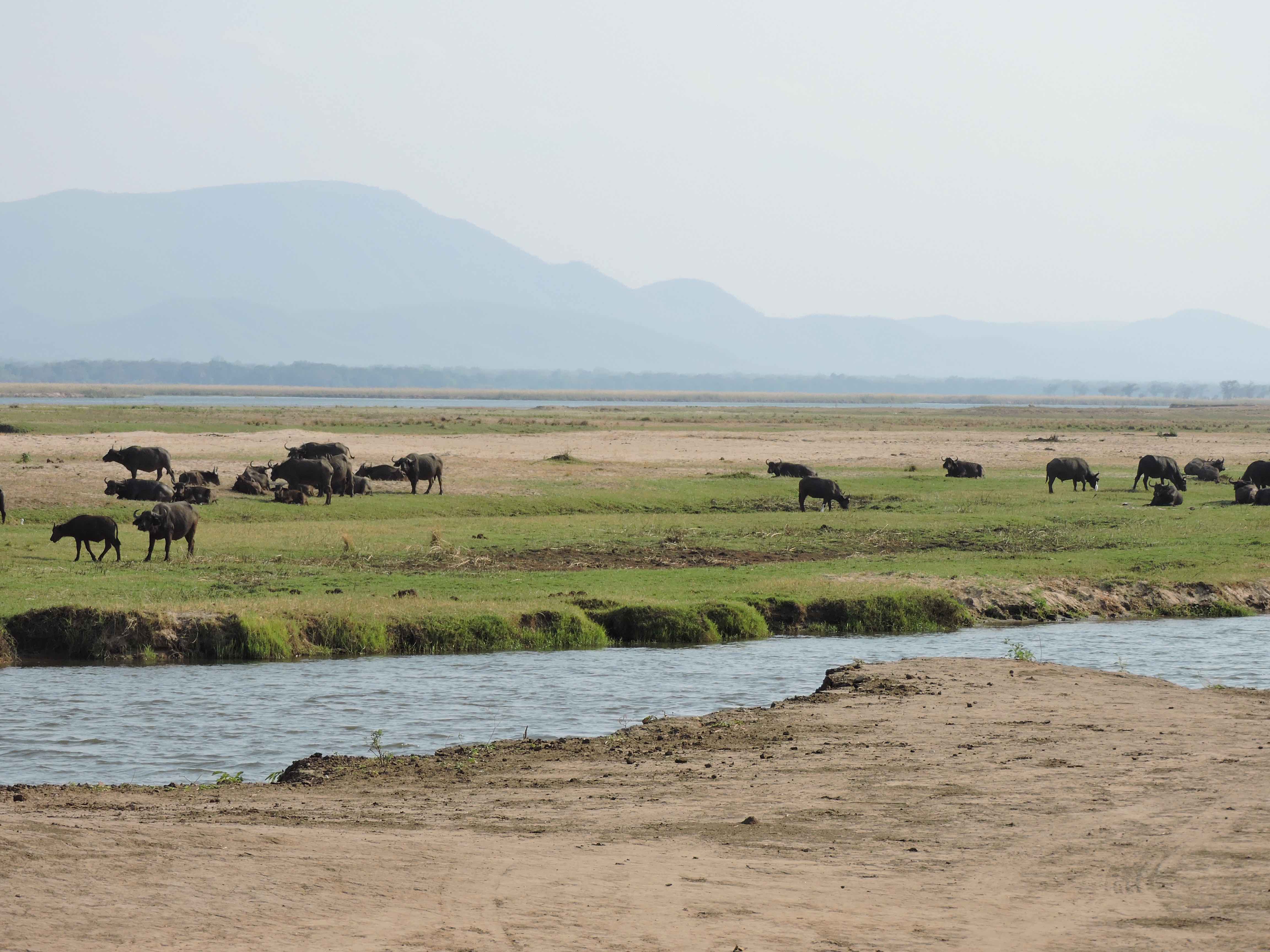
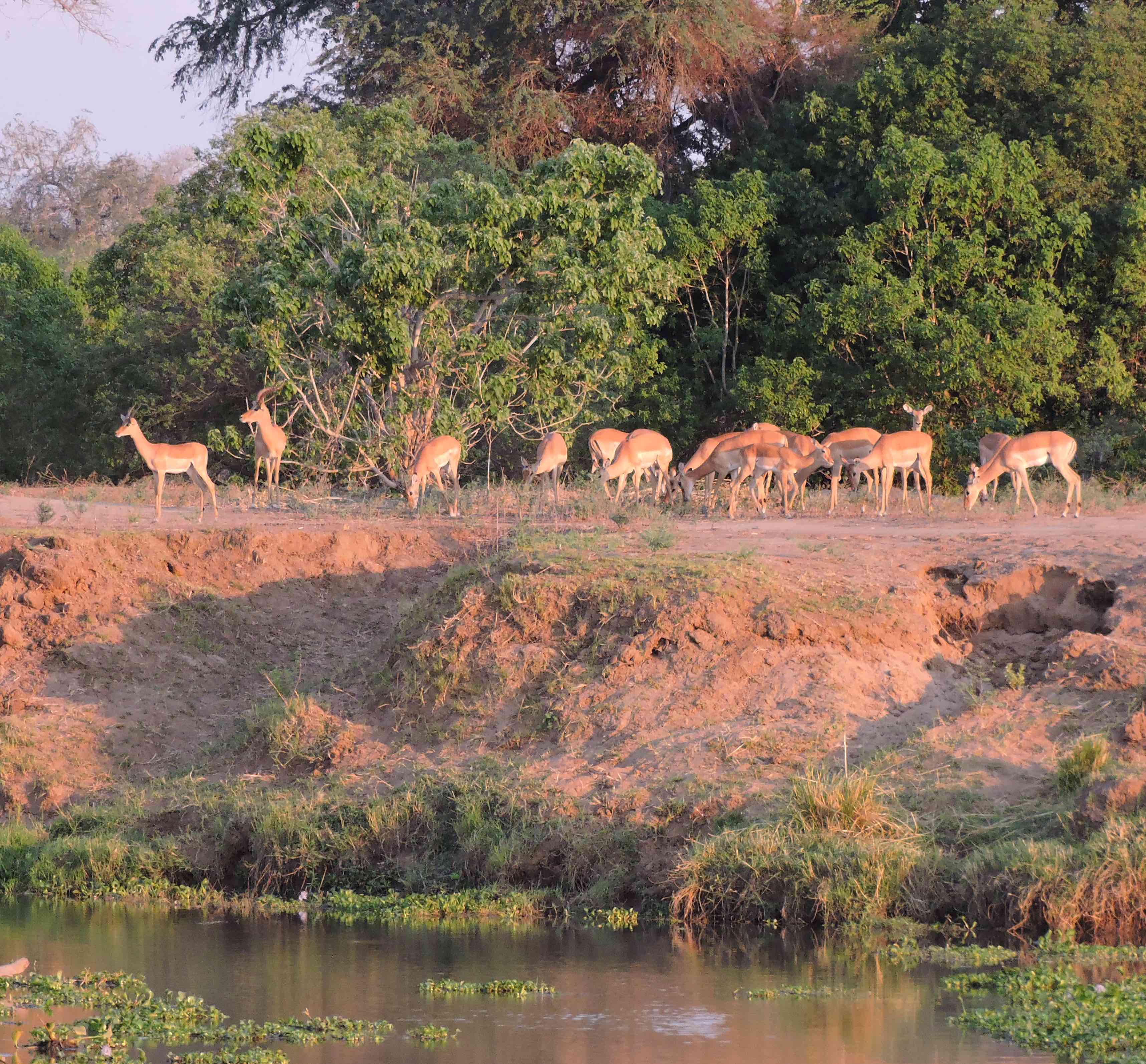
As expected, most game now gathers around the only permanent source of water, the Zambezi river. Adjacent to it the plains are still green and teeming with animals grazing intensively in a fragile and unstable truce between different links of the food chain. There are thousands of impala within a kilometre from the river as well as buffalo, eland, zebra and waterbuck that have also moved residence to this true “food land”.

Buffalo taking advantage of the grass by the river.

Buffalo taking advantage of the grass by the river.

Impala by the river.

Impala at Mana mouth, very close to the Zambezi.

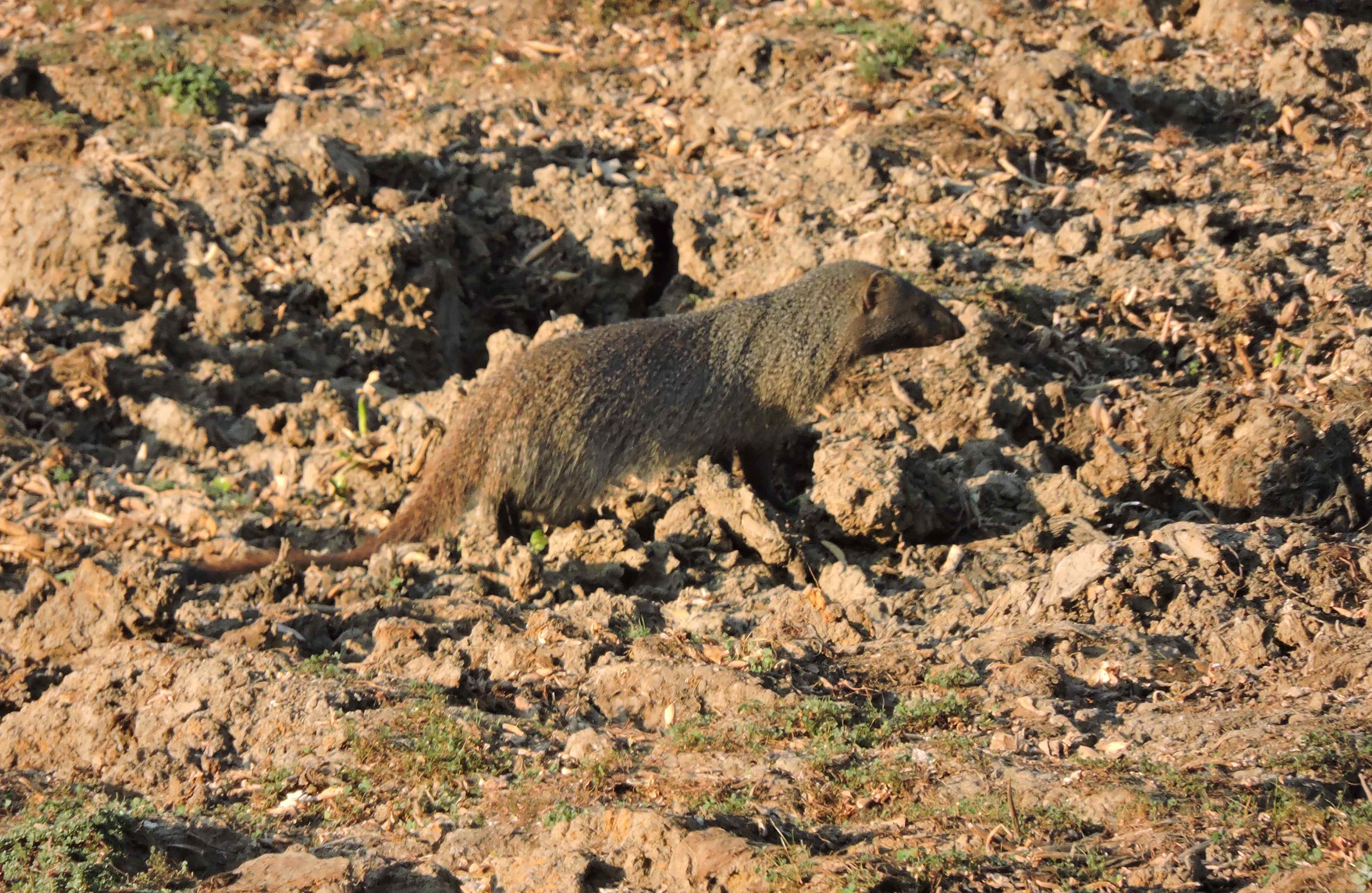
Aware of this, the area is now also the home of the predators. These range from water and land birds consuming prey that gets caught in small pools or drying mud to hyenas, leopards and lions on the prowl for larger animals.

A grey mongoose searching for food in the drying mud.

A large grey mongoose searching for food in the drying mud.

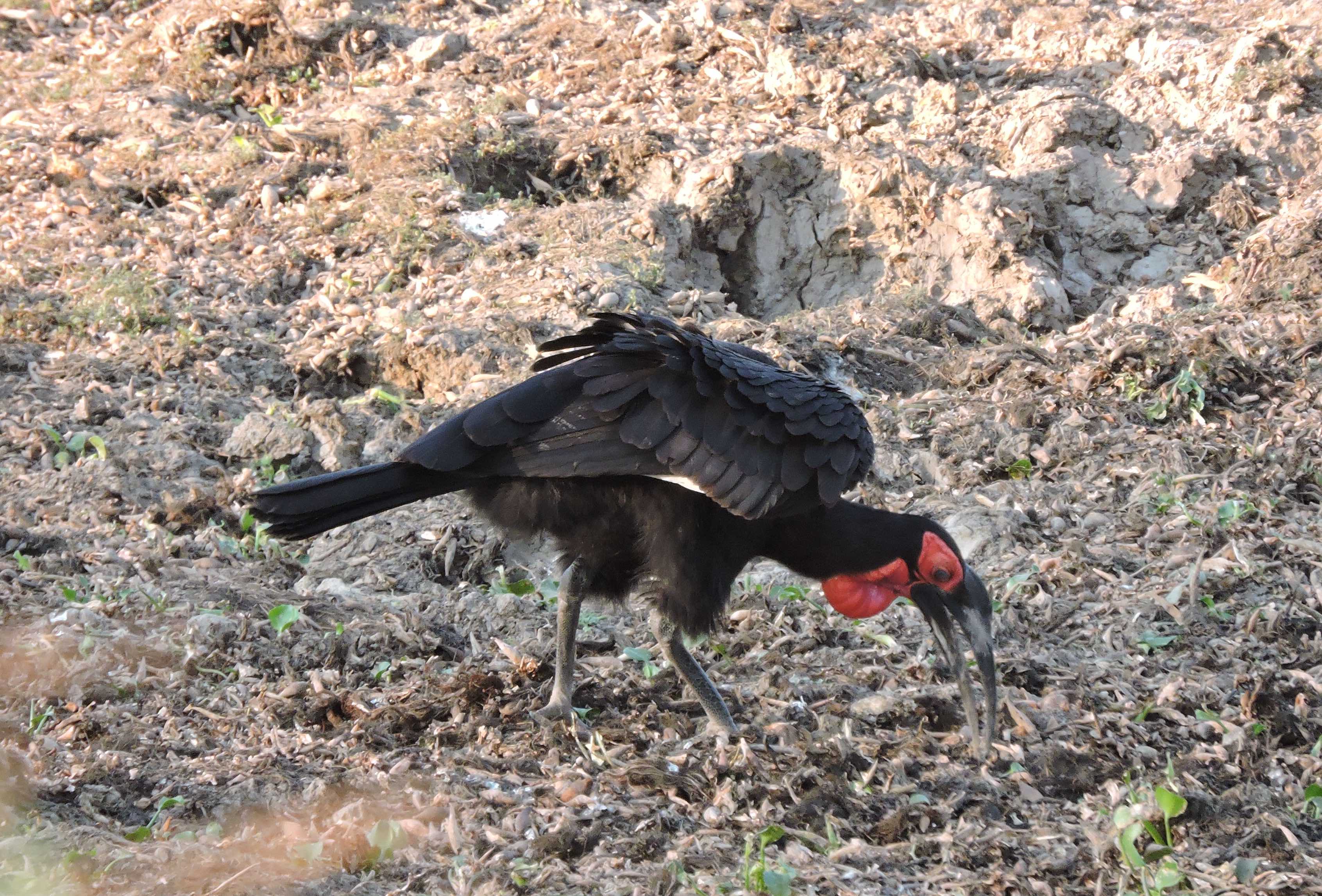
A ground hornbill also taking advantage of the dry river bed.

A ground hornbill also taking advantage of the dry river bed, feeding on what looked like snails.

The elephants dot the plains with the relaxed attitude that their size allows them. They are all over the place. There are family groups composed of a matriarch and her progeny as well as bulls in small groups or preferring their own company.

DSCN8537 copy

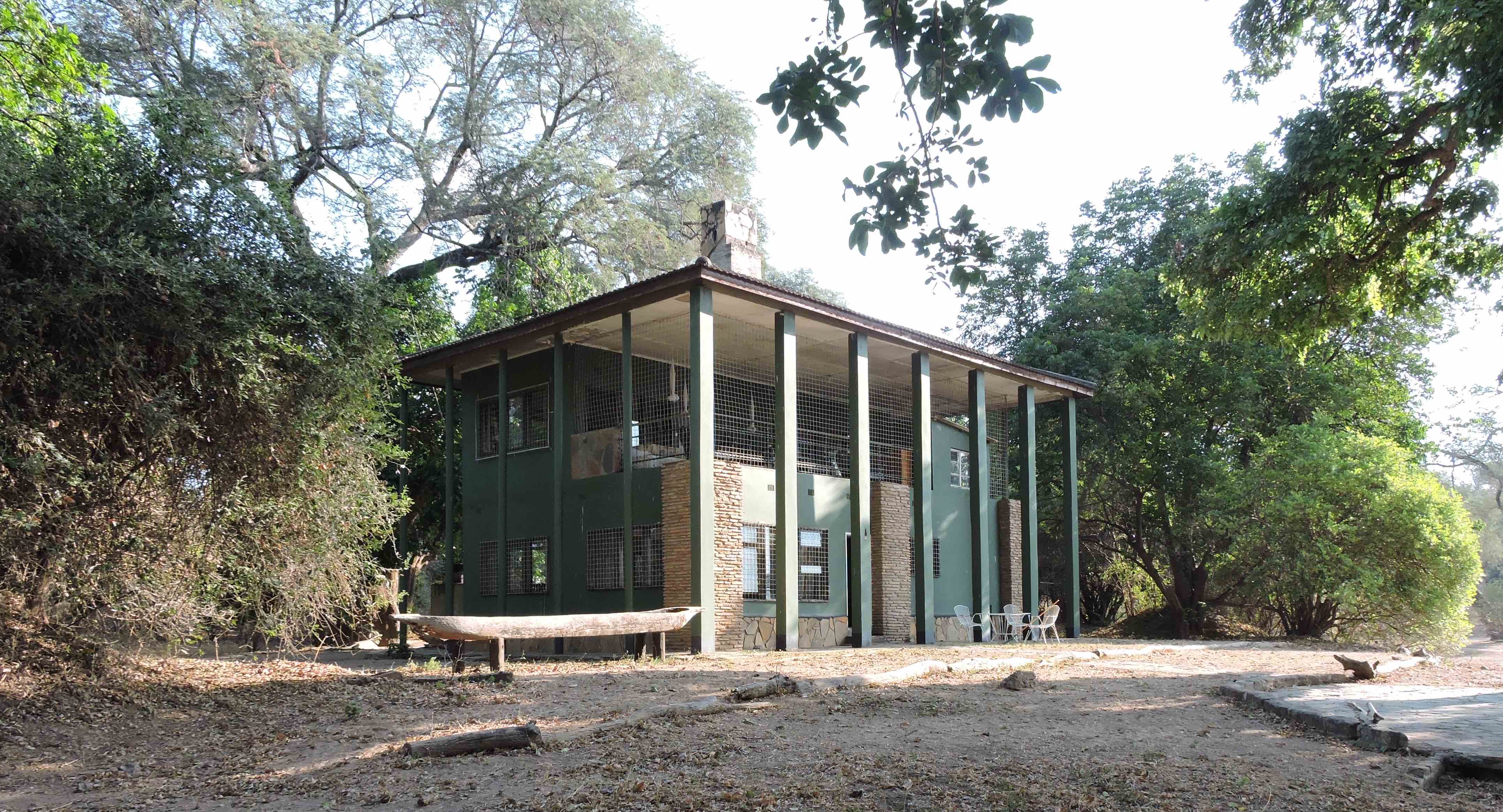
Game drives inland only find the ocasional heat-enduring animal so game watching focusses on the river area where being comfortably seated with open eyes normally rewards the observer with good finds. We were well placed at Mucichiri lodge, a two floor building offering an open upper deck from where a great view of the river was available. While hippos were always in the neighbourhood either in or out of the river, impala and waterbuck grazed under the shade.

DSCN8253 copy

Muchichiri lodge seen from the river side.

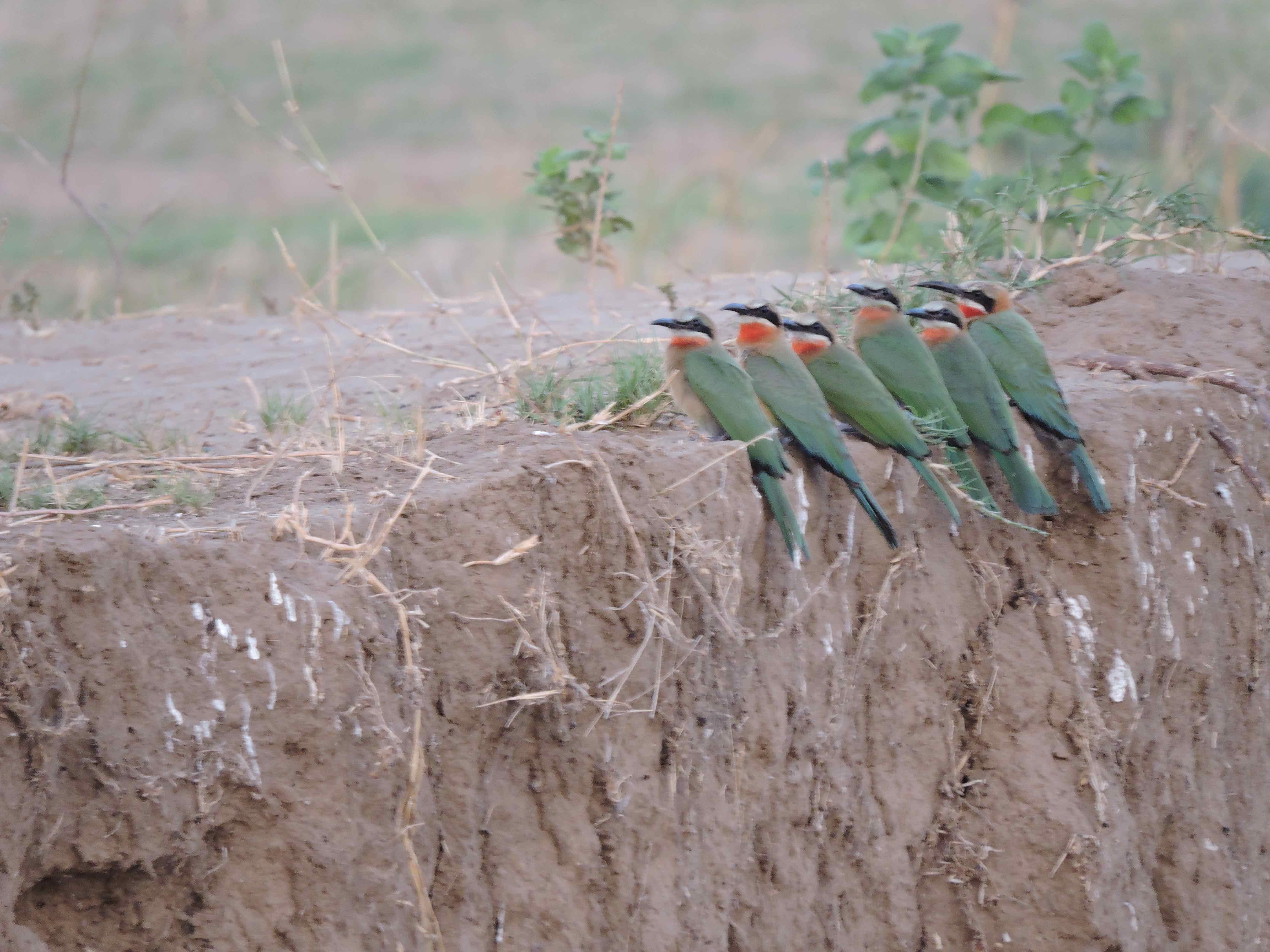
The birds were busy nesting, anticipating the rainy season that it is just round the corner. In addition to spur-wings and Egyptian geese, the bee-eaters were very numerous, both white-fronted and carmine. They were busy going in and out of their burrows in the alluvial banks of the river found on the oposite margin.

DSCN8714 copy

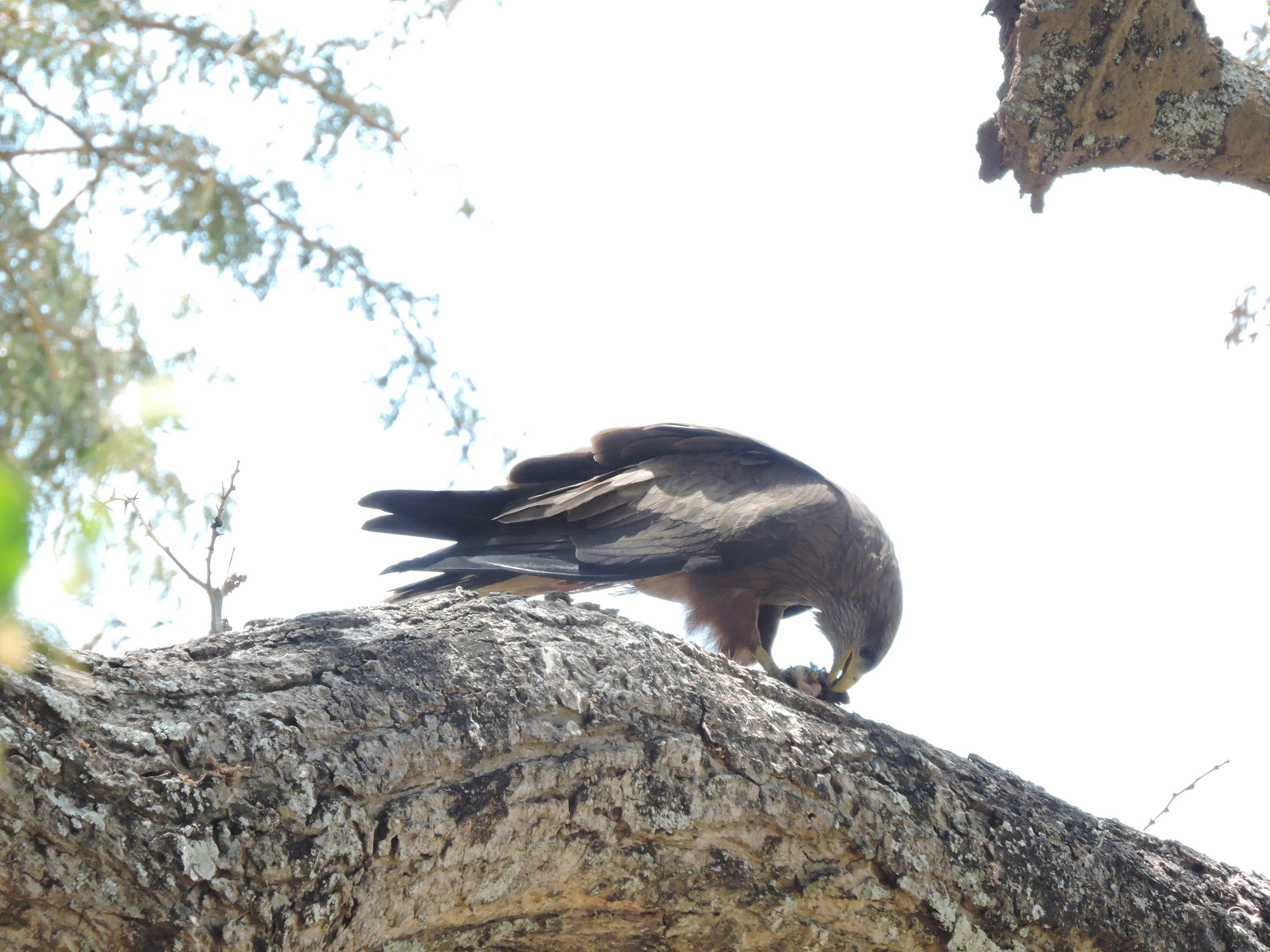
A few times a day they their constant chirping noises ceased for a few seconds and then all would take off screeching loudly in alarm as some threat approached.The most common predator seen was the Yellow-billed Kite (Milvus parasitus). The latter would come from high and then gradually descend as it approached the river banks. Although birds did all possible to disuade the attackers, the kite would continue relentlessly on the hunt and it would  suddenly swoop down fast and land, either on the banks or on the trees near our lodge. Twice I saw it catching fledglings and land nearby to eat them. Once prey was taken, the predator was quickly forgotten by the birds that will soon return to their socializing, clearly showing “short memories” or being resigned to the inevitable!

The kite feeding.

The kite feeding.

By mid afternoon Mana Pools was a furnace with the shade offered by the large trees and the hot wind as the only relief. Luckily the lodge has a bathtub and a shower and we took turns seeking refreshment until the sun power finally slacked and we slowly revived. It was time for the evening game viewing drive and, on return, a barbecue kept simple and managed from a distance to avoid getting too close to the fire!

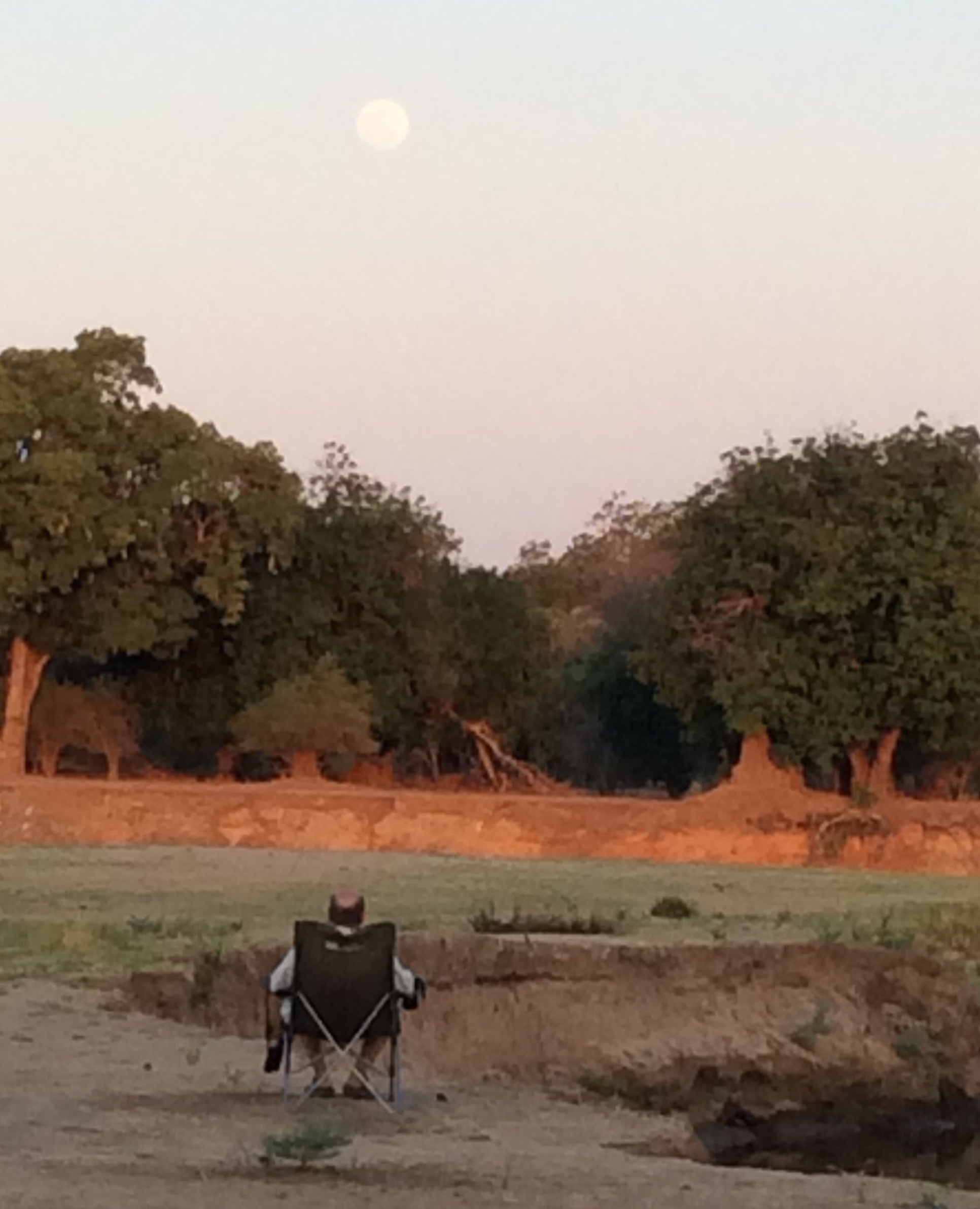
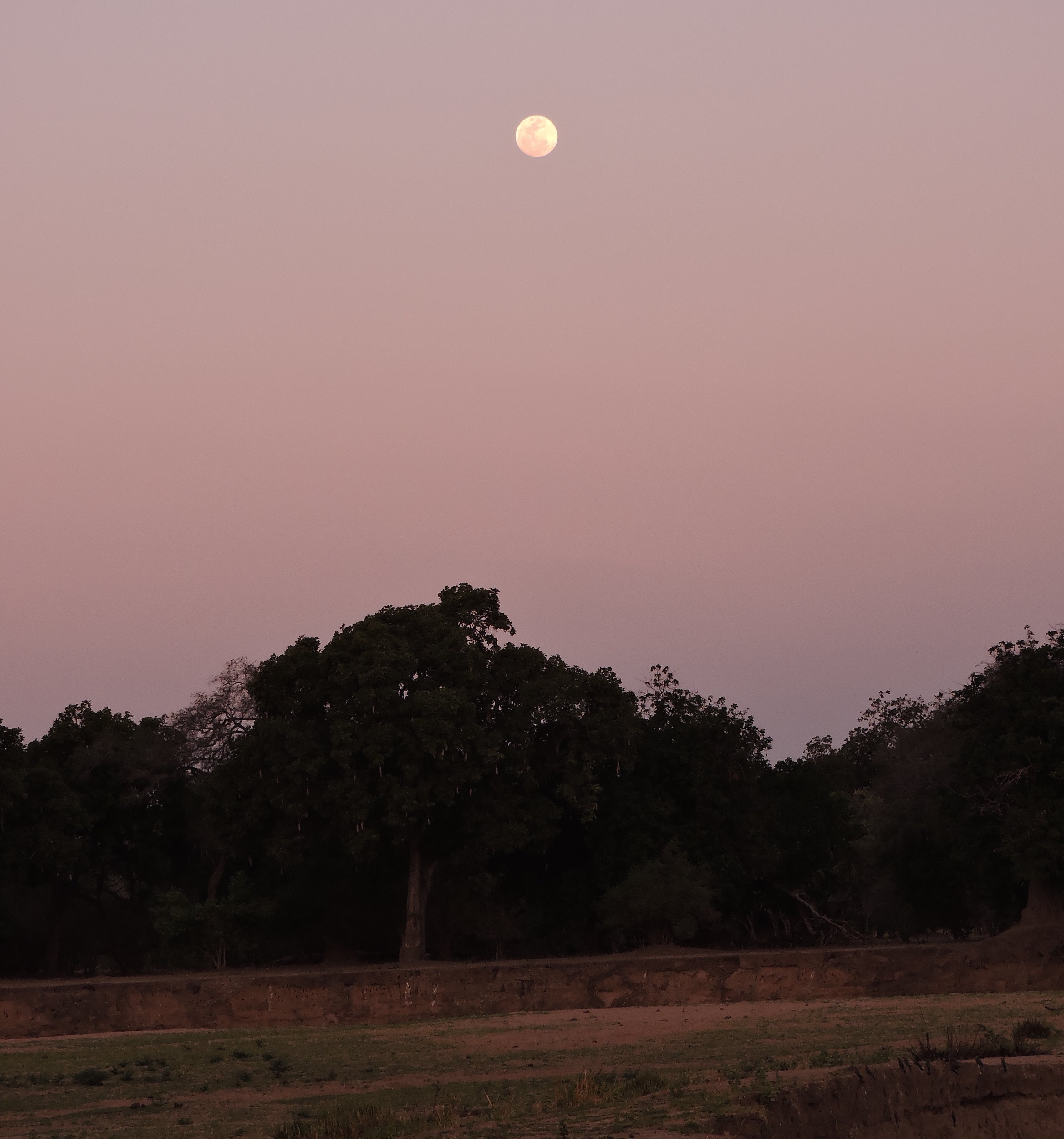
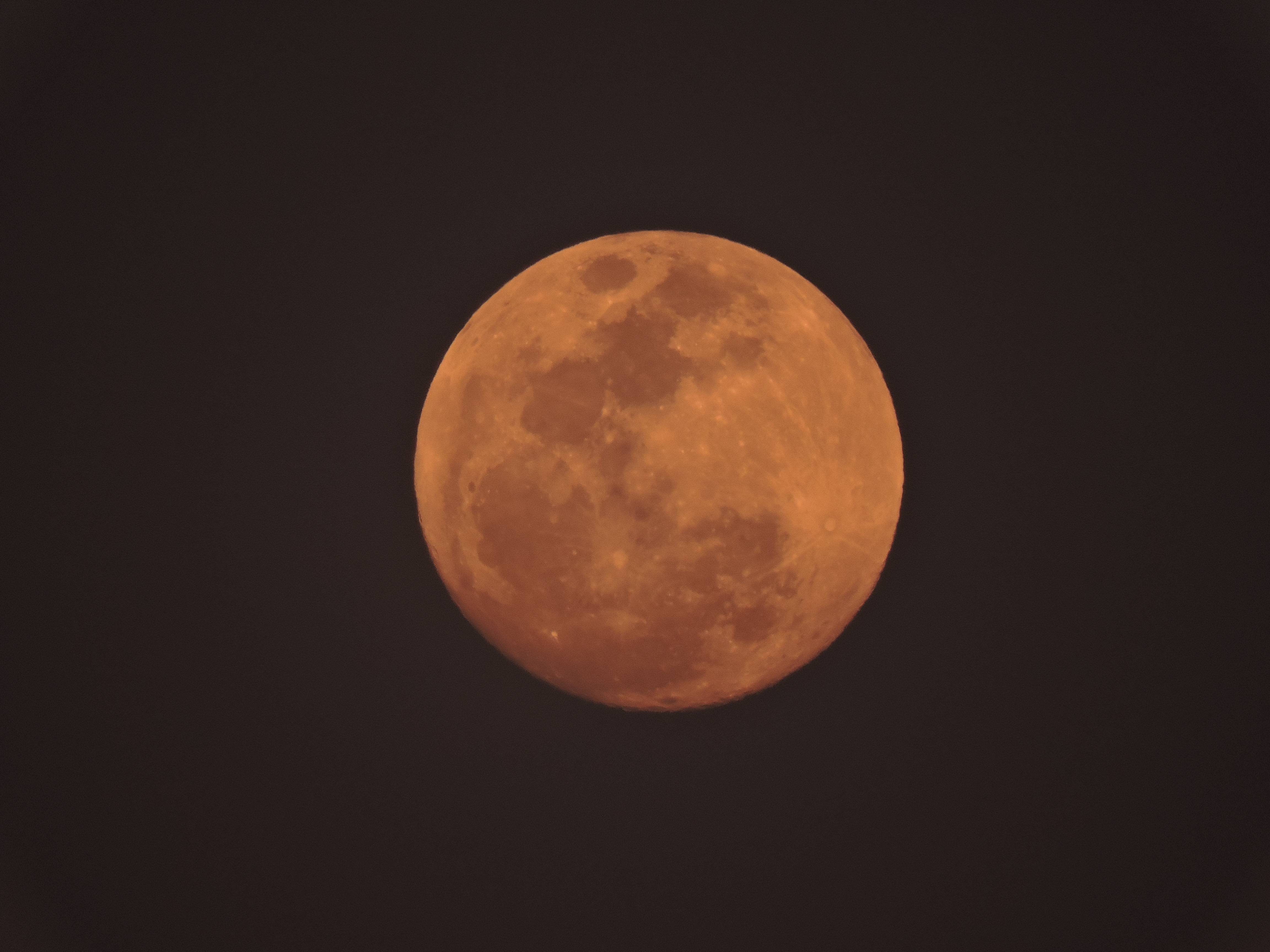
At night the wind dropped and, unfortunately, the little that blew got stopped by the mosquito net. The consequence was that sleep was hard to find. Fortunately there was a full moon and the animals outside the lodge were very active. We are surrounded by impala and waterbuck while the hippos grazed in the grassy banks, their bulk easier seen while they walk about as true lawn mowers.

DSCN8740 copy

The full moon gave us good light.

The full moon gave us good light.

The elephants also passed by in numbers, as usual, in total silence but rather obvious to us sitting only a few metres from them! Loud calls preceded the arrival of hyenas checking for some left overs before embarking into their longer missions in search of substantial prey. Lions were only heard once and far away, clearly hunting much further downriver.

While watching and listening to the Mana inhabitants the temperature eventually dropped to “sleepable” levels and we went to sleep aware that we needed an early start to our game drives the next day, before the heat would set in. Looking at the clear sky we could be sure that on the morrow we could find anything, except rain. 

 Mana Pools, Zimbabwe, October 2015.


[1] You will note that I now know the names of the four pools, courtesy of a helpful park ranger that we met during this visit.

Javelin throwing (almost Olympic games)

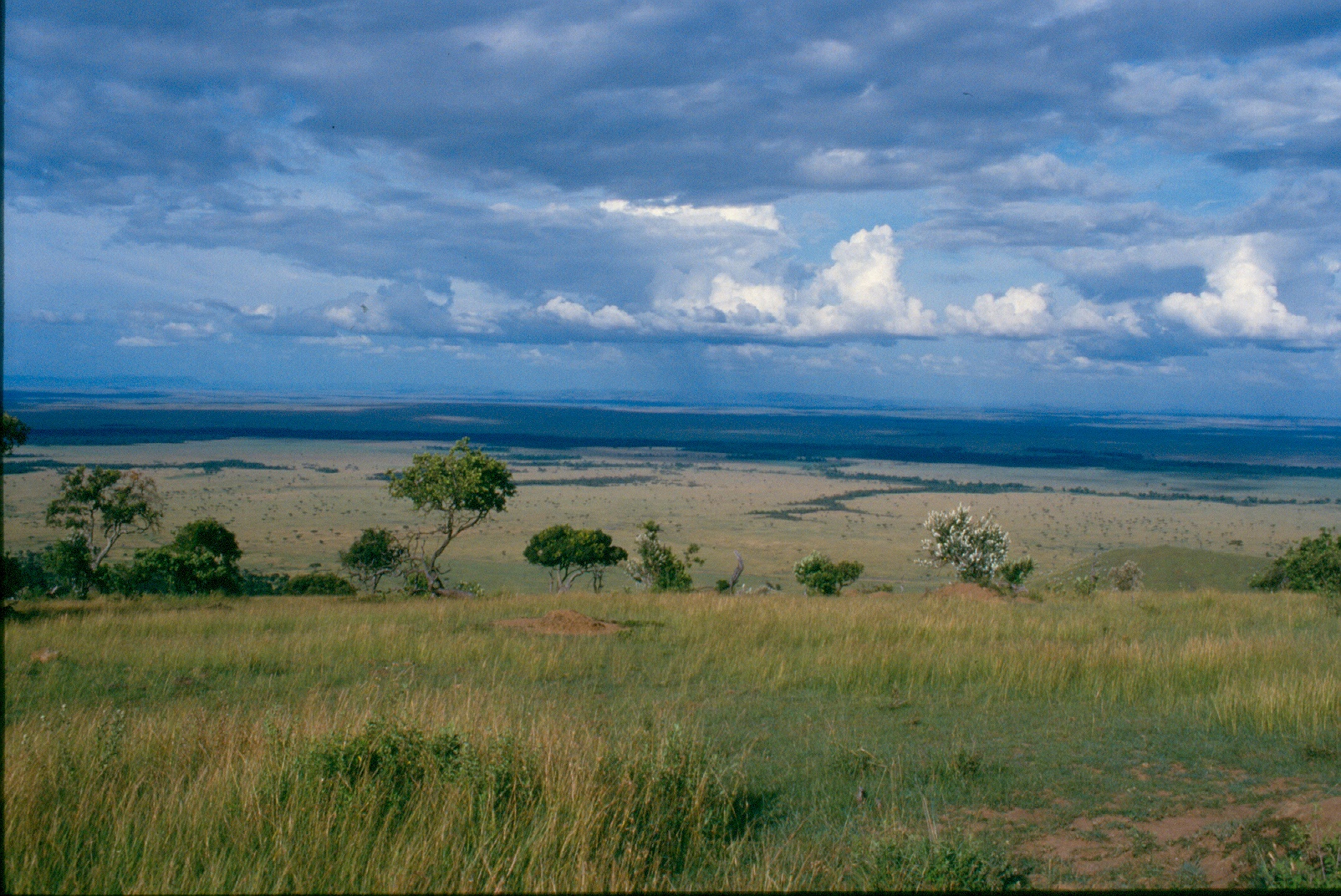
The view of the Mara triangle on the Maasai Mara from the Oloololo escarpment on the way to Intona ranch.

The view of the Mara triangle in the Maasai Mara from the Oloololo escarpment on the way to Intona ranch.

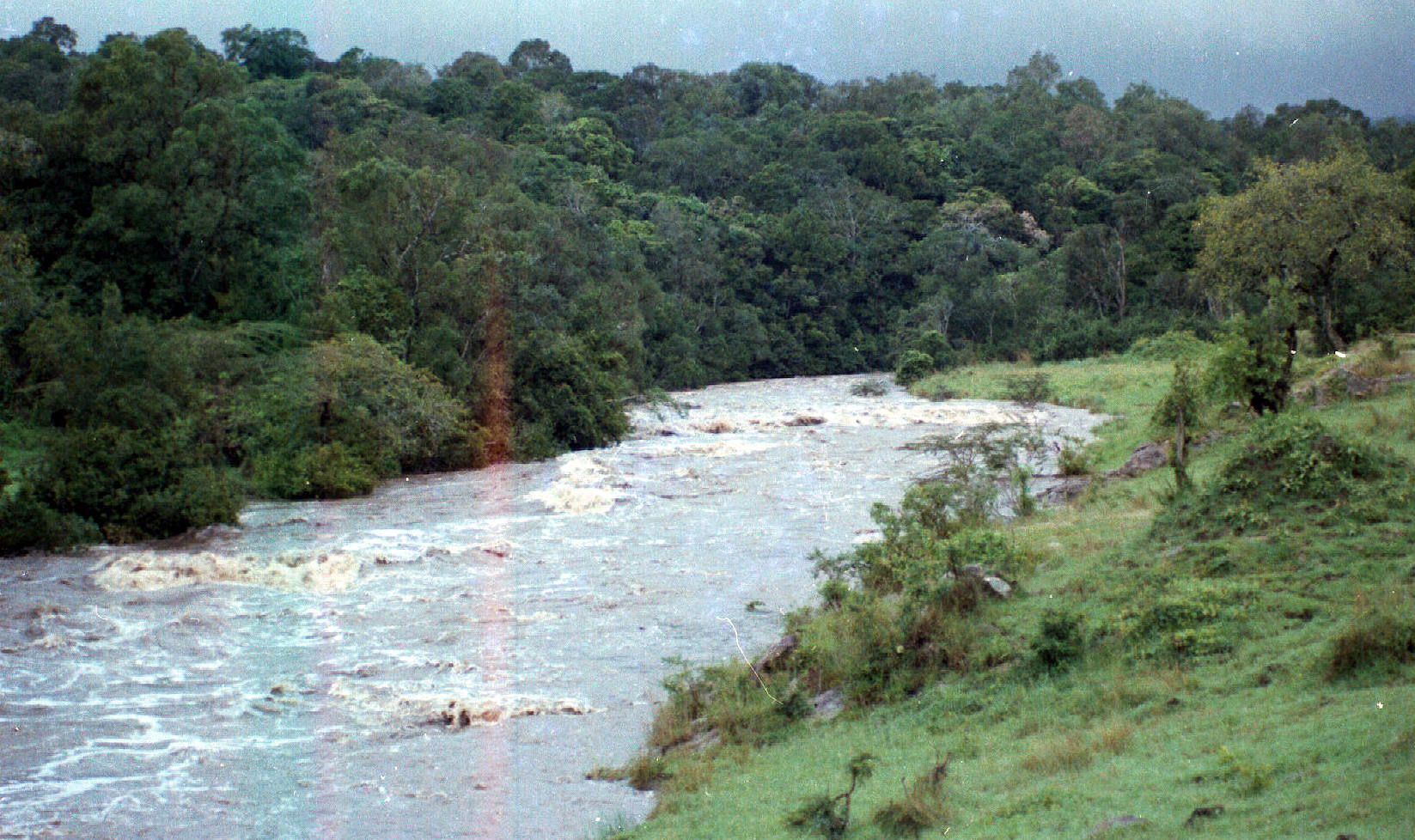
Despite our busy work schedule we did not work on Sundays. We took the morning to explore Intona and its surrounds as there were always interesting sightings, particularly in the area towards the Migori river forest.

A flooded Migori river at the back of Intona ranch.

A flooded Migori river at the back of Intona ranch.

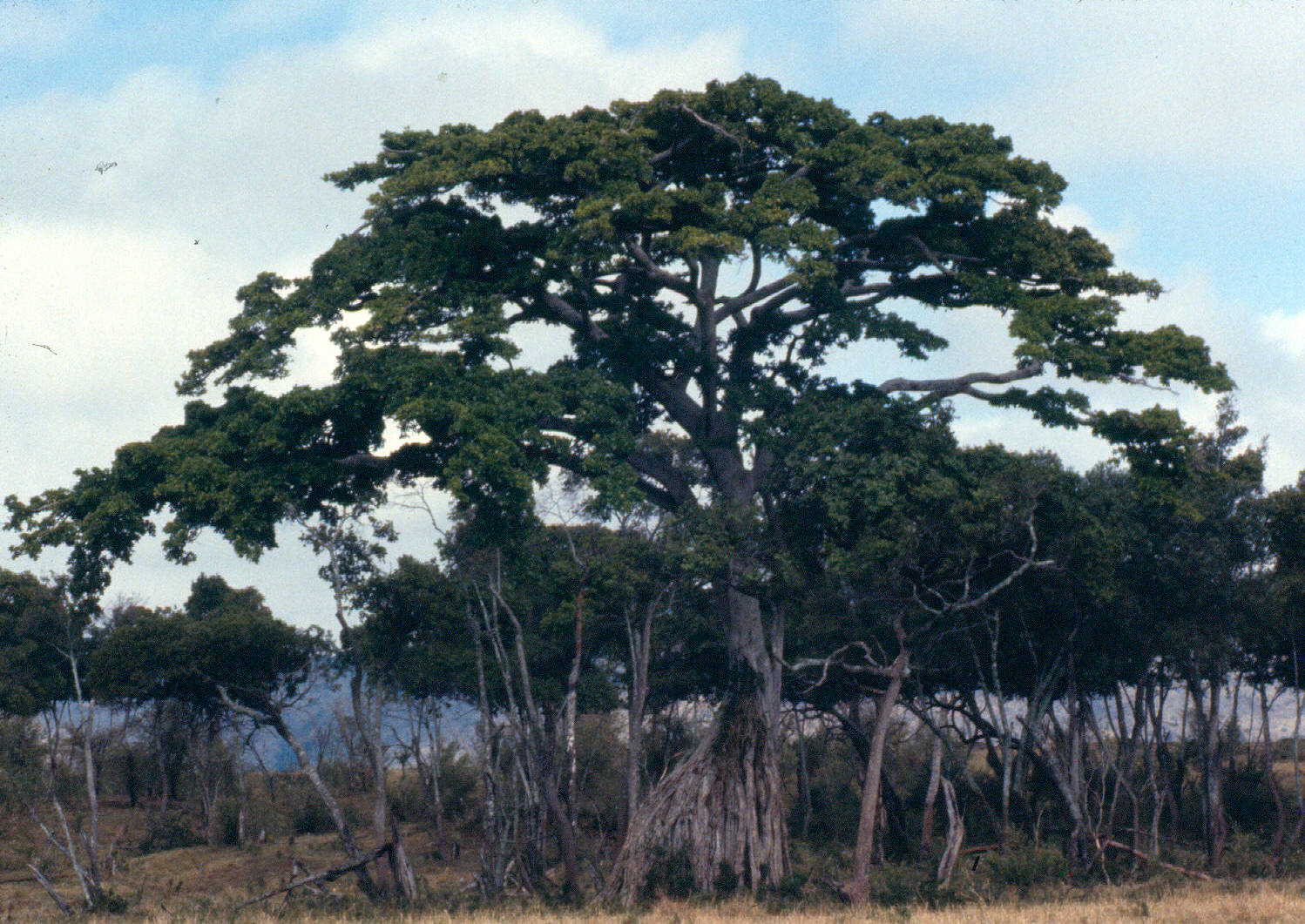
A notable tree in the Migori river forest.

A notable tree in the Migori river forest.

After lunch and seeing that there was not much to do I hatched the idea of a spear-throwing contest and mentioned it to Ernest. “What about an international spear throwing competition this afternoon?” “We can have participants from Africa, América and Europe, almost like the Olympic games”, I added. Ernest happily agreed and I got on with the organizing.

Apart from Ernest and myself there were also a Ugandan veterinarian and Kikuyu and Maasai assistants, admittedly both Kenyans but from different ethnic groups. “After all, we are in Maasailand” I thought and we should find a suitable javelin” “Let’s find a good spear and get the throwing field organized,” I said as I was already walking towards the herdsmen camp to arrange the details. “Tommi, I need to find a good spear” I said before I said good morning, and added, “I have an idea”.

He and the other herdsmen knew me by now and they smiled in anticipation. Tommi assured me that he could easily find the right tool as there were Maasai nearby that he knew. Good news!

A similar spear to the one used in our competition.

A similar spear to the one used in our competition.

While Tommi strolled through the bush in search for the spear we walked about to find a suitable field where the competition could take place. We found a good site and placed some distance marks while we waited for Tommi’s return. I also went around the farm inviting participants to the event. I managed to engage Joseph (Kikuyu, Kenyan) and Kiza (Ugandan) in addition to Tommi (Maasai, Kenyan), Ernest (Swiss) and myself (Uruguay). We had an international field!

By the time Tommi returned after lunch we were all ready and waiting. He brought a sturdy looking spear that we judged suitable for the task although it was rather long and heavy. It had a long metal blade, a wooden middle part and along steel rod at the end. It was time to start to get done before the daily 17:00 hours shower!

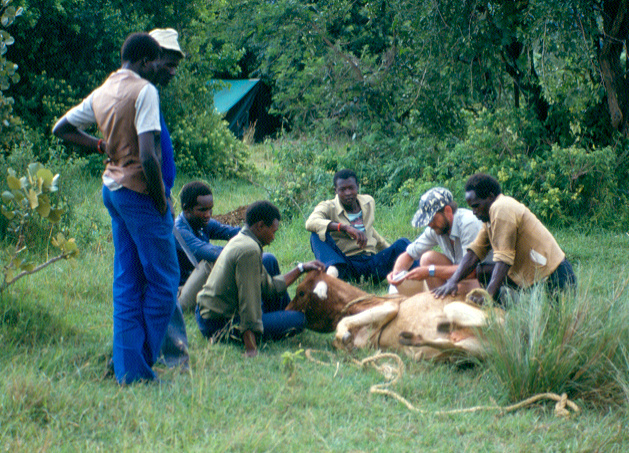
Ernest and helpers examining an animal for ticks.

Ernest and helpers examining an animal for ticks. The herdsmen tent can be seen in the background.
Av copy

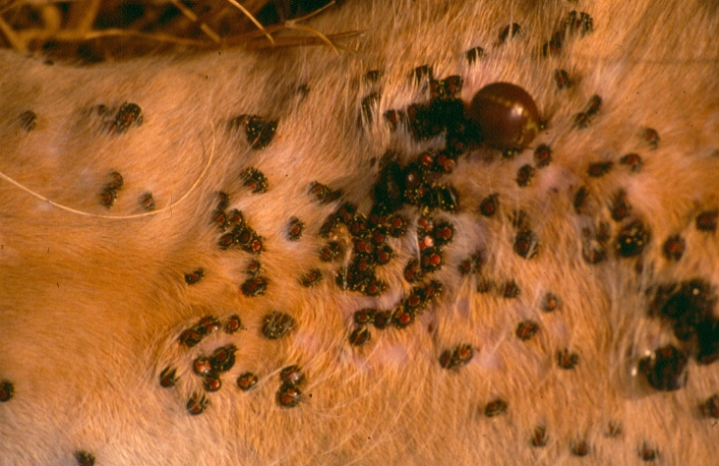
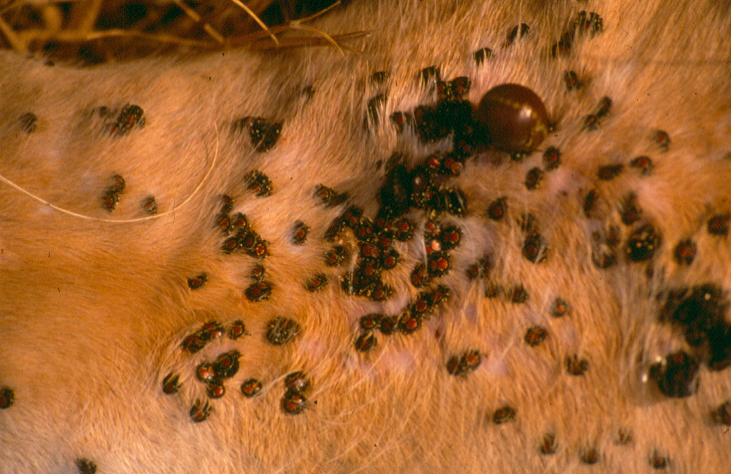
A heavy Bont tick infestation on a heifer at Intona ranch.

All participants agreed at the onset that measurements would be done in paces. It was thought that equal throws were unlikely and the need for laser-aided technology[1] was thought not to be required. No bets were allowed, as just by looking at the competitors, an inexperienced observer should have been able to guess who the favourites were! This did not come to our minds while we warmed-up.

As the start of the competition approached, the tension increased and, by the time we drew our throwing terms, it was almost unbearable… For some reason Uruguay went first, followed by Joseph the Kikuyu representative, Switzerland was third, Kiza, the Ugandan fourth and, a fitting finale, the last to throw was Tommi, Maasai. It may as well as he was the “host country”.

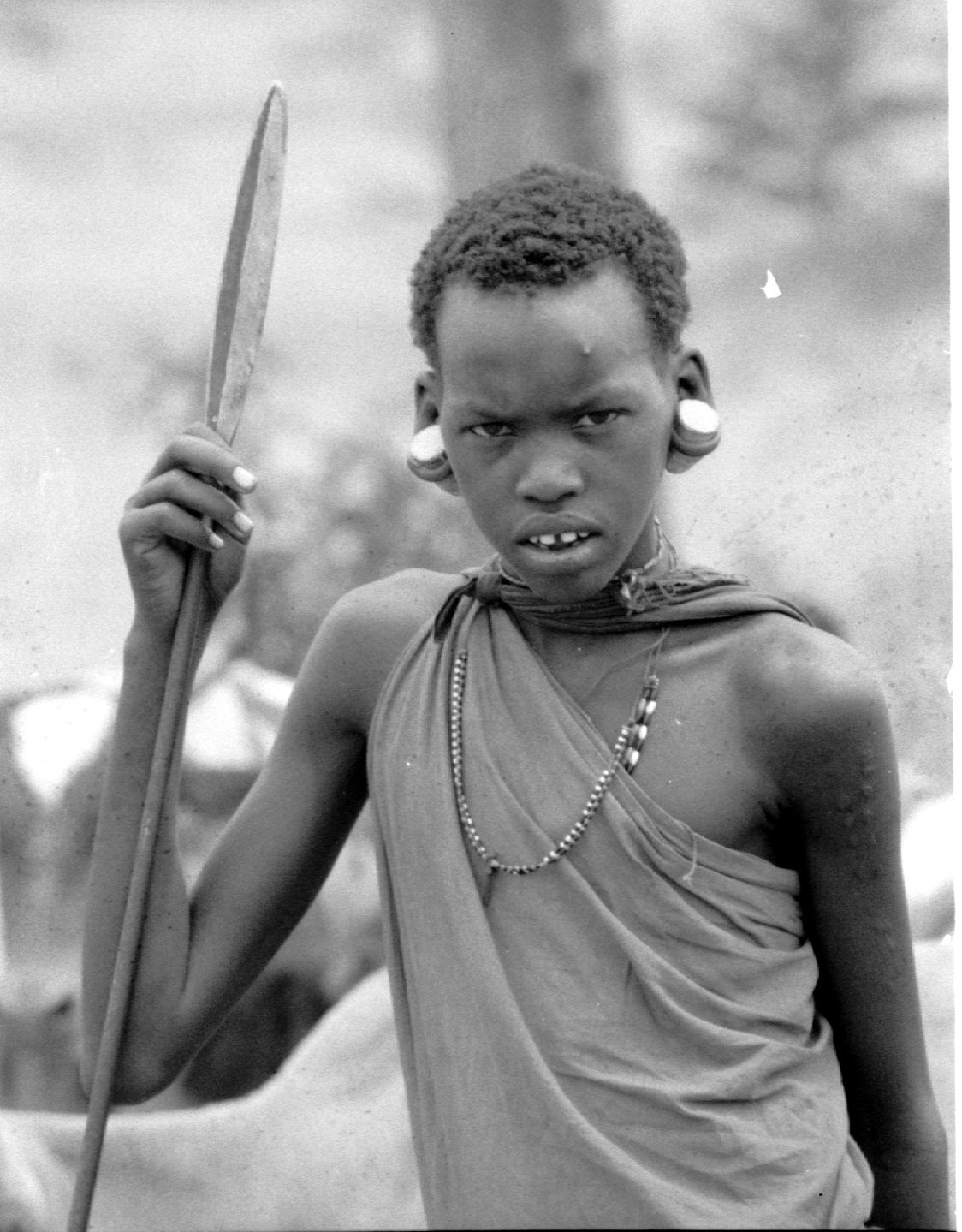
Aware that I would not win I argued in favour of some try throws to get the right balance of both body and javelin but, regrettably for me, the other competitors (unkindly in my opinion) refused arguing that this was not in the rules (?). So, resigned to my fate I grabbed the spear and got ready to do my best. It felt heavy and rigid. I threw it and, the second it left me I knew that there were problems with both direction and distance. It was a rather poor show that landed a long way from the cattle boma and far from my possible personal best. “I have never had any strength in my arms” I said, trying to feel better. “about 20 paces is not too bad for my age”.

Joseph was quite fit although he was from a relatively well off Kikuyu family and this was beginning to show around his midriff. His throw was better than mine but stopped at 26 paces. Ernest, the Swiss researcher turned athlete improved my mark by a couple of paces and Kiza, the man from Uganda, despite his relatively small size, did much better than all at about 30 paces. A big smile lit his face, as usual and a lesson to us all that size is not that important but good technique is!

It was the turn of the Maasailand representative, the final competitor. He was perhaps the most relaxed participant and the one that was enjoying the tournament the most! From the moment he picked the spear we all new that the competition was over! We exchanged resigned glances and head shakes and got ready for an Olympic humiliation! We tried our best to disrupt his throw by talking to him but, he just smiled and replied to our remarks without losing his composure.

He held the spear naturally, balancing its weight by instinct. Almost without running and with a fast and wide arm movement he threw it, almost unexpectedly and even casually. The spear flew high vibrating with a “swiiiiiiisshhhh”. It went beyond our throwing field and over the cattle boma. We lost sight of it but run in the general direction where we last saw it to see how far it had gone. Behind the cattle boma it was the herdsmen camp so, when we fail to find it inside the boma we got more worried and started looking around the camp. There was no trace of the spear anywhere and the camp looked normal. For this we were reassured as at least there were no casualties!

We looked around the tent, near the fireplace, chairs, table, up the trees and all over: no spear! Nothing stuck on the ground, nothing visible up the trees or stuck anywhere. “Another mystery of the African bush”, I thought, or some Maasai magic I was not aware of?

As there was no point in arguing in favour of declaring the throw void on account of it having gone beyond the throwing field or even worse, on account of the disappearance of the instrument, we declared our Maasai warrior the undisputed winner. The absence of the spear meant that there was no possible revenge. This came as a relief as a change of the result would have been unlikely!

I apologized to Tommi for having had the idea that has led to the losing of his borrowed spear and offered financial compensation for his loss. He said that he had thrown it and lost it so I did not need to worry. He will eventually find it he said. I expressed serious doubts but gave him the benefit of the doubt and, as the rain was starting, I moved to our tent.

That night, while we were having our dinner we herd loud talking and laughing at the workers camp next door and went to have a look. The spear had been found! In its wild trajectory it had gone through both the flysheet and the tent and it was embedded in one of the herdsmen’s camp beds, luckily empty at the time of the event! I felt great relief that nothing had happened and a lesser one that the spear could now be returned to its owner!

I cannot remember how I explained the tent holes to my senior managers. Maybe I did not and it just remained as normal “wear and tear”!

Transmara, Kenya circa 1986.

[1] I do not think it was available at the time, anyway!
Hyenas and planet-gazing

The morning after the Maasai chicken dinner a good breakfast was in order! We prepared bacon and eggs to compensate for our austere meal of the night before. In an attempt at avoiding another fasting episode I offered to take over the next dinner and to roast the beef we had brought from Nairobi.

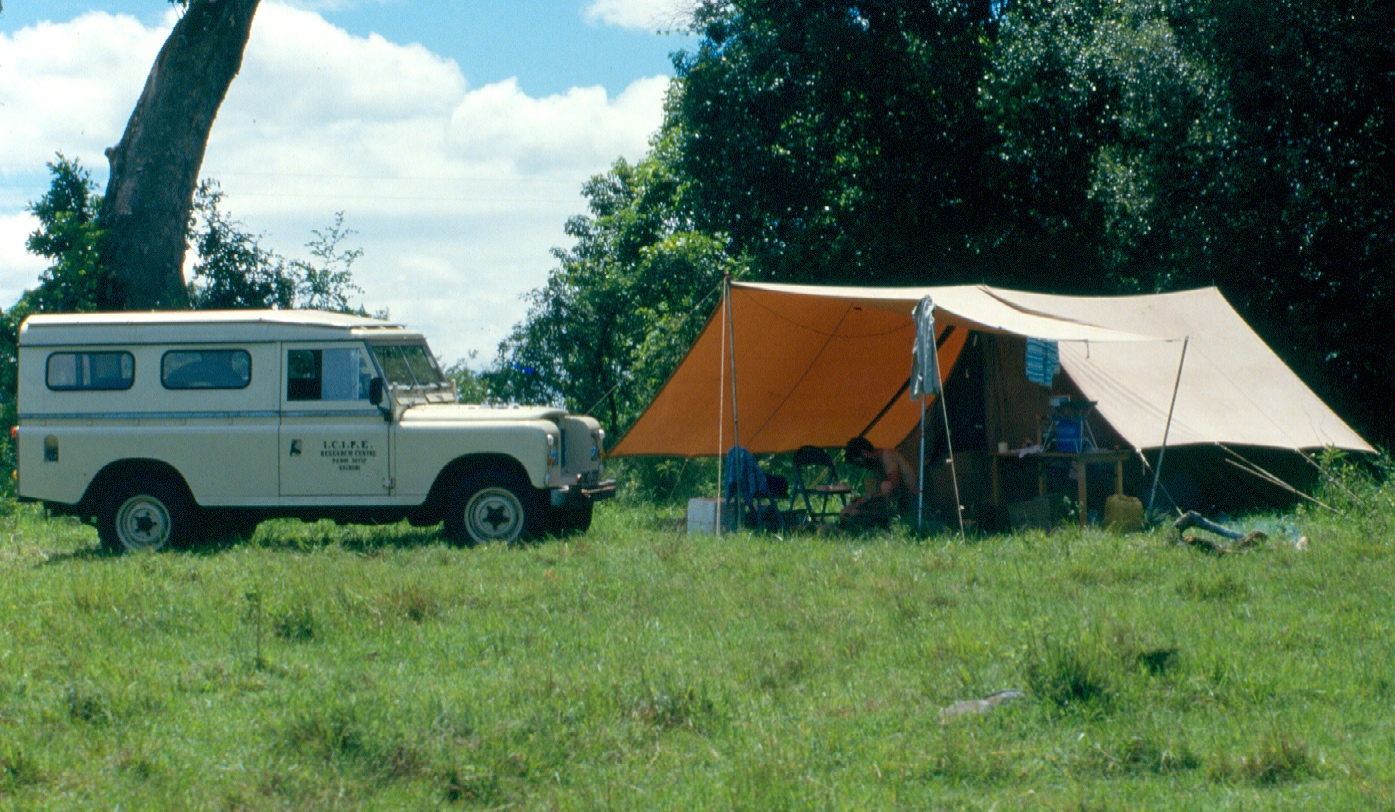
Camping at Intona ranch.

Camping at Intona ranch.

After breakfast, another day of routine field trials followed, as we needed to do many replicates of our tests in order to confirm the results. We worked without stopping until late afternoon when we decided that we had done enough and it was time for a shower and to prepare dinner. As a South American I am ashamed to confess that I am fearful of horses and prefer to keep a good distance from them. That is not all, I am a real disaster at barbequing! Therefore, on the occasion I struggled through and I made sure that the food was abundant and we ate our fill.

The night was truly spectacular. The relative short distance of Intona ranch from Lake Victoria meant that it rained very often. It poured in late afternoon and then the sky cleared at dusk. The consequence was that the rains cleaned the air and the night sky was always very sharp.

Ernest and I stayed awake until late talking and contemplating the pristine sky. We talked about many issues, occasionally stopping to listen to the night sounds, in particular the spotted hyena calls getting closer to our camp. Getting gradually bolder they moved close to the periphery of the light of our camp fire. I reassured Ernest that this was a normal event when camping at Intona and that “normally” hyenas would not be aggressive.

Despite the good time we were having, we have had a long day and we felt very tired so soon we went to bed. As soon as we were inside the tent we heard something sniffing all around our tent. A white-tailed mongoose was seen scurrying away when we shined our torches. That small mystery solved, it was back to bed, hoping that sleep would come soon.

Not so. This time it was a loud crush outside the tent that also merited investigation. This time a hyena was the culprit! The beast had grabbed a dirty pan and had taken off at speed. We run after the beast but it was a futile effort and came back to bed thinking on resuming the search for the pot in the morning.

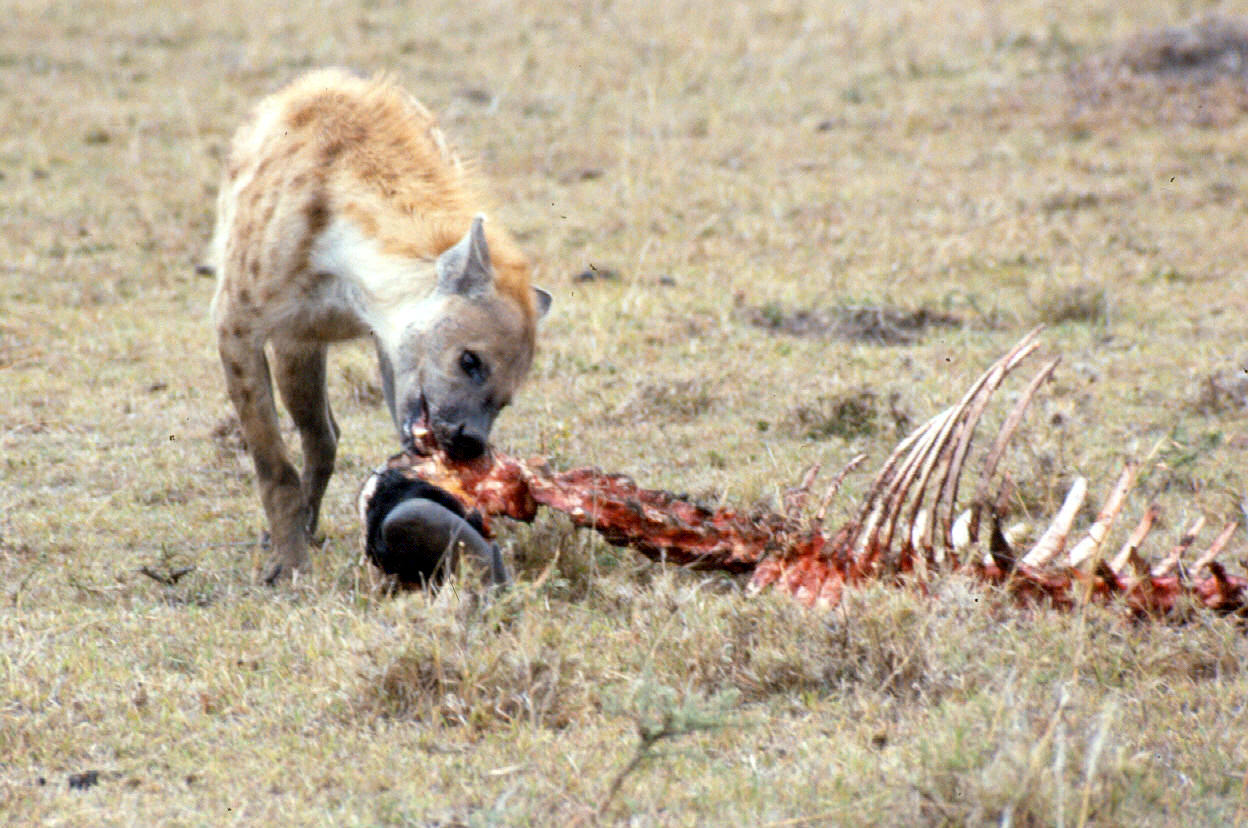
mmara hyena 2

A Brown hyena with wildebeest carcass in the Maasai Mara. Its cousins visited us nightly at Intona.

While thinking and hoping that normality would return, I finally fell sleep. Again, it did not last long. It may have been 03:00 hs when I heard Ernest opening the tent door zip. My first thought was that his gut had finally lost the fight against the filtered water drunk on the way in! In addition, aware of the hyenas I remained awake although without moving, hoping to go back to sleep immediately. No chance! Ernest came back and started to shake me up shouting “Wake up, the sky is perfect to look for planets!” I felt like slaying him but, remembering his partial deafness and on account of his contagious enthusiasm, I made the mistake of getting up!

By the time I managed to go out of the tent, Ernest was already looking through the binoculars, identifying the various noteworthy celestial bodies, accompanying his successive discoveries with shouts of joy! Although I had enjoyed contemplating the night sky both in Uruguay and in Kenya, I have never been that interested in astronomy. However, he convinced me to look at Jupiter (a small orange sphere) and even managed to see Saturn and what I though were its rings! Finally Ernest’s excitement subsided and we managed to hit the camp beds again, this time until the sun was up!

The large ball of crunched aluminium that we found about one hundred metres from our tent was not the remains of a recent asteroid that had narrowly missed us but all that remained from our cooking pan after the hyenas had squished it to get its juice.

Although our cooking options suffered another severe setback we still managed to produce some pan-less and chicken-less dinners during the following days!

Skewered Maasai chicken

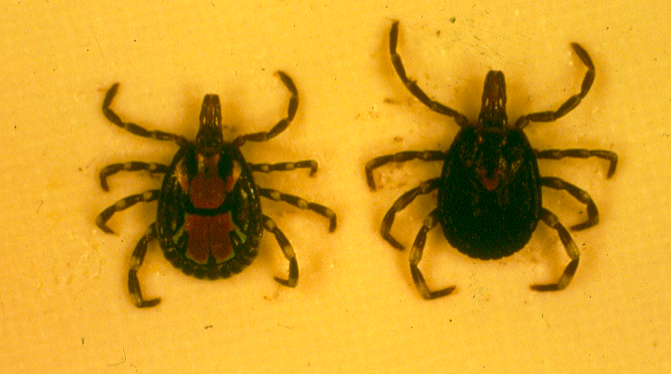
When I was there in the 80’s the International Centre of Insect Physiology and Ecology (ICIPE) in Kenya had established various partnerships with universities and research centres outside Africa. I was involved with the collaboration with the University of Neuchâtel on tick pheromones. The idea was to explore ways of attracting ticks to pheromone-baited traps and, with the addition of a tickicide[1], to destroy them.

Bont ticks male (left) and female. A bad picture.

Bont ticks male (left) and female. A bad picture.

The composition of the aggregation pheromone of the Bont tick[2], one of the important cattle ticks, had just been discovered. It was a mixture of three chemicals that were available commercially. This offered us a good opportunity to test this compound in the field. Ernest was the scientist from Neuchâtel that would work with me at Intona ranch where natural populations of the tick occurred.

Ernest was a very enthusiastic and good-humoured Swiss that had a hearing problem as a consequence of firing cannons during his military service in the Swiss Alps, forgetting about wearing earmuffs! Luckily, we got on well from the start. So, armed with the necessary research tools, we departed for Intona to spend a few days doing fieldwork.

As a precaution, we did take a few ticks from the tick colony in case the bush ones would not cooperate! Crossing the Maasai Mara Game Reserve was never disappointing and, as usual, we spent a night there on the way to the Transmara where Intona was located. Ernest was delighted being able to see the plains game and we wee also lucky to spot elephants, lions and hyenas.

In the morning, as usual, we laboriously climbed the Oloololo escarpment and stopped to admire the breath taking view of the Mara triangle from its highpoint. The almost aerial view that it offered was really thrilling, even for me, a regular visitor to the area. Lines of wildebeest could be seen in the distance as well as dark patches that indicated buffalo herds. As I knew he would, Ernest loved the view. After spending a long while in contemplation, it was time to continue our long journey.

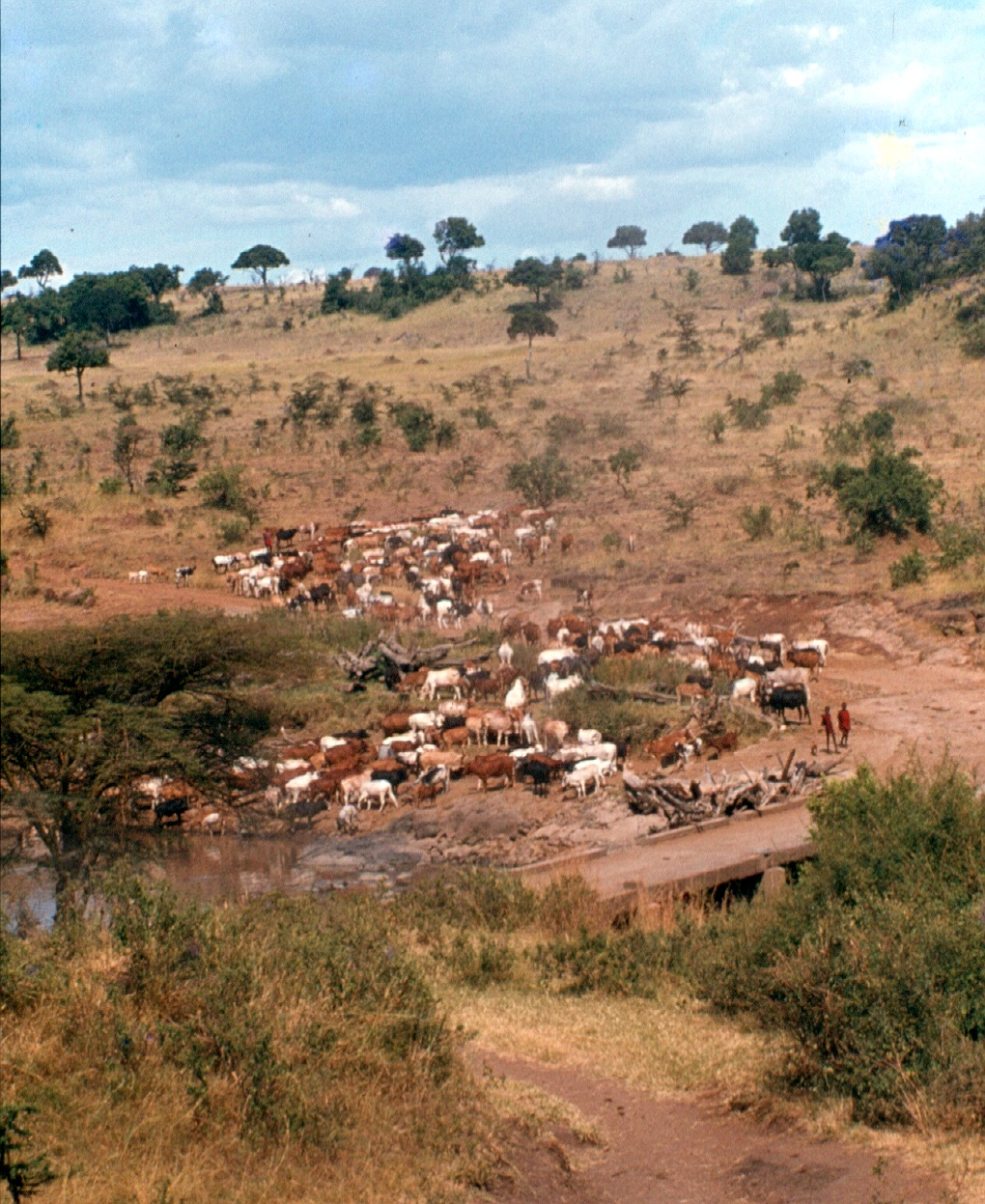
Maasai cattle at the Mara River bridge on the way to the Transmara.

Maasai cattle at the Mara River bridge on the way to the Transmara.

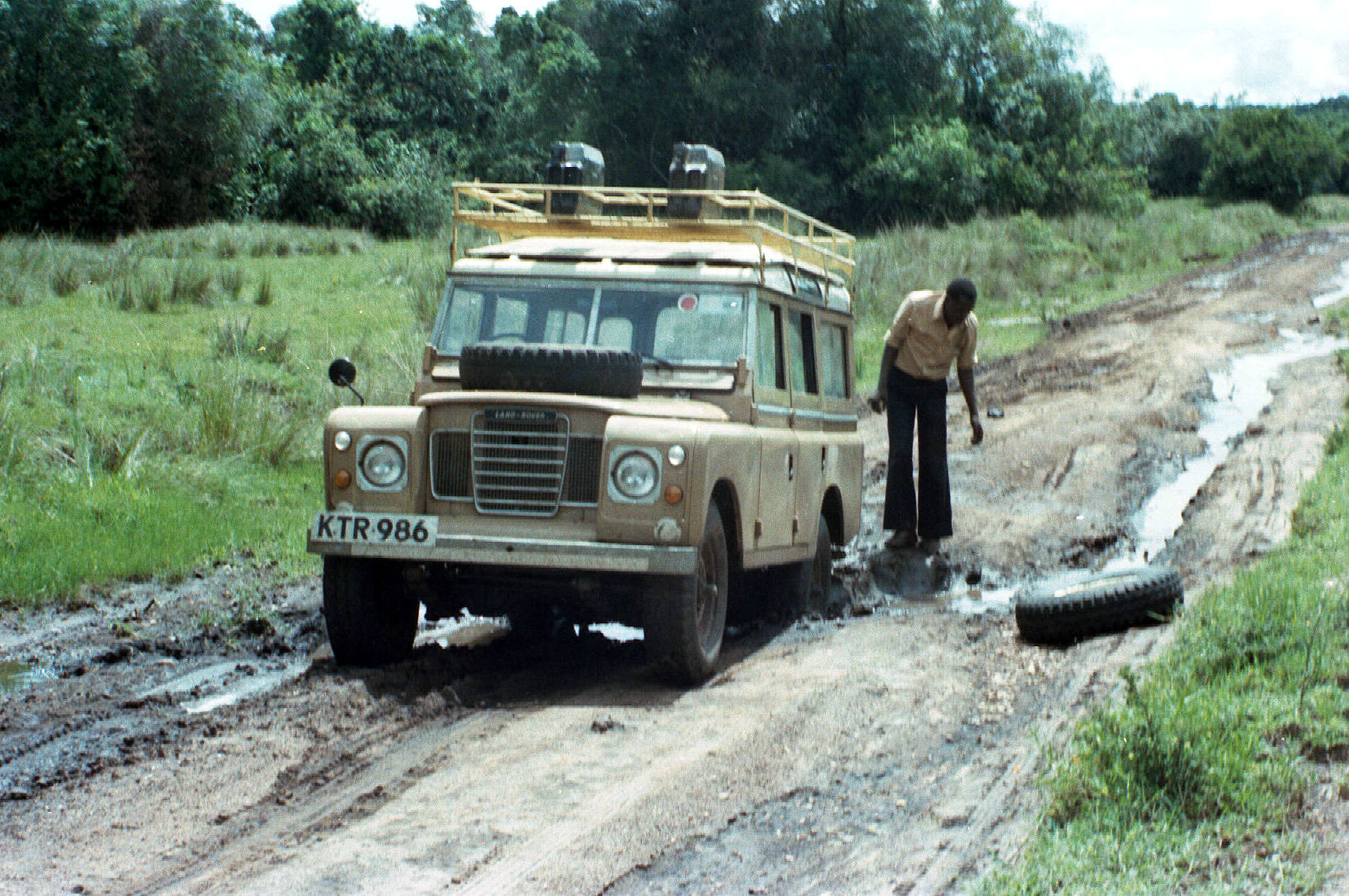
Following the escarpment the road was bad as usual but luckily this time it was dry. However, we needed to stop a few times, not because of getting stuck or having mechanical problems, but because Ernest was amazed at how bad the road was! “Ooohh no, please stop!” he would shout and then get out of the car to photograph it even before I managed to stop. Clearly he was comparing the Transmara tracks with the Swiss roads!

Stuck on the way to Intona on a rainy day.

Stuck on the way to Intona on a rainy day.

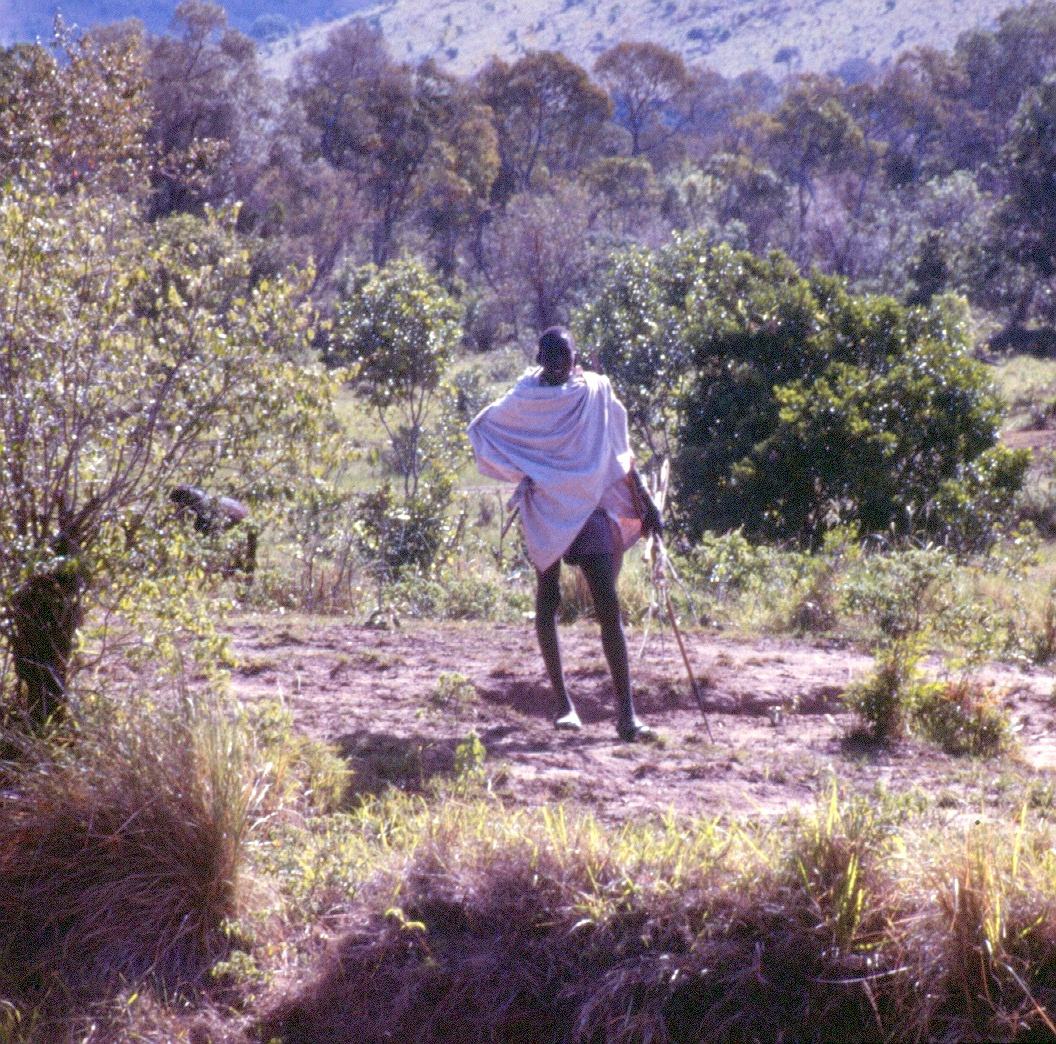
Eventually, after a few halts, he got used to the rough road but, being a very active person, his attention drifted to other things. As all first time visitors to the Transmara he took a great interest on the Maasai people and their cattle, a normal sight in the area for me but quite so for guests. As the Maasai were not keen on pictures, we did not stop.

Maasai herdsman on the way to Intona.

Maasai herdsman on the way to Intona.

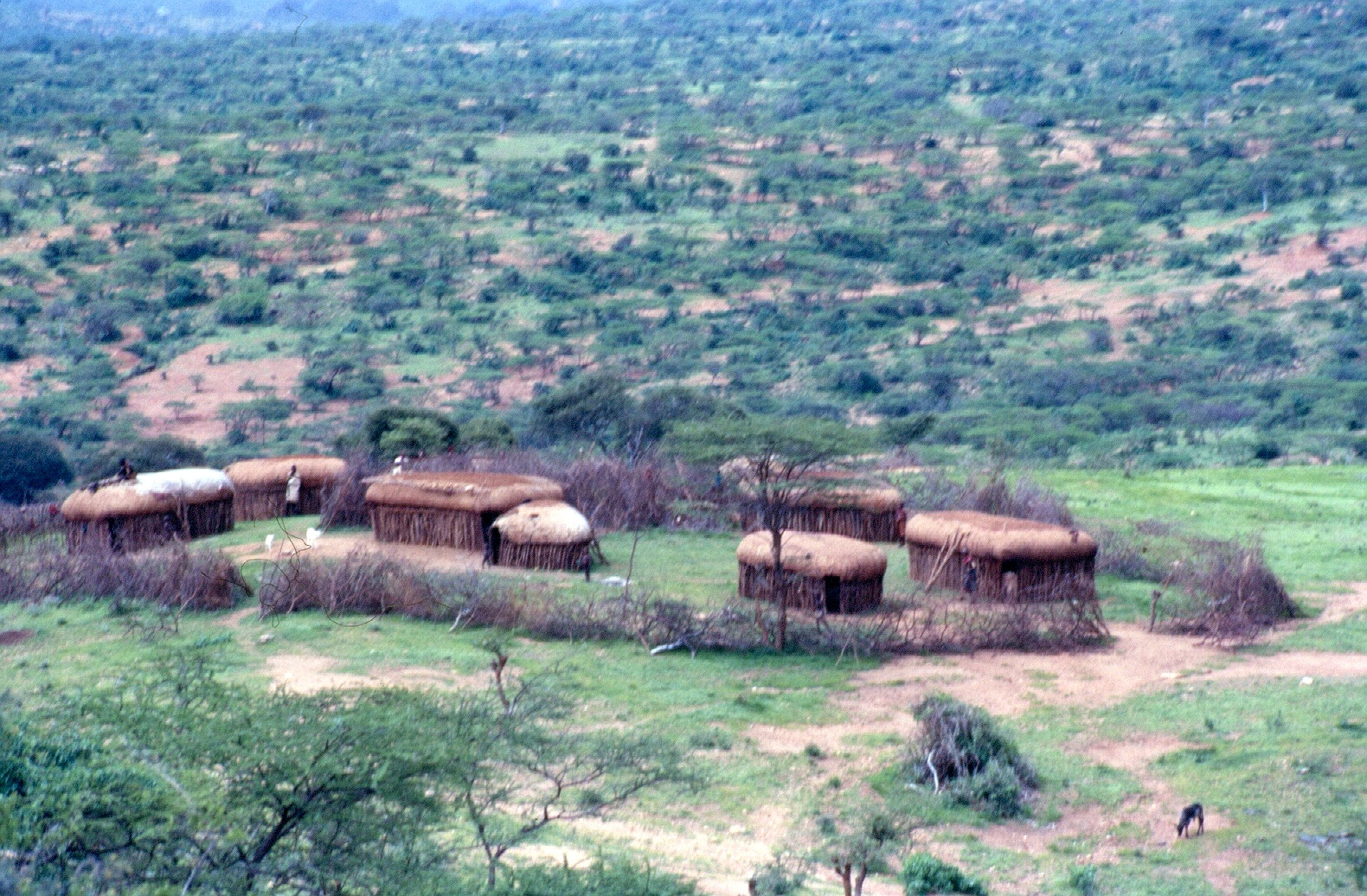
Maasai Manyatta (dwelling).

Maasai Manyatta (dwelling).

Maasai children looking after livestock.

Maasai children looking after livestock.

After about half an hour of hard going I heard “Stop” coming from Ernest as we approached a large muddy pond by the side of the road. While I stopped the car he rummaged in his rucksack from where he extracted what looked like an over-sized hypodermic syringe and a tumbler. I was not sure of what was going on and limited myself to watch, together with our herdsmen travel companions. “This is a Swiss water filter that will make any water suitable for drinking” he said as we were walking towards the mud and the terrapins swam away in fear! He added “It is recommended by the Swiss Tropical Institute, so it must be good!”

Without further ado he sucked water into the syringe and, once it was full, it poured into the glass. The water was indeed crystal clear! “You see,” he said, showing the glass. I must confess that it was an impressive feat as the puddle was truly a thick chocolate mud and I had not seen such a contraption before! Ernest offered the water to us and, when we all politely declined, he drank it himself before I could stop him, fearing for the consequences on his guts.

After praising the quality of what he had just drunk, he repeated the operation once more. This time one of the herdsmen agreed to try it and he agreed that it was indeed OK if with a bit of a muddy taste. “The filter must be getting clogged,” declared Ernest, “I must clean it when we get to Intona”. I refrain from commenting on the cost-effectiveness of the device and we resumed our trip, clearly ready for innovation.

Eventually we arrived at Intona ranch. It was almost dark so we rushed to assemble our tent, had an early dinner and went to bed as we both felt the long two-day trip.

The following day we started our work early and spent most of the day carrying out several trials that were quite successful. In the afternoon we decided that we would have roasted chicken for dinner so while Ernest continued working I went with Tommi, my Maasai assistant, in search of dinner. Eventually we managed to persuade a Maasai lady to sell us a cockerel.

Our prospective dinner was killed by me and plucked by Ernest. The size of its talons were unequivocal indicators of its seniority and its leanness qualified it as a Maasai chicken long-distance runner! Its muscular condition spoke of speed and endurance at the service of survival! Oblivious to all this, Ernest assembled a boy scout-like contraption with branches where, after impaling the chicken, it would be rotated over the fire. We invited our herdsmen to join us and they prepared their traditional “ugali[3]” to go with it.

The cooking of the chicken took a very long time. Ernest kept stabbing it and declaring that it was cooked but still tough. The lengthy turning process led to inexorable shrinking and darkening until it was declared fit for human consumption. The cockerel had turned into a “toasted baby chicken”. I saw the herdsmen exchanging doubtful glances over their Tusker beers, a bad omen!

Ernest cut it into equal pieces and -luckily- Joseph placed large chunks of ugali to go with it. Tommi bit the first piece and I heard a “Taargh” coming from him that became a clear “tough!” once he managed to swallow it. Bad news coming from a Maasai! Ernest agreed on its toughness but declared that it tasted like real chickens did a long time ago in Switzerland so he was happy! As for the rest of us, we could have done with a second runner Maasai chicken!

Transmara, Kenya, circa 1986.


[1] Also known as an acaricide, a substance that kills ticks.

[2] Amblyomma variegatum (the Bont tick) transmits Cowdria ruminantum that causes a deadly disease of ruminants known as Heartwater.

[3] From Swahili, maize flour cooked with water to a thick porridge. It is the staple food in Kenya.

San paintings

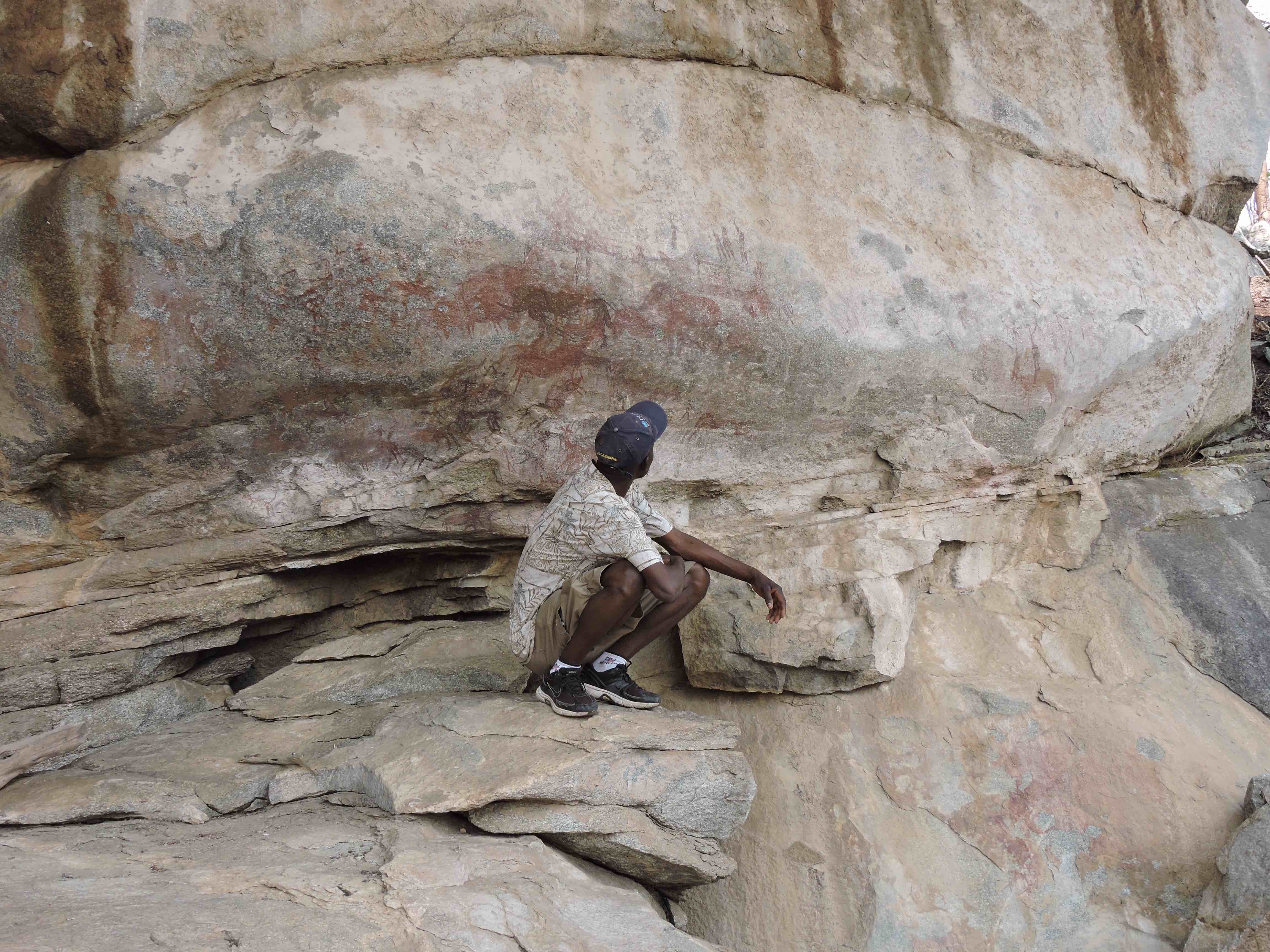
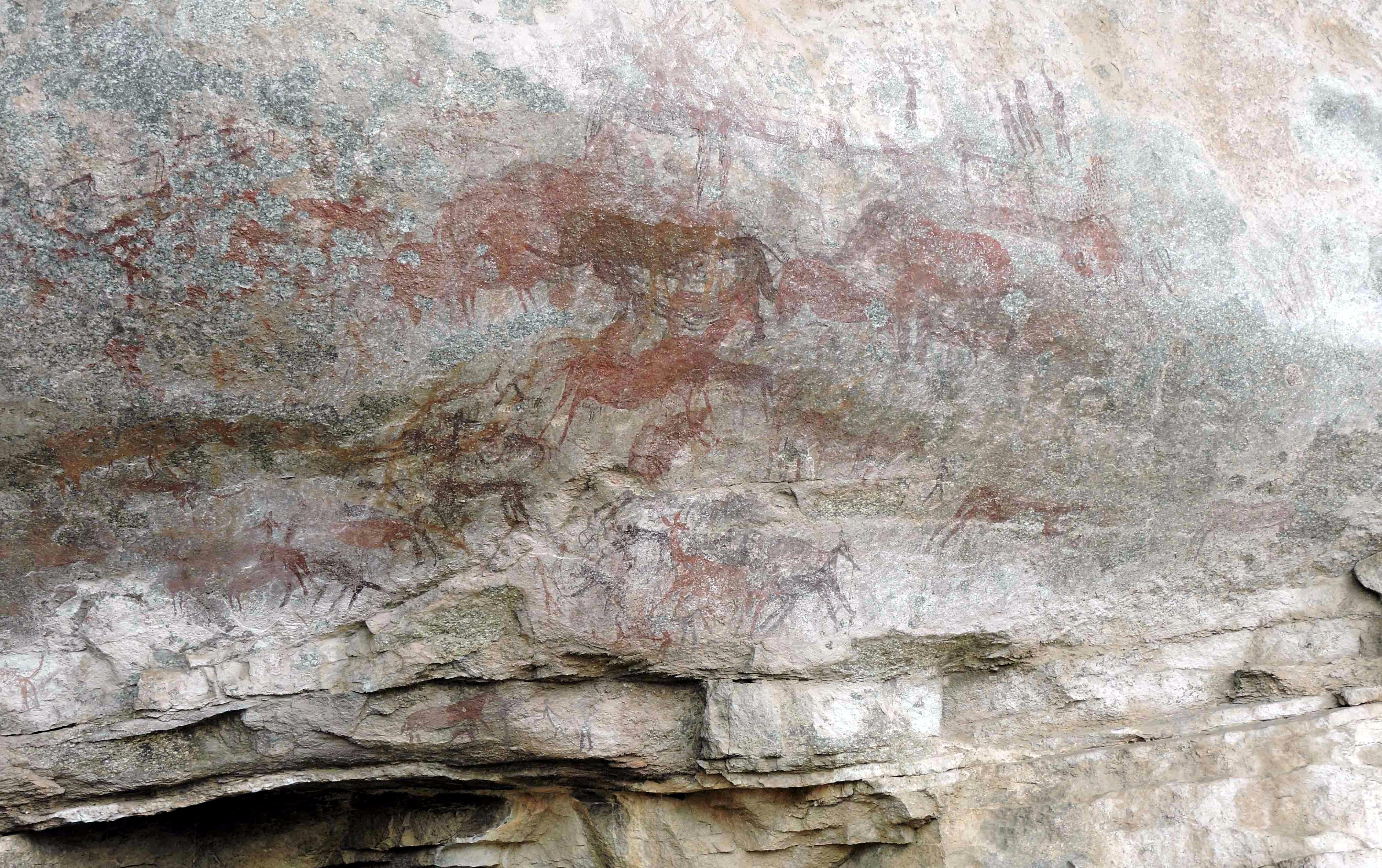
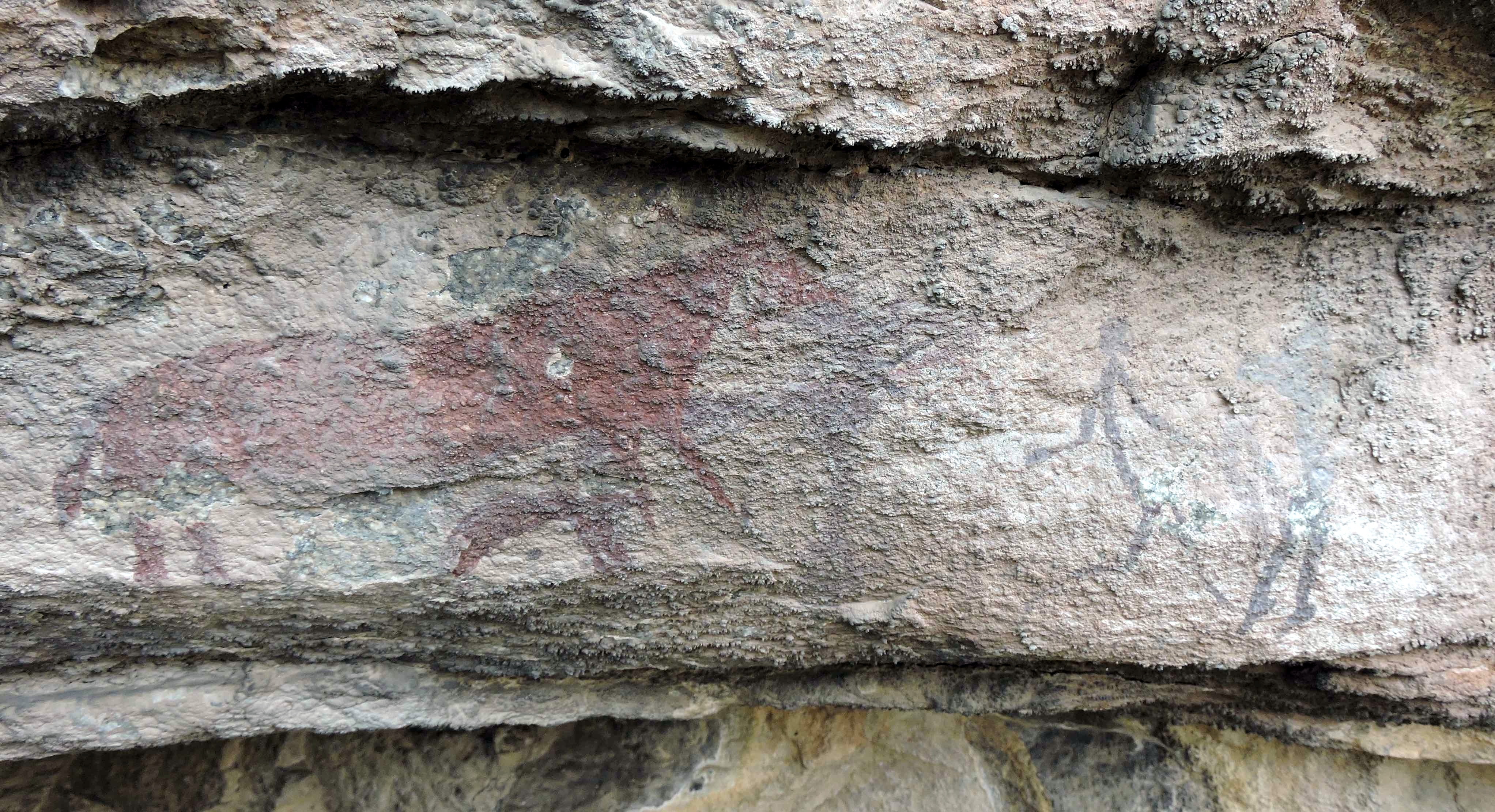
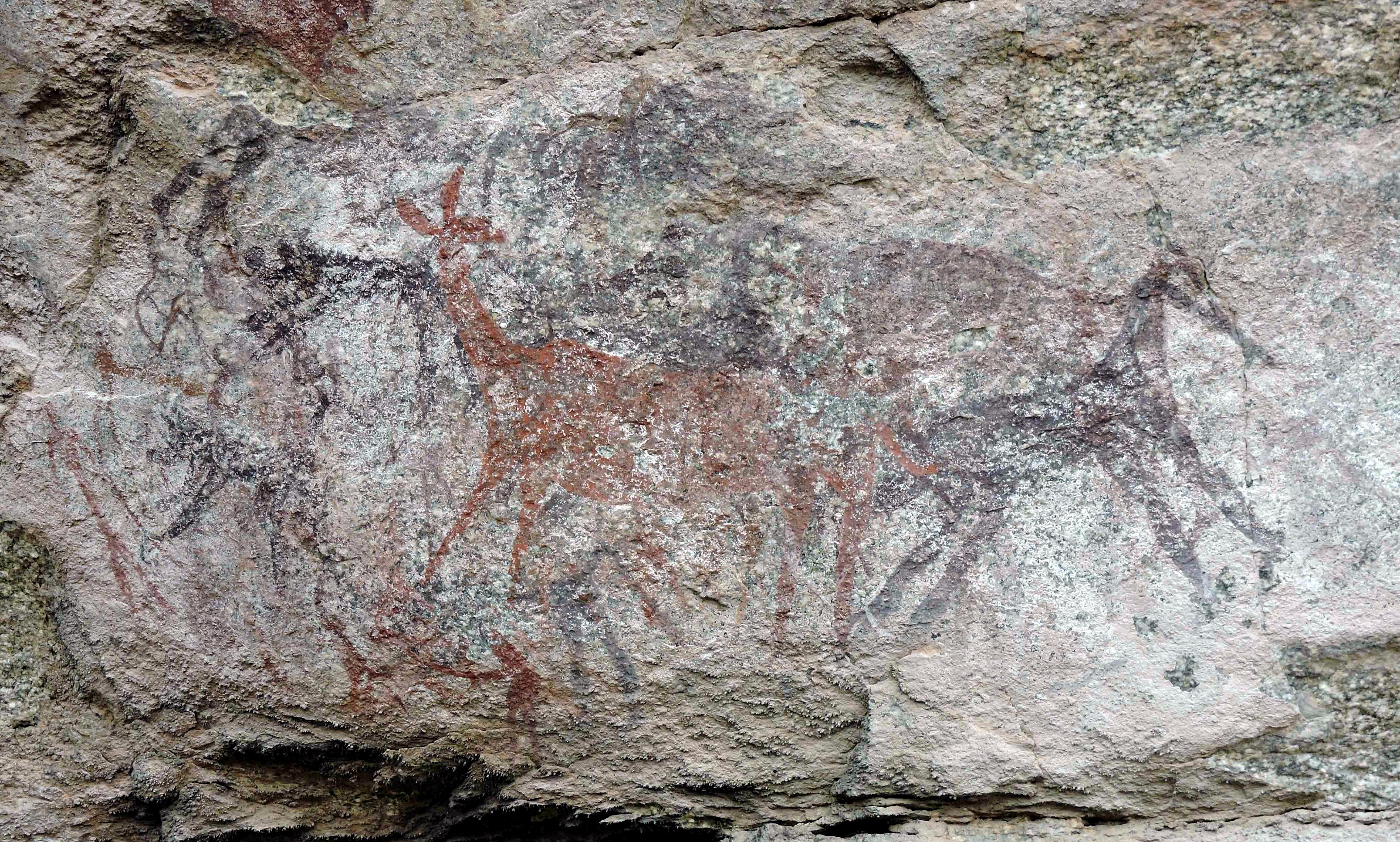
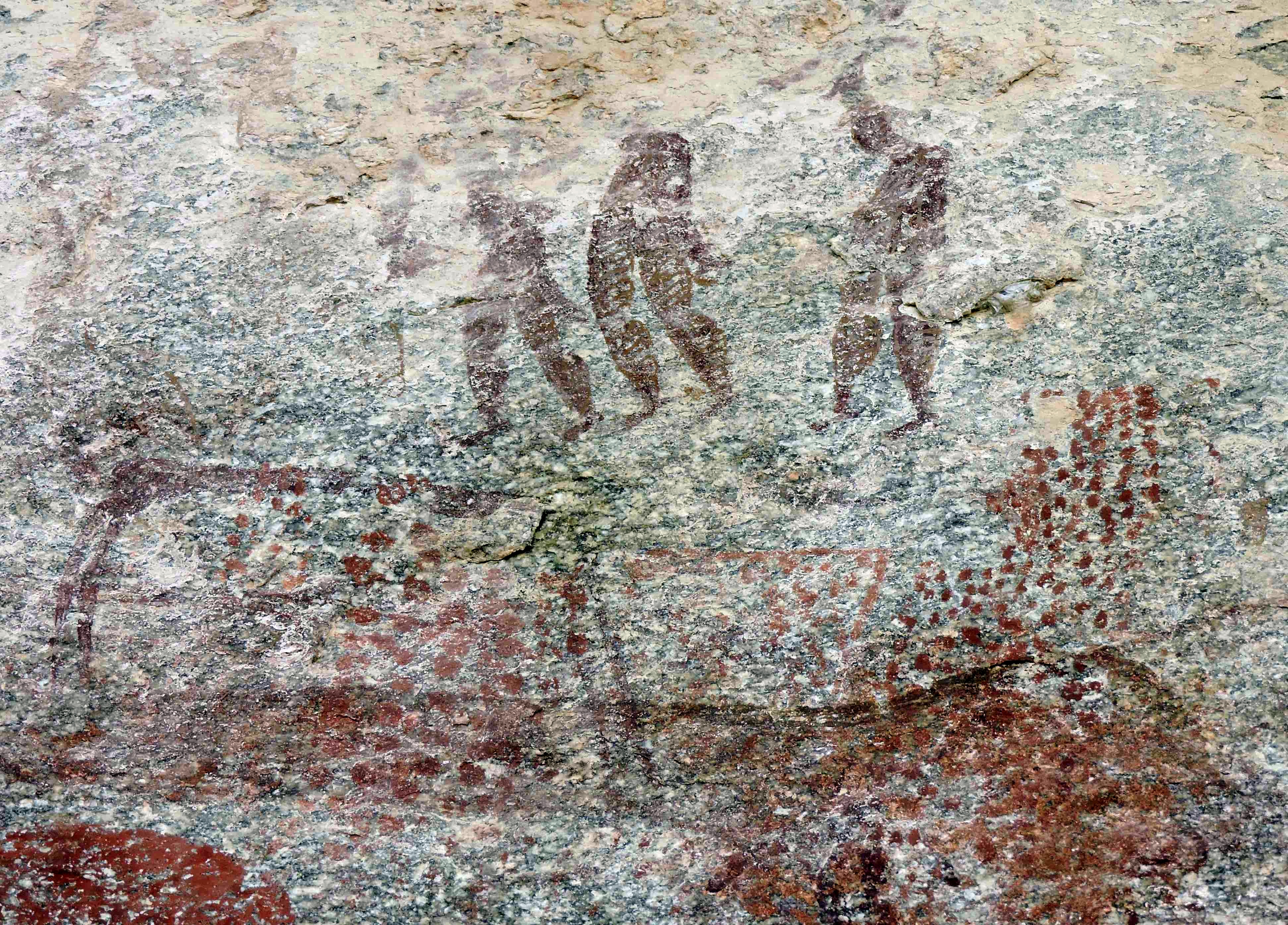
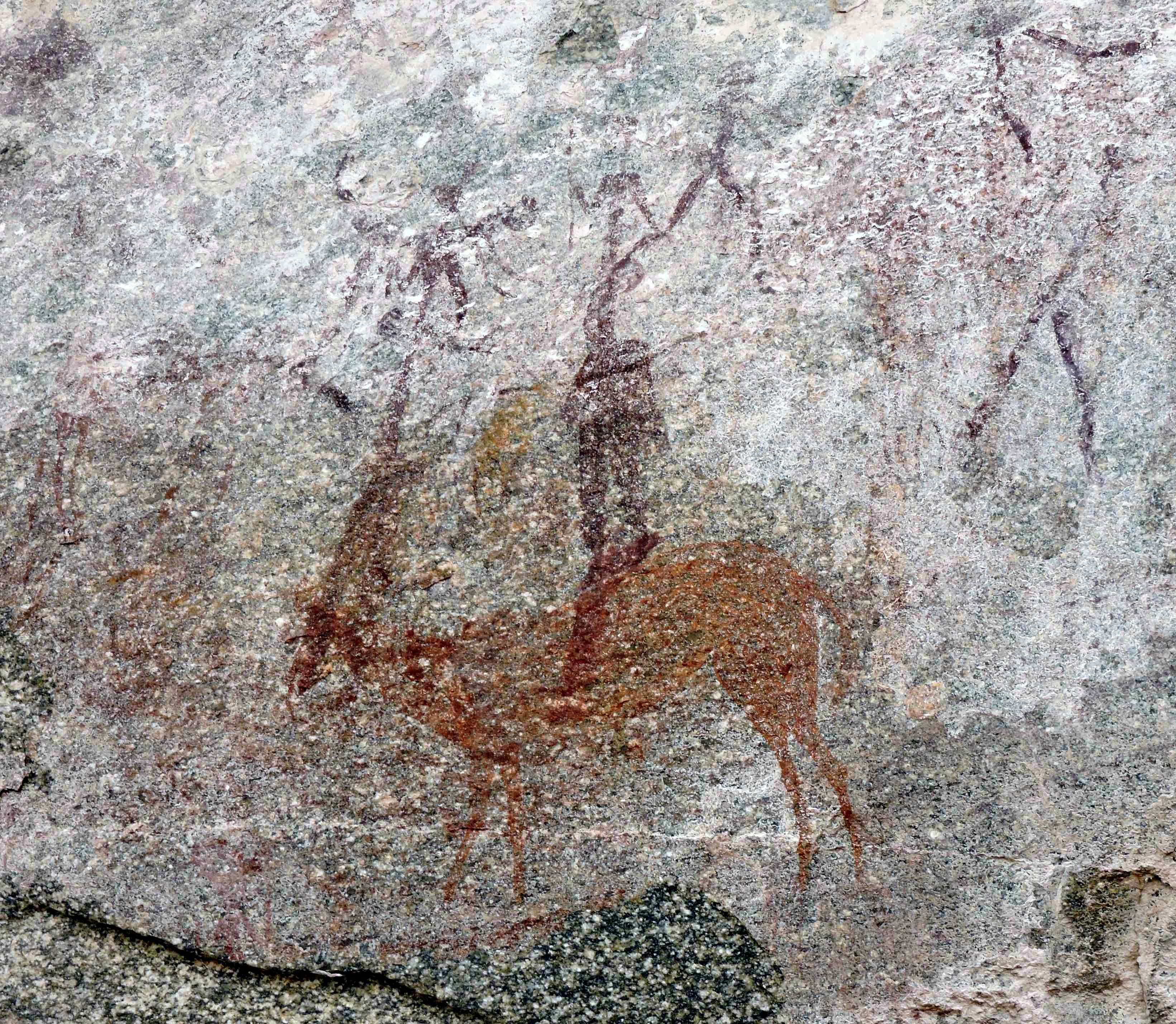
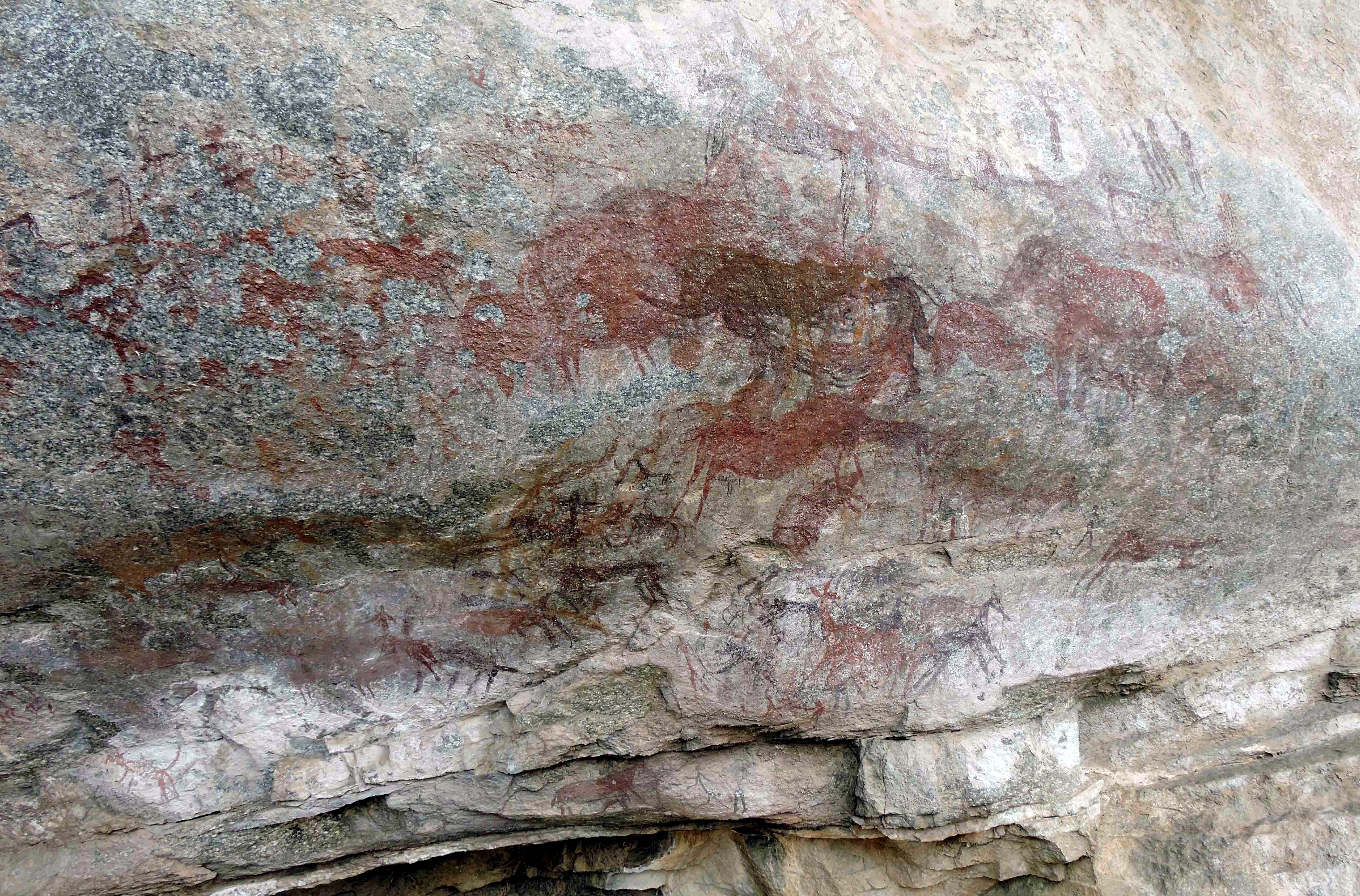
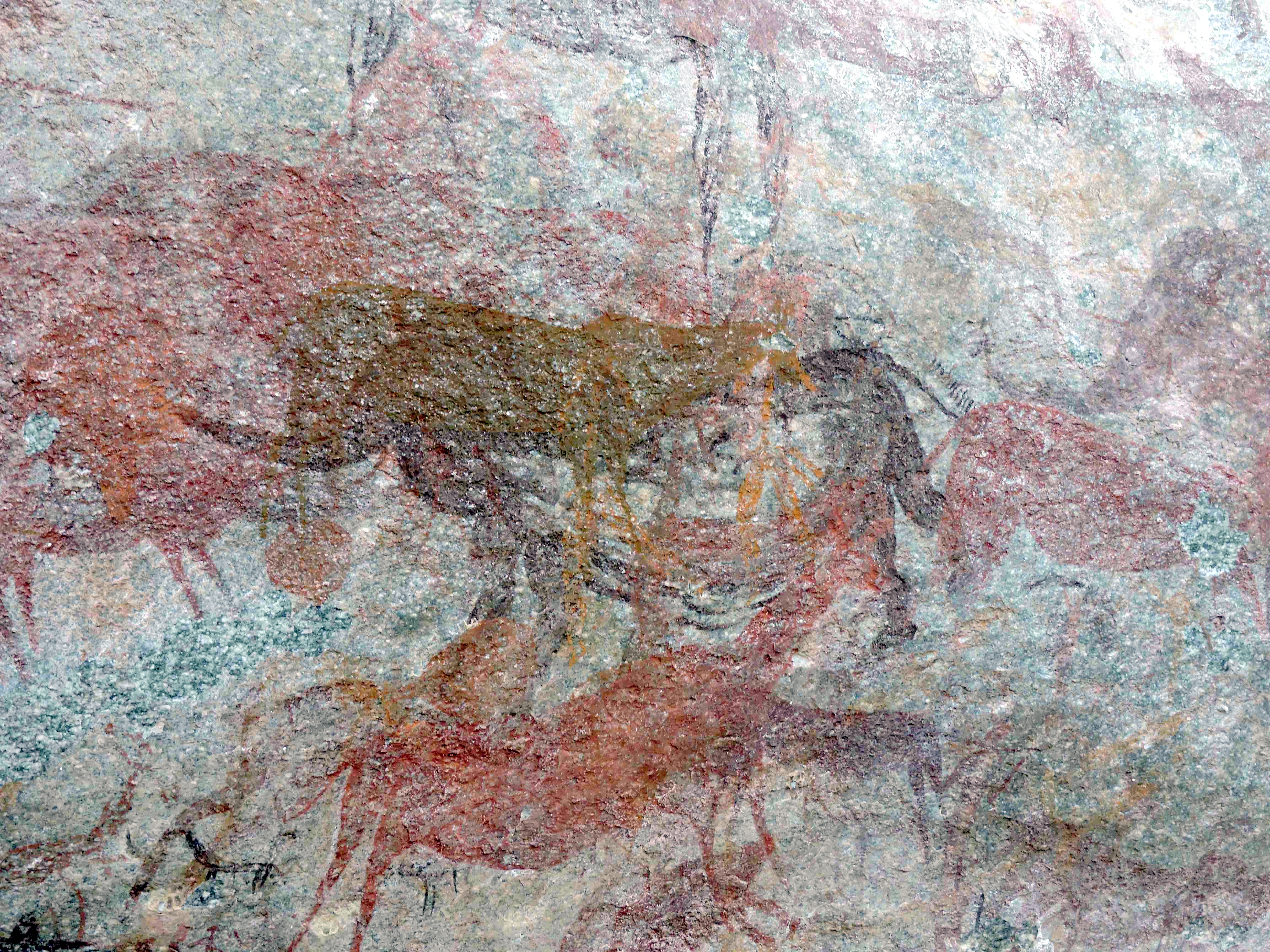
During our visit to Hippo Pools, apart from the eagle nest and baobab, we also visited one of the sites where San paintings had been found some time ago. Although I searched the web for some specialist information on these particular paintings, I failed. However, I present you with a gallery where I insert my comments on what I saw and you may see things in a different way.

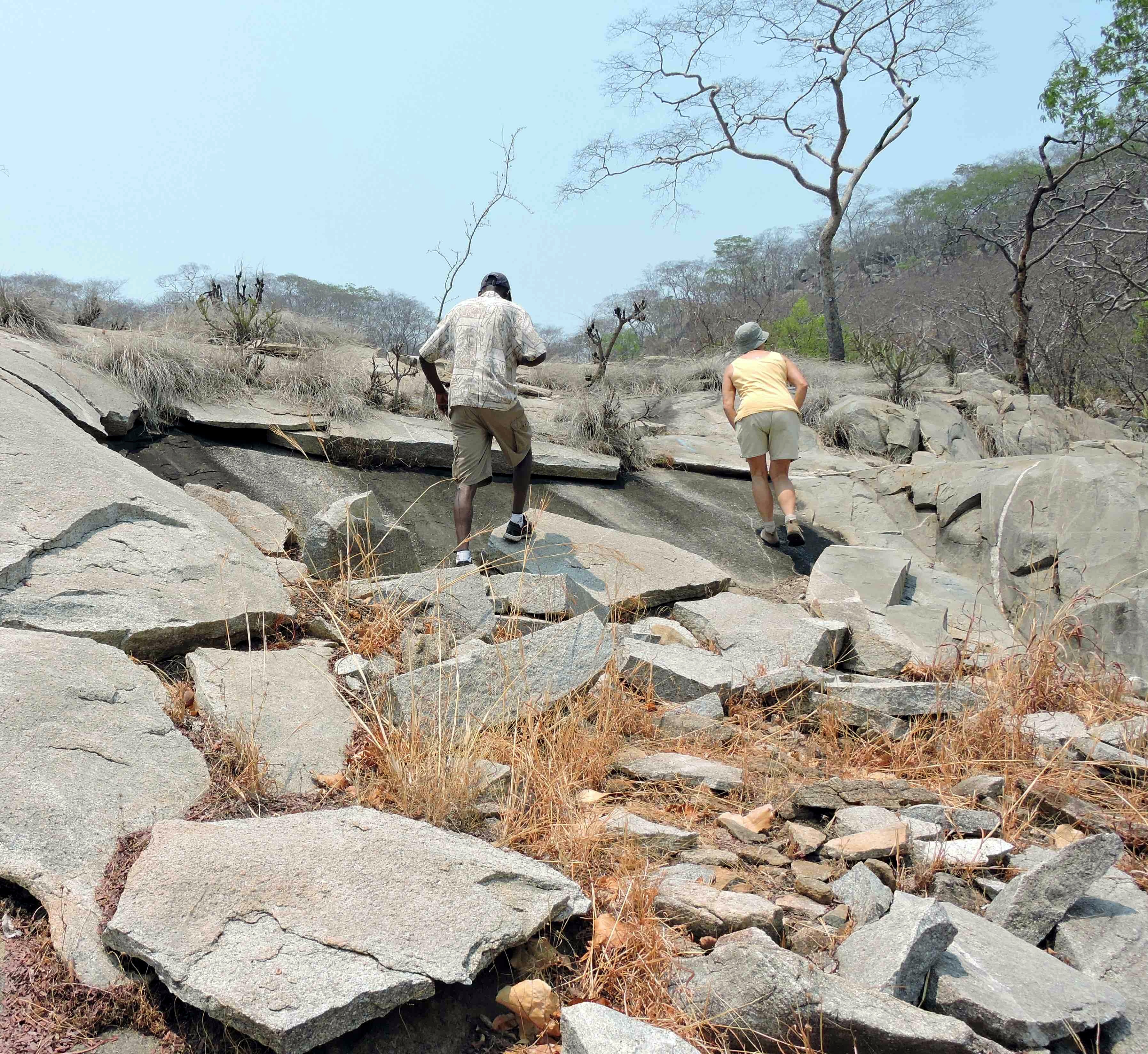
The San always chose hard places for their art!

The San always chose hard places for their art!

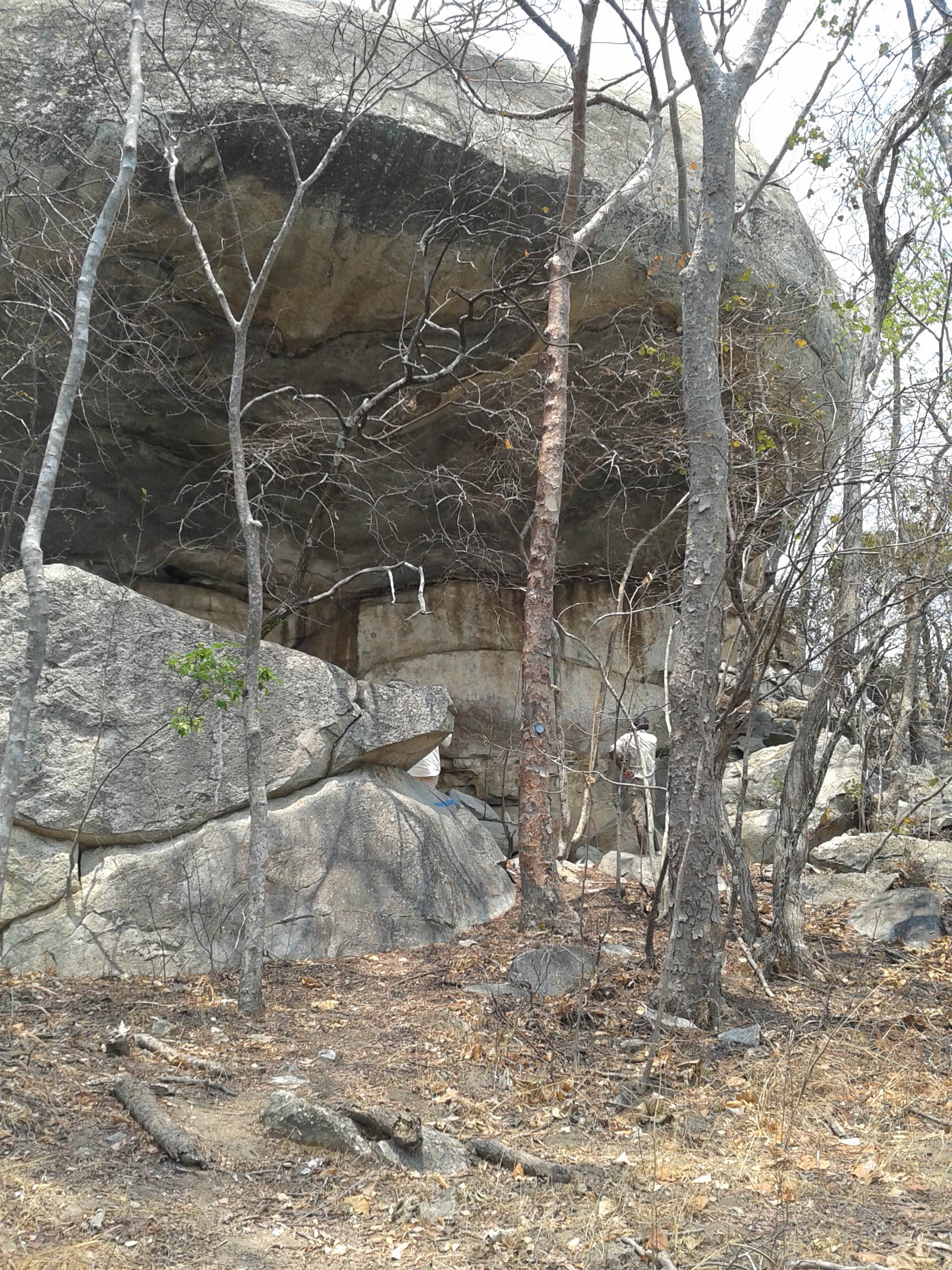
Finally we spotted the rock ledge.

Finally we spotted the rock ledge.

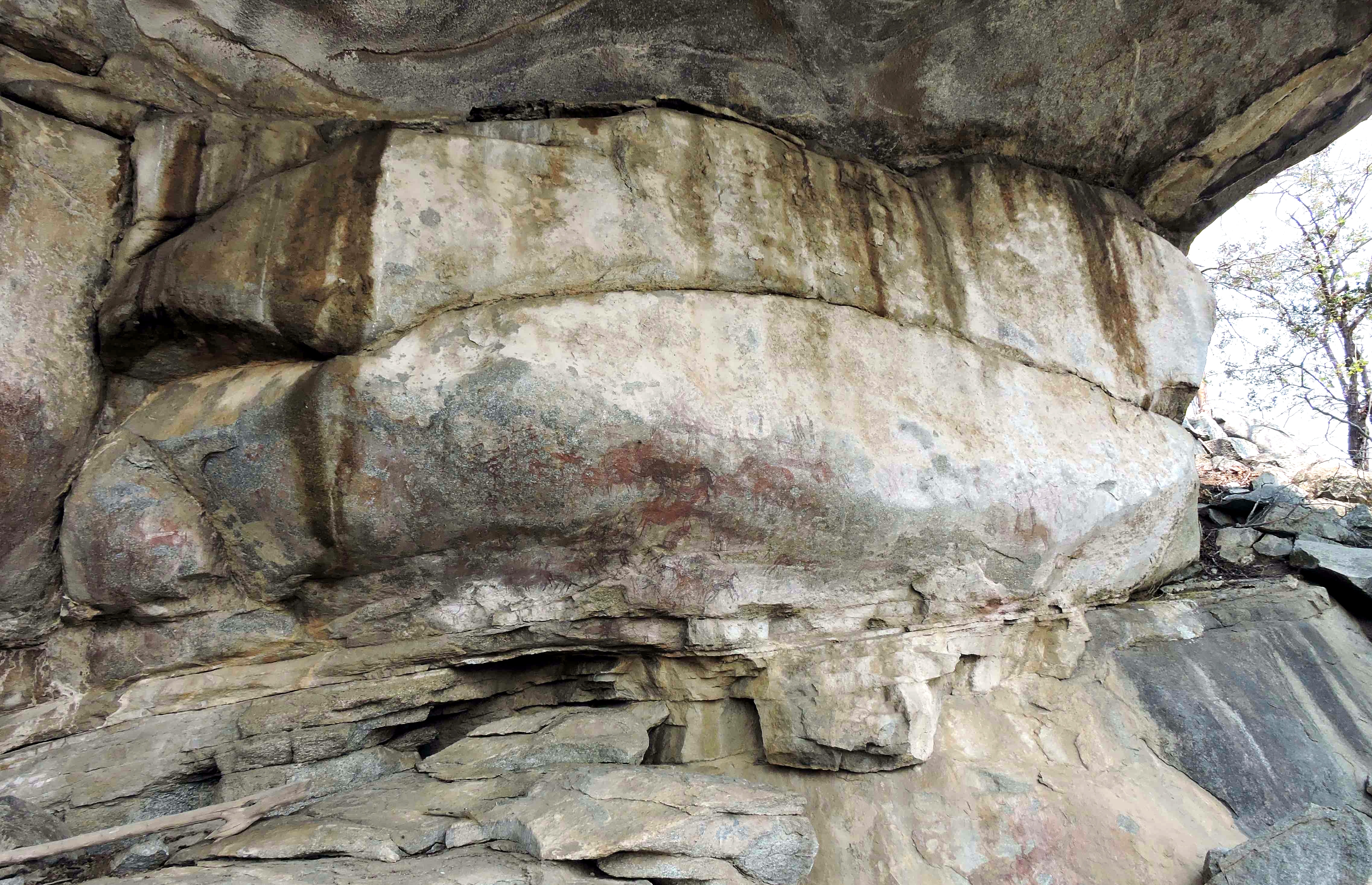
A close-up of the "canvas".

A close-up of the “canvas”.

DSCN8140 copy

Stephen, our assistant and now safari companion, watches the paintings.

DSCN8139 copy

An overall view of the paintings. Unfortunately some damage has taken place.

Eland and hunting party?

Eland and hunting party?

DSCN8147 copy

Antelopes and hunters.

DSCN8149 copy

A view of their camp?

Although it seems that there is a rider on the antelope this is probably the way the painting of the hunters and the animal was done.

Although it seems that there is a rider on the antelope this is probably the way the painting of the hunters and the animal was done.

DSCN8154 copy

On first look this seem to depict a rhino looking towards the left (ochre colour) and probably an elephant behind (reddish).

DSCN8153 copy

A close-up of the “action”. Although an ochre-coloured rhino could be seen looking left, its horn might be the tail of a lion/leopard(?) that has jumped on an animal with the head looking towards the right?

20151009_111741 copy

On the way back we found some of Nature’s own art!

20151009_111756 copy

More natural art.

20151009_111426 copy

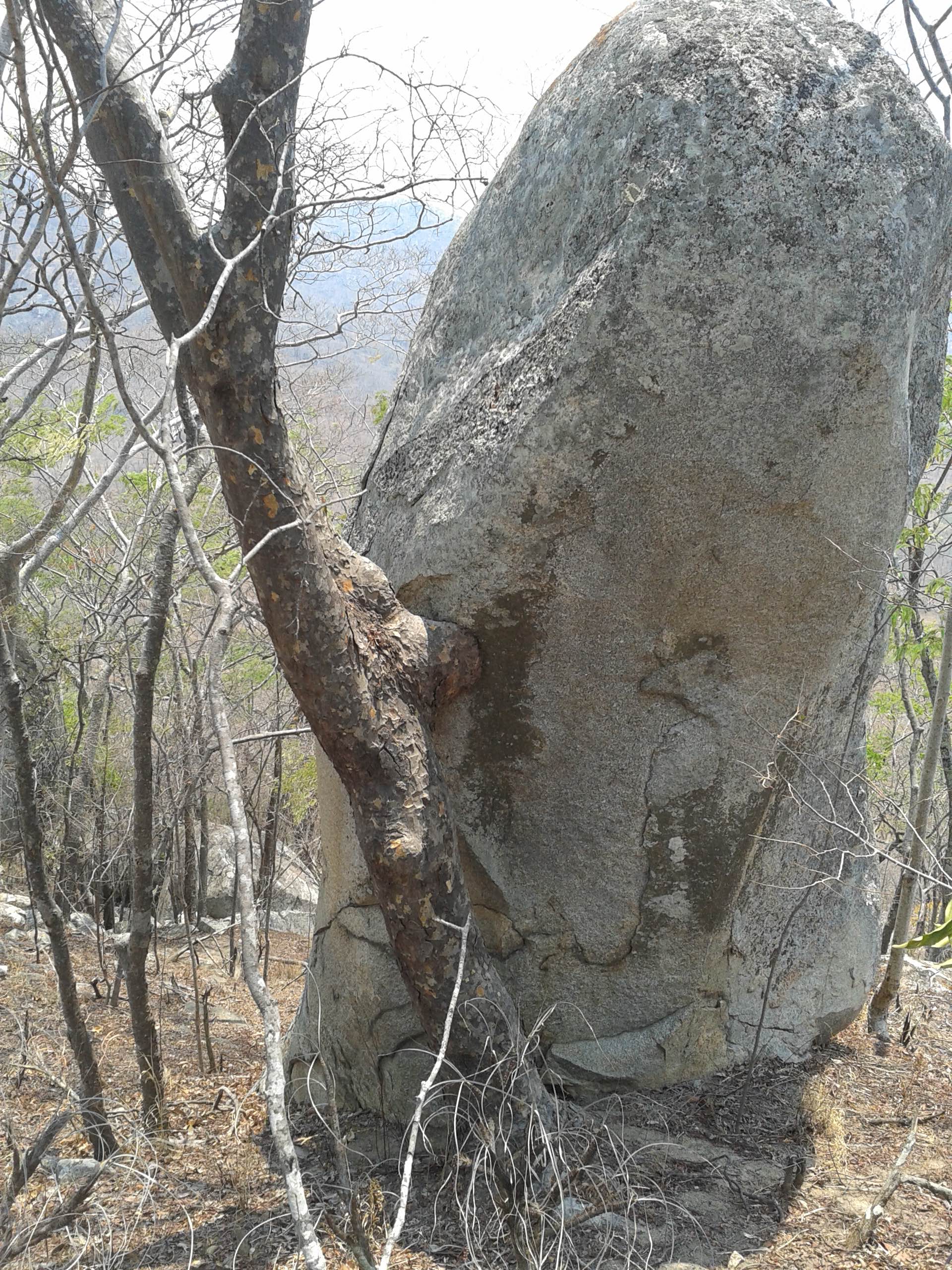
The rock or the tree? We were not sure what was holding what?

DSCN8167 copy

A descendant from those depicted in the paintings watched us all the time from the cover of the bundu.

Hippo Pools, Zimbabwe, October 2015.

The Eagle and the Baobab

Keep reading, this is not a children’s story, despite the title!

I knew this project would be difficult from the beginning as war movies dealing with eagles show a lot of hard work and heavy casualties!

In earlier visits to Hippo Pools Wilderness camp[1] ( and even earlier ones) I learnt that the camp offers a number of attractions for those feeling like trekking. Among these are old ruins, San paintings, several viewpoints a large baobab and various eagle nests. I was aware that both Verreaux’s and Crowned eagles had nested nearby for many years but I had not seen them before.

Aware of this possibility on arrival I enquired about the eagles’ and I was informed that there was also one of an African Hawk Eagle that had a fledgling. I expressed my interest on a walk to the site but later on I was informed -to my regret- that the bird was no longer where it had been seen before. However, before I could feel too bad, I was told that an egg had been spotted at the Crown’s eagle nest and that we could go there instead! I immediately booked a walk for the following morning.

The walking party.

The walking party.

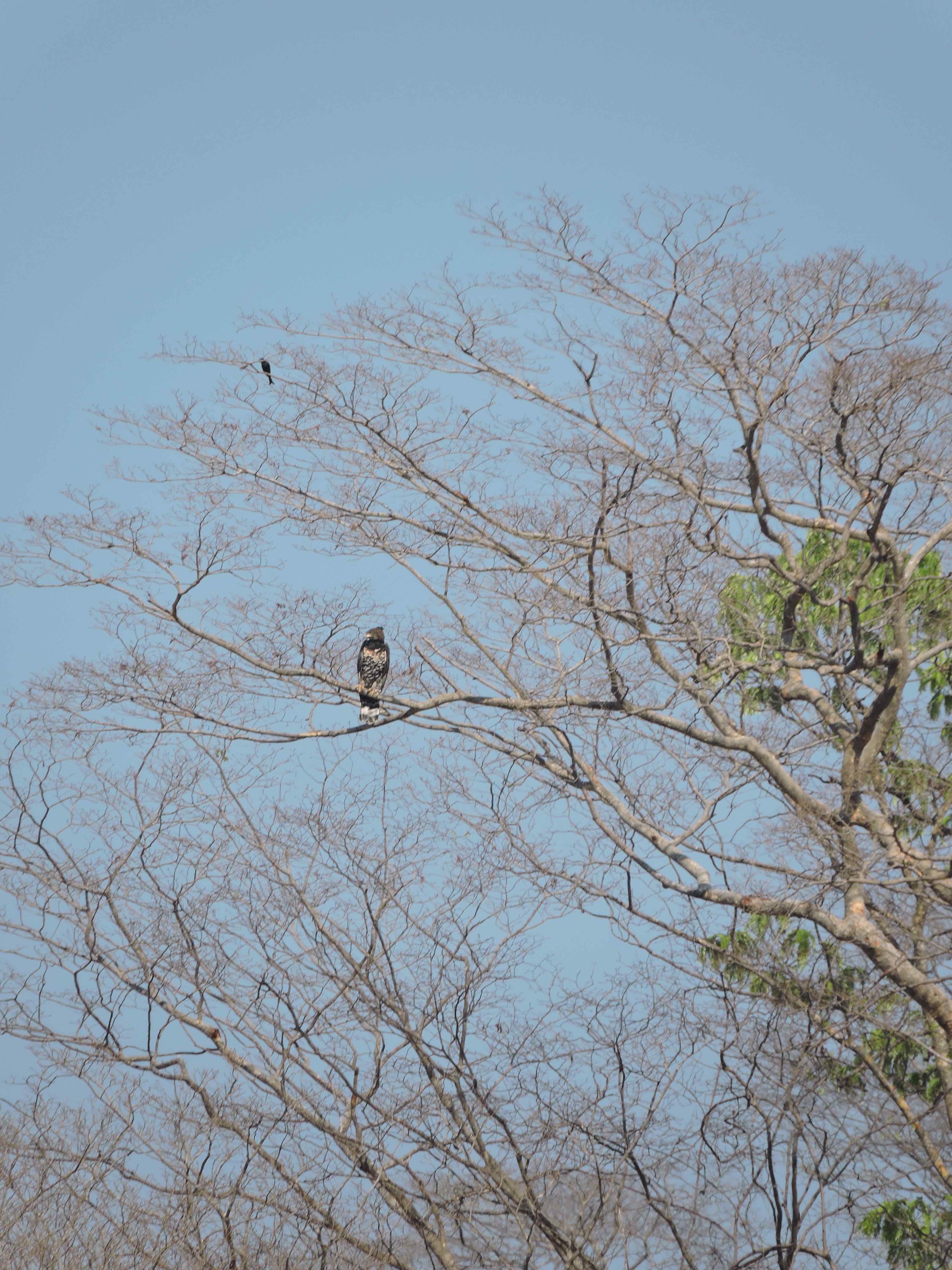
We left about 07:00 hours and walked for about one and one half hours over rather broken terrain and mainly uphill. After going for about an hour we spotted one of the eagles perched a long way away. However, we were advised that the nest was not in that direction but up the hill! It was clearly one of the pair, probably the male eagle scouting for food as these eagles are special in that the male often feeds the female while she incubates.

The first eagle.

The first eagle.

Close-up of the first eagle.

Close-up of the first eagle.

It should be noted that these eagles are not common and rather secretive and as Roberts VII Multimedia Birds of Southern Africa puts it, “Normally chooses the tallest canopy tree in which to build its large stick platform nest”. Luckily I did not know this while our trek was in progress as I was having additional difficulties with my recently acquired hiking shoes that were destroying my toes!

Examining an interesting cave en route to the nest.

Examining an interesting cave en route to the nest.

After another thirty minutes of steep uphill walk, we got to the general area where the nest was. Although I could not yet see it, my companions did and they got excited about what they saw. Eventually I spotted the nest as well as the second eagle perched about one metre above it.

Getting close to the nest meant that our up hill walk changed into a steep climb until we managed to get to a large rock above the nest. From this really great vantage point we could appreciate the situation and observe. We sat down and remained quiet while my toes throbbed, also quietly…

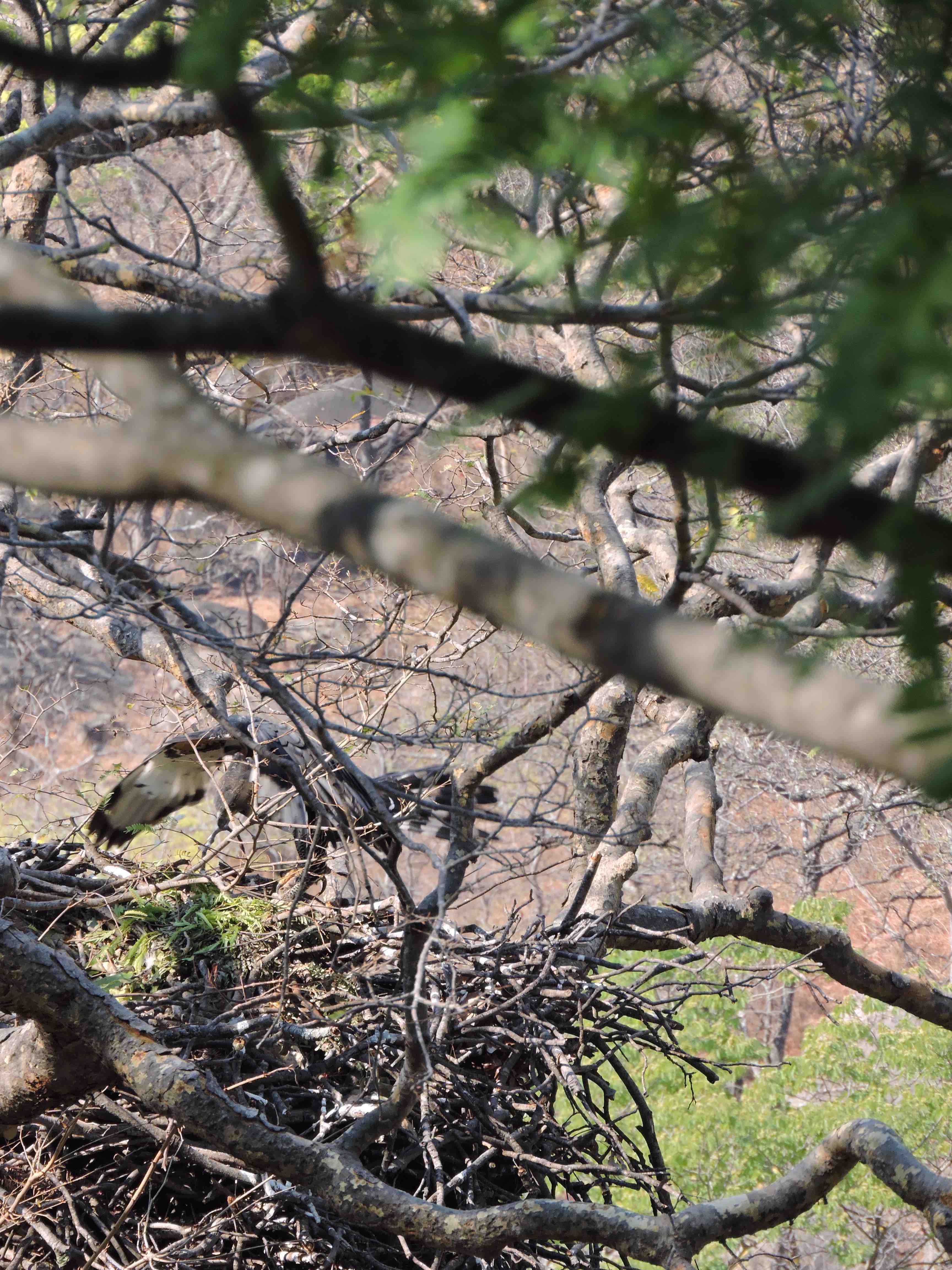
The return of the eagle to the nest and egg moving.

The return of the eagle to the nest and egg moving.

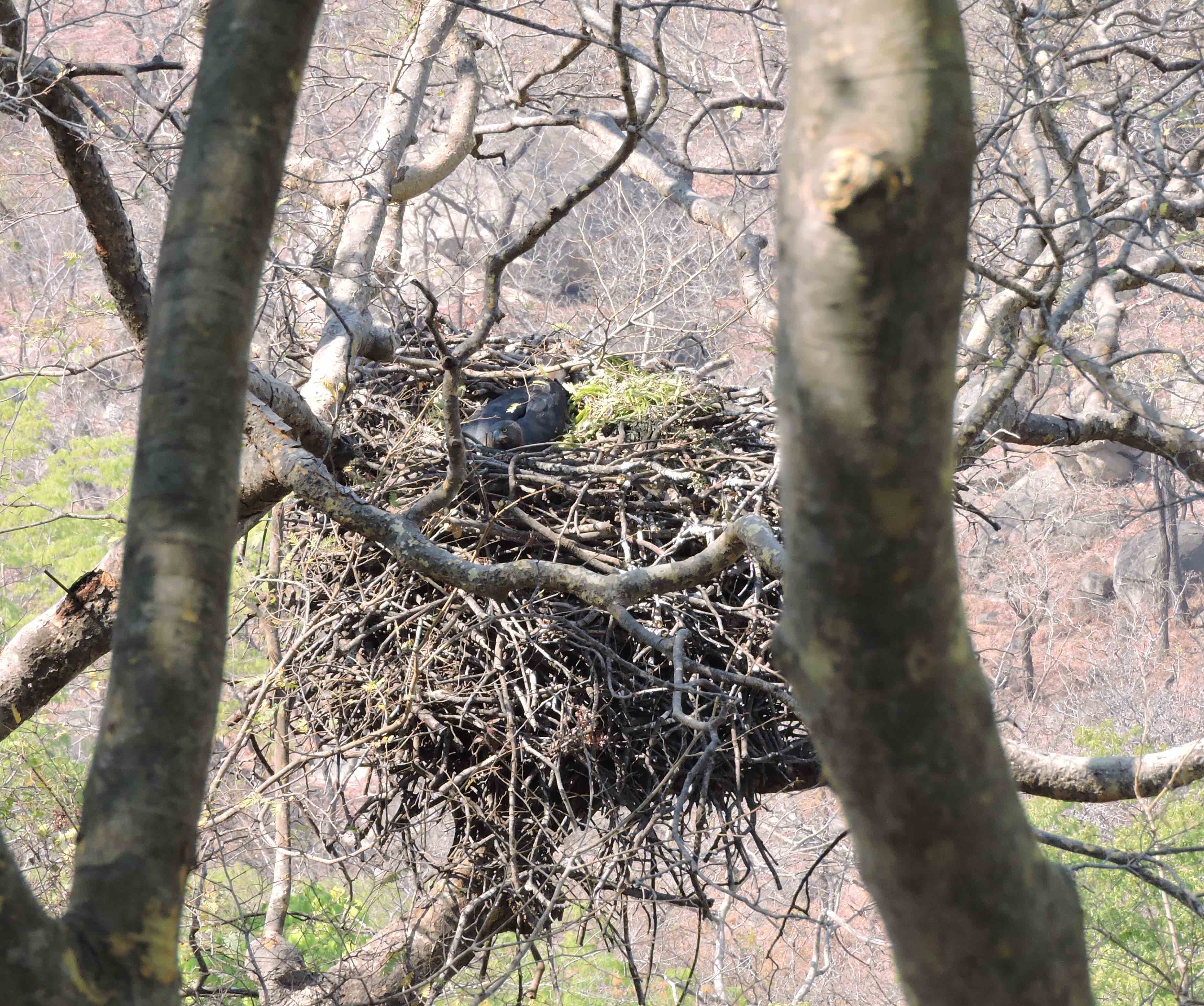
The nest was large, much larger than I had anticipated! Clearly it had been there for a number of years and its occupants had made a good job at building it. It must have been about two metres across and at least one and one half metres deep! This was a large nest for the species as Roberts VII Multimedia mentions an average diametre of 1.5-1.8 m with a height of up to 70 cm but old nests -such as this one- can reach up to two to three metres in diametre and three metres in height as the eagles add new material every year.

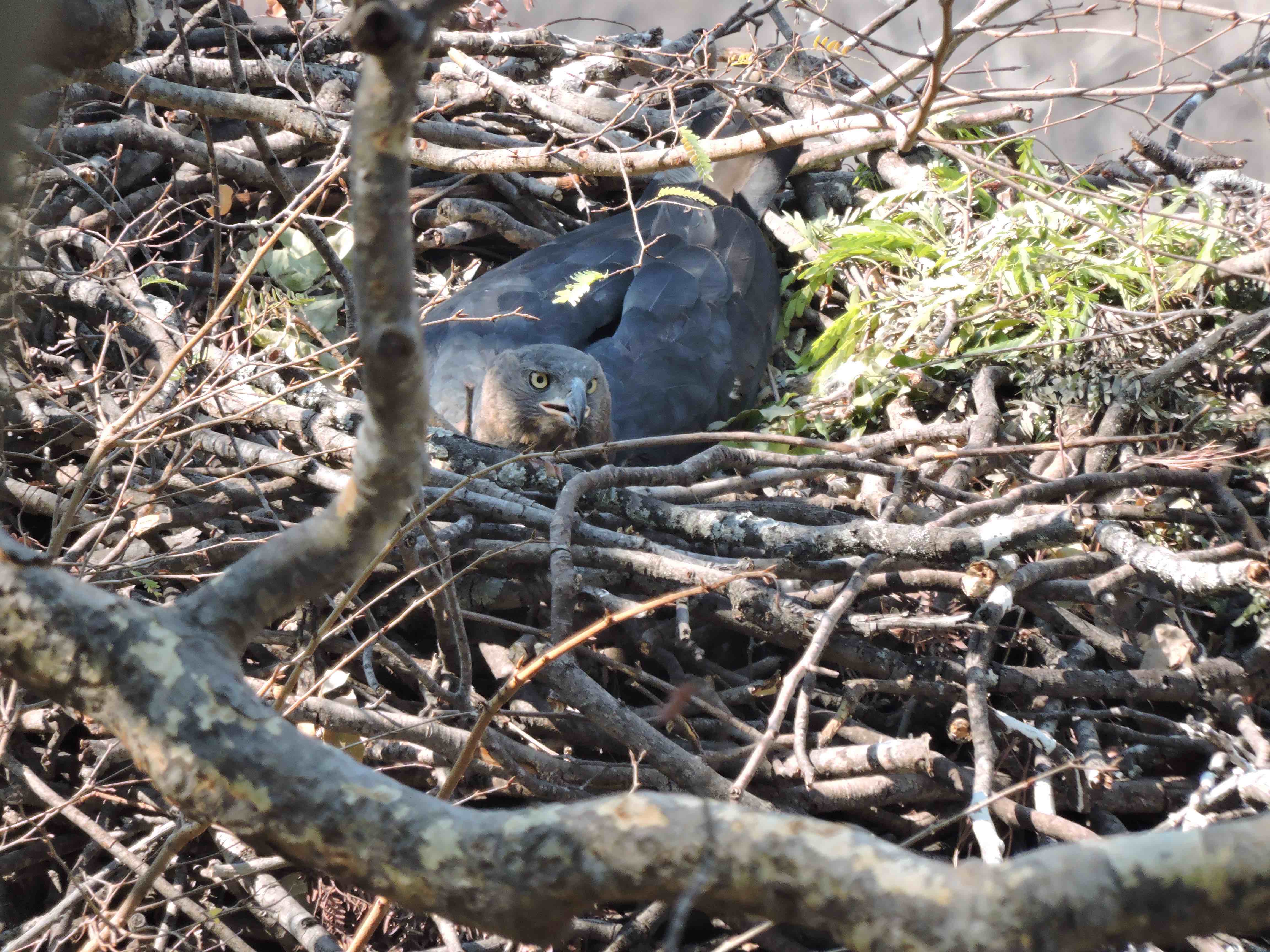
By the time we reached the “watching rock” the eagle was no longer there and we (or rather my companions) could see the egg that, on further observation, turned out to be two! While watching the nest the eagle came back and, after turning the eggs with its beak, literally “sunk” over them and stayed there unmoved by our presence for the rest of the time. Crown eagles are large birds reaching a height of up to 99 cm (tail included) being the fifth longest eagle that exists weighing about 4 kg with a wingspan of 1.50 to 1.80 m, comparatively short for the bird’s bulk. Mainly the female incubates for about 50 days and two eggs laid but normally only one chick goes through as siblicide is the norm. Only after 9-11 weeks the new bird is fully feathered and able to leave nest for nearby branches at 110-115 days. Despite its large size, the bird was truly dwarfed by its nest!

The eagle "sunk" in the nest.

The eagle “sunk” in the nest.

DSCN8074 copy

Over 95 per cent of this eagle’s prey are mammals and they have a reputation for being great fliers and being able to take off vertically inside the forest. I was wrong in thinking that they fed mainly on monkeys, as these mammals are only 7 per cent of its diet. Their usual prey are hyraxes and small/young antelope (65 per cent).

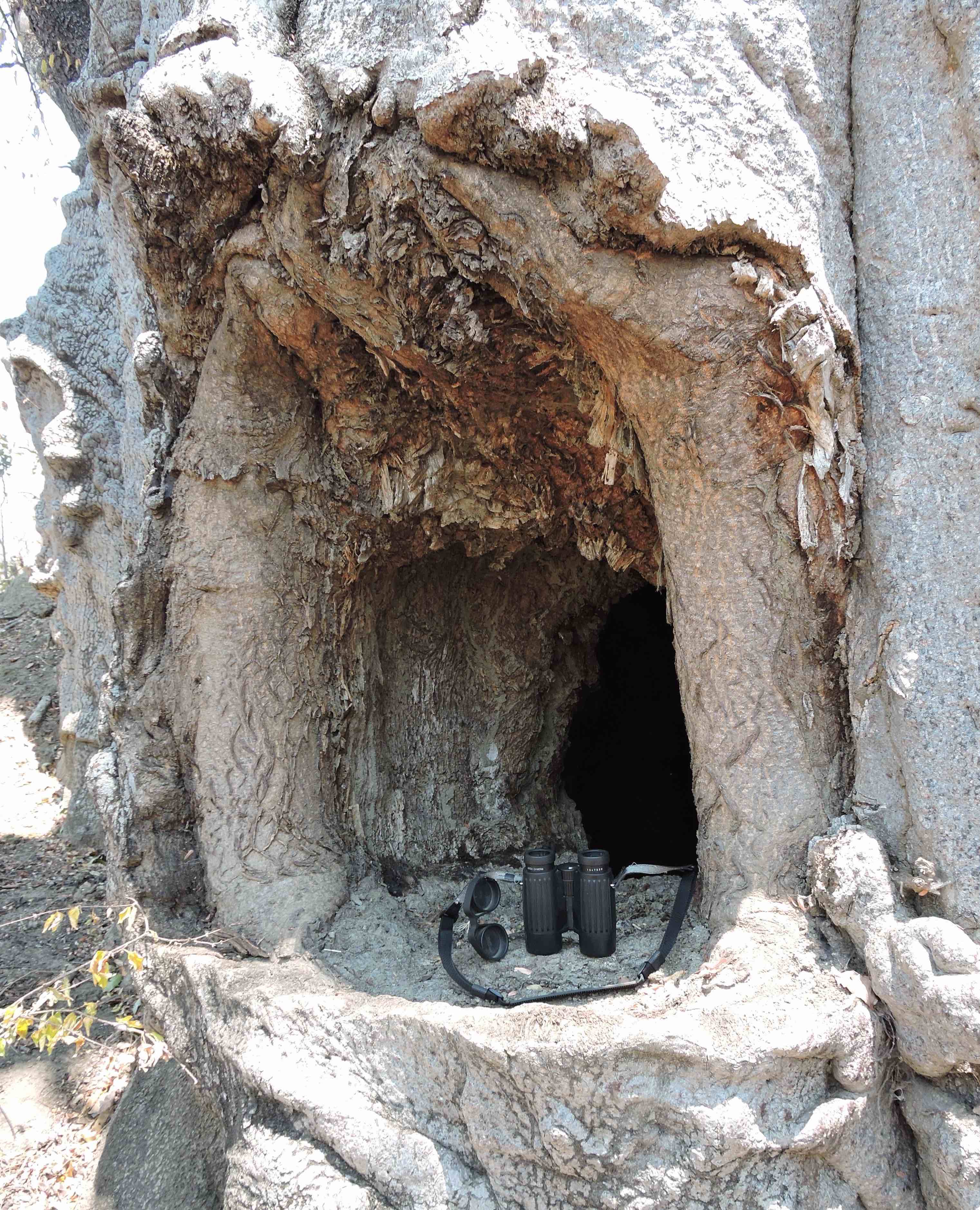
We returned to camp from the eagle’s nest via the baobab tree. I have already spent time on these fantastic trees in a recent post on Chitake so I will not waste too many words. This particular baobab has two main visible features: spikes driven up its trunk and a hole that allows you to see the inside and even enter the tree if you are interested and adventurous. Probably the spikes are there to enable people to collect either tree produce or honey but we could not tell.

The baobab.

The baobab.

The large hole.

The large hole.

The spikes.

The spikes.

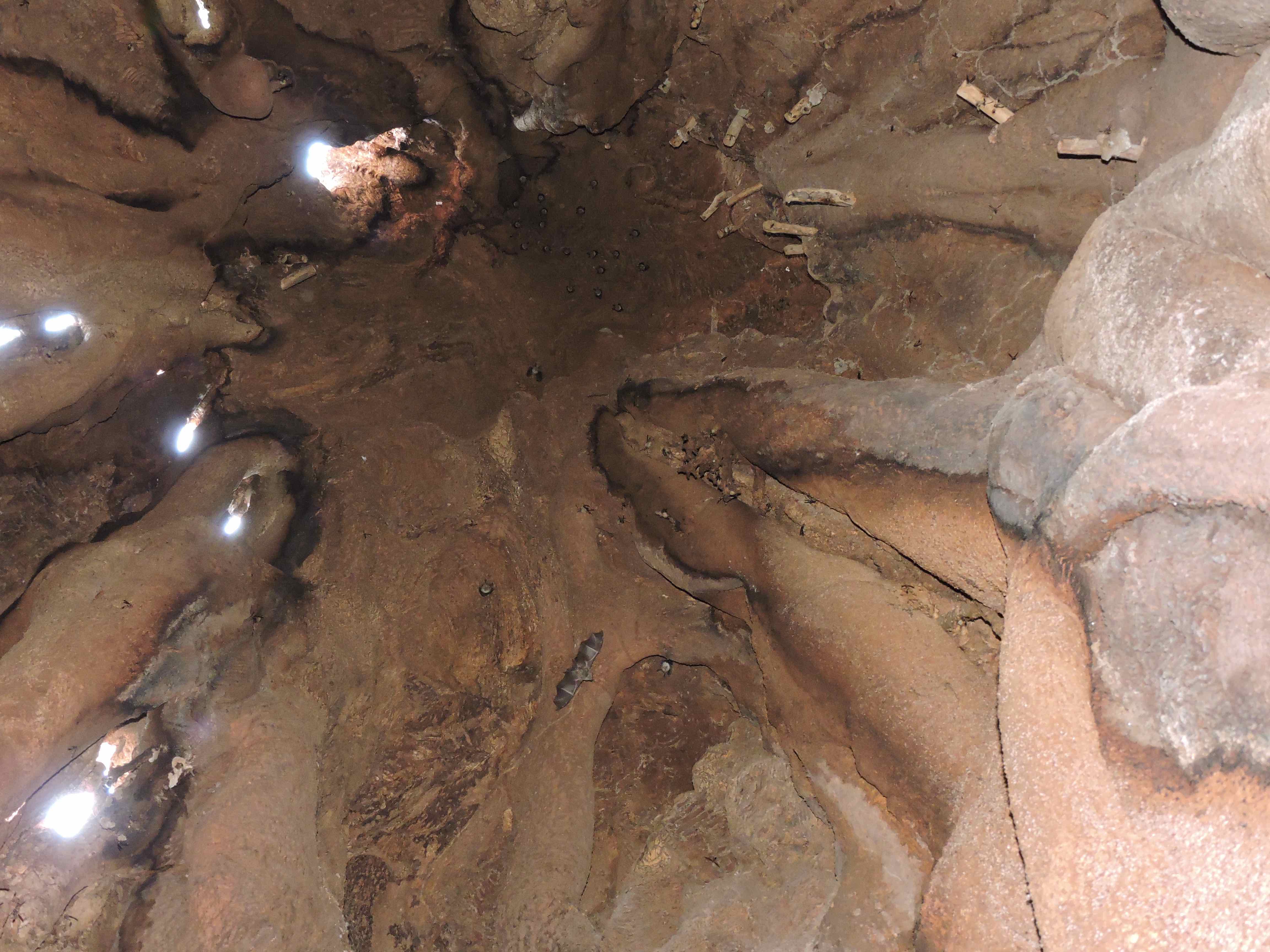
As we did not carry torches while looking for eagle nests during the day, there was not enough light to undertake a proper examination of the tree’s interior. We saw that there were some sun rays that filtered through small gaps on the roof, where the branches had sprouted, indicating that the top of the tree is not sealed tightly (as I thought) but there are gaps in its cortex. The holes were small and the light was not enough for us to see inside so we appealed to the trick of using the camera flash to look inside.

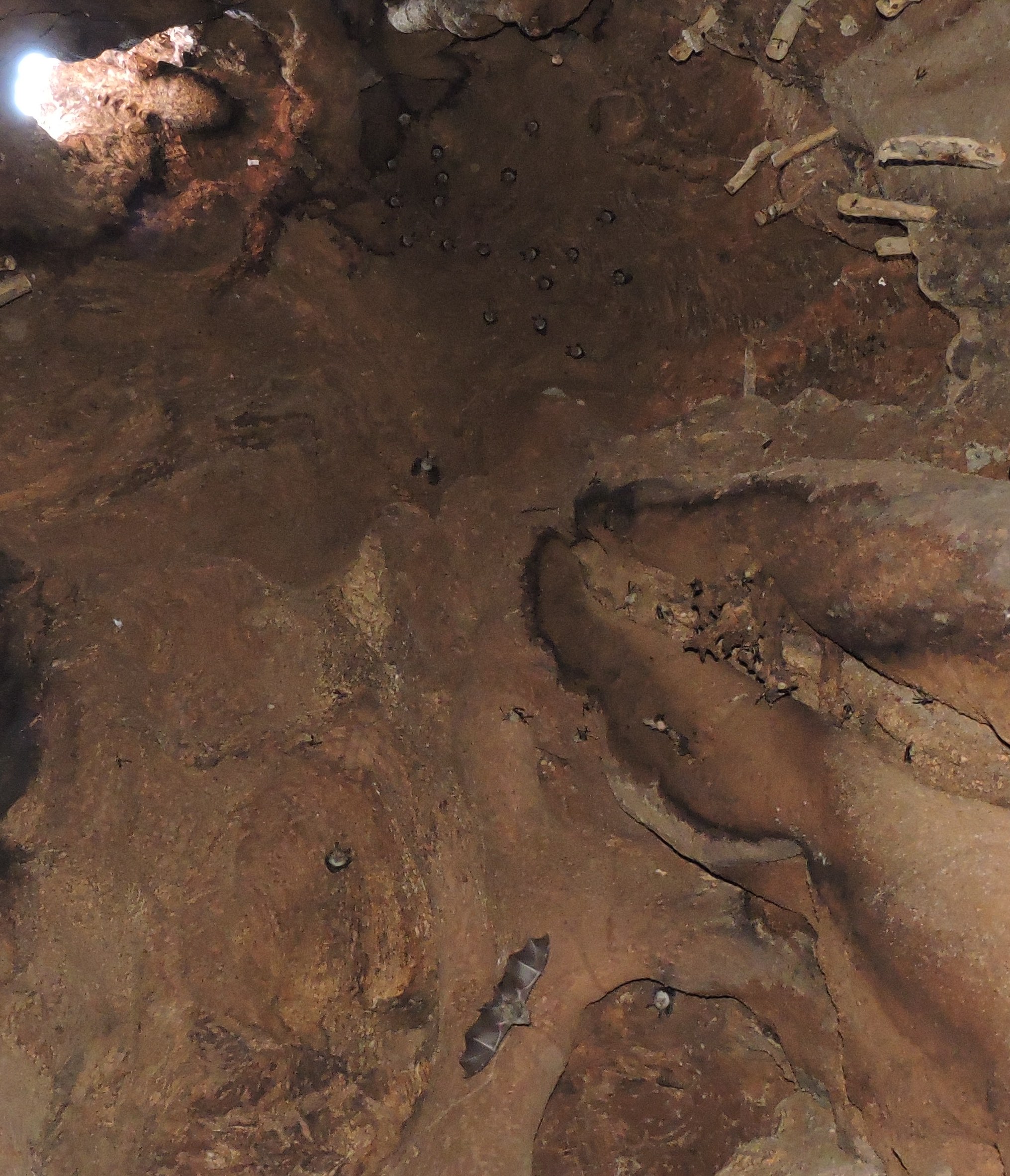
The inside of the tree. The spikes are seen on the right upper corner. The flying bat (centre bottom) and stationary bats (centre top), The small light spots are gaps on the top of the tree.

The inside of the tree. The spikes are seen on the right upper corner. The flying bat (centre bottom) and stationary bats (centre top), The small light spots are gaps on the top of the tree.

We saw that there were also spikes inside the tree! Although we did not detect any animal presence or smell (particularly the pungent bat smell!) inside the trunk, we took some pictures and, later examination of these, we noticed a small dark spot on its pale brown interior. It was a bat caught in flight! Further observation and enlargement of the pictures revealed other bats hanging from the roof, not in bunches but keeping distance from one another.

Close-up of the bats.

Close-up of the bats.

By the time we finished our observations of the baobab it was lunchtime and hot so we took walked back to camp, my toes still complaining in silence!

Hippo Pools Camp, Zimbabwe, 8 October 2015.


[1] https://bushsnobinafrica.wordpress.com/2014/08/29/hippo-pools-revisited-2/

Pangolin unseen

If you read this blog you are aware that I have never seen a pangolin in all the years I have been “bush-bashing”. Admittedly I have not actively searched for one but luck has had it that my path has not crossed a pangolin’s (see https://bushsnobinafrica.wordpress.com/2014/07/06/the-year-of-the-pangolin-2/).

My dream encounter nearly took place during our trip to Hippo Pools via the Umfurudzi Park, located about 130 km North of Harare. While paying the entry fees for the park, the ranger informed me that the Police had seized a pangolin at the border with Mozambique with a prize on its head of USD 5,000! The animal was brought to the park for releasing but he did not know when this would take place!

DSCN7974 copy

We drove directly to the park HQs hoping to get there before it was gone. To my disappointment, we arrived too late: it had been released the night before!

The pangolin. Picture by Mukululi Ndlovu.

The pangolin. Picture by Mukululi Ndlovu.

Pangolin release. Picture by Mukululi Ndlovu.

Pangolin release. Picture by Mukululi Ndlovu.

Despite the setback our visit was very useful. It enabled us to have a look at the improvements taking place at the Umfurudzi Park. Initiated a few years ago, this is a joint venture between The Zimbabwe Parks and Wildlife Management Authority and the Pioneer Corporation Africa Ltd., a new idea for Zimbabwe with the purpose of the rehabilitation, conservation and sustainable operation of the Umfurudzi Park. In brief, very comfortable facilities are being built including safari tents, bungalows and a nice swimming pool and boma[1].

Parking area showing the wooded area where the accommodation facilities are.

Parking area showing the woodland where the accommodation facilities are.

One of the comfortable bungalows.

One of the comfortable bungalows.

The common facilities and swimming pool.

The common facilities and swimming pool.

The park is also being re-stocked and animal numbers have increased during the last couple of years. According to the information contained in the park’s map, there are today approximately 13 elephant, 160+ buffalo, 300+ eland, 43 giraffe, 30+ tsessebe, 1 sable, 200+ wildebeest and zebra respectively as well as a good number of other smaller antelope.

While driving to the park’s HQs. we found a herd of about fifty buffalo looking relaxed and being “serviced” by red-billed oxpeckers. They are part of the buffalo population now resident in the park. We saw a few calves in the herd so it is clear that numbers will increase in future.

Buffalo being re-introduced.

Buffalo being re-introduced.

DSCN8203 copy

One of the calves.

One of the calves.

The Umfurudzi park now presents me with an irresistible lure as five other pangolins have also been set free into the park, probably making it the park with the highest number of “known” pangolins!

I will return and find one.

Umfurudzi Park, Zimbabwe, 7 October 2015.


[1] Place for eating.


Picture credits: Mukululi Ndlovu


Showering “al fresco”

As days passed the temperature at Mana Pools continued to rise. The morning of the 19th of September it was already oven hot at 06.00hs so the decision on what to do was easy as the moving car seemed to be the coolest option available. We planned a longish route as we wanted to re-visit a rather remote dry river bed close to the Rukomechi area. When the hot wind started to blow dust on us we knew that it was time to leave the camp!

We skipped breakfast but took all necessities with us to stop and enjoy it on route near the Zambezi as the drive offered a few nice shady spots. We drove until a place known as Vundu[1] point and stopped there to break our fast after a couple of hours of slow driving and enjoying the wilderness.

A gaggle of Spur-wing geese (parents and five young adults) were at the riverbank and slowly walked away as soon as we left the car.

Some of the Spurwing geese.

Some of the Spur-wing geese.

One of the adults.

One of the adults.

The heat could be felt despite the thick shade provided by the gigantic sausage trees of the riverine forest but this did not seem to bother a lone and open-mouthed crocodile basking on one of the riverbanks nearby.

Breakfast over, we moved on reaching the dry Nyakasanga river an hour later. We crossed its sandy bed and drove a while thinking that we would get back to the Zambezi but, as it is often the case, we had misread the map and in fact we were moving away from it! So, after searching for cell signal up a tree (my wife) and taking a few pictures of a baobab tree, it was time to get back to camp for lunch at an oven-like Gwaya camp.

In search of that elusive cellphone signal!

In search of that elusive cellphone signal!

The baobab tree.

The baobab tree.

The heat and dust were still waiting for us when we made it back by 13.00hs as we got further delayed examining a rather large fungus we found on a tree trunk!

A large fungus.

Fungus close-up. The bluish circle above is Nature's.

Fungus close-up. The bluish circle above is Nature’s work.

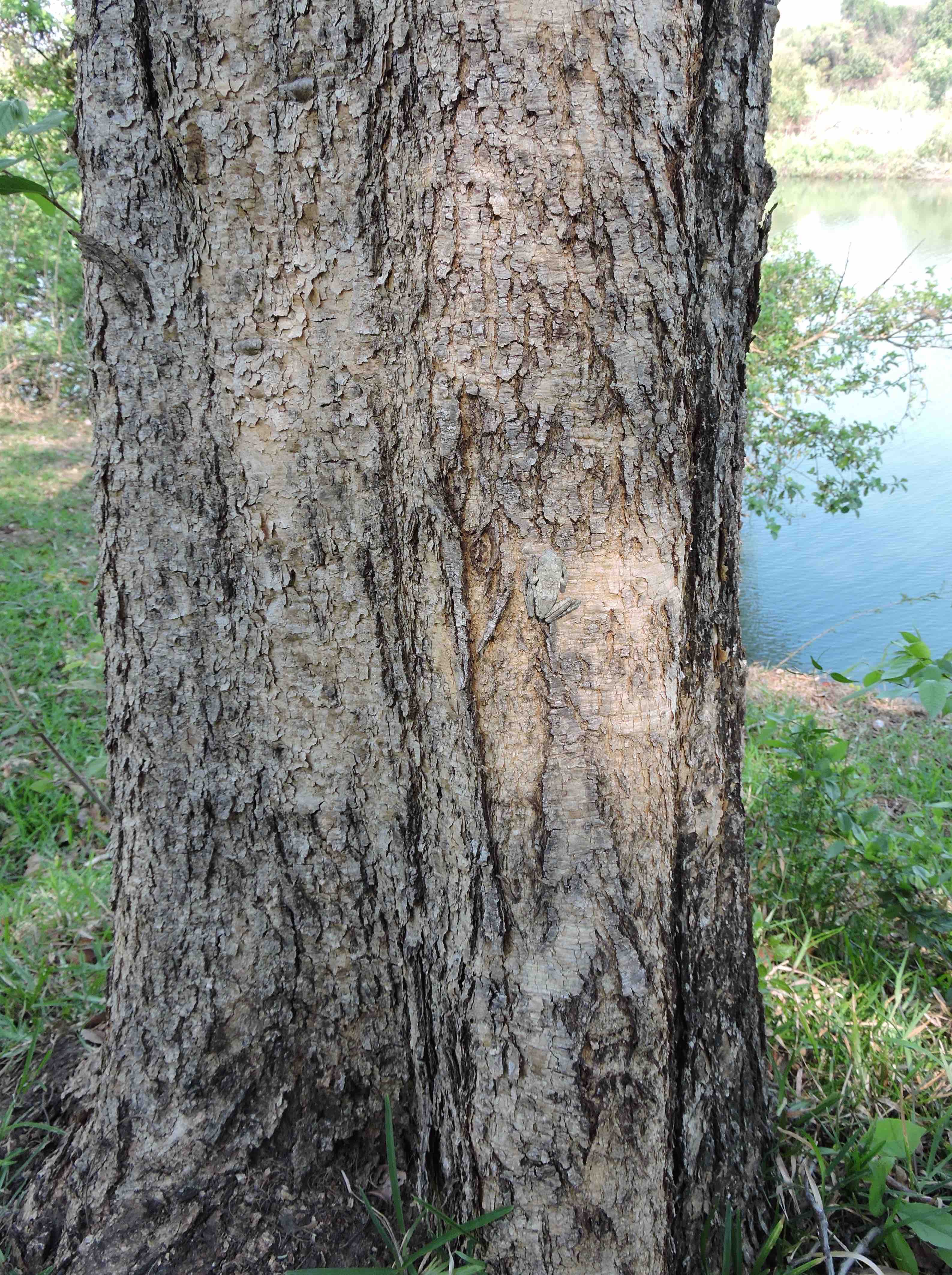
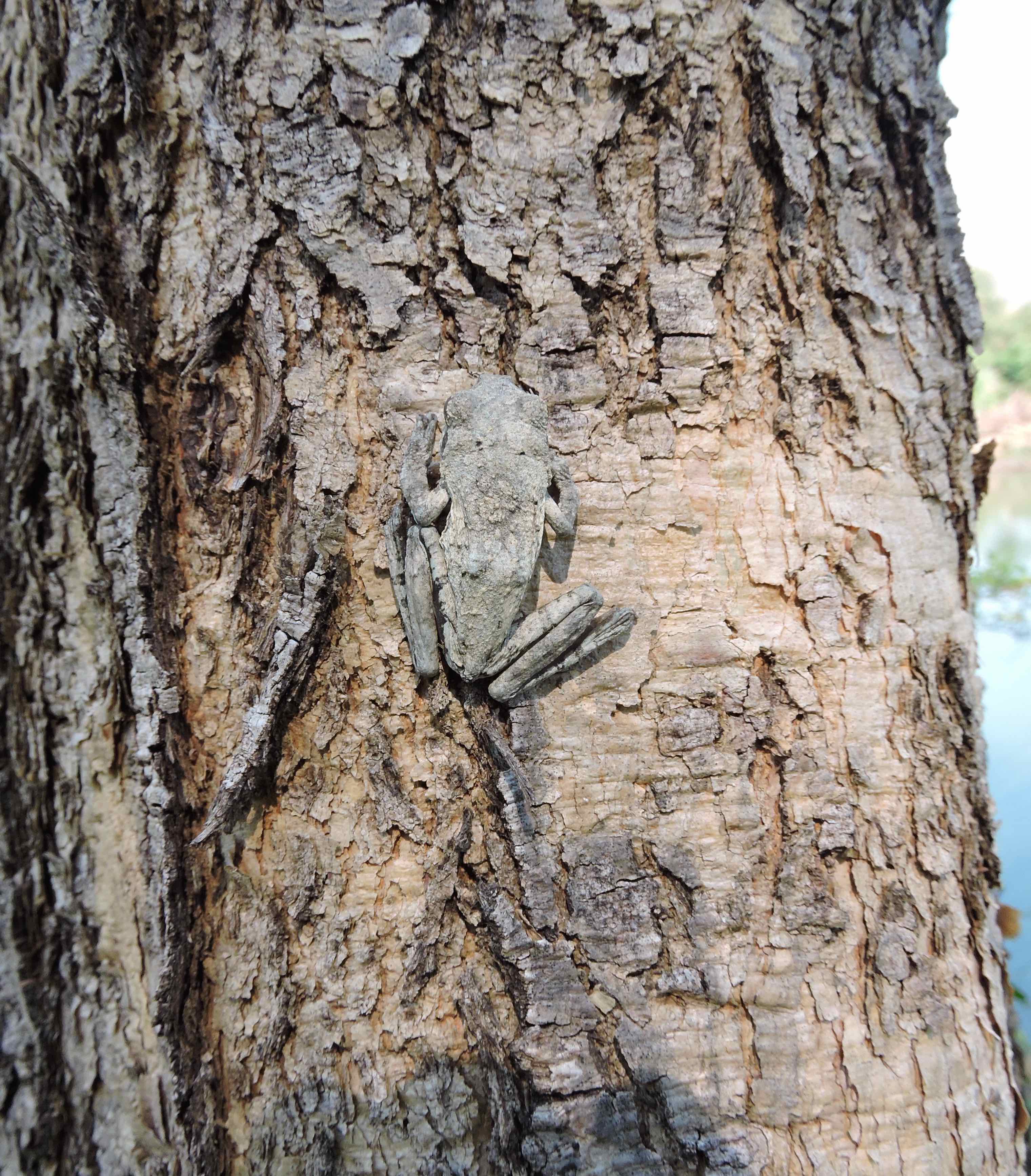
After a very light lunch it was a question of surviving the heat and dust (mainly for my wife!). She decided to have a cold shower at the small toilet/shower cabin and to remain there, away from the heat and dust for the rest of the afternoon, until the temperature dropped. She did not mind sharing the place with its tree frogs occupants. There were at least three of them and one insisted in staying under the WC plastic seat. We removed it everyday for fear of crushing it and placed it on a tree outside but it was back the next day!

My wife's vantage point!

My wife’s vantage point!

As usual, it was siesta time for me, despite the heat and dust. It was quite a feat but I managed a few minutes! The siesta over and feeling heat-hit, I hanged my sun-heated shower (I do not like cold showers!) from a tree behind our tent, open the tap and started to enjoy the refreshing feeling of water being poured over you in the open air.

I had showered for a couple of minutes and I was busy soaping myself when I heard my wife calling me, pointing towards the back of the camp. An elephant was walking, apparently, in my direction! As elephants do that all the time at Gwaya, I continued with my shower as I still needed some cleaning to do!

The elephant coming (I forgot to leave my hat on...).

The elephant coming (I forgot to leave my hat on…).

After a minute I looked again and the pachyderm was much closer! It left me in no doubt that I was the object of its curiosity! “I cannot believe this” I thought and, thinking that the soap smell was the lure, I started removing the foam and placed the soap back in its box. “#$@&%*!” I thought, seeing no change in attitude, “the blipping elephant is coming for the shower water having the whole Zambezi behind me!” I closed the tap and remained immobile and soapy[2].

It came quite close...

The elephant came very close. Luckily it stopped a couple of metres away and it had a long look at me. As it was also naked, I did not feel any embarrassment, only moderate panic and an immense wish to survive in order to remove the soap from my body and continue living.

Although I am sure that “the look” it gave me was brief, it felt long. Eventually the elephant slowly moved off as it clearly decided that my “manhood” was -naturally- no challenge to his “elephanthood”! I even thought I heard a jeering noise coming from the curious pachyderm as it walked away! My relief at its withdrawal was short-lived. The water got finished and I had to remove the remaining lather with what I wanted to avoid: cold water!
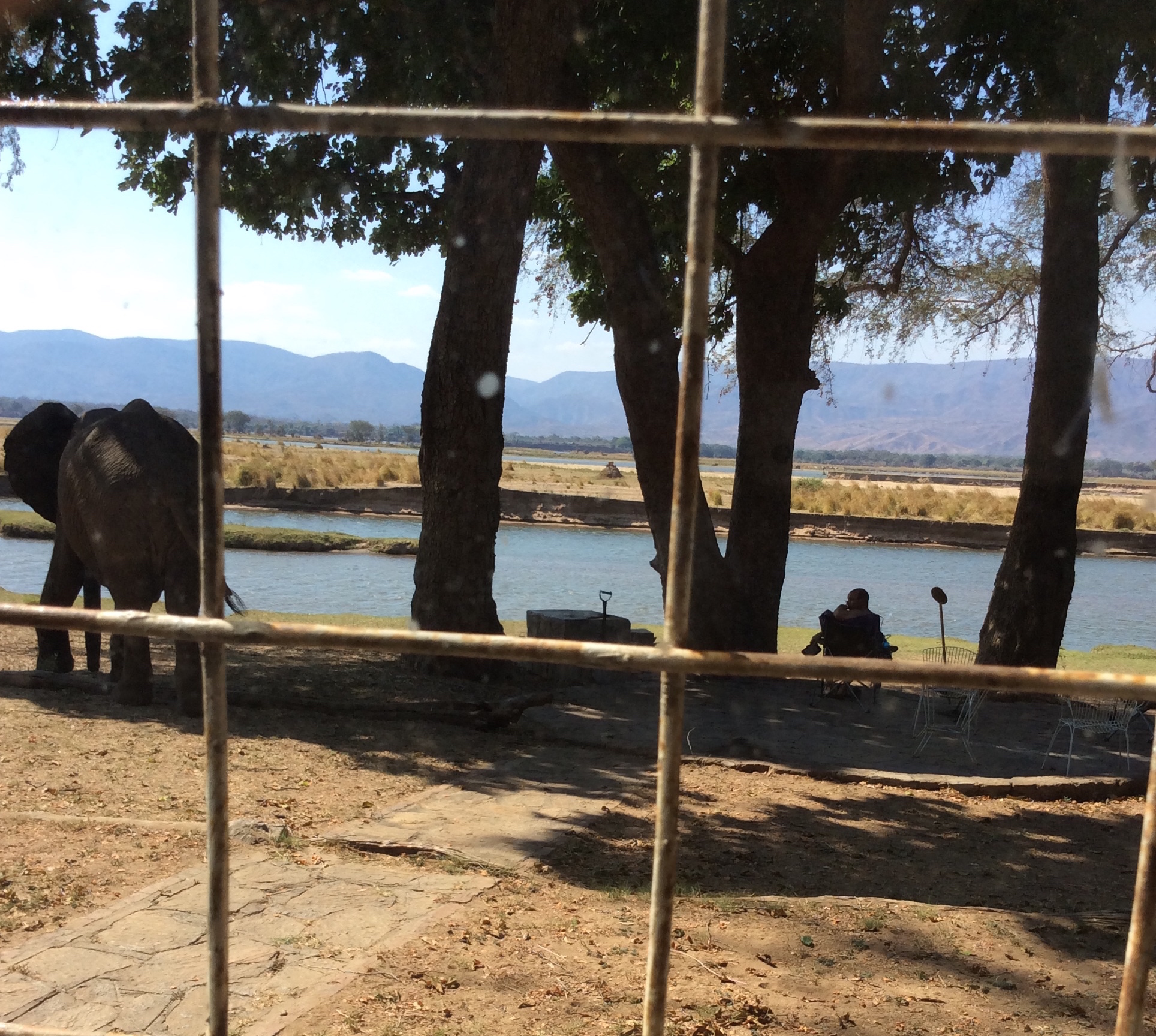
Needless to say that my wife watched all this and forgot about the heat and dust. So did I!

Gwaya camp, Mana Pools, Zimbabwe, September 2015.


[1] A Vundu (Heterobranchus longifilis) is a catfish reaching up to 150 cm in length and 50 kg of weight.

[2] Although the elephant is shown naked, pictures of the bushsnob “al fresco” are omitted to keep this blog PG.

Elephant overhead (and it was not Dumbo…)

During one of our game drives we came across a couple of cars parked in the woods and we noticed two elephants nearby, a large bull and a younger companion, also known as an “askari”[1]. From close quarters we immediately recognized the large one as “Big V”, a well known and placid bull that a game ranger first pointed it out to us on another visit to the park. His name derives from a large notch shaped as an inverted “V” on the lower edge of its left ear.

The viewing and photographing.

DSCN9998 copy

Big V coming.

We approached the animals, parked the car and got out to join the elephant-watching crowd (two people in one car!). Big V was busy chewing through an acacia branch the size of my forearm! “This is ridiculous”, I thought while I watched it in amazement as it crunched it loudly and started to swallow the splinters. While this was taking place, a game-viewing car with only one passenger came and Big V got somehow separated from the askari while we kept watching, trying to make the best of this photo opportunity.

Equipment comparison!

Equipment comparison!

The sole occupant of the newly arrived vehicle clearly thought that this was a good sight and proceeded to offload a humongous filming camera on a tripod. “This is not fair”, I thought as I tried to make do with my comparatively modest Nikon Coolpix! After spending quite a while assembling the equipment, he filmed for about one minute and they were off!

While we continued watching the elephants in awe, another two cars with South African plates arrived, full of people with spectacularly long lenses. They took hundreds of pictures at the elephants and, as soon as they arrived, they also left. I speculated for a while on a better game viewing opportunity and failed to understand where were they rushing! I still need to learn a lot about my fellow humans…

Finally we were alone. We waited as we knew that at this time of the year elephants in Mana Pools feed on the pods of the Apple ring acacia (Acacia albida) and we estimated that this was the intention of Big V as we were in acacia woodland. After a while, with calm restored, he obliged and started stretching to get at the pods, offering us some photo opportunities that are the heart of this post.

IMG_0105_2 copy

DSCN6464 copy

DSCN6501 copy

DSCN6504 copyI have some difficulties taking pictures looking at the camera screen so I use its viewfinder, a hang up from my SLR’s days! On this occasion I was so engrossed taking pictures of Big V at full stretch nearby that when I heard “the other one is coming” from my wife, the askari was almost stepping on my toes!

I was caught “between a car and an elephant” and, although I made myself as thin as possible by contracting my stomach, I could feel its body heat while busy watching his feet to avoid being maimed for life! Luckily the elephant was so focused on feeding that did not even look at me!

IMG_0083_2 copy

Before my pulse went back to normal I saw Big V coming the same way. I am not good at mathematics (in fact that is one of the reasons I became a vet!) but it was not too difficult to calculate that I have just had a near miss with a smallish bull in that spot and there was a much larger animal coming… I jumped in the car, relieved to be a coward!

The view through the mirror was a warning.

Watching events from the relative security of the car!

My wife meantime had cleverly placed herself on the other side of the car and was watching and taking pictures of my predicament while chuckling seeing me being squeezed…! Once inside the car I felt more secure and continued to shoot as the situation was amazing to miss even in fear!

Big V passed a metre from me and, once by my side its head moved towards me and I could see that he had dry skin as well as every detail of its tusks ivory quality.

My view suddenly got blocked...

My view suddenly got blocked by Big V’s dry skin!

“This is ridiculous” I thought, “what is it doing?” I thought in a kind of resigned panic as I was totally at its mercy! Before I could find an answer his head disappeared from my sight as it stretched over the car to get at a particularly attractive pod!
IMG_0089_2 copy

I prepared for the bang (and how to explain the damage to the insurance company) thinking on the branch or branches that it was going to break and bring over the car! Luckily, it only got small twigs and I only had a “leaf-rain”.

IMG_0085 copy

I am afraid that my fingers did not respond to my mental commands for a while so perhaps my pictures do not reflect proximity too well! It was fortunate that my wife managed to capture the moment, even if between chuckles.

(A brief video taken by my wife showing the situation)

The elephant munched the result of its effort fast and moved on leaving me with the incredible feeling of having been under its shadow and survived, showing how tolerant of people the elephants in Mana Pools are!

A more relaxed bushsnob, posing.

Survived! A more relaxed bushsnob, posing after the event with the askari in the background.


Gwaya camp, Mana Pools, Zimbabwe, September 2015.


[1] One or more younger males often accompany older bull elephants staying away from herds and these are referred to as “askari” a word from Arabic meaning “soldier”.