Zimbabwe

World Elephant Day

Yesterday (12 August)  it was World Elephant Day and I thought that what we saw last week at Ngweshla pan in Hwange National Park, Zimbabwe is a suitable scene to remember these amazing animals that the more I watch, the more I get entertained and admire.

I owe my increasing interest for these animals to my daughter (the intermittent Senior Editor of this blog) who, from very young age was fascinated by these animals and gradually “educated” me to appreciate them.

I hope you will find the video fun!

Pachyderm GO!

Apparently there is a new, rather hazardous, cell phone game going around in selected places of the world, mainly the “developed” part of it where “players” follow creatures called Pokémons that somehow materialize in their cameras. Amazing technology that I hope can eventually be used for the good of humanity. But this is just another of my idealistic hopes.

In Zimbabwe, away from it all, as usual we decided to go in search of real creatures and, having our two children with us (knowledgeable on Pokéscience), we went to the bush where they assured us Pokémons do not yet dwell. We chose Mana Pools National Park, a jewel among the Zimbabwe parks. We were in for a surprise!

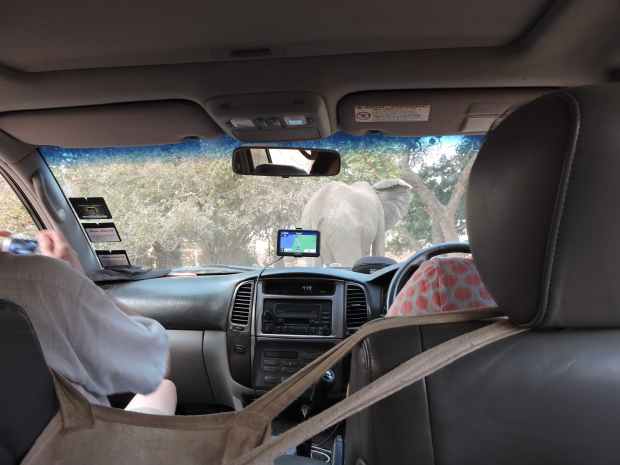
At some stage during our game drive I saw some elephants and stopped the car to watch them with the naked eye, together with my children. My wife, however, looked at them through her tablet to catch the best images of them. At some point, one of the elephants started to walk straight for the car.

I was enjoying its closeness when my son decided that the beast was too close and asked me to move a little to feel safer. My wife in the meantime continued trying to catch the beast.

DSCN9919 copy

Seeing that my wife was still looking through her device totally oblivious to the animal’s proximity, I started wondering whether she was watching the same beast that we were or if she was actually trying to throw a Poke Ball at a Phanpy[1] or a Donphan?

After the incident my wife explained that she did not realize how close it was until I moved the car. The creature had come within a couple of metres from us before I drove off but she said that she had managed to capture it.

We are all looking forward to get home to see what she caught!


[1] Phanpy is a small, blue elephant-like Pokémon that evolves into Donphan, a gray, elephant-like Pokémon with a thick, black band of hide running down the length of its back and extending to the tip of its long trunk.


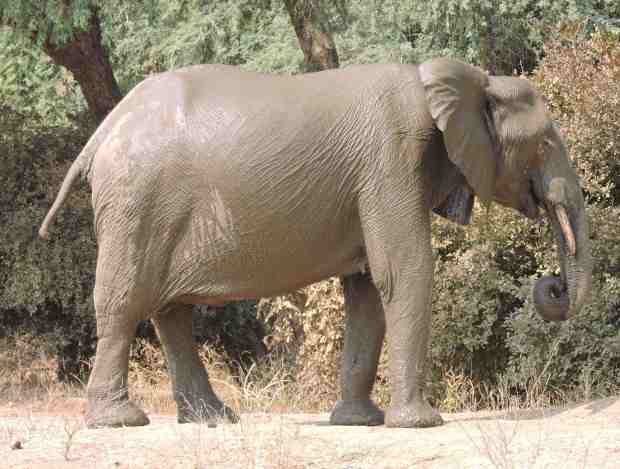
Follow up: The situation was clarified later and, luckily for Mana Pools, this is what she actually saw:

DSCN9950 copy


Ups and downs


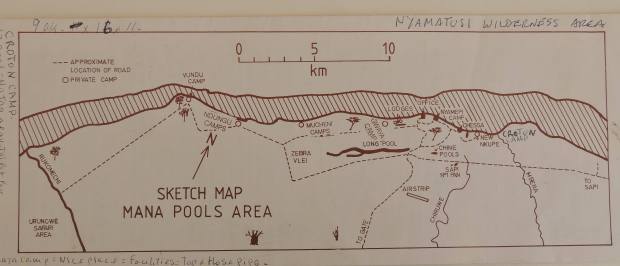
The final day of our stay at Mana Pools we drove all morning and hardly saw any mammals. Our drive started towards the west, following the river frontage (from right to left in the map below), towards Vundu camp. Although the views of the river in that area are really beautiful, after a while we decided to take another road in a southerly direction, towards the Kanga pan area (outside the map). Although the sighting of  crowned eagle lifted our spirits for a while, our luck did not change.

DSCN9960 copy

Crowned eagle.

DSCN9944 copy

Map of the Mana Pools area adjacent to the Zambezi River.

Our last hope of finding some interesting action was to re-visit the “carnage” at Long pool of the day before but our bad luck continued! Professional-looking photographers had moved in and probably paid some good money to film the birds so we did not wish to interfere with their work and drove on and back to our lodge.

To recompense ourselves for our rather poor morning performance we decided to go for a late hearty English breakfast, also known as brunch. We enjoyed bacon, scrambled eggs and fried tomatoes. The siesta under the trees that followed recharged the “morale batteries” and, by 16:00 hours, we went out again. This time we headed towards the Nkupe campsite and the Zambezi shore near Mana mouth where earlier we had some interesting sightings.

When you start getting carried away by watching Matabele ants (Megaponera analis) and photographing armoured crickets and dragonflies you know that Mana is on one of the occasions that it hides its booty from you. Clearly the park had water “up country” and most animals were spread out beyond the area that we could cover by car.

To be fair, we actually enjoyed watching the ants[1] that reminded someone of the fierce Matabele warriors of the past, hence their name. It was a rather large colony moving over the ground as a coordinated force. The major workers of this group were carrying brown capsules that were not prey as we initially thought but their own cocoons as I later learnt. One of these major workers would have also carried their queen but we did not pay sufficient attention to spot that.

Eventually we managed to see some zebra and even three shy eland bulls that quickly moved off as soon as they spotted us. Because of their premature departure we did not hear the unique clicks that are normally loud enough to be heard from some distance away. A knee tendon slides over a bone and vibrates causing the clicks. The larger the animal and the thicker and longer the tendon, the graver the sound and the higher place the animal occupies in the pecking order. The clicks, therefore, prevent fighting.

Soon the shadows started to lengthen and it was time to return to our lodge. We decided to spend the last minutes of the day checking our mail so we drove via the park’s office to access their Wi-Fi. It was close to 17:30 hours and the sun had already dropped behind the escarpment on the Zambian shore of the Zambezi.

On arrival to the office our luck turned! At the parking area we met head on with a large bull elephant and we stopped mesmerized at such a great animal so relaxed yet so powerful and potentially dangerous. Ignoring us it kept feeding as we drove within a couple of metres from it to park the car. We have had the privilege of having been close to these bull elephants before[2] but the experience is always exhilarating.

I got out of the car to watch the animal and joined onlookers from the park’s office that were also there enjoying the moment. It was one of bulls that reside around the most popular area of the park and clearly used to humans. In pursuit of good food it was performing some really funny contortions.

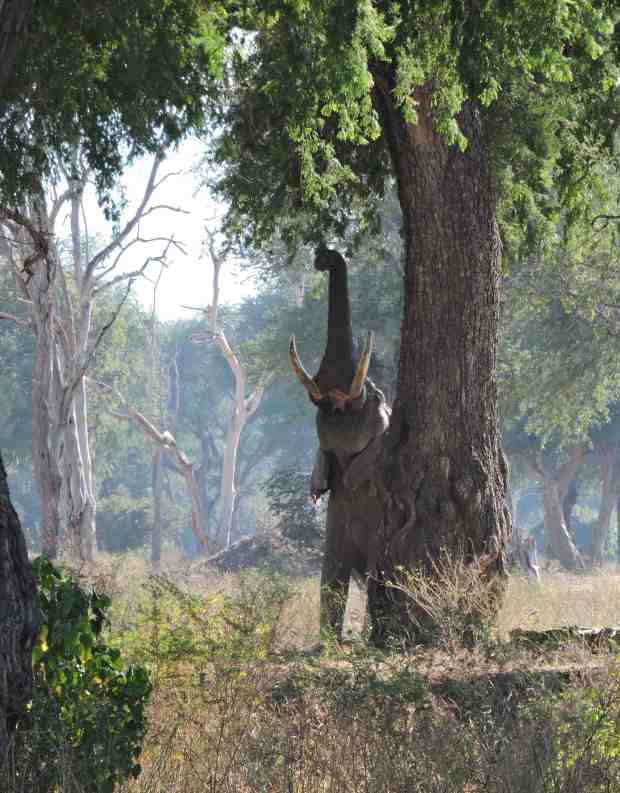
Boswell is probably the best-known bull elephant at Mana Pools. It has developed the ability of standing only on its hind legs while stretching an amazing length to reach the highest of branches. Although the elephant we found was not Boswell, it was probably one of its disciples as I am sure that at some stage it was actually on its hind legs though hidden by bushes!

I got carried away taking pictures and, rather carelessly, I forgot that I was photographing an adult bull elephant a couple of metres away! At one point, after removing my eye from the camera’s viewfinder, the animal was actually towering over me and I thought that I was ridiculously close for comfort and hastily retreated concerned about my bush-future! Luckily, harming me was not in the pachyderm’s mind and it continued feeding and keeping the distance that it thought prudent for both!

Unfortunately, the light soon faltered and I was forced to stop taking pictures so we parted company and we returned to our lodge. Our experience confirmed yet again the nature of Mana Pools: you can go through a frustrating day and then, suddenly, you find yourself in a unique situation that not only makes you forget the tedious drive but that leaves an enduring memory!


[1] For more information, see https://bushsnobinafrica.wordpress.com/2015/10/03/talking-ants/

[2] See: https://bushsnobinafrica.wordpress.com/2015/10/14/elephant-overhead-and-it-was-not-dumbo/

Carnage at Long pool

In the morning, as expected, we failed to locate the lions again but, driving over a small bridge nearby we found about twenty marabou storks (Leptoptilos crumenifer) congregated by a pond of green stagnant water. That was all that remained from the stream that flows there during the rainy season. As soon as we stopped they slowly moved away to what they considered to be a safe distance from us, away from the water. We moved off to a bend in the dry riverbed to watch them undisturbed. As soon as we withdrew they returned to the pool and resumed their activity.

DSCN9918 copy

The first group of marabou storks we saw.

The storks were feeding on stranded fish, probably catfish judging by the frequent rises they made to breath on the surface, opportunity immediately taken up by the storks that would rush towards the water movement ready to snap one up. We left them undisturbed and continued with our drive. A couple of hours later when we returned they were gone but there were still fish there. The African sharptooth catfish (Clarias gariepinus) are special in that they can bury themselves in the mud when the water evaporates and they can also survive in muddy water as they have a special breathing system that they can use in addition to their normal gills.

However, I am sure that despite their toughness the catfish days were numbered as the next rains will only come in December if the rains are good, far too late for them. At that time the ground would be bone dry. It was surprising that the marabous had abandoned what looked like easy food but we are used to Nature’s ways!

We soon forgot about the storks as we continued with our quest for new sightings. Our hopes of finding the lions seemed to revive when we found their fresh footprints. Judging that they had been left there during the early morning we tracked them for a long while, trying to guess what their aim was, only to lose them when they moved away from the road. Following lions on foot through the bush and without an experienced ranger is not recommended so we decided to leave them alone. As it happened, they eluded us for the rest of the trip.

We normally do not see large elephant herds at Mana Pools. Some family groups come together at the height of the dry season while staying near the river. At the time of our visit, although the rains had not been abundant, there was still water inland and the elephant population was still spread out all over the park. The few elephants we saw were the usual resident bulls that seem to hang around the shores of the Zambezi. It was one of these that we found that morning and we derived entertainment watching it stretch for the apple-ring acacia branches and leaves. The pods, their favourite food later on in the dry season, were still small and immature so they were not the elephants’ target at the moment.

DSCN9962 copy

A bull elephant stretches to feed under the special Mana Pools light.

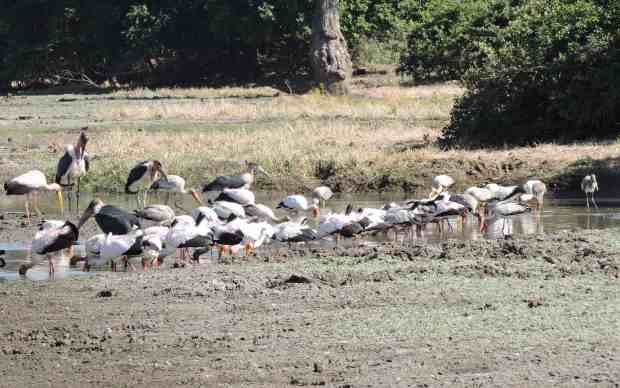
Returning to camp at about eleven, we saw a large number of yellow-billed storks (Mycteria ibis) in one of the smaller segments of Long pool that usually dries up during the dry season. There was clearly something special going on that attracted such large number of birds so we decided to go and have a look. Getting closer we saw that there were also African spoonbills (Platalea alba), a few herons and also a few marabou storks. “So here they are”, I thought while stopping the car to get closer on foot.

DSCN9928 copy

We saw a large number of storks congregated at Long pool.

The pool was full of birds and it appeared that mostly the yellow-billed storks were -again- catching other shoal of stranded fish.

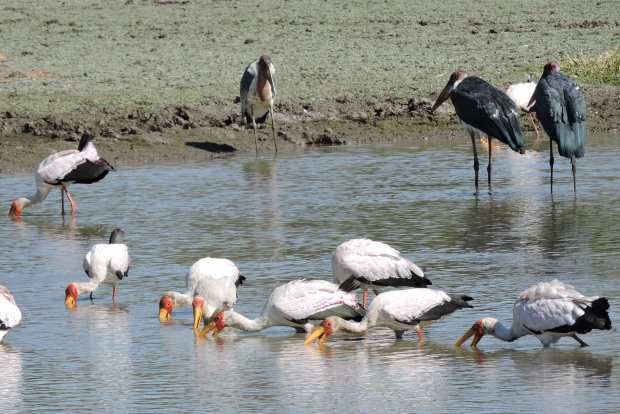
They seemed to be alternatively “driving” the fish towards one of the narrow and shallow ends of the pond and, once there, they would pounce on their victims. Both the yellow-billed and the marabous seemed to be on the same wavelength and after fish. The few African spoonbills present, however, continued wading in their usual fashion as individuals and they did not seem to take any notice of the other birds.

DSCN0019 copy

The yellow-billed storks chasing the fish in a coordinated fashion.

DSCN0023 copy

Marabous waiting for the right time to join in.

DSCN0029 copy

African spoonbill.

At first we assumed that the prey were catfish as we had seen earlier at the small bridge and on other occasions in Kenya (Maasai Mara) and Mozambique (Gorongosa). We soon saw, however, that this time the victims were silvery fish of 5 to 15 cm that were being picked in large numbers by the birds. Whether they were immature Chessa (Distichodus schenga) or Nkupe (Distichodus mossambicus) both common inhabitants of the lower Zambezi, or perhaps some other small fish I could not be sure. It was interesting to note that, as the pool was dry last year, the fish must have come in during the wet season through a connection between the pool and the Zambezi.

The yellow-billed storks outnumbered the marabous about 10:1 and they strode in groups following what looked like a cooperative fishing strategy. They would wade together towards one end of the pool driving the fish in front of them and then they will pick them from the reduced area they had created. They fished in their usual fashion; by placing their half open bills inside the water and snapping them shut when feeling a touch through a very fast reflex. They frequently caught fish but if they missed they would do a short chase that soon ended with or without a fish being caught and back to their feeding posture.

While this would take place, the marabous watched like smartly dressed supervisors. The moment the fish were trapped they would lose their bogus formality and join in the feeding frenzy with gusto! They would jump or fly in spreading their wings to make room for themselves submerging their heads under water to catch the fish. Often their feeding enthusiasm would be such that they would plunge almost totally in pursuit of the fish. Many of them had their gular sacs[1] inflated and probably their pouches full of fish. Many of them were also flashing a bright red bubble-like sack at the back of their necks, probably a consequence of their excited condition!

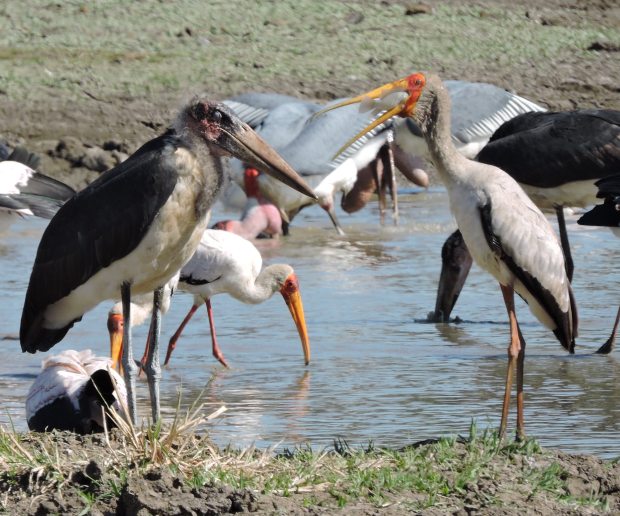
Although we witnessed the occasional confrontation between the two stork species, these were minor incidents and we saw no physical contact.

DSCN9964 copy

A brief stand-off or “don’t step on my toes”

Conversely, there was a lot of interaction among the yellow-billed storks in the form of bill clattering, chasing and jumping facing each other. Occasionally the opponents would interlock their beaks as if involved in some kind of courtship. All these encounters were of short duration and the temporary “rivals” quickly got back to feeding. The grey immature yellow-billed storks congregated at the periphery of the pond, not taking part of the adults’ activities but trying their fishing technique as best they could where there were clearly less fish and I did not witnessed any catch.

While the collective fishing took place, a pair of fish eagles, perched on a tall dead tree, watched the storks attentively. They called regularly and, from time to time, they would swoop down among the alarmed storks and, at least once, one of them managed to snatch a fish although we could not see if it caught it itself or it robbed it from one of the fishing storks.


The following video gives a dynamic view of what we witnessed.

Note: I recommend that you watch it first as it is and then you use the cog wheel at the bottom right corner of the screen to slow it down and see things with more detail.


[1] Later, reading about marabous, I learnt that the large sacks that hang under their heads are not crops but gular sacs. The latter are cooling devices as well as used for displaying purposes.

Note added on 3 July 2016. One of the pictures above shows what I thought was a confrontation between a Marabou and a Yellow-billed stork. I saw that the Marabou was rather indifferent but I thought it was because of its size. However, looking at the picture again, I realized that the Yellow-billed stork was swallowing a fish! Additionally, the fish looks like a young Tilapia so the birds may have been feeding on these rather than on the other possible species I mentioned. Bushsnob

Lions first

Although we agreed that we were in no hurry to leave for Mana Pools National Park, somehow we found ourselves getting up early and soon enough we were on our way before what we had planned. Fortunately the road from Harare to Chirundu in the border with Zambia was rather quiet. We were able to travel fast and well until we found ourselves snaking our way up and down Marongora or the Zambezi escarpment.

This is the worse part of the journey as long lorry lines coming and going between Zambia and Zimbabwe are formed here and the pace can be very slow if not nil as frequently we find serious accidents that cause long delays. The road is littered with lorry remains to the point that we call it the “lorry cemetery”. This time, even this infamous place offered us no difficulties.

We turned into the Mana Pools turn off in good time. As usual, the first 30 km are as rough and corrugated as ever and we decided to break the journey over half way entering the track leading to the Rukomechi Research station where groundbreaking research on tsetse fly control was carried out in the 70s and 80s. The idea was to see the place and to find a place to have our lunch away from the main road.

The station was rather quiet and, after a quick drive through, we returned towards the main road, stopping at a dry river bed that we had identified early as a “lunch spot” to enjoy our sandwiches. The halt did not last long as the stingless Mopani bees (also known as Mopani flies) Plebeina hildebrandti kept getting into our eyes, a very uncivilized behaviour!

Worse still were the stinging honeybees that started coming the moment we opened our lunch boxes and kept landing on our food and drinks. Soon we were fed up with both bee types and decided to abandon our lunch break and continue our trip.

We were greatly relieved when we reached the gate into the park with the car apparently in one piece. A quick check confirmed that this was so, at least all the expected parts were there! The road corrugations were such that the usual trick of driving fast to “skim” over them did not really work and to drive slowly was even worse so we tried both hoping to get an improvement that we did not achieve! Satisfied with the toughness of our car, we continued for the final 40 km on a much smoother track.

DSCN9890 copy

The first lioness.

We aimed for the park’s office to check in our lodge called Nyati[1]. As it happened, a couple of kilometres before, my wife spotted a tawny shape that turned out to be a resting lioness. We stopped and for sometime forgot our immediate plans. After scanning the area with our binoculars, another two females were found. We stayed with them for some time but, as they did not seem to move, we decided to go back to our plan and to sort out our lodge. The latter was very nice, on the Zambezi River shore, clean and ready for us.

After organizing our belongings and food supplies, we decided that it was time to get back to the lions. As these are our number one interest in the bush we were happy to go and try to find them again!

DSCN9899 copy

A long distance shot.

Luckily they were still there. Other visitors had also found them and two cars were watching them but, as it often happens, they soon left. I always question myself about what could be better than staying with a pride of lions waiting for action! However, more often than not, most people have other ideas and, after a few minutes, they invariably move on. I find this conduct surprising but they probably have other bush tastes such as elephants or perhaps sundowners by the river? We, the wiser, stayed with the lions.

A few minutes of observation later and we had seven individuals: six females -in excellent condition- and one young cub. We found this a bit strange as we expected more youngsters but we did not see another one. Typically, for about an hour nothing much happened. As the afternoon became evening all of a sudden they were off. It happened very fast and they entered the tall grass towards our left, leaving the cub behind.

Trying to stay ahead of the game, we moved forward looking for the reason of their exploit while trying to position ourselves at a place from where we could see what would happen next. About one hundred metres ahead we found a clearing with some male impalas grazing and, apparently, oblivious to the lions.

“Could the lionesses be after the impalas?” we asked ourselves, as these antelope are not the number one choice in a lion’s diet. We had seen lions in past years at Mana feeding on buffalos and even elephants so these rather small antelope did not qualify even as a snack for such a group! However, in the absence of other possible candidates we stopped and waited.

I immediately switched on the camera and soon I was looking at the impalas through the camera’s viewfinder when first I heard the noise of animals running to my right and immediately caught a glimpse of the lionesses through the corner of my eye. Three of them came out of the bushes at full speed towards the impalas that reacted immediately and started running away. The lionesses picked one as their target and got closer and closer.

The impala, aware of the mortal danger it was in, quickly recovered from the surprise of the attack and ran for its life leaping and zigzagging with great skill as the terrain was uneven and bushy. Despite this, the lionesses were getting desperately close and, when all seemed lost for the antelope, it jumped and turned sharply to its right. This final feat of nimbleness put the lionesses off balance and the impala managed to escape snorting loudly as it realized that it was still alive! What I described took place over a few seconds and well before I could move my finger to take a picture!

DSCN9894 copy

When I could press the shutter, the chase had ended…

The impala snorting was answered, to our surprise, from somewhere in the midst of the lionesses! At first we thought that the huntresses had got another impala and what we were hearing were its last throes. Soon, however, the truth revealed itself as another impala came running flat out from the “lionesses-hot area” and soon joined its colleagues at a prudent distance. We had clearly missed this impala that had turned towards the opposite side from the others and probably saved its life because of it!

The short chase over, the huntresses relaxed and one by one they broke their cover and we saw seven female lions. Realizing that the chase was over, they returned to the place where the cub was. After a while we saw another rather large head emerging from the tall grass: a large male lion could not be bothered to lose its royal status chasing impalas and wished to have a look around!

Soon the light started fading and we left them, convinced that they would hunt later on. We agreed to return and look for them the following morning but, as they can move long distances, we did not hope for another sighting.

Back at the camp the donkey boiler[2] supplied ample hot water for a good bush shower to wash off the thick dust from the already very dry Mana Pools roads. As for the various aches from the journey, I appealed to a few sips of a South African Cabernet Sauvignon, with therapeutic meticulousness! The latter also greatly helped with the writing of this post!


[1] Nyati in Shona language means buffalo.

[2] Known as Tanganyika boiler in East Africa. It is basically a metal drum over a wood fire.

An ambitious Hammerkop!

We allowed plants to take over our water reservoir (former swimming pool) hoping that they would slow down the evaporation. Whether water plants do this is probably debatable but they did enable the African clawed frogs (Xenopus laevis) to multiply really well.

DSCN9354 copy

As the frogs are happy to stay in this small “wetland”, the population reached large numbers and, although they devoured all the guppies placed there for mosquito control, the population has not yet crashed. They are also tolerated as they are rather quiet, unlike other visitors we have had in past years.

Luckily, attracted by the “fast food” on offer at least one (I am not good in identifying individual birds yet…) hammerkop[1] became a frequent customer. It walks around the pool stalking the frogs that it catches them often. It is nice to have these birds in the garden and we hope that some of them will eventually come and nest here as there are a few trees that would be able to hold one of their humongous nests.

On a Sunday in January last, before we went for lunch to a nearby place, a hammerkop arrived. It was late morning and it perched by the pool’s edge with its sights fixed on the water plants, undoubtedly waiting for its prey. We watched it for a while but it did not move so we left it to find its food while we found ours.

After a nice lunch we returned home (for a siesta…) and found the hammerkop still there. It had caught a frog larger than anything I had seen before. It was already dead and the bird was busy “hammering” it against the floor. It seemed that the technique was to break its bones to be able to swallow it and it was really going for it!

We watched the bird “tenderizing” the frog for about one hour until it was totally limp. At that stage the hammerkop attempted to swallow it a couple of times and failed so it decided to wet it and try again but it was still a “mouth full” and it was not able to gobble it up completely so, after swallowing about half, it was forced to expel it out or it would have choked!

Eventually, after wetting it again, the bird had another swallowing attempt that nearly succeed but clearly the frog was larger than its throat so it came back out again. This time the bird, probably fed-up (my interpretation!), just dropped it in the water and left!

I thought that this was a real waste of a meal and, to avoid the toad rotting inside the pool, I fished it out to dispose of it. While getting it I noticed that despite all the hammering the carcass received, the skin was not broken anywhere, an indication that the rather large beak of the hammerkop is not used for piercing and also that it was “all or nothing”!


[1] Scopus umbretta

Spot the beasts

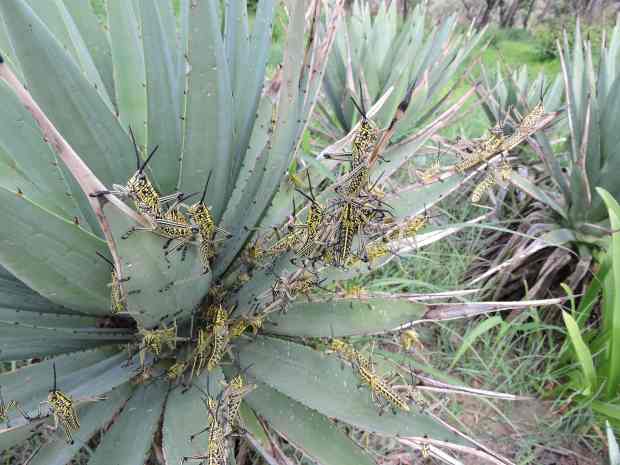
While walking in the garden of the Inn in the Vumba in December last year, we came across this sight:

DSCN9947 copy

Here they are, closer:

DSCN9946 copy

They were a swarm of locusts bunched up together. A very striking and interesting find.

As far as I could find out, they are nymphs of the Green Milkweed locusts (Phymateus viridipes).

.

Naughty hippo, again…

On our final day, after watching lions and birds, we planned a “sundowner” drink at Nyamandlovu pan to end our safari in style. Before it was time for drinks, we got busy watching the many migratory birds present at the pan. These were a large flock of Abdim Storks and Amur falcons that provided us with much entertainment while they fed on beetles and other insects found in the grass.

A family of five jackals, probably residents of the pan, were also around. While four of them were gnawing at an old elephant carcass, a fifth came close to the viewing platform for a look. As I was on the ground at the time I saw it coming and prepared for pictures. Despite the warnings shouted from above by fellow game watchers for me to be careful, I remained motionless and was rewarded with the closest encounter I have had with a black-backed jackal!

While watching the jackal I heard loud splashing noises coming from the pan and I saw a large crocodile (one of the three present) coming out of the water holding a very large chunk of carcass. I left the jackal to its business and rushed up the platform for a better look. The beast, at the left end of the pan, was violently shaking the carcass and scattering pieces in the water while it swam off with the remains to the opposite end.

DSCN9895 9.14.41 PM copy

The crocodile feeding on the submerged carcass.

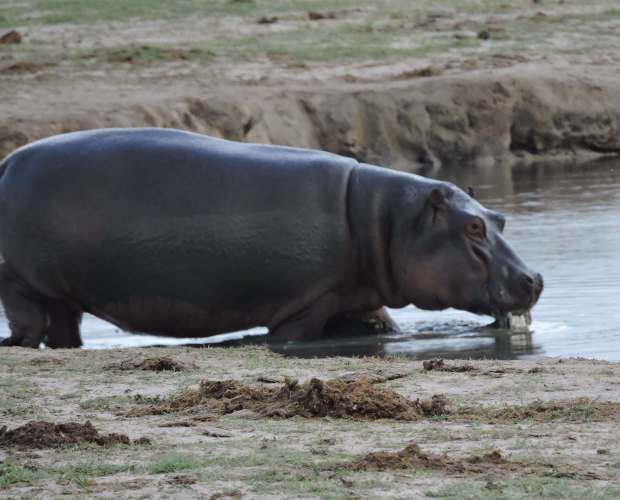
The slow approach of a hippo to the area where the carcass had been shaken apart came as no surprise to my family and I, all well aware by now of our earlier observations on meat-eating hippos at Masuma dam![1] We watched while the hippo approached and searched the area with its head submerged. Suddenly it lifted its head and chewed on what appeared to be a piece of the carcass that it had found! This was a very interesting observation, as we had not seen any of the three resident hippos engage in this activity before, despite having spent many hours there!

DSCN9898 9.14.41 PM copy

The hippo starts approaching…

DSCN9901 9.14.41 PM copy

Eating a chunk of the carcass that the crocodile left.

After munching on its find, the hippo left the area jumping in the water in a rather funny display that probably expressed approval at what it had just eaten! Fortunately I managed to take a picture of the crocodile (regrettably only after the carcass shaking took place…) and of the hippo finishing its snack and merrily moving off!


[1] See https://bushsnobinafrica.wordpress.com/2015/02/22/hippos-from-hell/ and https://bushsnobinafrica.wordpress.com/2015/03/23/hippos-from-hell-the-videos/ Muy Interesante also covered this issue: http://www.muyinteresante.es/naturaleza/articulo/los-hipopotamos-pueden-comer-carne-921450193942

An antisocial lion!

Bush lions are normally tolerant of vehicles, even the open tourist ones. The only aggression we have seen was related to times when mating was taking place and the male normally leaves no doubt about how close you should be! The situation can be different on foot when the utmost care is needed where these cats are concerned to avoid accidents.

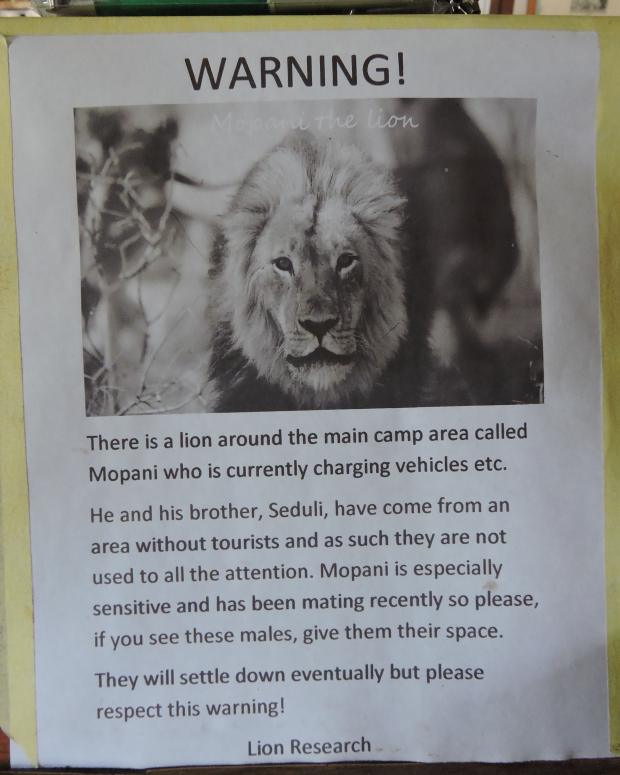
While checking in at Main Camp in Hwange National Park, we were warned of the existence of a new lion: Mopani[1]. The lion, explained a sign placed at the booking desk by the “Lion Project”, came from an area devoid of tourists and it was aggressive, charging vehicles! Siduli, another male, and two females accompanied it. We were also shown a video taken from a tourist vehicle being chased by Mopani and learnt that one of the females was in heat and mating with one of the males. We thought that Mopani’s progeny was assured and planned to keep our distance from him!DSCN9991 9.04.30 PM copy

The lions had taken residence around the Main Camp area so we were delighted at our luck, as we were sure not to miss them! “Cecil may have gone but in comes Mopani!” was our thought!

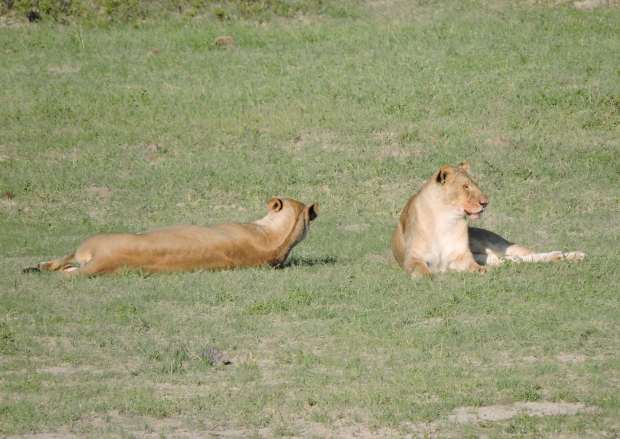
Although recently arrived from a longish trip, the possibility of spotting one of our all time favourite animals made us drop our luggage at the lodge and drive off in search of lions. We found the two females at Dom pan. They were clearly different: a paler one and a darker one. The latter appeared to be the older of the two.

DSCN9902 copy.jpg

After watching them for a while, a male came out of the bushes and greeted the darker one while the other moved away a short distance. Were we about to witness some mating? Not so as Mopani, who we assumed was the dominant male, only rubbed heads with the female and then moved off in the direction it came from, leaving the female pair alone until the day ended and it was time to get back to our lodge before the mandatory return time of 18:30hs.

DSCN9996 9.04.30 PM copy.jpg

We did not need to plan our next day activities as finding the lions again and spending time watching them was the only option! As a friend of mine says, “we slept in a hurry” and we were up before 06.00hs. No need for alarm clocks! We drove straight to Dom pan, as we believed that they would not have gone very far from there. On our way we realized that several migratory bird species were present at Hwange at the time. These were Crowned Cranes, Abdim and Woolly-Necked Storks, African Kites and Amur Falcons to name but a few!

We had little time for bird watching as the lions had killed a young elephant at Dom pan during the night and the two lionesses were feeding on it! After this find, most of our activities during the visit centred round Dom pan where we spent a lot of our time. We watched the lionesses feeding and interacting for several hours and I present you with a number of pictures and a video, as these are better than words. We only left them to return to the lodge for lunch and a rest.

When we came back during mid-afternoon, only the paler lioness was by the carcass. A search of the surrounding area revealed two lions laying together a few hundred metres from Dom. They were the mating pair: the darker female and a male that, to our surprise carried a radio collar. As we doubted that Mopani had one, it could only be Siduli. Clearly the lion that acts most ferociously towards cars is not necessarily the dominant when it comes to affairs of the heart! It was then clear that the male we had seen the day before was Siduli and that Mopani was hidden from view somewhere! But where?

Luckily my wife was with us as, if there was someone that could spot it, it would be her. And spot it she did, to our amazement, again! The wild-looking Mopani had been lying low under some bushes, unseen by anyone (except my wife) until then. It remained unobserved by our fellow game-spotters with the exception of another lady that clearly shared my wife’s eyesight. We thought it better that it remained unseen and got used to cars if it is to remain in a tourist area so we did not reveal its whereabouts.

As Mopani was still not willing to socialize and remained sulking under a bush, we focussed on the others. Mating in lions is a long-lasting affair as the pair remains together and mating takes place often for a few days, while the female is still receptive to the male[2]. This was clearly the case, as they remained “occupied” for the rest of the time we were at Hwange. That left the other lioness guarding the elephant carcass and Mopani hidden from view! After a while it was time to move off.

We drove to the Nyamandlovu pan as our daughter is very partial to elephants. Despite the abundance of drinking water all over the area, we were extremely lucky to witness the visit of a herd of about fifty animals that, as usual, appeared suddenly as if the product of a magic tree-to-elephant metamorphosis. The result was about one hour of one of the greatest shows on earth: elephants enjoying life at a water hole! There were about five family groups, each led by a matriarch and composed of its progeny, including some really young and tiny babies that were the centre of our attention.

The elephants not only drank but also entered the water where many were seen frolicking about and playing as only elephants are able to do among wild animals! It seemed to us that the latter were at risk of drowning while entering the water with their huge siblings and that they were under even more danger while swimming among them! Somehow they managed to keep their tiny trunks above the water and their mothers were extremely protective and they were always in close contact and ready to assist them!

The three resident hippos felt very uncomfortable at this sudden disturbance and two moved to the very centre of the pan while the third moved to the shore where it put up brave stance against the elephants, only to return to join the others as it was not at all respected by the excited pachyderms! Again, a picture gallery and videos are better than my limited power of description to let you know what took place.

The elephants’ joyfulness in the water delayed our return so we only drove past Dom pan, catching a glimpse of the lions who unwittingly startled a herd of 30 odd elephants intent on drinking from the pan, who retreated in a cloud of dust as soon as they caught sight of the lionesses. We arrived late at the gate where we were told off by a rather grumpy lady game ranger! The justification for our tardiness did not go far with her, clearly used to all sorts of excuses from people arriving late to camp!

The following morning, as expected, the lion pair continued their courtship, the pale female was still guarding the carcass and about fifty vultures (white-backed, white-headed, hooded and lapped-faced) were waiting on the side-lines for her to leave it. While in waiting, the Lappet-faced vulture was seen having a snack by pulling and cutting the dry tendons and sinews from an older dry elephant carcass that other vultures also shared once it opened up the hard bits!

Mopani, the antisocial, still preferred to remain out of sight! We can only hope that he starts turning into a more car-tolerant lion by accepting their presence as part of his daily life. Who knows, maybe one day he could become Cecil’s successor.


[1] To name wild animals or not to name! This is the question… for which I have no clear answer!

[2] Both leopards and lions have the same mating procedure. They can mate as often as every fifteen minutes for up to five days. This is the consequence of weak sperm and mating-induced ovulation.

Sleeping rock python

Our final visit to the Zimbabwean bush before leaving for South America took place from 8-10 January, and it was shared with our daughter who is also leaving for Italy later this week.

As usual, we enjoyed our safari in one of the jewels Zimbabwe has to offer. Learning from previous experience, we stayed at Main Camp as time was short and camping during the rainy season is not really a comfortable option! We were correct as it did rain and the sky -thankfully for the hitherto dry Hwange- was waterlogged so we expect and hope that the rains will continue.

Although there were a number of interesting observations during the trip, I will start with the one I feel “inspired” to write about, while I think about how to present the others to you.

Several memories of my past experience with African Rock Pythons (Python sebae) came to my mind when, on reaching the top of the Nyamandlovu viewing platform we were warned that there was a python in one of its corners!

My experience with rock pythons on safari is very poor. In fact, until this find I had never seen one in a national park or game reserve! My only encounters with these magnificent creatures were in Kenya, either first hand or through pictures and/or stories. I recall seeing a picture of a really humongous python (most often and most regrettably killed) that had swallowed a goat at Intona Ranch in the Transmara. It was probably about five metres long and about six people held it up for the picture. That was interesting but a real pity.

On a more optimistic note, we once met a Swiss fellow “safarier” at Meru National Park, also in Kenya in the 80’s, who told us the story of a python swiming towards his little daughter who happened to be near the water. The moment it approached her, the snake stopped swimming towards her! He also mentioned that when he kneeled next to it, the snake resumed its approach, only to stop again when he stood up, suggesting that there is some size-assessment from the python when stalking its prey.

Apart from stories and pictures, I also remember two first hand encounters. On one occasion, while staying at Elsamere[1] in lake Naivasha on a bass-fishing trip in lake Naivasha, other guests spent their time looking for pythons at the lakeshore! I was really sceptical about python-collecting so I was really surprised when two -albeit small ones- were found! I should also add that luckily they were small as my friend Paul jokingly hung them around my neck with the obvious result that I carried the scars of 2 python bites on my upper torso for a few days! I can testify that pythons bite at least as hard as laboratory rats!

The second encounter was when, perhaps inspired by the above incident, Jim, my wife and I decided to go on a python-safari! Jim was a good friend with whom I shared a liking for snakes. My wife does not like snakes so she came for the walk, hoping for a fruitless search! Our trip took us to Hell’s Gate[2], long before it was declared a National Park.

We did enjoy a magnificent walk along the gorge and dry riverbed. It was there, at a narrow, shady and wet passage between narrow cliffs that we found a young rock python that had recently moulted and was shiny and healthy. As until then, finding the python was just our pretext for the walk, we were as amazed to find it as I am sure the snake was to see the three large primates walking towards it!

Enough reminiscing and back to the present safari! The Nyamandlovu pan viewing platform offers a magnificent view of the water and the action that is always present there. This time the action was clearly inside it! The empty half of the platform was clear proof of the snake’s presence, fear of snakes prevailing even among animal lovers who preferred to pack themselves at the other end!

DSCN9989 9.28.32 PM copy

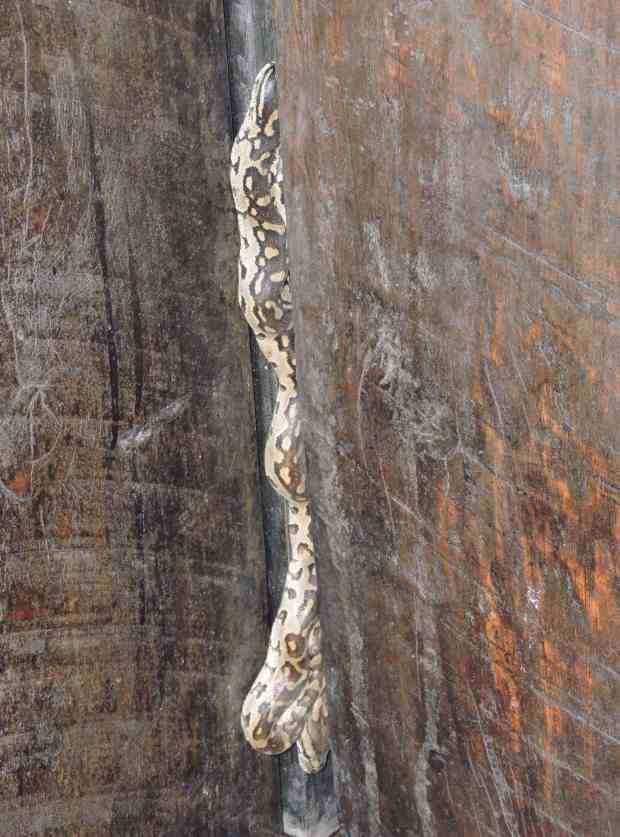
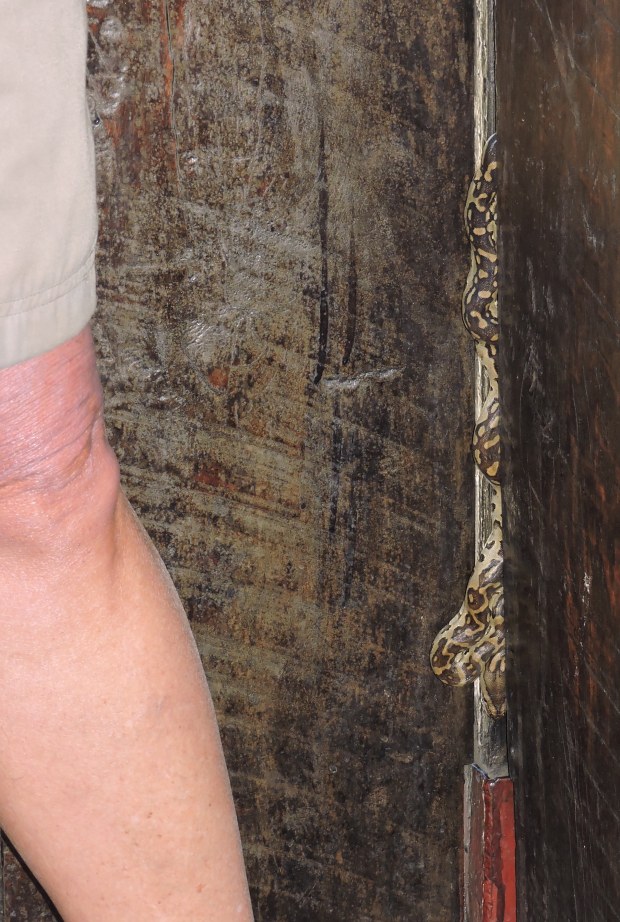
The young  rock python wedged in a crevice of the platform, head down.

We were really thrilled by the news and moved closer to have a good look. The snake was a juvenile. It was comfortably wedged head-down in a gap of the railing, apparently enjoying an afternoon nap[3]. We took a few difficult pictures and sat in the empty corner next to it leaving it alone, happy to watch it every now and then while focusing on the events at the pan.

DSCN9990 9.28.32 PM

Regret the leg but it is only for comparison!

Amazingly not one of the several occupants of the platform came to have a look at the snake although all of them were aware of its presence. They preferred a packed platform end while we remained undisturbed at the “snake end”!

Needless to say that the snake did not move while we were there! It was still in exactly the same position when we left at the end of the day, still enjoying life. We were a bit concerned about it being rather vulnerable but hope that it will find its way and we will see it again.


[1] Elsamere Conservation Centre was the home of George and Joy Adamson for a time and it has accommodation facilities.

[2] It was named by Gustav Fischer and Joseph Thomson in 1833 after its narrow cliffs.

[3] Although snakes do not have eyelids, they still sleep by being able to close their pupils and sleep.