Zimbabwe

Horn-borer moths

One of the advantages of being a “safari veteran” apart from a bushsnob is that I am now able to enjoy what I found, even the small things that were overlooked while seeking large game. The years of long game drives and walks, some of them starting very early and with freezing temperatures, are a thing of the past. Apart from seeing a pangolin in the wild, I have few wishes left about finding new beasts.

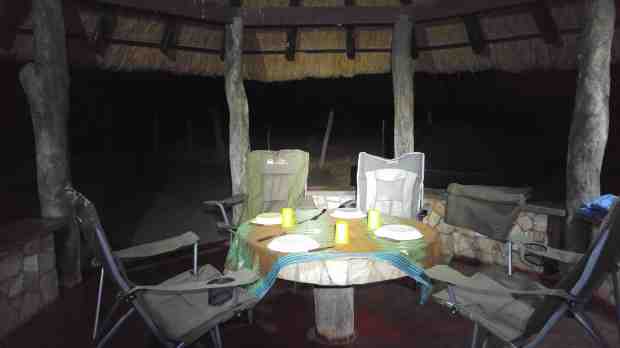
At Ngweshla Picnic site, Hwange National Park, you are allowed to camp and have the site for yourself from 18:00 to 06:00. During the day you share it with picnic site users but there is still plenty of room for everybody. Although rather unique, this is a good arrangement as most of the day you are game-watching away from the site and the camp attendants keep the camp tidy and the toilets sparkling at all times!
20160803_184901-copy

The site has seen better days and, as a consequence, it has a rather “porous” fence that would, if the animals wished, allow them to mingle with the campers, a rare occurrence though. The site entrance has been “decorated” with many animal bones. Although it is debatable whether these are suitable for the purpose, I find the skulls, useful to explain various issues regarding wild animals to our visitors.

The more recent antelope and buffalo skulls on display still had their horns and, as it is common if Africa, most showed little brown tubes protruding from them. I had seen this phenomenon many times before but I never followed its origin in detail. A short search educated me that the Horn-borer moths (Ceratophaga vastella) were responsible.

The larva of this moth, related to the one that upsets us by eating our woolies, are able to digest keratin and, although there are reports of them entering the horns of live animals, it is generally accepted that they only penetrate the horns post-mortem.
dscn9992-10-35-21-pm-copy

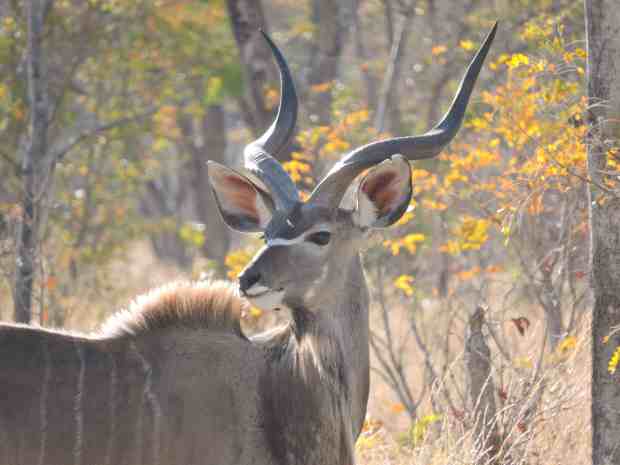
A nice and “mothless” Greater kudu bull.

The protuberances on the horns are the cases of the larvae that the latter built using their own faeces. The cases protect the soft insects from predators and the climate until they pupate and emerge as adults to fly away and colonize new horns.

Ceratophaga vastella, known as a detritivore[1], is widespread in the Afro-tropic ecozone[2]. Thus far there are 16 described species in the genus, with 12 found in Africa. The larvae are cream-coloured and bulky, with a brown head and tip of abdomen. The adult moth is a typical tineid[3], having a conspicuous tuft of yellow hair on the head.

Whenever an animal dies or is killed it will eventually be consumed by the killers and/or depredators including various mammals such as hyenas and jackals, birds such as vultures and others, fly maggots and ants until only bones, horns and hooves are left. The horn-borer moths are one of the last participants turning the carcasses to dust.


[1]An organism that feeds on and breaks down dead plant or animal matter, returning essential nutrients to the ecosystem.

[2] One of Earth’s eight ecozones. It includes Africa south of the Sahara, the southern and eastern fringes of the Arabian Peninsula, Madagascar, southern Iran and extreme southwestern Pakistan, and the islands of the western Indian Ocean.

[3] Moths of the Tineidae family, also known as fungus moths includes more than 3,000 species, unusual among Lepidoptera as most feed on fungi, lichens, and detritus. Apart from the clothes moths, which have adapted to feeding on stored fabrics, others feed on carpets and the feathers in bird nests. 
 

Bug get together

It was during a “pit stop” while returning from Mana Pools National Park to Harare in August when we found an interesting beetle aggregation. As usual, it was my wife who detected the “funny-coloured leaves” on the tree.

dscn9993-4-47-19-pm-copy

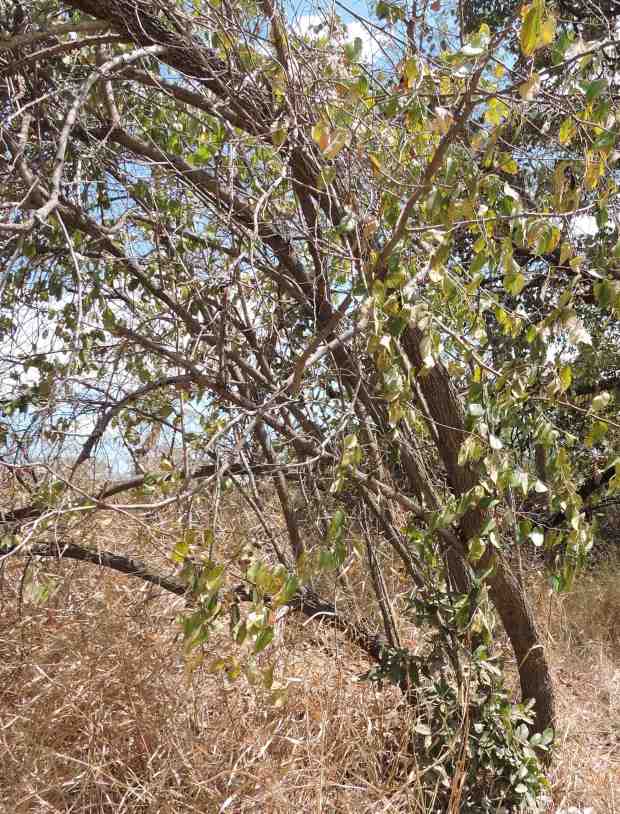
The tree where the bug meeting was taking place. The bugs are the darker spots on the right.

We had a good look at the tree and took a few leaves and fruits from it to see if we could identify it. We also took pictures and videos of the insects as it was a really interesting find. Later, after some time we decided that the tree was a Buffalo-thorn, Ziziphus mucronata. Thinking that the finding was interesting, I followed it up and consulted the experts.

I sent pictures to the Biosystematics Division of the Agriculture Research Council-Plant Protection Research Institute in South Africa from where I got a very helpful response the following day! Luckily, they agreed with our tree identification and clarified that the beetle was in fact a bug of the Plataspidae family and not a beetle.

As expected, to positively identify a bug through photographs is not really possible. However, the creatures’ identity was narrowed down to either Brachyplatya testudonigra or B. rubromaculatus. However, more important than the identification was the fact that the bugs were swarming, not a common phenomenon.

Things then turned a bit more scientific when I tried to get more information on swarming and learnt that Sithole and Oelofse (no date) described the rather unusual swarming of the green stink bug, Piezodorus purus. The latter was observed in several areas of the Kruger National Park but their aggregation reached large numbers at the Mooiplaas area where the bugs became a nuisance for the park personnel living there.

I also learnt that there is actually a stink bug considered to be a delicacy! This beast, aptly named the edible stink bug (Encosternum delegorguei) found in northern South Africa and Zimbabwe, does swarm during years that the conditions for such event are right (Stiller, personal communication). If interested, Nelwamondo (2015) gives very interesting information on this species.

Sisterson (no date) mentions insect aggregation in general as a phenomenon that obeys to three main reasons:

  • environment: e.g. low temperature and/or low humidity forcing the bugs to migrate searching for better conditions,
  • mating strategy: it seems that although swarming could be positive by allowing weak females (after debilitating winters) to be able to mate with multiple males, it can also create confusion among active seeking males that would spend energy chasing each other in addition to the females) and,
  • defensive strategy: aposematic[1] insects aggregate. It is believed that they do so to become more obvious and, in this way, better deter predators.

The aggregation pheromone is responsible for this behaviour that, although it can be used in pest control it can also have deleterious effects on some attractive insects such as butterflies as their aggregation sites get degraded with the risk of their number diminishing below critical levels.

The behaviour observed in the Green Milkweed locusts (Phymateus viridipes) reported earlier in this blog[2] was probably migratory as they were not feeding on the cacti. However, feeding is another reason for insect aggregation. Stiller (personal communication) mentioned that he has observed leafhoppers swarm on the trunks of trees, that are probably their feeding plants and the pest Bagrada hilaris, can occur in very large numbers on feeding plants.

The introduction of the bean plataspid, Megacopta cribraria, into the United States in October 2009 has attracted considerable research on this bug as it has become a pest of soybean in Georgia and South Carolina (Poplin and Hodges, 2015). These researchers mention the overwintering congregation of the bugs on buildings as a possible nuisance, a similar situation as the one described above that took place in the Kruger National Park.

It is interesting how a rather casual observation of a cup of coffee stop during a road trip could develop into a motivating investigation on the aggregation behaviour of insects. Of course, after all the reading and writing, I still do not know the exact nature of the bug but I learnt something about the biology of the plataspids, a group of insects I totally ignored.

Acknowledgements.

The assistance of Elizabeth Grobbelaar and Michael Stiller of the Agriculture Research Council-Plant Protection Research Institute of South Africa was critical in checking the identity of the bugs.

References

Nelwamondo, V. (2015). Edible stinkbug. SANBI – Zoology systematics. Accessed on 15 October 2016. http://www.sanbi.org/creature/edible-stinkbug

Poplin, A. and Hodges, A. (2015) Bean Plataspid: Megacopta cribraria (Fabricius) (Insecta: Hemiptera: Heteroptera: Plataspidae). Document EENY527, Department of Entomology and Nematology; UF/IFAS Extension, USA.

Sithole, H. and Oelofse, J. (no date). Accessed on 15 October 2016. https://www.sanparks.org/docs/parks_kruger/conservation/scientific/interesting_facts/mooiplaas_insect_oubreaks_2006.pdf)

Sisterson, M. (no date). Insect Aggregations; The Phenomena Itself, Why It Occurs, And Its Implications To Us. Accessed: 15 Oct 2016. http://www.earthlife.net/insects/aggregat.html


[1] brightly coloured and/or toxic insects

[2] https://bushsnobinafrica.wordpress.com/2016/01/31/spot-the-beasts/

Spot the beast 12

I was not planning to blog today, Sunday. However, there are no rest days for Nature so I found this creature in the garden and took a picture for you to find it. This time it is not very difficult…

scn9945-copy-2I am sure that you spotted it but, just in case I give you a close-up.
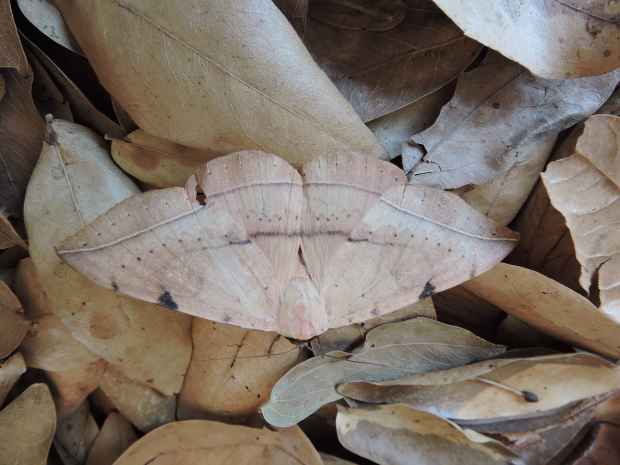
scn9948-copyIt is (I believe) a Red Tail moth (Hypopyra capensis), a common moth of Southern Africa that has a cryptic upperside that blends very well with dead leaves this time of the year.
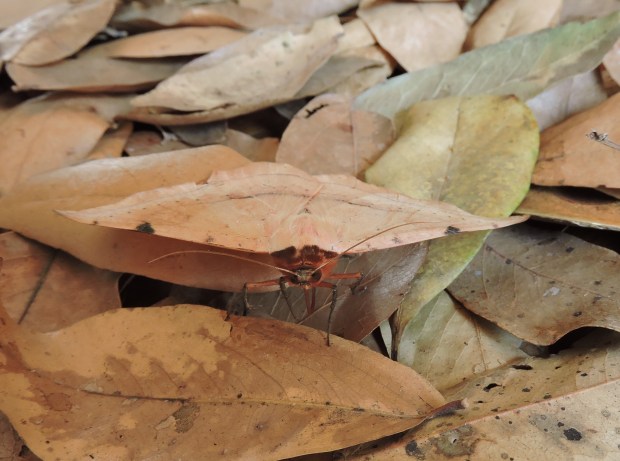
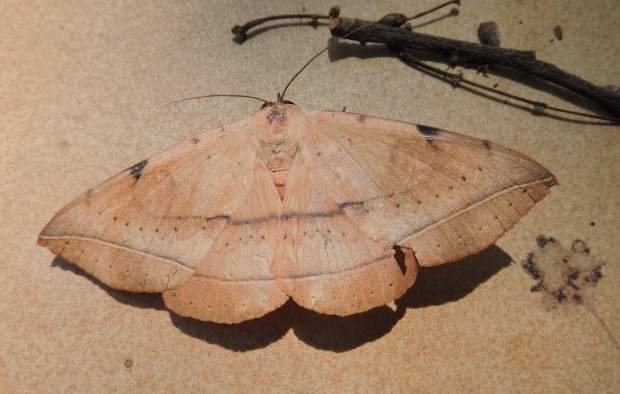
Its under-wings and abdomen, however, are bright orange-red hence its common name.

scn9944-copy

As I try not to handle them, I thought I would not able to show you its underside as it flew away. Luckily it decided to land on the floor of the patio for a while where I could photograph it under direct sunshine and the underside colour can be seen, even from above!

scn9951-copy

The larvae of this beautiful large moth of about 70mm wingspan feed on false-thorn (Albizia) and its range goes up to equatorial Africa.[1]


[1] Picker, M., Griffiths, C., and Weaving, A. (2004). Field Guide to Insects of South Africa. Struik Nature. pp366.


Daring parents

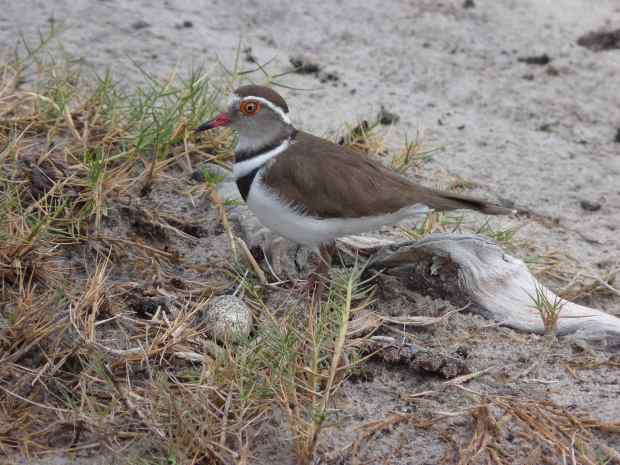
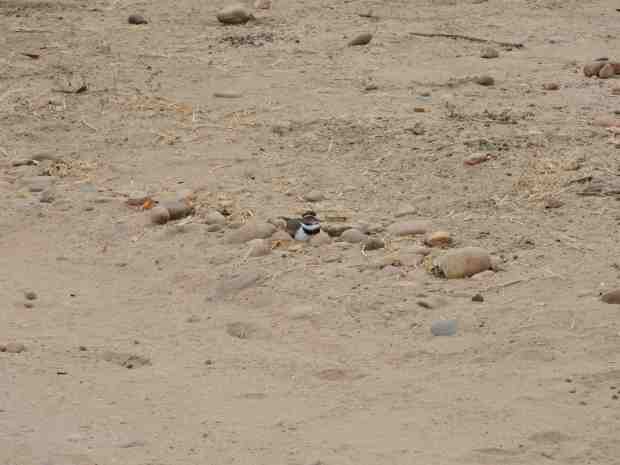
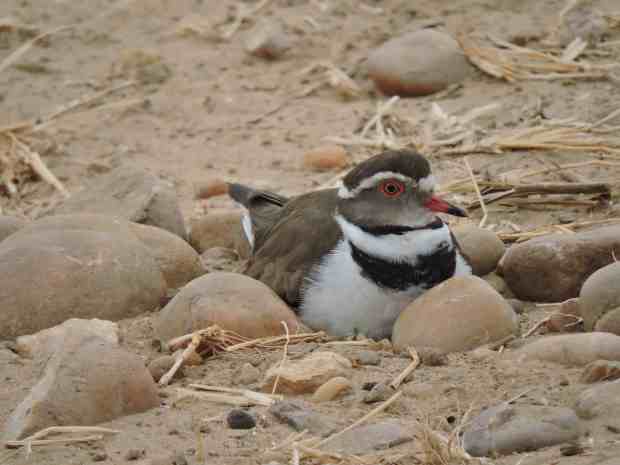
It seems that the Three-banded plover (Charadrius tricollaris) has a knack for living dangerously or rather incubating dangerously.

I rarely find ground birds’ nests. In fact, I have only found two so far and both belong to this little plover!

The first nest I found was at the Maputo Special Reserve in 2011 near Milibangalala while driving through a stretch of road between the woodlands and one of the swampy areas. There, by the shore and almost on the road, we noted the nest as the bird stayed on its eggs up to the last minute until we almost drove upon it and only then it moved a couple of meters to wait for the danger to pass so that it could return.

p1010653-three-banded-plover-11-10-37-am-copy

The first nest in Mozambique.

We spotted two eggs (the normal number) rather large for the bird’s size that looked very much like round pebbles and melted very well with the ashy background.

We found our second nesting bird at Mana Pools this past August and I have already given an advance of it at an earlier post[1]. This time the nest was about one kilometre from the Zambezi River but probably nearer some of the pools. As with the nest in Mozambique, the bird would run off a couple of metres away when we drove past and return to the nest soon afterwards.

Again, there was no nest to speak of and the two dark grey eggs had been laid on the ground in a small area of about 7-8 cm across, among some stones at the very edge of the road. After watching the nest for a while we noted that there were two birds taking turns to sit on it. As soon as its shift was over, the relieved bird did not stay and flew off, probably to feed and drink although we did not see where it went.

Although the birds sat on the eggs, they were also seen standing over them as if shading them from the direct solar heat. At some stage we observed the absence of both birds for a few hours and became concerned that we or other cars passing had disturbed them. The following day we saw them back. In the absence of the birds the eggs are extremely difficult to spot among all the small stones.

It appears unlikely that such a seemingly unsafe choice of nesting site would be successful as the eggs were completely exposed in the absence of the birds. Further, the birds themselves do not seem to offer much protection to the many predators, scaly, feathered and hairy that roam around the area, not to mention the stones thrown by passing cars. Despite these apparently large odds against them, the strategy must work as they are fairly common!

As a note of interest, searching the web I found an account of this bird’s nesting habits in Eritrea written by Stephanie Tyler while she and her husband -Lindsay- were kidnapped by guerrillas in the north-east of the country [2]. Her interest on the birds and the observations she made while being held captive are remarkable. She also stresses the bird’s tolerance to the approach of humans, their failures with the incubation and rearing of the chicks as well as the first observation that the Three-banded plovers are multiple brooded or able to raise more than one brood of young in quick succession. We can say that Three-banded plovers are tough parents!

A video that shows the nesting behaviour of the birds and the “change over” their nesting duties.


[1] See: https://bushsnobinafrica.wordpress.com/2016/09/09/spot-the-beast-12/

[2] Tyler, S. (1978). Observations on the nesting of the three-banded plover Charadrius tricollaris. Scopus 2, 39-41. If interested on the details, the original communication is here: https://archive.org/stream/scopus2197east/scopus2197east_djvu.txt 


Spot the beast 11

dscn9951-copyI know, this is a difficult one. I give you a closer view below to see if you can spot it…
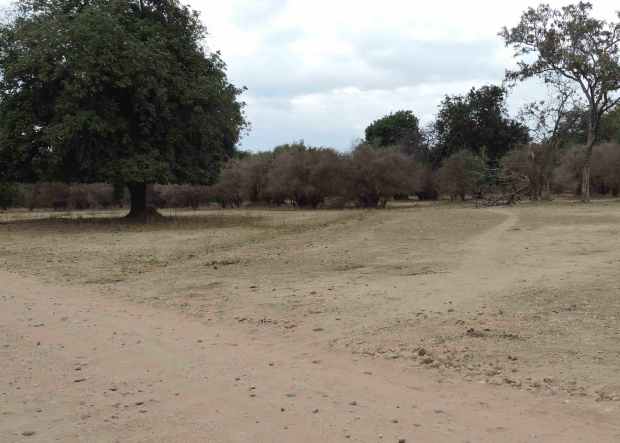
dscn9951-copy-3Still, all you can see are the two bush tracks joining , dust and trees? What about below?
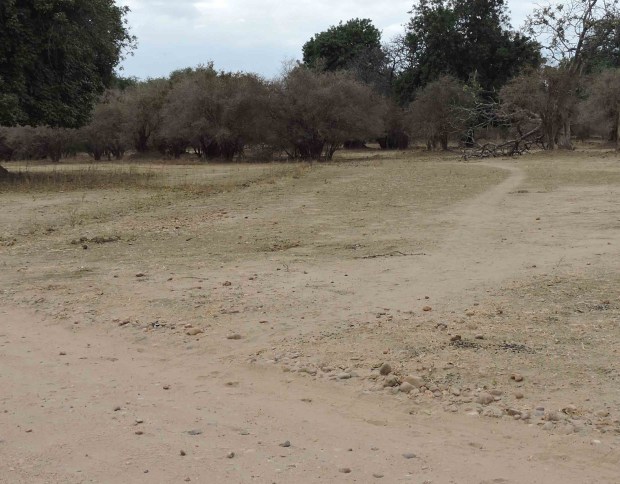
dscn9951-copy-2You should be able to spot it but here it is:
dscn9952-copy

dscn9950-copy

A Three-banded lapwing (plover) sitting on its nest and quite well camouflaged. I will expand on this finding on a future post.


The “hoo” call

After watching Big V and the other elephants until the light faded, we decided to get back to our lodge, as you are not allowed to drive in the dark. Shortly after the turn off to our lodge my wife heard a strange call. As it was unusual we stopped and listened.

At first we thought that it was an owl or some other large bird. Whatever its origin,  we were sure that we had not heard it before so we decided to retrace our “tyre marks” and see if we could spot the originator.

We returned to the main road and, immediately, my wife spotted three ghosts that, as they got closer, gradually became  African wild dogs (painted dogs) walking in the dry bush. We stopped, watched and listened. Suddenly, one dog crossed the road in front of us and started emitting the sound we have heard earlier. It was a plaintive sound repeated three or four times. The call was repeated a few times and then the dogs got together again and walked into the darkness.

The only option I had to record the sound was to take a video and hope that the sound if not the image will reflect what we heard. The results are a dark video with the wild dog call repeated three times.

Later on I learnt that when wild dogs get separated from their packs they get very concerned and in these situations they emit the call we heard that aims at getting a reply from the pack in order to reunite with them. This call is known -rather appropriately- as a “hoo” call.

So, what we saw were probably three dogs trying to re-join their pack by hoo calling. Later on we learnt that there was indeed a pack of about twenty dogs roaming around Mana Pools at the time so we probably saw three members of that group.

After that, we lost them but their plaintive call got “recorded” in our minds.

The hoo call (and the bad video!):

I am sure that you will agree with me that you do not expect such a sound to come from a wild dog!

Big V

Boswell and Big V[1]  are the best-known elephant bulls in Mana Pools National Park. I recently reported about Boswell’s skills to feed on his hind legs[2], a rather unique trick. When we witnessed an elephant feeding on Acacia pods overhead and I reported in an earlier post[3] was Big V so I have already introduced both to you.

Mana Pools this August was extremely dry, as last year the rains were not good. For this reason the area looks more as it does towards the end of the dry season in November than it should be in August: a dust bowl! I believe that the animals are in for a tough two to three months until new rains arrive, if they do as these days weather patterns have changed.

Luckily for most of the animals in Mana the Zambezi River is there and, together with the pools that lend the name to the park, they provide water and fodder to keep the grazers going while the trees such as the apple-ring acacia (Faidherbia albida) will supply elephants with browsing. The animals that seemed hardest hit at the moment were the hippos that need to consume large amounts of grass so it was common to see them walking about during late afternoon already far from the water.

While checking in we learnt that lions had been spotted around an area known as Mana mouth. After recovering from the six-hour journey from Harare and, after unpacking and organizing our lodge, we decided to go there as it is close and the sunsets there are usually beautiful, even without lions! We never reach our destination as on our way we found Big V!

With him were, in addition to his usual young male retinue, a young female and its small calf, something unusual as large bulls tend to hang out on their own or with a few askaris[4]. He towered over the lot and he was clearly the undisputed leader of the group.

In an interesting contrast to his dominance over other elephants, Big V is an extremely relaxed elephant that allows the human observer to approach him either in the car or on foot. In contrast, the younger males can be more boisterous and occasionally perform threatening displays and mock charges that remind us that we are dealing with wild animals!

On this occasion it appeared that Big V was doing some “community” work by pulling down branches from an apple-ring acacia. Clearly, for the elephants this was the equivalent of eating at a Michelin-starred restaurant!

Although Big V was not standing on its hind legs “Boswell style” it stretched and reached high up the tree, to a height the others could not. As a result of its efforts large branches were brought down showing a great dexterity with his nose (it is easy to forget that he was breathing while doing this!) as well as the damage elephants can do to trees!

He will then fed on them, including the main branches, some of which were really thick! While Big V was eating, the other elephants were eager to collect any fallen pods or small branches but from a distance as Big V’s belly rumblings were sufficient to keep them all at bay! Well, not all…

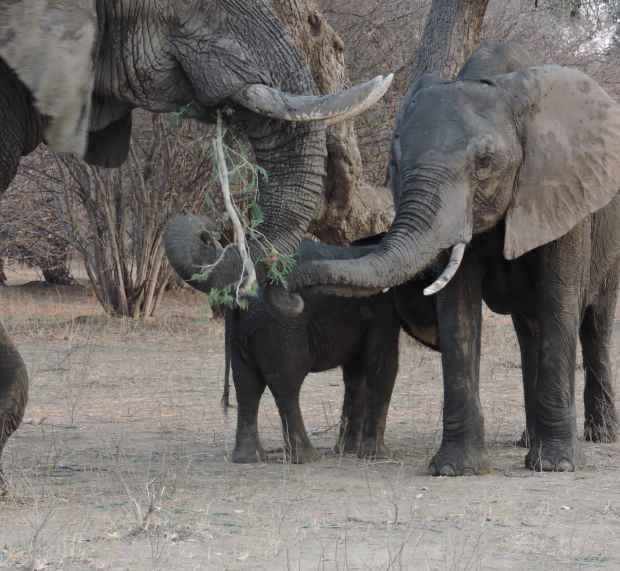
The small female and her calf approached the feeding giant ignoring his rumblings. Expecting some rebuke we were surprised to see that they slowly got closer and closer  she started to steal bits of the branch to feed. The calf was also allowed into Big V’s inner circle and managed to pick some scraps. The large bull completely ignored them!


DSCN0022 8.49.54 PM copyAt one stage, the female even took bits of the branch from Big V’s mouth!

The reasons for this closeness I ignore but it was unexpected and we spent a few minutes watching how it developed. Spellbound with these interactions, we forgot about the lions and when the light was fading we returned to our lodge still talking about what amazing creatures elephants are!


[1] This elephant has a large v-shaped notch on its left ear.

[2] https://bushsnobinafrica.wordpress.com/2016/08/17/boswell/

[3] https://bushsnobinafrica.wordpress.com/2015/10/14/elephant-overhead-and-it-was-not-dumbo/

[4] From Arabic, an askari was a local soldier serving in the armies of the European colonial powers in Africa. It is also used for security guards and the young bulls that accompany large bull elephants.

Fish eagles

A visit to Lake Chivero Recreational Park, just over 30 km from Harare, does not sound like a grand outing when you have just come back from a family trip to Mana Pools and Hwange National Parks. However, it was a Sunday and our good friends Tom and Chizuki had time to share so we decided to explore the area and have a picnic lunch there.

Lake Chivero had some influence on our daughter’s life, the Senior Editor of this blog. My wife and I visited the area on 27 October 1990 and she still remembers that I had to help her to climb over the rocky terrain to see some of the San (Bushman) paintings as she was heavily pregnant. She claims, possibly with some justification, that this accelerated the arrival of our daughter the following day!

It was also at Chivero a few years later, when we were living in Zimbabwe, that our friend John invited our daughter -about eight years old then- to join him as part of a crew of two on a sailing regatta. We all went there and watched the race and also the moment when they capsized in the middle of the lake. We watched the events from the shore with great concern! Luckily, they managed to straightened the sailing craft and continued racing! This probably had something to do with our daughters’ love of the water and her keenness on sailing!

During the present visit we aimed for the game park area of the park as it was still unknown to us. We were aware that the park is somehow too close to the city so we did not have high expectations.

The total area of Lake Chivero Recreational Park is 6,100 hectares including the 16 km long lake. The animals that populate the game park, of about 1,900 hectares, came from Hwange National Park. Additional animals were brought in from Lake Kariba during the game rescue operation better known as “Operation Noah” that took place between 1958 and 1964.

We enjoyed watching several impala, tsessebe (Damaliscus lunatus lunatus), wildebeest, giraffe, zebra, wild pig and a slender mongoose as well as a number of ostriches and other birds. Busy watching animals we were, very soon it seemed, faced with our lunch! We decided to stop by the lake where the lodges are. The area was clean and the personnel very friendly. They pointed us to a viewpoint on the lake where we could have our sandwiches.

As soon as we stopped the car we were pleasantly surprised to hear a fish eagle (Haliaeetus vocifer), a call that we regard as the quintessence of the African wilderness. Usually fish eagles occur in pairs and their territories are large so you find them a good distance apart. What we saw in this area of the lake was different. There were many eagles and we estimated the number at between 40 and 50 birds, both adults and immature. They were all over the place, at the lakeshore, flying about and perched on the trees above and around us!

At some point we noted fast forming ripples on the surface of the lake and,after a while, we realized that shoals of fish were responsible for them. The latter would take place spontaneously or when the walking marabous or the eagles scared them by either wading or flying over them. We observed lots of interaction between eagles and between them and the marabous, particularly when fishing.

An area among the trees seemed to attract the attention of the eagles and, on close inspection, we found several dead fish that looked like Tilapia. Judging by the amount of guano present the spot was probably used for sleeping by some of the eagles.

Clearly there was a lot of fish at the lake and the eagles were profiting from it! It was by far the larges concentration of fish eagles I have ever seen and we were pleased to be able to watch them at close quarters. However, as this was the first time where we had seen such a congregation of fish eagles, I made a point to follow up the subject later.

Our lunch over we left the eagles thinking that a return visit to watch them at leisure would be justified. On our way out of the game park we were surprised to spot three white rhinos grazing placidly about 100 metres from us, a rare sight these days that added another justification for a re-visit!

Back home, searching the internet, I learnt that lake Chivero showed high levels of pollution in the 1970s but that the toxic levels had since declined. However, the lake is now highly eutrophic[1] and this, through the abundance of fish feeding on the increased amount of nutrients, has had a positive impact on the fish eagles’ increase in numbers[2].

Although the increase in nutrients may benefit bird populations -in our case the fish eagles- this may be at the expense of other species that require other -more fragile- resources that may be altered by nutrient changes and/or pollution and the overall environmental health may be in fact poorer[3].

So, what in principle appeared as a good thing, it may turn out badly for the lake habitat. It will be interesting to come back to the lake in a few years to see how things develop.

Below you will find four videos of what we heard and saw so that you can get the atmosphere at the lake that day.


A fish eagle flying over the lake shore and attempting to catch fish a few times. The response of the fish every time the bird approaches them can be seen as ripples on the water surface.


Fish moving ahead of the walking marabou storks.


Listen to the calls of the fish eagles!


Spontaneous fish runs indicating the large fish population in the area.


[1] Euthropic (From Greek eutrophos = well-nourished). Eutrophication of a pond or lake arises from the oversupply of nutrients of various origins, which induces explosive growth of plants and algae.

[2] Mundy, P.J. & Couto, J.T. 2000. High productivity by Fish Eagles on a polluted dam near Harare. Ostrich 71 (1 & 2): 11–14.

[3] MacDonald, M.A. (2006). The indirect effects of increased nutrient inputs on birds in the UK: a review. RSPB Research Report 21. Royal Society for the Protection of Birds. 204p.


Boswell

It is irrelevant here to argue against or in favour of naming wild animals. It happens often among the big five and others that are singled out for certain notable characteristics or behaviour and I am sure it helps researchers in their work. There is a tusker-naming project at the Letaba Elephant Hall in the Kruger National Park and many notable animals have been given names, not only in Africa but also throughout the world.

Boswell in Mana Pools is a bull elephant that is one of the legitimate owners of the place. It kindly let us enjoy its home without a grudge while it goes about its business. Boswell is well known by all that, like us, are frequent visitors of this beautiful wilderness area. It has a distinct feature: it can reach for the apple ring acacia pods higher than its colleagues.

Over the years it has developed a trick that few others can match: it does not only stretch but over-stretches by standing on its hind legs in perfect balance while it feeds at incredible heights. I do not know how it learnt to do it but perhaps it is an elephant tradition that is passed from generation to generation at Mana Pools.

Whatever the origin of its skill, many brilliant pictures have been taken in the past by great photographers and these can easily be found in the Internet. However, one thing is to watch professional pictures and/or documentaries and another, rather different one, is to see it performing live, just like any artist!

We have seen Boswell often once we learnt to recognize it but we have not seen its trick as it only takes place at a certain time of the year when the right conditions are present. Even at that time, you must find Boswell and it has to be willing to perform. This is not as easy as you may think.

During our last visit to Mana Pools last July game was not yet abundant in the riverine part of the park so I decided to cut short my participation in a family game drive and stay in camp to take things easy and to watch what was going on there as its proximity to the river is always rewarding. We had been, as usual, “attacked” by monkeys and the baboons were particularly vicious when they did not find anything, pulling down one tent an even biting our solar-powered lamps!

I spent some time tidying up and eventually sat down to have a cuppa and to write notes on the trip. Although it passed about five metres from me I only saw Boswell’s bottom and looked for the camera only to realize that it was with the rest of the family! Luckily I had my iPad with me!

Boswell crossed the river fast and soon reached a couple of acacias on the other side, about one hundred metres from me. There it started feeding and I watched for the first time his two-legged feeding trick.

As usually happens, my pictures are rather pathetic but I am, nevertheless, proud to be able to say that I saw Boswell performing for me alone at its home!

Curious

A couple of mongooses at what we thought was their burrow inside a termite mound was the first we saw while on a game drive close to Ngweshla pan at Hwange National park.

See what happened next in the slide show and video below.

This slideshow requires JavaScript.