Bush stories and anecdotes

The heart of the blog, where I present observations, accounts, funny stories, etc.

Leopards

When on safari, finding a leopard is the cherry on the cake. These scarce predators are hard to find as they are very secretive and cunning animals. The fact that protected areas are shrinking does not help their conservation status either. Luckily, as you will see, the Kruger National Park (KNP) still remains an excellent place to spot these elusive and beautiful cats.

This year our “out of Zimbabwe” travel included South Africa and Botswana where we visited the KNP at the beginning and at the end of our trip and the Kgalagadi Trans-frontier Park in between. Quite a journey (about seven thousand km!) but well worth it.

The first visit to the KNP included the northern section as this is the closest to Zimbabwe. We visited three camps: Sirheni Bushveld camp, Shingwedzi Rest camp and Bateleur Bushveld camp.

While we did find other interesting things in Sirheni and Shingwedzi (that I will tell you about soon), it was while arriving at Bateleur that things became really exciting. Near the “Red Rocks”, the main attraction near Bateleur, we found a dead impala under a tree. Fellow travellers informed us that a leopard had killed it and that it was a female with a cub. Scared by the vehicles they had left the kill and hid somewhere.

We decided to wait quietly and were rewarded. After about an hour we saw a movement up the tree just above the kill and, soon enough, we could see a leopard moving in the thick foliage. A few minutes later it climbed down. It was the youngster that, hungry, started to feed on the impala. The area was very bushy and photography was difficult but it was a good sight.

DSC_0120 copy

After a while the cub walked in front of us and briefly joined its mother. We had a glimpse of the female that immediately hid again in the long grass while the cub returned to the impala. We waited a bit more but as we still had to check-in at our camp we decided to leave making a note of the site to return later.

This slideshow requires JavaScript.

So, quite encouraged by our find we re-joined the road towards Bateleur camp. We had not travelled more than a couple of kilometres when we heard the alarm snorting of impala and found that a large number were looking in the same direction while calling in alarm! This situation can indicate the presence of a predator. I need to clarify that in the Southern Africa’s more bushy landscapes you need to take all possible signs into account to find game.

We stopped and waited and when we saw that the monkeys, guinea fowls and francolins -among others- joined the chorus, our belief that a predator was near firmed up. After a short while we spotted another leopard! It was waking in parallel to us in a direction that would take it to the river, on the other side of the road. The leopard ignored us and it never hesitated once on the direction it was traveling. We watched it walk, still followed by its mobbing retinue but completely unmoved, until it went down the river!

This slideshow requires JavaScript.

Finding three leopards in a couple of hours left us rather stunned and we thought that Bateleur was “the place” to spot leopards. Well, as usual we were wrong! During the four days we spent there the leopards carefully avoided us! However, there was more to come on our return to the KNP later on.

On the second visit to the KNP about two weeks later, we entered through the Paul Kruger’s gate and headed for the Olifants Rest camp. About one kilometre from the gate a bunch of cars marked the whereabouts of a sleeping leopard! As our journey was still long, we left it and continued towards Olifants where we arrived late in the afternoon.

Olifants Rest camp is probably the most spectacular of the KNP camps as it is built on a cliff that overlooks the Olifants river, located quite a way below, offering a breathtaking view of the river and its environment. We were fortunate to have booked one of the “river view” bungalows so we could just sit in our verandah and take in the scenery opening up below us!

DSC_0111 copy

DSC_0052 copy

The morning after our arrival, after a “breakfast with a view” we drove towards Olifants satellite camp Balule [1] and then followed the Timbavati river, an area well known because of its white lions. The latter are not albinos but a leucistic form, similar to the starling reported in this blog [2].

We knew that to find white lions was very unlikely as most of them are now in captivity or game reserves nearby but we had driven through this area earlier on another journey and found it very attractive. It did not disappoint us. Fortunately, the river had water and we found lots of water birds, including a family of saddle-bill storks fishing at a stagnant pool.

DSC_0065 copy

Further on, on another stretch of the river we spotted a pair of ibis and, while trying to confirm that they were the rarer purple rather than the more common glossy, I spanned the area a couple of metres to their left and I could not believe my eyes: a large leopard was lying down next to the birds! I was very excited, as I had never experienced such an accidental find! I believe that the leopard was walking to the river to drink at the time we appeared and its reaction was to crouch not to be seen!

DSC_0054 copy

We waited and watched. After a couple of minutes, it stood up and walked to a small water pool where it drank for a couple of minutes and then, as it is often the case with leopards, it disappeared in the thicket.

This slideshow requires JavaScript.

We drove back really excited by the find and, before reaching our camp, we had a fleeting sighting of yet another leopard well inside the thick bush!

After a fruitless early drive looking for the leopard spotted near camp we decided to relax at our bungalow to take in the beauty of the Olifants river as we could lots of animals coming to drink and to graze there. That morning, apart from the usual hundreds of impala and dozens of waterbuck we could also see lots of greater kudu and a few bushbuck. However, our attention was focused on a couple of elephant families enjoying drinking and bathing.

DSC_0053 copy

While busy watching I heard my wife saying, “the elephants are scared” and then I could hear their loud alarm calls. Immediately I heard her saying “there is a hyena walking behind the elephants towards the water” and immediately, “oh gosh, there is a leopard drinking also!” As I wanted to see it, she explained me where it was so I started looking and, after a while, I spotted it. After a while the leopard moved “it stood up” I said. “No” replied my wife, “it is still drinking”. We started to argue but then we realized that we were in fact looking at two different leopards on the river bed!

The afternoon of our last day we spent it back at the Timbavati river. It was during this time and before arriving to a pan called Ratel that, lo and behold, a leopard was looking at us from a donga and, of course, it immediately took off before we could do anything, as usual and we could not see it again!

So that was our experience in the KNP where we spotted nine leopards in a couple of weeks, a marvelous experience that we know it will not be repeated and certainly it will not be forgotten!.


[1] Interestingly, this was one of the few camps where people of all races were allowed during the Apartheid times!

[2] https://bushsnobinafrica.wordpress.com/2017/01/05/odd-bird/


Spot the beast 30

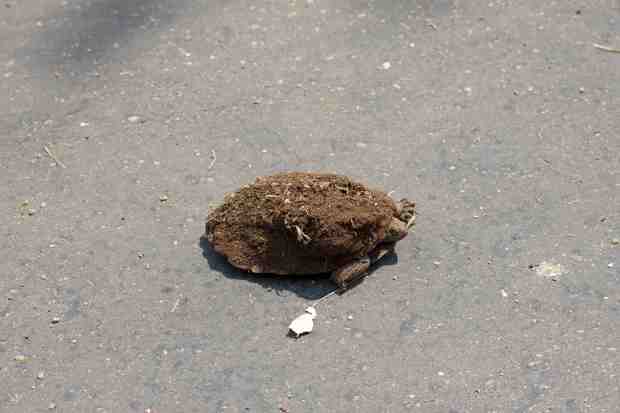
This curious “beast” was spotted while driving around in the Kruger National Park. This is what we saw. Can you see it also?

DSC_0070 copy

?
?
?
?
?
?
?
?
?
?
?

Here it is, in case you failed…

DSC_0071 copy


Hamerkop

Although the hamerkop (Scopus umbretta) is the sole member of the genus, it is now believed that it has genetic similarities that are closer to the pelicans and shoebill stork than other water birds.

We find these true Cinderella of the swamps extremely interesting despite being rather common and overshadowed by the most colourful species. Perhaps their better known feature is their huge nests that take them 2 to 4 months to complete and that are often used by other birds as well.

I have mentioned that these birds frequently visit our former pool (now a water reservoir) in Harare and spending long hours stalking the African clawed frogs [1]. I was intrigued by how the frogs were caught as I always heard a splash but, by the time I looked, the frog had already been caught.

A couple of years ago, while camping at Shumba in Hwange National Park [2] I had the chance of seeing a hamerkop hovering over the dam there but it was evening and I could not watch it long enough to find out whether it was fishing or on some other kind of display so the mystery continued.

Luckily, during our visit to the Kruger National Park early in October we were stationed at a water pond waiting for large game to come to drink and, during the time, we were entertained by a couple of hamerkop that were feeding and we could watch them at leisure and resolve the issue.

Each bird repeated a routine that involved landing on shore and, after a time that went from a few seconds to a couple of minutes of walking about, take off and fly very slowly over the water with dangling feet and slow wing beats that would keep it just above it. During the hovering its feet sometimes touched the water and it occasionally would drag them on the water surface.

This slideshow requires JavaScript.

While we were there the bird was performing this routine constantly and our comment was that it must be effective for the bird to spend all this flying energy on this, apparently, futile activity. The answer to our questions came after about an hour when the bird suddenly landed in the water with feet and beak and emerged victorious with a frog!

DSC_0126 copy

It then took off from the water and proceeded to eat it. Unluckily, after its success the bird landed on the opposite shore of the dam so I could not even guess at the identity of the frog and only managed poor pictures.


[1] See: https://bushsnobinafrica.wordpress.com/2015/09/05/garden-and-gadgets/

[2] See: https://bushsnobinafrica.wordpress.com/2014/10/31/watched-at-shumba/

Spoiled siesta!

A loud “crack” woke me up from my after lunch nap, or at least I think that that was the reason for the interruption of my daily ritual (well, I must confess that sometimes I wake up myself up with my own snoring but that is another matter…).

In any case, when I regained my faculties after a while (a slower process as you grow up), I did not hearing it again but I became aware of some loud splashing noises nearby. My son helped me to focus and informed me that -apparently- a croc had caught something and that our campers next door had seen the action.

I had already made contact with our neighbours -coming from Zambia- as soon as they arrived earlier to warn them about the viciousness of the baboons at the campsite that forced us to get a guard as described earlier. In fact, despite my cautioning, they still suffered the consequences while they were away on their first game drive, although they had taken the normal precautions that are usually enough!

So, I went to see them to find out what they had seen. Luckily they had not only witnessed the event but also taken pictures of it! They had detected the commotion in the water and heard the noise. A crocodile had caught a rather large terrapin and, after kit was trying to devour it.

IMG_4653 copy

The crocodile eating the terrapin. Picture by Eloise Wells.

The event was a surprise to me as we usually see both terrapins and crocodiles sharing their water territories ignoring each other! Perhaps the terrapin was already dead when the saurian found it? We will never know.

The victim was rather large but eventually the croc had managed to break its carapace -the crack- and it was busy trying to swallow by the time I watched. Although I could not help feeling sorry for the unfortunate victim, it was an interesting event, worth mentioning.

The crocodile was busy for a few hours until it moved off and we lost it for a while. It reappeared later a few metres downriver with its mouth closed so we believe that it had already consumed its prey.

DSC_0348 copy

The crocodile after the event. Picture by Julio A de Castro.

Believing that only to write about this would not have been enough, I asked our neighbours to let me have some of the photographs of the event for this post and they kindly did so. Thanks to their generous contribution I am able to share them with you as the story that, without pictures, would not have been the same.


Wild elephants…

As we were in the Zambezi valley, after Mana Pools we decided to spend some time in an area of the river that we knew through our earlier boating experiences when we were in Zambia in the early 90s (blog posts still pending, oh dear!). A number of fishing camps are located near Chirundu town, one of the border crossings to Zambia.

We had fished in the Zambezi before and had some great fun with tiger fish (Hydrocynus spp.) so we wished to try our luck again. We know that there are large Vundu (Heterobranchus longifilis) lurking somewhere[1] that we had, so far, failed to catch (and release, of course).

The road to Jecha Camp was easy to find just before Chirundu and we managed to slip through the very long lorry queues that are a feature at borders, not only in Africa but also in Latin America.

On arrival to this true green oasis after the Mana Pools dryness, we were warmly greeted by the owners of the camp and shown to our comfortable bungalows. In the meantime we were warned that elephants were frequentl visitors. It was stressed that the latter were wild elephants, unlike the ones in Mana Pools (?). We remembered our Nebbiolo wine incident but politely kept quiet. The elephants are part of a small population of about forty individuals that live in the area and that also visit Chirundu town where they -as expected- come into conflict with the local residents.

DSCN1057 copy

There were elephants all the time!

IMG_2967 copy“If an elephant approaches the swimming pool while you are there, move to the opposite side and wait” said the Manager and then added: “they are allowed to drink from the pool but not to bathe”. I immediately imagined the consequences of such an event and remembered the famous elephant in the pool scene of the movie “The Party” with the late Peter Sellers!

After arrival we spent the sunset at the hide overlooking a small stream where we spotted bushbuck and s few rats up the tree where the hide was built on. After dark we went back to camp (by car as advised) and we were greeted with the “elephants in camp” warning. We were advised to move carefully around the facilities in the dark. As we had no plans for “night walking” we were not too concerned but, indeed, the elephants were walking about feeding on the pods from the apple-ring acacia from the lawn. One of them -I thought smartly- was picking pods only from under one of the camp lights!

That night after going to bed, we heard a commotion at the back of our chalet and realized that two elephants were apparently busy unpacking our car! When we went to inspect the situation, we saw that, despite the watchman’s efforts to shoo them off, they were intent to get the contents of our roof rack! Only then we realized that we had -carelessly- forgotten our Mana Pools rubbish bag on the rack and that was the reason of their intense interest! Aware that there was nothing to be done -apart from re-collecting the rubbish the following day- we returned to bed, leaving a worried watchman that we failed to persuade to leave the animals alone!

DSC_0040 copy

One of the troublemakers near the car, after the rubbish incident.

Luckily, the following morning the car was still there, intact, but we spent quite sometime collecting all the bits and pieces that they had scattered around the area!

Elephants were not on camp sometimes but rather all the time! In several occasions we were forced to move away from our sitting areas to keep a prudent distance from the pod-collecting giants that would get too close for comfort.

Although we tried our hand at fishing, only our son caught a medium-sized tiger fish after a lot of boating efforts over the two days we spent in the river. However, fishing was only the excuse to travel the Zambezi! We had a great time remembering our old days when we navigated these waters in our inflatable rubber dinghy and we really enjoyed seeing the large pods of hippo and the occasional elephants drinking and feeding at the river shore.


[1] From https://en.wikipedia.org/wiki/Vundu: The vundu is the largest true freshwater fish in southern Africa, reaching up to 1.5 m (5 ft) in length and 55 kg (121 lb) in weight.


Check in…

Some “local customers’ heading for the Reception area at Mana Pools National Park.

IMG_2947 copy

Needless to say that we queued correctly while guessing what their business was!

Luckily, they seemed satisfied when they left a while after!

IMG_2952 copy

Only then we proceeded to check in!

This is the beauty of Mana Pools National Park: the unexpected is commonplace.

Night visitor

A camera trap is now part of our safari gear as we find it really useful to unobtrusively  spot animals at camp and I have already published a few pictures and videos taken with it in the blog. It often reveals what animals that are around and then you can be prepared for their possible appearance and also for surprises as you will read below and in future posts.

This was the case while we stayed at Swimuwini rest camp at Gonarezhou National Park last August. A genet was detected by the camera trap moving near our bungalow.

It was relatively easy afterwards to find it moving about the camp and close to our bungalow in search of something to eat. As it was relatively tolerant of our presence, I took a few colour pictures later on.

DSCN0287 copy

DSCN0286 copy

All genet species are indigenous to Africa although the common genet was introduced in Europe long ago and it became established there. Related to cats they have a slender body, a rather long ringed tail, a pointed snout and partly retractile paws. Although they have shorter legs they are very agile and fast and they are at ease both on the ground and on trees. They are omnivorous and, apart from invertebrates and small vertebrates they feed on fruits and plants.

An interesting observation, again through a camera trap in the Hluhluwe-iMfolozi Park in South Africa, showed a large spotted genet riding on the backs of both buffalo and rhino![1] So, next time I see any of these large mammals I will look for extraordinary riders apart from the usual oxpeckers!


[1]  See: https://wildlifeact.com/blog/camera-traps-catch-strangest-behaviour/  for some amazing pictures.


Spot the beast 29

While watching elephants at the Nyamugwe pan in Gonarezhou National Park, a small movement caught my eye up this dead tree. This is what I saw from the distance. Can you see the beast?

DSCN0322 copy

?
?
?
?
?
?
?
?
?

DSCN0327 copy

A curious squirrel keeping an eye on our movements. Squirrels -to us- look somehow out of place in Africa but they are a frequent sight in Southern Africa.


Matlakusa

You will recall that on 20 August 2014 I published a post titled “A tusk task” (https://bushsnobinafrica.wordpress.com/2014/08/20/a-tusk-task-2/) where I presented the finding of ab elephant bull that, as far as I could tell, had not been identified before. I called this animal the “Balalala tusker” as we saw it near the Balalala area at Kruger National Park.

A month later in “Unraveling the tusker mystery” (https://bushsnobinafrica.wordpress.com/2014/09/21/unraveling-the-tusker-mystery/). I reported that I got confirmation that what we had seen was indeed a new tusker that “will definitely escalate him to the top of the list when the time for the naming review comes and hopefully at that time he will be confirmed as a new bull and named“.

The naming process took a while during which I kept asking the Emerging Tuskers Project (ETP) of the Letaba Elephant Hall of the Kruger National Park for progress but I had no news for over two years. When I was starting to lose hope, on 28 June 2017, I received an e-mail from the ETP that I reproduce below.

Dear Julio,

I am sure you are convinced by now I had forgotten you. I am sorry this process took so long… I finally got the media release and approvals done and I can formally tell you now that your bull is named Matlakusa. 

It proved quiet an interesting story in the end, as once we had identified your bull as a new bull, we noted that with one of our other new bulls some of the submissions characteristics matched your bull better and we actually managed to split these sightings far more accurately after the great series of images you and another contributor provided so it actually helped link the two new bulls and discover a completely new bull and a new area for him as well.

Below is the link to the website as well as the info for Matlakusa (this is a summary of the info that is on file with the project), if you have any further questions please do not hesitate to contact me.

https://www.sanparks.org/parks/kruger/elephants/tuskers/emerging.php#matlakusa

Origin of Name: ‘Matlakusa’ from tlakusa, in Tsonga meaning to ‘raise, lift up’, this is a large open pan and bore-hole, alongside the eastern border, southeast of Malonga in the Kruger National Park and links to this bull’s large home range. 

Range: Northern and Far Northern KNP. 

Special Features: This bull’s ivory closely resembles that of Xindzulundzulu, that it is fairly symmetrical, straight and widely splayed with a shallow curve from a side profile. The left ear holds the defining characteristics that separate these two bulls, there is a R5.00 sized hole in the tip of the lobe as well as an area of damaged cartilage at the top give a large v-shaped ‘collapse’ in the ear. A very small u-shaped notch and two R0.20 holes are visible on the middle of the lobe but only at close inspection and with the ears extended. The right earlobe had a R0.50 sized hole towards the bottom of the lobe that has recently been torn and is now a u-shaped notch with a small hole towards the inner lobe above this. Other than this the lobe is fairly clean edged. A small protrusion of skin is visible on the trunk at the top adjacent the left tusk. Visible from a side profile is a growth on the left foreleg behind the leg just above the joint.

General: Initial images of this bull from Joël and Di Roerig were identified as Xindzulundzulu due to his ivory shape. Later in 2014 a full series of images submitted by Julio de Castro [1] between Shingwedzi and Balalala created a dilemma as at the time as Xindzulundulu was known to only be local to Shingwedzi and a new bull was suspected. Additional images by regular contributor Frans van Achterbergh submitted showing his left and right side allowed the defining characteristic’s to be seen and to be able to determine that there were in fact two separate bulls. This revelation allowed two previous sightings one of which was by Ian & Deirdre Outram and the other by Forum member Lion Queen both in 2012 that were both previously thought to be Xindzulundzulu but could not be confirmed as the locations did not make sense and defining characteristics in these images were not very clear. However the receipt of the 2014 submission with clearer images could confirm these identifications. Several other images placed with Xindzulundzulu’s monitoring file could now also be separated out as being those of Matlakusa and in 2015/6 it was decided that sightings of him were sufficient to name the bull confirming his status.

Kind Regards

Kirsty Redman, Interpretive Officer, Nxanatseni Region, Kruger National Park, South African National Parks.

As you can imagine we are delighted that our contribution assisted the ETP to identify Matlakusa and separate it from Xindzulundzulu as a new tusker.

new-tusker-cropped

Matlakusa showing off its ivory!

We look forward to find Matlakusa again during our next safari to the KNP next week. We hope that Matlakusa will continue to live its peaceful life for many years to come and that its ivory stays with it, where it belongs!

[1] the Bushsnob.


Night surprise!

At night, returning to our bungalow at Swimuwini after a hot shower I took a detour to investigate what looked like a small pond. From a distance I shone my torch in the general area and I froze in my tracks. There was a crocodile there!

DSCN0382 copy

Without moving I maintained the light on the reptile’s head -all I could see- and I not only saw it moving but also its eyes shone under the torch’s light! “This is amazing” I thought while watching the beast. I dropped my towel and other shower implements and slowly approached the pond in the dark until I estimated to be close enough to have a good view. Then I switched on my torch again.

To my relief it was a false alarm but a clever ruse nevertheless! Someone had somehow placed a tree trunk semi-submerged in the pond with the intention of making it look like a croc. Whoever he/she was succeeded with me! The movement and shiny eyes were not fiction as the head was a resting place for a bunch of toads [1] that were using the wooden croc as their resting place!


I returned to the bungalow and the following morning I came back to the pond for a better look.

DSCN0368 copy

During the day the trunk was more obvious but less so when the toads were on it adding some greenish colour and movement to it!

DSCN0451 copyDSCN0446 copy

DSCN0459 copy

Luckily it was a wooden croc but it was nice as it offered a good opprtunity to see the toad’s interaction and to take some nice pictures of the batracian colony.


[1] From Wikipedia (https://en.wikipedia.org/wiki/Frog). “The use of the common names “frog” and “toad” has no taxonomic justification. From a classification perspective, all members of the order Anura are frogs, but only members of the family Bufonidae are considered “true toads”. The use of the term “frog” in common names usually refers to species that are aquatic or semi-aquatic and have smooth, moist skins; the term “toad” generally refers to species that are terrestrial with dry, warty skins”.