Life in Nairobi

After a while in Tigoni Mabel decided to look for a job and Nairobi was the obvious place to find it. The idea was to capitalise on her Spanish and English knowledge. She started doing translations for Spanish-speaking embassies and very soon she got a permanent position at the Embassy of Chile. After a while she moved to the Commercial Section of the Embassy of Argentina where she remained for a few years.

Luckily, John, a neighbour at Tigoni gave her lifts to work mornings and afternoons, as I was busy at Muguga and regularly traveling to Intona. Despite John’s kindness and flexibility there were days that the arrangement was not possible and I needed to drive to Nairobi to take her or to collect her. Sometimes I would be delayed so she would be stuck in Nairobi! Although we enjoyed the relaxed and picturesque life at Tigoni we decided that it was time to move to Nairobi.

Although still very manageable at that time, Nairobi had moved on from its origins as an offspring of the Uganda Railways to a vibrant city. It had started around 1899 when the railways work arrived to the then known as mile 327, a treeless swampy area watered by the Ewaso Nairobi river that in Maa (the Maasai language) meant “cold water”. At that spot the railway construction work was delayed while the engineers tackled the steep and difficult climb to the highlands ahead on their way to Uganda and from a railway depot the city grew.

Through the landlord of the building occupied by Mabel’s office we found a suitable flat located on Bishops Road, behind the then Panafric Hotel. Our move was very simple as all our possessions fit in our VW kombi and we negotiated for the flat to be furnished with the essential gear and household appliances. We soon realised, however, that we lacked a few more “essentials”.

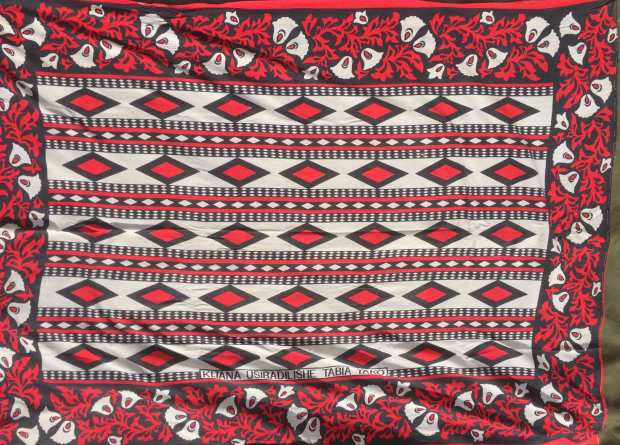
We did not have curtains, cushions and other domestic necessities so Mabel went to look for the needed materials to make them herself and this is how she discovered Biashara (Business) Street and its great assortment of cloth shops where she not only managed to find what she wished but also became a frequent visitor returning there again and again in search of materials for her dress-making as well as to get the colourful kangas [1] that she loved and still keeps to date! She was always well treated by their owners, mainly Indian settlers that were tough to bargain with. She kept visiting them to the last day as it was there that she got all needed materials for our move to Ethiopia in 1988.

IMG_4757 copy

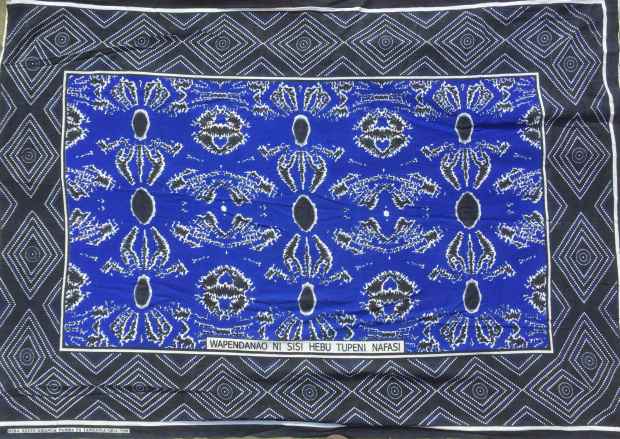
One of the first kangas that Mabel bought in Nairobi still with us today! The inscriptions can be translated as “youngsters do not change their character”.

After a while we realised that we also needed a carpet for our sitting room. As new ones were rather dear to us we searched for a second hand one. We found one at an auction place and we managed to outbid the competition rather easily. When we put it in place we realised that it stank of dogs and it would be difficult to keep it at the flat. So smelly it was that our cats would refuse to step on it and would stay well clear of the sitting room! We sprinkled a couple of kilograms of coffee on it to try and neutralise its stench but, eventually, it had to go.

We were now living in a large capital city and we enjoyed the experience. Nairobi had a nice air about it and it was not yet as large and car-choked as I found it to be more recently. The amount of people walking around was, however, staggering. Particularly in the mornings while driving to Muguga I could see the long lines of people that were walking from the outskirts to their jobs in the city and the impression was such that these became imprinted in my mind to the present day!

We had not visited the Nairobi restaurants very often while in Tigoni as we were reluctant to drive back home at night. So, moving to Nairobi meant that we could start dining out. Although we found the Tamarind beyond our reach, there were others we could enjoy such as “El Patio” a place that served some nice dishes including paella. We also gradually started to visit some of the Indian restaurants that were accessible and served excellent food.

We also found a special local restaurant on River Road (not really a safe place at the time) that was opened all the time and where we sometimes dined while returning from safaris. Amazed at it being always open we eventually learnt the reason: its door had been removed!

IMG_4767 copy

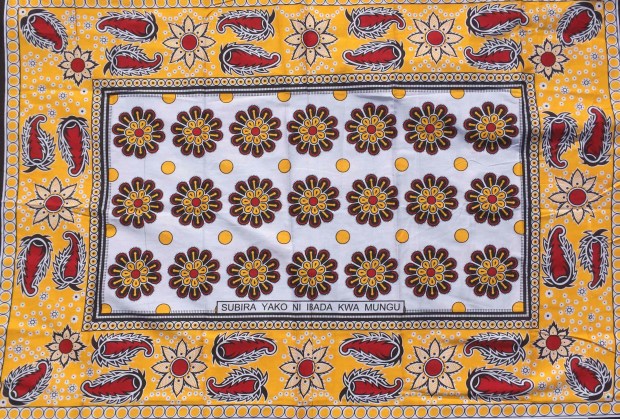
A newer kanga from Kenya. It is written “your patience is a worship of god”.

Soon, Mabel also discovered “La Trattoria”, an Italian place that made excellent ice cream and reasonable pizzas and, with Ranjini, she would frequent some of the hotels such as the Hilton and the well-known Norfolk (built in the early 1900’s) that offered good Kenya tea (served English style) accompanied by first class cakes. I also enjoyed the occasional Kenya coffee and the New Stanley hotel with its huge fever tree was my favourite.

After a while Mabel also started a “Cordon Bleu” cookery course. During each of the classes she would return home with the dishes she had prepared so we took this opportunity every Wednesday to invite friends to join us for a meal!

Gradually we got to know good supermarkets and butchers and, again, Mabel began to explore the latter in search of the meat cuts that she preferred from our South American days. She found a “tame” butcher that allowed her to venture into the cold room to choose what she required. That was the way we acquired “matambre” (flank steak)[2].  This is a superficial and thin ventral muscle that -if not care is taken to remove it- it can be damaged or even removed with the hide. Mabel managed to get it and it became known as “Mabel’s cut” among the Latin American consumers that soon were ordering this speciality as well!

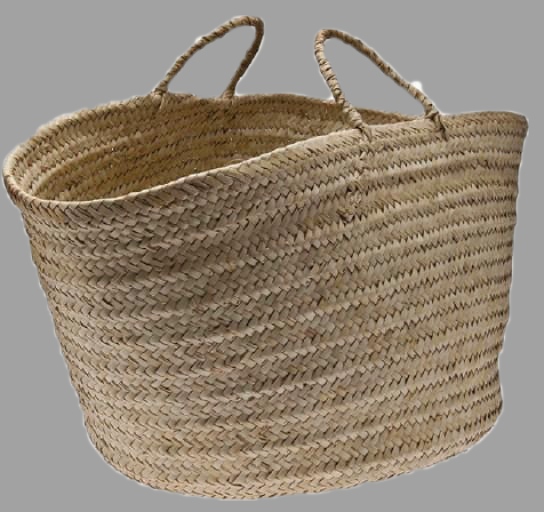
Fruit and vegetable markets were really fantastic and it was great fun to shop in them. The Westlands roundabout area offered a great shop run by a Sikh gentleman that had great quality and excellent client service as your shopping would be carried by a “helper” in a “kikapu” basket [3] to your car.

kikapu

A kikapu.

Outside that shop, a gentleman we came to know well constantly shouted “sweet peas madam, sweet peas madam” as he would follow you to the car. It was difficult not to buy his fresh peas as they were the sweetest I remember! The Central Market on Muindi Mbingu Street was also an enjoyable experience as there was an amazing abundance and variety of produce that was staggering for us, some that we had never seen such as mangoes, papayas and other tropical fruits.

Peter, our housekeeper, came with us to Nairobi on loan from our Tigoni landlord until we found a replacement as he was needed back at our former house. He stayed a few months traveling all the way from Uplands and basically helped Mabel with the cleaning of the flat. He insisted on walking with her every morning to her office in the centre of town and back home in the afternoons as a true bodyguard!

IMG_4765 copy

A newer kanga bought in Mozambique in 2012. Its message refers -as far as I could gather- to Valentine’s Day! Things change…

Eventually we found someone to replace him and we sent him back to Tigoni with a heavy heart as he was a good man. So, a Peter left and another one arrived. The new Peter was a “supercharged” one and luckily for us, he only lasted for six months! It happened that he was the cook at the Canadian High Commission but, as there was no Head of Mission at that time, he was idle and wished to earn some extra money until his new boss would arrive.

We took him on the understanding that he would return to his permanent job whenever he was needed while we looked for a permanent worker. Not only Peter could cook well, do the shopping for us and kept our small flat squeaky clean (I am sure he cleaned it about three times a day as it was very small compared with the Ambassador’s residence!). He was constantly walking on “polishing shoes” shining our floors that looked as shiny as slippery to walk on! He brought to our lives the usual colonial custom of waking you up with a tray of tea at 6 am. without hearing anything, we would find the tea tray ready every morning.

The time for spoiling came to an end after about five months when Peter announced that a new High Commissioner was about to arrive. Fortunately, he brought a replacement that was also a Peter! The third Peter was somewhere between the previous two and perfect for us. He could cook well and did not bother with polishing the floor at all times. We liked the early morning tea and we asked him to continue with that tradition! Kenyan tea was very special and we really enjoyed it. He stayed with us until our departure for Ethiopia when we passed him to our good friend Susan.

The move to Nairobi also took us out of the British- and settler-dominated Tigoni into a cosmopolitan city. There were already international organisations based at Gigiri and their number was increasing. It was like this that we got new friends from other parts of the world, including a few from Latin America, of course. In particular we befriended the very few Uruguayans and Argentinians with which we had more affinity.

As some had “proper” houses with BBQ places, we re-encountered some of our culture through weekend gatherings to enjoy good “asados” (wood grilled meat) and some excellent Argentinian wine to go with it, courtesy of a few diplomatic friends we made. Carlos, one of them from Argentina had persuaded one of the main butchers called Gilani to make sausages following his own recipe from Necochea in Argentina. These were “real sausages” unlike the ones we found in the Nairobi shops that were made following the British recipe, something totally different and -for us- inferior.

It was with a group of Argentinian friends (headed by the Ambassador at the time) that we managed to organise ourselves to watch the 1986 World Cup games where Argentina played. Most of them were during the small hours of the morning and we “negotiated” to go an watch them at the studios of the Kenya Broadcasting Corporation (KBC) where a small crowd of us (as well as some Kenyan employees of KBC) would seat in front of their recording monitors!

Argentina did well and reached the final that was broadcasted live by KBC and that we all watched at the Argentinian Ambassador’s residence after enjoying a great reception at lunchtime. It was a very dramatic final but Maradona helped Argentina to beat Germany and we forgot our regional rivalries to celebrate the title together as a Latin America community far from home.

I also started playing tennis on some weekends at the Nairobi Club and we also discovered learnt the Carnivore restaurant in Langata where, for a fixed amount of money, you could eat as much meat as you wished. The menu included meat from domestic and wild animals and we went there a few times although we found it to be too much meat! However, it was a very popular eating venue for the Latin American community. Eventually, as the winners in the casino, some of them were from entering the restaurant as they consumed too much meat! Being a resourceful bunch they managed to circumvent this problem by booking the place under fake names and continue to visit it!

During our time the National Museum offered a great introductory course to Kenya known as the “Know Kenya” series of lectures. In this was we enjoyed great educational lectures on many aspects of Kenya, including those delivered by Mary and Richard Leakey on the evolution of humankind. Mary’s husband (and Richard’s father) was the famous Louis Leakey that had already died by then. He was a famous anthropologist that was born in Kabete and greatly advanced the study of hominids. He was also responsible for bringing Diane Fossey and Jane Goddall to Africa to study large apes.

Another hitherto unexplored asset of Nairobi was its National Park located a few minutes from our house. We started to frequent it and, after a few visits we bought a year permit for our car to enter the park freely so this became a favourite outing. As the place was on the way from the airport, from that time onwards we started bringing our overseas visitors home by driving them through the park to give them a taste of the bush a few minutes after leaving the airplane! They loved it and helped making their stay even more memorable.

We spent many hours at the park as it offered all desirable wildlife with the exception of elephants. I will tell you a few stories about our visits in future posts.

Before we handed back our beloved kombi to FAO at the end of my FAO Fellowship, we managed to acquire a Land Rover and I described the process in https://bushsnob.com/2017/07/20/buying-a-car/. Later we bought our first new car, a Peugeot 504, together with Paul (see: https://bushsnob.com/2018/01/21/simbas-bush-baptism/). The Peugeot was, at the time, the most sought after car in Africa, known as “Simba” because of the lion of its make. We enjoyed both good and bad times with it.

With the new car we were able to travel faster and longer trips became more feasible, particularly reaching the coast where we managed to explored a few places. I also had a spell of bad luck when I had the only crash I had ever had (see: https://bushsnob.com/2018/04/28/collision/) and also the only robbery we suffered during the years we lived in Kenya: my spare wheel was stolen while the car was parked at our parking place in our flat! So much for the security guard!

The “Drive-In” cinemas, in particular the Fox Drive-In on the way to Thika, were places we frequented often as we did not have a television at home. It was a popular place where you could enjoy a tasty meal while watching a good movie. The food had Indian influence and the potato “bajhias” were fantastic. There was another drive-in cinema on the way to the airport that we also tried but only once. We were very impressed about the Indian food served but did not suspect that the programme was aimed at the Indian community showing Bollywood movies! We left during the first interval after finishing our meal!

So, life was going great for us and I am sure we would still be in Nairobi if it would not have been -again- by FAO. The manager of a project in Ethiopia had suffered a serious heart attack and needed to be evacuated for medical attention and FAO needed a replacement rather urgently to continue with a tick survey and population dynamics study. When the position was offered to me, after a lot of thinking I accepted it.

It was a risky decision as the contract was for an initial period of eighteen months but the salary offered was very good for my standards so, after over seven years in Kenya, we took the short flight to Addis Ababa to re-join FAO, this time as a fully-fledged employee. Little I knew then that I was going to stay with FAO in various capacities for twenty-five years.


[1] In Ki-Swahili a kanga is a piece of colourfully printed cotton fabric, about 1.5 m by 1 m, often with a border along all four sides (called pindo and a central part  the mji which differs in design from the borders.

[2] The panniculus adiposus is the fatty layer of the subcutaneous tissues, superficial to a deeper vestigial layer of muscle, the panniculus carnosus. Together they make the cut. It is also known as the “fly shaker”, because it is the muscle used by the animal to twitch to repel insects.

[3] Several kinds of baskets were in use in Nairobi those days. A kikapu was a simple straw-woven open basket.


Vundu fishing in Kariba

Introduction

My brother and I have fished together many times over the years. Our shared passion started when we were still very young and fished in the River Plate and tributaries and extended to the present expedition in search of the vundu (Heterobranchus longifilis) in lake Kariba.

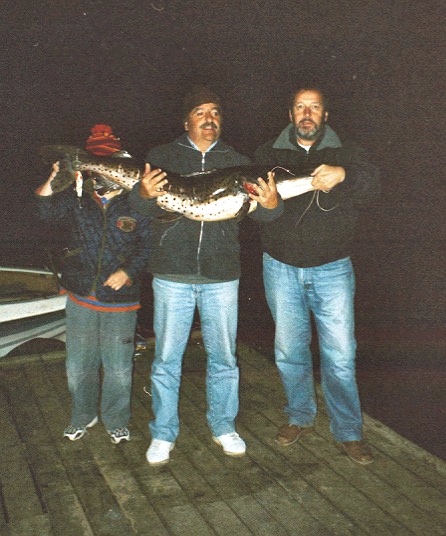
We have fished in several places of the Paraná and Uruguay rivers on a catch and release basis. We have been very fortunate to catch a few of the two most coveted fish: the dorado (Salminus maxillosus) and the surubí (Pseudoplatystoma corruscans). My wife and I had our first experience fishing for dorado in Paso de la Patria, Corrientes in the 80s[1] and have fished more fish in the Corrientes province with my brother afterwards, always on a catch and release basis. Accompanied by my son and I, my brother caught a large surubí at Ita Ibate that is still the family record to be broken!

Ita Ibate surubi de AC copy

Holding the surubí estimated by the local guide to be around 40kg.

We have also fished in the upper Amazon tributaries in Bolivia and earlier in Zimbabwe in Kanyemba where we caught the also sought after tiger fish (Hydrocynus vittatus). Despite this, the vundu has remained elusive for my brother although my daughter and I managed a few as described earlier [2]. This, together with tales of gigantic specimens, became intolerable so we went there to try our luck!

Before I go on I need to be honest up front, my brother Agustín is a fisherman with unlimited patience and a passion to get things out of the water. I am not patient and therefore only function when the fish, preferably large ones, are biting. However, I enjoy his company and we have good laughs together and as a late great fisherman of Paso de la Patria, Don Luis Shultz, always said ” the worst day fishing is better than the best day working”.

Preparations

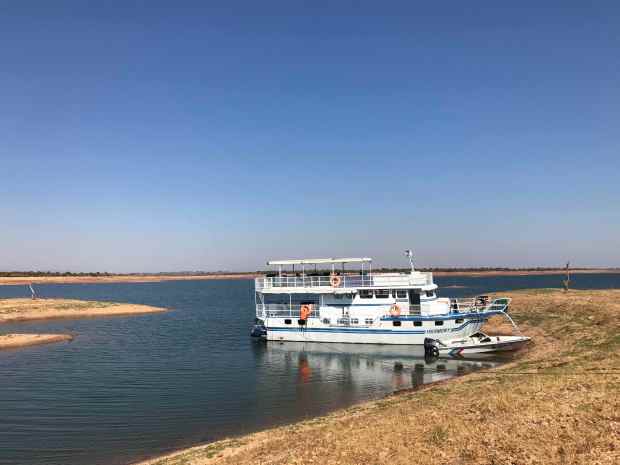
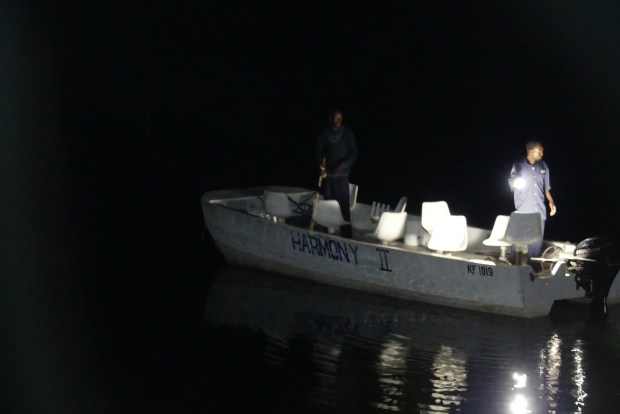
Still following earlier advice from my wife’s dentist and our own experience mentioned above, again we hired a boat to sail lake Kariba up to the Ume River like the last time. On this occasion, in view of the fuel situation in Zimbabwe, we decided to go for a smaller houseboat so we hired the “Harmony”, a cruiser, for a week.

IMG_3116 copy

The Harmony, our home for one week.

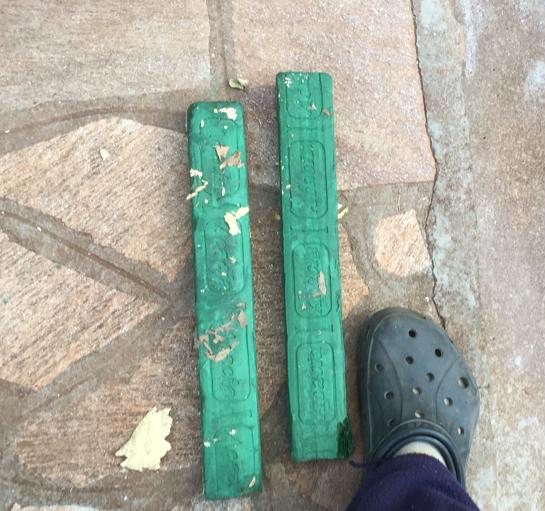
Apart from booking the boat, getting food and water to last us for the whole period was the priority. We also needed bait. This consisted of dry kapenta (Limnothrissa miodon), earthworms [3], ox heart and liver and more exotically: green soap! The latter was a favourite of the vundu and my wife secured a couple of bars from the local supermarket just in case. The soap was so stinky that, after a few days, we needed to wrap it tight to avoid its stench pervading all over the garage. Needless to say that it traveled -together with the earthworms- on the roof rack!

PHOTO-2019-06-21-16-41-52 copy

The stinky green soap bars.

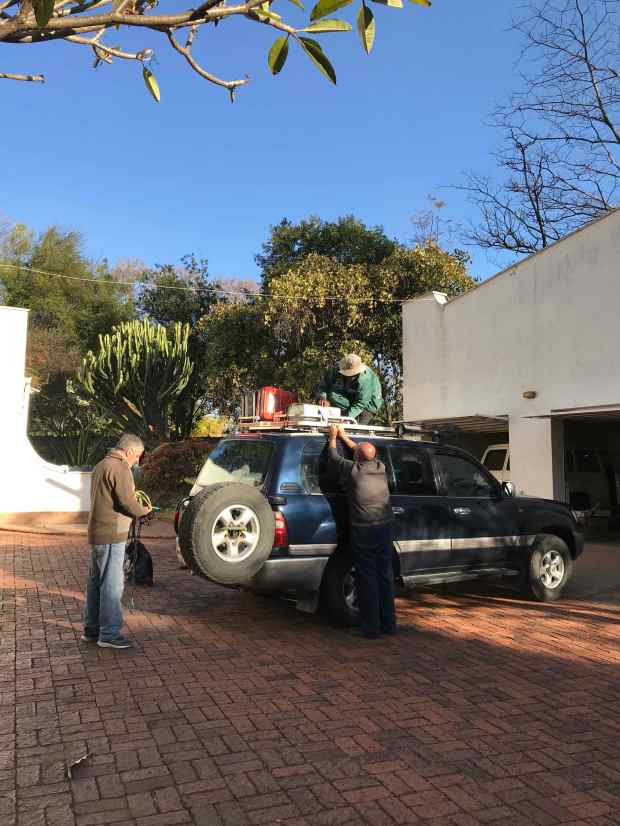
Days before the expedition we secured some extra hooks, sinkers, steel trace and line just in case. We were going after large fish and did not wish to fail due to lack of equipment! That prove to be a good precaution as we will see. So, finally all was ready and with the car packed we went.

0 IMG_2960 copy

Loading the car.

The trip

We left Harare at the unacceptable time of 03:30am. This early start was needed to be able to board our cruiser at 09:00am in Kariba Breezes harbour. After an uneventful trip we arrived in good time and met our supplier of drinks (mainly water) and our crew: Message, the captain and fishing guide, Eddie, the deckhand, cleaner and helper and Smart, the cook.

From the start we realized that we were lucky with Message and Eddie but faced some difficulties with the cook. The latter was used to cooking for the local fishermen and we had brought ingredients for Mediterranean cooking! Therefore it is not difficult to imagine that Mabel, being Italian, needed to closely supervise the food preparation and, although she kept a close eye on the action, we still suffered a few small cooking tragedies!

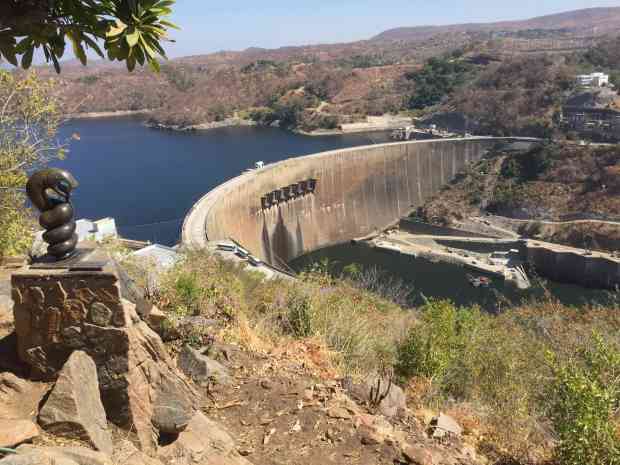
The lake was, as usual, a beautiful blue and, although we have seen it and navigated it a few times before, still very impressive. The Kariba dam was built between 1955 and 1959 by an Italian company that poured one million cubic metres of cement into it.

IMG_4734 copyWith its 617m of length, 13m of width and 128m of height. It has always amazed me that such small barrier can create a lake of 280 km long with an average width of 18km (widest 32km) and two thousand km of shoreline! Its deepest point is 120m but it is also very shallow in some areas so the average depth, if of any use to know, is 18m.

When the dam stopped the waters of the Zambezi, animals got trapped in islands that were going to get submerged so an operation called “Noah” was launched headed by Rupert Fotherhill, a well known conservationist. Today Fotherhill island in the lake remembers him that sadly passed away in May 1975[4].

Enough of data and history and back to the story.

The fishing

We left the harbour with a farewell organized by the resident hippos and navigated for about five hours. We stopped beyond Elephant Point as it was not possible to reach the Ume river with good visibility that day. We fished there but had no luck. The same bad luck stayed with us during the couple of nights spent at the Ume river, although we had a couple of bites (suspected by vundu) that we missed and we had to be happy with a couple of small bream (Oreochromis spp.) that we kept for the pot and tasted great!

Fishing in the African rivers is never boring, even if the fish do not bite. Apart from the abundant birdlife that can always surprise you as we will see below, the abundant hippo population is always keeping you “entertained”. Either you watch their water antiques and interactions while letting you know that they are there or outside when sunning themselves when you discover the very small babies that you miss in the water when they travel in the backs of their mums.

In addition, apart from the usual antelopes, there is always the possibility of seeing some of the large predators and the certainty that elephants will turn up and also keep you amused.

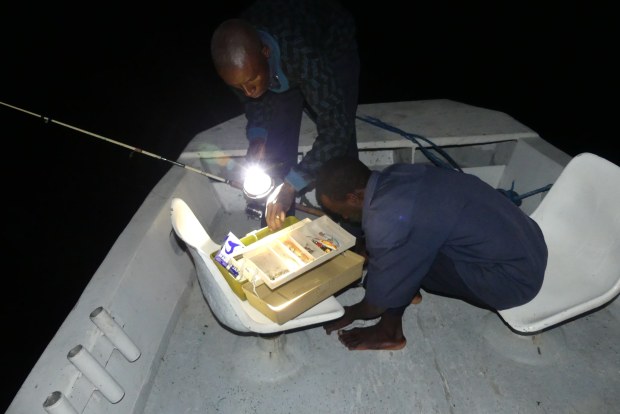
Disappointed after having fished at the Ume river we decided to move off the following day. That night we decided to leave two rods baited with green soap from the stern of the house boat with the hope that we would get some fish during the night. We set the reels with their alarms with the idea that we would hear the fish taking the bait and running. Although we tried to stay long, very soon, tired after a whole day under the sun, we forgot about the rods and retired to bed rather early.

Although neither we nor the crew heard anything that night, both rods had fish on them the next morning and we were very excited! It was immediately clear that we were on large fish as the rubber tie that held my rod had been cut by the fish pulling! Sadly, our lines had also become entangled in the many submerged trees and we could not see what we had as both lines needed to be cut!

So, that morning we went out fishing seeking revenge but, again, we drew blanks but my brother continued fishing from the houseboat after lunch and his efforts were rewarded with a vundu. It was a very small one but at least it was good to confirm that vundu were not yet extinct!

IMG_0499 copy

Agustín’s first vundu.

This small success, together with the night episode, was sufficient to prompt us to stay fishing that night. Needless to say that our enthusiasm gradually waned and by 01:00am, in the absence of fish activity, we gave up as a result of a combination of feeling cold and sleepy!

Following our lack of success during our night fishing, in consultation with Message, we decided to depart from the Ume area after lunch as we would still try to catch something in the morning. Message was sure that we would catch what we were after at Elephant point so, after yet another luckless morning we departed at midday of day four.

Once moored safely at our new location we resumed our fishing. The water was very calm but we saw lots of dry trees in our new location as the water of the lake was very low. Although we joked that with less water the fish would be more concentrated, the hidden trunks were a menace to our lines.

We decided to go all out and put all our rods out with different baits to care for all possible tastes! After a while I had a fish on the green soap that I missed by striking it too early and taking the soap away from its mouth (apparently). It was a good start and a while later I had another strong run. This time I waited but stroked too hard and broke the line, causing great hilarity all round as I nearly fell backwards out of the boat! It seemed that Message had been right, there were some interesting fish at Elephant point.

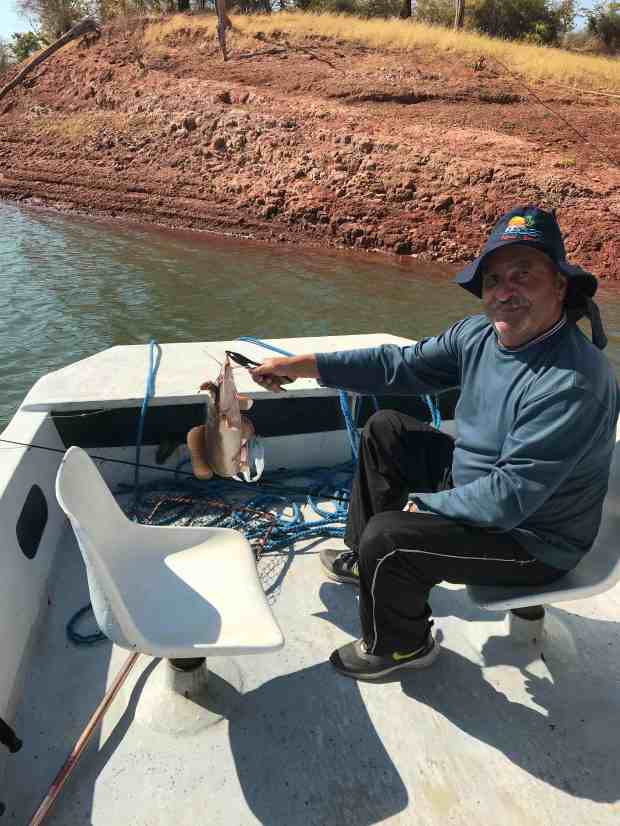
The following morning (day five) we hooked a couple of fish that we also lost as they would go around submerged trees causing the lines to snap. The situation was getting desperate when, luckily, Agustín hooked a vundu that ran towards a treeless area and, eventually, was brought in. It weighed 6.5kg and it was returned to the lake to continue growing! That was something after the effort we had put in so far and it was celebrated that evening with some whisky on the rocks.

During day six, while I was busy losing hooks, sinkers and line for various reasons, my brother caught another fish that at 11.6 kg was quite decent and, although still far from our expectations, made as (and mainly him) very happy. Of course Agustín still claims that my balance was faulty and that the fish must have weighed about 15kg but I ignored his comments as I used my luggage balance and it has worked well for many years! The new fish provided another good excuse to give our bottle of whisky another hard time!

vundu3

Agustín with the 11,6 kg vundu.

That day, while my brother was busy fishing and I entertained myself losing gear, my attention was called when I herd loud honking coming from a sand bank about 60m from us. Through the binoculars I saw that two Egyptian geese (Alopochen aegyptiaca) were having a fight. This was not the usual confrontation in which posturing and threatening displays end with the withdrawal of one of the contenders. The fight had gone physical!

They were holding each other by their heads while strongly hitting each other with their wings. Several other geese had formed a crowd around them (no doubt cheering their favourite wrestler) honking madly.  Just before the scuffle broke up, a Fish eagle (Haliaeetus vocifer) swooped down towards the fighters and, when I thought it would take one of them, it changed course at the last second and flew off to a perch nearby, unnoticed by the furious fighting geese.

About a couple of minutes later the contenders separated and, one of them flew off very close to the water. This was spotted by the eagle that attacked it again at full speed forcing the flying goose to crash into the water to avoid the killing talons of the eagle that did not made contact. At that point I thought that the goose was a goner and waited for the predator to return. Surprisingly, the eagle did not press the attack and flew off!

The final drama

It is mandatory that the last night on the lake is spent near the harbour at Kariba town as the boats must be back by mid morning. That s the time to re-fuel and settle all expenses with the suppliers. Usually that night is spent at a rather nondescript area called Antelope island where we had not fished anything before.

This time we discussed with Message whether it would be another place where we could stop where we could still have a chance of getting large fish. He proposed to go to the Sampakaruma island. As the name sounded quite exotic, we instantly agreed to go there.

We arrived at Sampakaruma late afternoon and went for our last attempt at catching a vundu. It was not to be although I had a good pull that eventually lost, nothing unusual in this trip. So it was time to return to Kariba the following morning but we still decided to leave two rods from our tender boat to see if we could catch anything at dusk and leave them until after dinner when we agreed that we would pack our gear and end our fishing.

Fed up with losing equipment I decided to leave my reel brake rather tight so that the fish could not take much line in case it decided to take the bait. This in my mind would avoid it running far and getting entangled in the submerged trees. Satisfied, I went to have my shower to prepare for the last dinner on board.

The rest of the team planned to take their showers in the morning so they preferred to sit at the table to enjoy a sundowner. However, their relaxation was abruptly interrupted by an ear-splitting noise coming from the stern of the boat. It sounded as if another boat had crashed against us so all able seamen and women, except me that was enjoying my shower, ran towards the stern.

“Julio!, Julio!” I heard my wife calling “come quick, something happened at the tender boat!” and added “they are there trying to see what is happening!”. I put my clothes without drying myself and run to join the rest of the team, rather confused at the news.

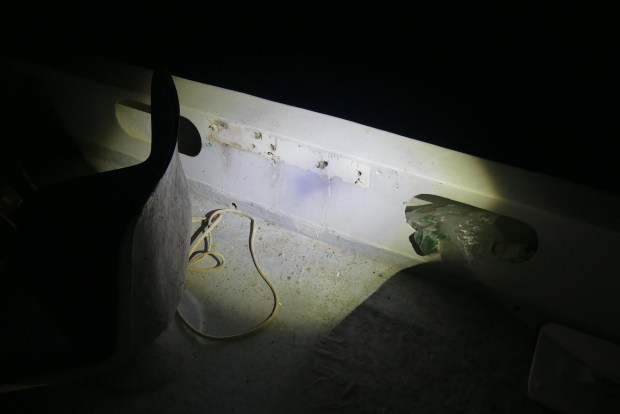
“Your rod is gone” were the words my brother greeted me before I reached the tender boat. When I could look at the scene I saw Message and Eddie illuminating the boat and the water. The rod had indeed gone and so it had the rod holder, hence the loud noise herd.

P1000617 copy

The first view of the place where the rod was. The outline of the holder and screw holes are clearly seen.

I saw that Message and Eddie were busy assembling a few hooks together to rake the bottom of the lake in the nearby area to see if they could hook the line.

P1000612 copy

P1000625 copy

Message and Eddie attempting to recover the rod.

All efforts were futile and the rod and reel were gone forever! A suitable end to my constant losing of gear!

Speculation immediately started on whether the responsible for the damage was a very large vundu or perhaps a hungry crocodile. As you can guess, the discussion of the cause of the rod departure is still being hotly debated and it will be for a few years to come as it could have been either of the two suspects.

However, I am about to reveal a different explanation, fruit of careful thinking that considered the local mythology, the history of the lake and the location where the incident took place.  

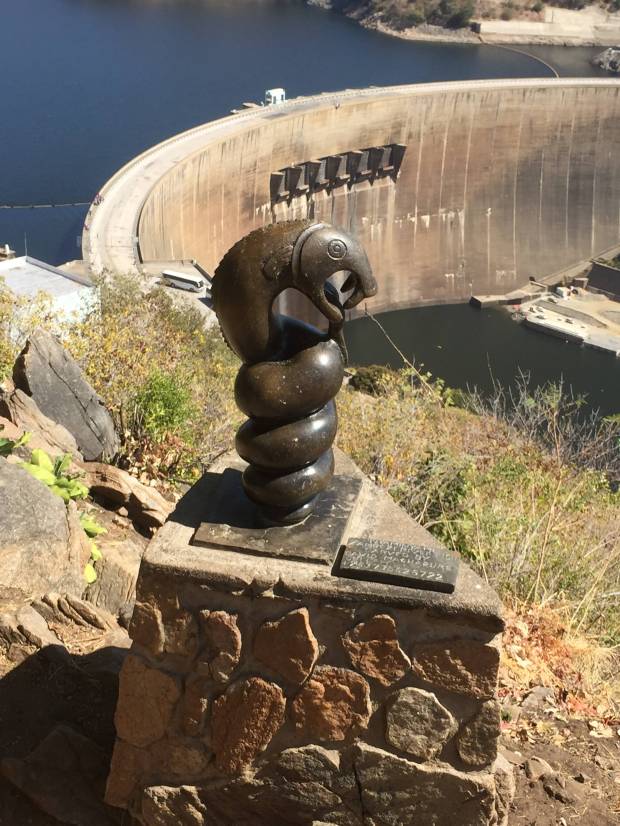
The Tonga ethnic group that lives in the Zambezi valley believe that a River God known as Nyami Nyami lives in Lake Kariba. It is a serpent-like creature of very large proportions, so long that no one dares to guess his length. The dam separated Nyami Nyami from his wife and this has angered him. He has  remonstrated in the past by causing severe floods and even some earth tremors. 
IMG_4735 copy

Nyami Nyami and the dam.

Apparently, when Nyami Nyami passes the water stains red and Chief Sampakaruma saw him on two occasions many, many years ago, but the River god has been in hiding since the white men arrived.

I believe that what happened to my rod was nothing to do with a vundu or a crocodile but that it was the River god remonstrating against us being there trying to remove its creatures from the lake! After all I am sure it was in this area of the lake that Chief Sampakaruma saw Nyami Nyami and I swear that I saw the water turning red towards the end of that day. Although it may have been the effect of the dying rays of the sun on the still lake, I am convinced that Nyami Nyami was around!


[1] See: https://bushsnob.com/2015/01/28/a-fishing-expedition/

[2] See: https://bushsnob.com/2018/01/15/vundu/

[3] Amusingly earthworm sellers have different names for them while they advertise them on the road. “Puffadder worms”, “Black mamba worms”, “Men worms” and “Worms of note” are some of the names that come to mind.

[4] See: https://www.nytimes.com/1975/05/28/archives/rupert-fothergill-is-dead-at-62-led-rescue-of-animals-in-africa.html; https://www.safaribookings.com/blog/operation-noah-rescue-of-the-kariba-wildlife; http://operationnoah.blogspot.com/ There is also a book: Robins, E & Legge, R. (1959). Animal Dunkirk: the Story of Lake Kariba and ” Operation Noah, ” the Greatest Animal Rescue Since the Ark. Jenkins publisher. 188p.


Mana Pools reception

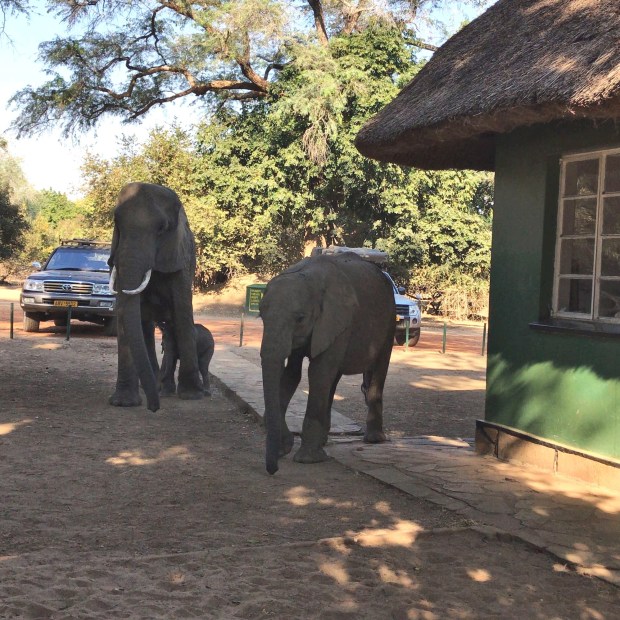
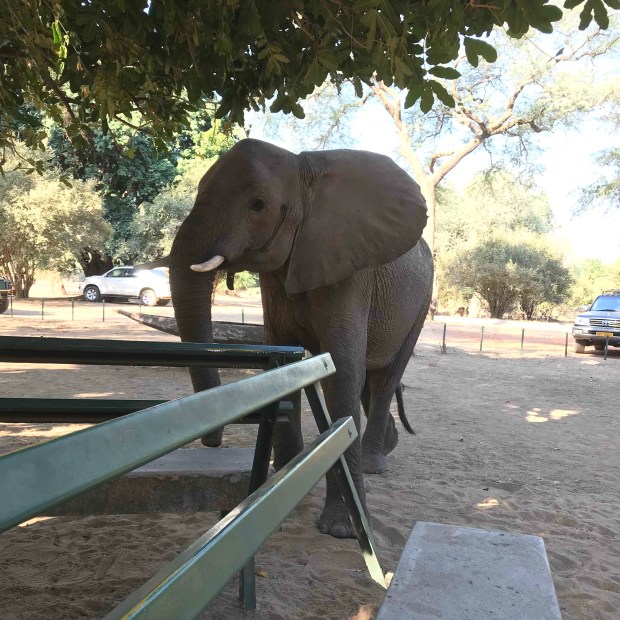
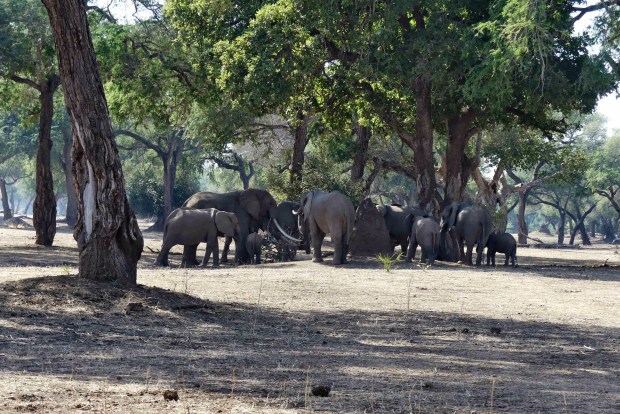
The unexpected is commonplace at Mana Pools National Park in Zimbabwe! Below are the receptionists!!!

4f41caf6-cf03-4ff2-81bd-5b78129a1157-mc-copy.jpg

We just waited a bit while they approved of us…

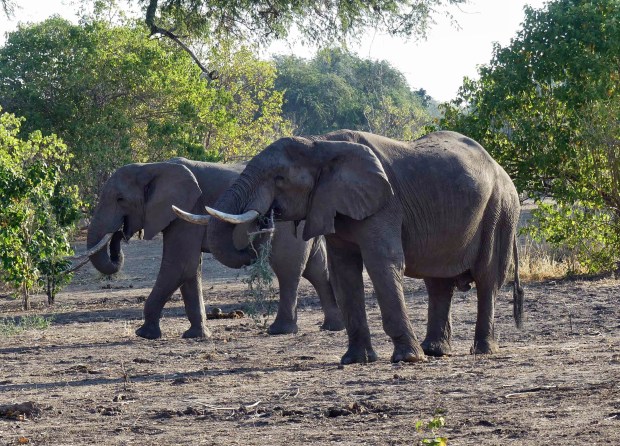
Later Mabel, my wife, experienced a close encounter with another elephant while sitting at this bench checking her WhatsApp!

img_2810-copy.jpg

The unique experience of Mana Pools!

Boswell’s genes

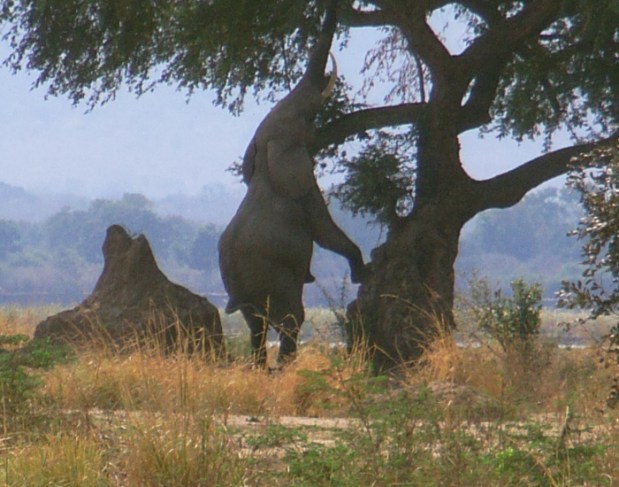
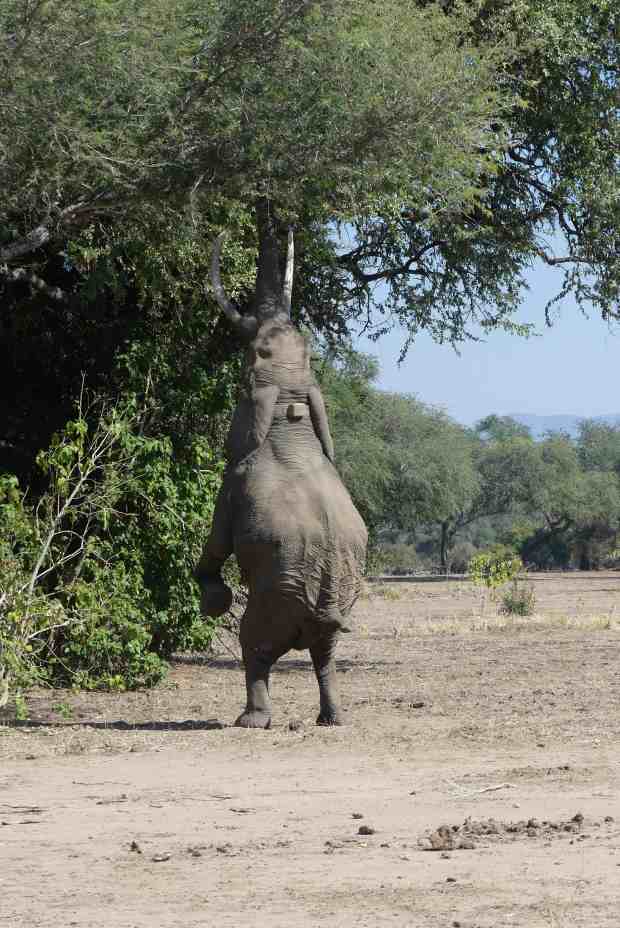
Three years back I wrote a post about a really iconic elephant in Mana Pools known as Boswell [1]. At the time I mentioned its ability to reach heights that other elephants (and even giraffes if they would exist in Mana Pools) cannot by stretching and standing on its hind legs. I showed a rather bad set of pictures that I took on an island in the middle of the Zambezi river and regretted that the animal did not “perform” closer to us.

pict0021-copy

Undoubtedly Boswell is the best known of Mana Pools’ elephants and it one of the classic sights of the park.

My brother Agustín and his wife Gloria had visited us in Zimbabwe in the late 90s and, to our delight, they decided to come back this year. As we had taken them to Hwange National Park and Victoria Falls in their previous visit, we decided this time to visit Mana Pools for game viewing and Kariba to attempt to fish for vundu.

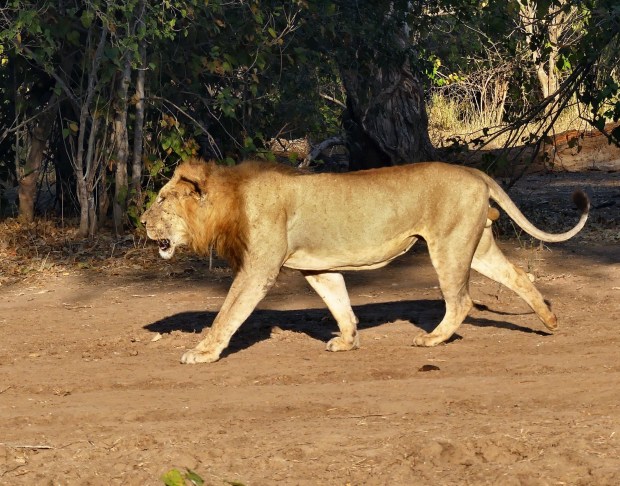
In the previous visit we failed to find any lions at Hwange despite our great efforts so one of the goals at Mana was to find wild lions. Fortunately we achieved this goal and spent sometime watching them. As lions are normally sleeping and these were not the exception, we soon decided to move on and return later to see if they decide to be more active.

P1000424 copy.jpg

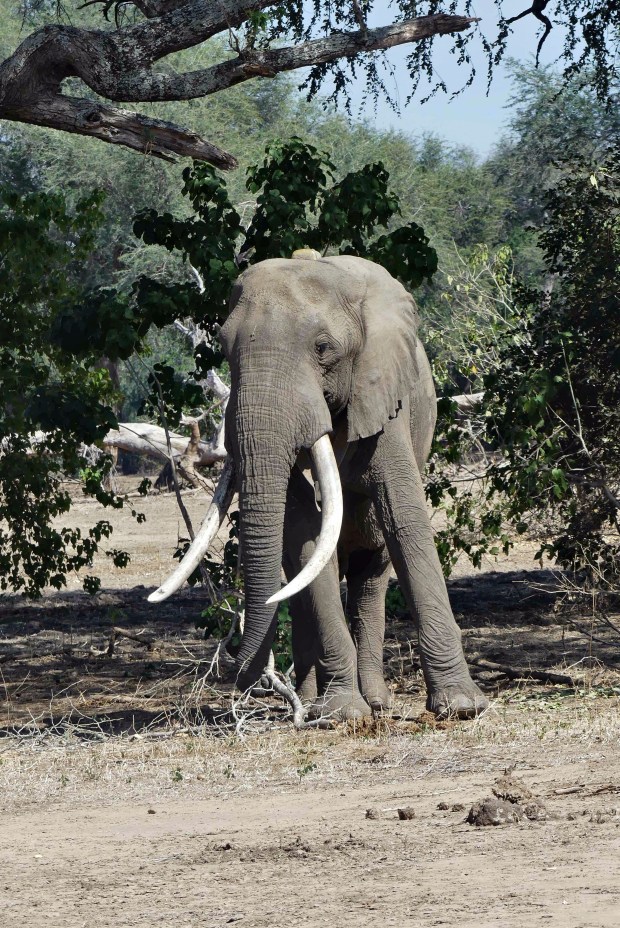
Luckily, after a while in the distance we saw the unmistakable shape of Boswell and we noted that it was slowly walking towards the river and we happened to be on its path. We placed the vehicle in a discrete spot not to interfere and waited for its arrival. Luckily we were alone! Boswell was accompanied by a few more elephants, two adult but younger males, a couple of females with babies and a young male.

P1000305 copy

Boswell.

Mana Pools was extremely dry as last year’s rains had largely failed so there was little greenery apart from the large trees. Further, the preferred food for the Mana elephants, the pods of the Apple-ring acacia (Faidherbia albida), we not yet mature so we were curious to see what would Boswell do.

As usual the very relaxed group came really close and when they were under a Sausage tree (Kigelia africana) Boswell started to lift its trunk clearly sizing it up.  Clearly satisfied with what it saw it started to stretch, arched its back and it was on its hind legs trying to secure a good grip on a branch! I desperately grabbed the camera and shot while it remained standing. After sometime we heard a mighty crack and down the elephant came with a huge piece of the tree!

This slideshow requires JavaScript.

Boswell starting eating the large branch while keeping the young males away by a combination of aggressive gestures, vocalisations and, with the too daring, pushing and shoving and some trumpeting as well. It did not liked to be disturbed during its meal! Conversely, he did allow the young females some bites and did not mind if the youngster came really close to him to feed, the latter often getting between its legs!

After a while, although there was still greenery left on the branch, it moved on leaving part of its bounty behind and, while it started to find another arboreal victim, the followers got busy finishing the spoils.

P1000292 copy

The event was repeated a couple of times slightly further from us and trickier to photograph. As the group continued its placid sojourn towards the water we moved off, very pleased with our luck and trying to explain this to our visitors.

P1000311 copy

Perhaps we had driven five km when we found another elephant, much smaller, also feeding. We then watched in disbelief when it also stretched and stood only on its hind legs! We made a comment to a safari car that was watching the action with us and the driver told us that this particular elephant was known as Harry! We were really lucky and elephants was the conversation at camp that night, despite the visits by vervets, baboons and hyenas!

The following morning, following the tip of a kind tour driver we found a large group of lions at a dry river bed and, after watching them for a while, we continued our game drive. While commenting on the very few greater kudu that we had seen we spotted an elephant standing on two legs. As we saw it from its back we thought it was Boswell again as we could see a radio collar. In fact it was a much smaller male that clearly knew how to look for the tender leaves of the Mana Pools’ trees!

The final act in this saga was yet to unfold when we were about to end the game drive and go back to camp for a well deserved branch. A dust cloud called our attention and we saw two elephant bulls clearly settling some kind of dispute. After a while we saw that one of the contenders gave up and moved off at a speed.

The “victor” stayed put and after a few minutes it decided to look for some food. It was at that time that we saw it well and the large notch on its left ear identified it as “Big V”, another of Mana’s “specials” that we have seen stretching to bet acacia pods before[2].

P1000509 copy

So it was Big V that delivered the final act when it also decided to go for some juicy branch and, lo and behold, before we knew it it was also standing on its hind legs!

We were now really impressed with the Mana Pools elephants and agreed that we have had our quota of elephant stretching while we can happily confirm that Boswell has been able to pass its genes to its heirs that will keep future visitors to Mana Pools amazed at their feeding habits!


[1] See: https://bushsnob.com/2016/08/17/boswell/

[2]: See: https://bushsnob.com/2016/08/31/big-v/

Too close!

During our recent visit to Mana Pools National Park we saw a Yellow-billed stork (Mycteria ibis) feeding in one of the pools that give the name to the park. This was nothing strange as we often see these birds in that pool.

What was unusual was that the stork was feeding very close to a semi-submerged crocodile of a size that could have gone for it!

What else can I add? My immediate thought was that the stork meat must be so bad tasting that this is its best defence!

Poor housekeeping

While staying at Muguga House (see: https://bushsnob.com/2015/06/30/life-and-work-in-kenya-muguga1/) I used to upset Richard with my parrot stories from Uruguay. I later regretted having done so when I discovered that he owned an African Grey parrot!

Richard found us a house in Tigoni where we moved after a few months living in Muguga House, once we got our VW kombi to move around. We were neighbours for about one year and we shared time together. So, when Richard’s time to go on annual leave came, we agreed look after his house and, more importantly, its occupants.

tigoni house

The house in Tigoni and our VW kombi, our all terrain vehicle.

Richard was very proud of his collection of African fresh water fish that he kept in tanks all over his sitting room area and, of course, he kept his parrot! The fish required feeding and cleaning and, in addition, the parrot required some entertainment as it was rather neurotic and pull its feathers! Luckily, his housekeeper would take care of the daily chores and all we needed to do was to get the necessary food and, whenever possible, keep the parrot amused by talking to it. This consisted of exchanging the phrase “silly old parrot” and submit to its loud and almost deafening whistling!

As it is customary in these cases, Richard gave us a briefing about some special details needed and also about a last minute addition to his menagerie: a small terrapin that he had found during a walk that also required attention. Although the new beast occupied its own tank and it should have been easy to keep, he was worried that the housekeeper was not familiar with it and asked us to keep a special eye on its welfare.

We listened patiently to all his recommendations and reassured him that all was going to be well so, the following day he left for one month to visit his family in the UK and we added the monitoring of his house to our ongoing activities.

We kept visiting his house daily at first but when we saw that things were going well, we relaxed our visits as we gained more confidence. Very soon there were only a few days for Richard to come back and we were pleased with ourselves as all was still in order. Clearly, we celebrated too early! Two days before Richard’s return his housekeeper, looking sick with worry, came to see us after we returned from work.

“The parrot is gone”, he said almost crying and not daring looking at us. As these were really bad news, we sprang to action immediately and walked with him to Richard’s house while we interrogated him on the way. Apparently, the parrot was gone since the morning and, as he could not contact us the poor man lived through agony until we returned in the afternoon. He said that he had looked for the feathered one all over but failed to find it!

richard parrot

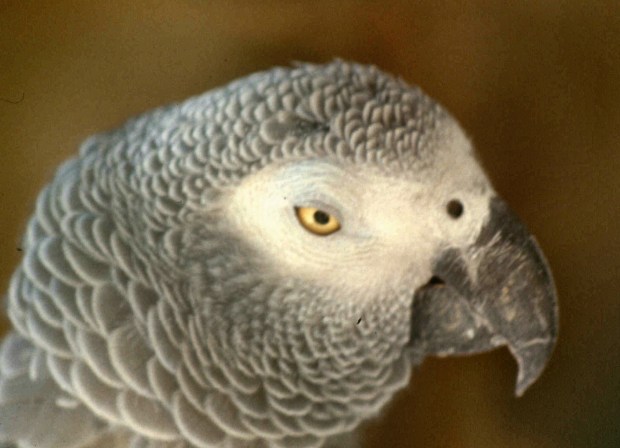
A bad picture of the parrot!

We fruitlessly searched the house from top to bottom and found no signs that the bird had been there and the investigation gave us no useful clue on where or how it could have gone out of the house. So our search moved to the rather large and bushy garden, open towards the river that run through the valley below, the same valley where I had my earlier encounter with the “siafu” (See: https://bushsnob.com/2016/04/19/fire-down-below/ ).

We were not very optimistic but continued with our search!

mabel peter tigoni

Searching for the missing feathered one. (Sorry for the bad shot but I was shaking with worry…)

That day darkness came faster than we wished and eventually we found ourselves in darkness without finding it or having a reply to our “silly old parrot” calls directed to the apparently empty bushes! I do not wish to know what anyone that heard us saying that with a parrot accent could have thought! But that is only an afterthought of today as the situation then did not allow for these kind of mental exercise!

After searching for about two hours in the dark we gave up and, with a heavy heart, returned to our house. Clearly a hand-reared parrot used to live in a cage had a very slim chance of making it through the night where we knew mongooses, genets, civets and probably other predators inhabited. We had a somber dinner while we discussed the issue and prepared for the worse, particularly how to break the bad news to Richard that was arriving in two days time!

The following morning we did not go to work and we asked Peter -our housekeeper- to join us in the search. We started looking as soon as there was daylight, admittedly more as a token gesture than with a real hope of finding our -hopefully still feathered- fugitive! While walking towards Richard’s garden, I still kept thinking on how I would break the bad news to him!

We decided that our chances of success would be higher if we separated and each one of us took an area to search while shouting “silly old parrot” again and again! At about mid-morning and after a few hours of walking around in the bush, it was Mabel who heard something and called us. We ran towards her and, as we got closer we heard “silly old parrot” in the inimitable voice of the missing parrot. There it was, perched low from the ground on a small bush, preening itself and removing a few more feathers from its already almost bare belly!

It seemed that the parrot had spent the night at about 60cm from the ground and survived! We soon grabbed it and brought it back to its cage where we left it with renewed recommendations to the keeper. We left for our house, quite relaxed and happy about our find.

Finally, the day of Richard’s return arrived. Still pleased with our parrot success, we went to his house to have the last check on his wildlife and wait for his arrival.

Then the last act of this play unfolded…

All fish looked fine but when I checked the terrapin tank, I saw it rather quiet and unresponsive to the touch! It was dead. This was an unexpected blow as we had seen it the afternoon before looking fine! Rather upset I took it out of the water almost at the same time that we heard Richard’s car arriving!

I was in a tight spot with the terrapin in my hand! Those of you who are familiar with these beasts would know how they smell when alive and you can only start to imagine how they stink when dead! So, I moved fast to the toilet to both dispose of the body and the waft from my hands while Mabel greeted and entertained Richard.

I tried to flush the small reptile about three times unsuccessfully and eventually, in desperation, wrapped in toilet paper and stuffed it in my pocket while, and washed my hands hoping that the soap would do its job.

So, with my best possible smile I emerged from the toiled to greet Richard and to break the news of the terrapin’s demise. Luckily, he took it well and, a few minutes later, after leaving him to settle in his house, I managed to bury it in our garden to close our rather poor experience at housekeeping!


The Nguruman Escarpment

My earlier post on lake Magadi [1] brought to my memory the only trip I made to the Nguruman escarpment. I traveled there with Robin after a few years in Kenya, on a collaborative work with the Tsetse Programme of the ICIPE that was working on the control of tsetse flies and trypanosomosis [2].

Maasai Magadi causeway.tif

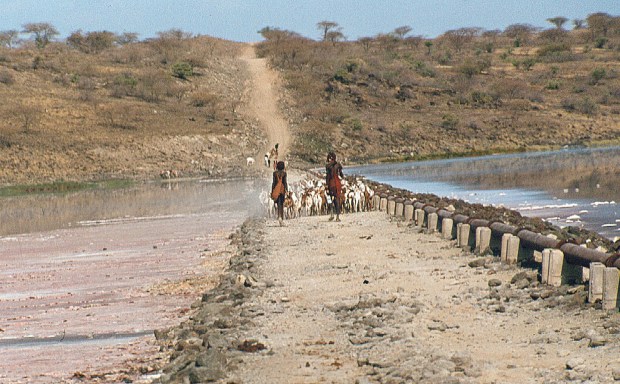
Maasai boys with their sheep and goats on one of the Magadi causeways.

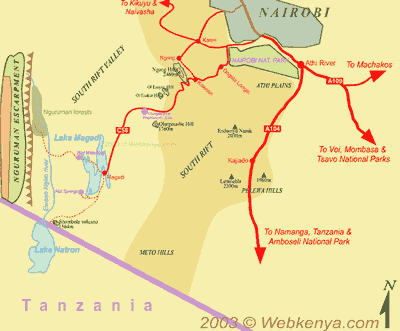
The Nguruman Escarpment forms the western boundary of Kenya’s Rift Valley to the south near the border with Tanzania. The trip from Nairobi to Nguruman went through the green foothills of the Ngong Hills followed by a long descent to the semiarid plains on the floor of the Great Rift Valley, crossing Lake Magadi in a westerly direction.

magadi 1

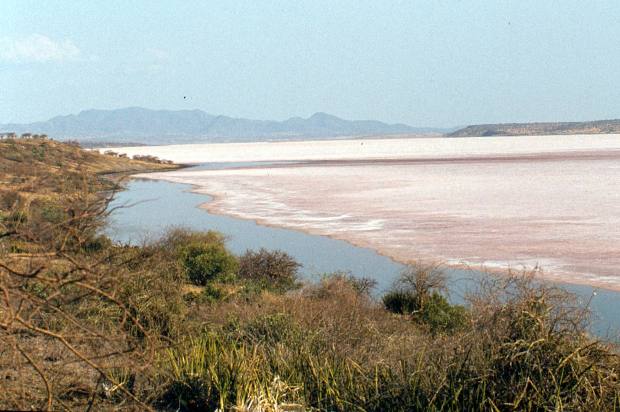
Lake Magadi.

After leaving the lake area there was a rather endless drive through dusty, rough and undulated dirt and very dusty tracks crossing very arid terrain.

As you finally approach its foothills about 60km after the lake, the vegetation changed and mango and pawpaw trees and other vegetables and fruits appeared thanks to some water available from the Entasopia and Ewaso Ng’iro Rivers that, coming from the Mau Escarpment, flow along the base of the Nguruman hills to end at Lake Natron in Tanzania.

The Nguruman -as this rather remote area is usually known- was inhabited by the Maasai and, as usual, they shared it with game. The pastoralists understood the benefits of controlling tsetse flies and welcomed the project to their land. As the main principle of the ICIPE was to avoid the use of pesticides, our entomologist colleagues were introducing odour-baited traps to control the population of the tsetse fly (Glossina pallidipes) in an area of 100km sq., groundbreaking work at the time.

The drive to get to the project area required some special arrangements. Because of the heat, it was impossible to drive with closed windows in a non air-conditioned car as our Series III Land Rover was. Very soon the white car bonnet would acquire a shade of gray because of the tsetse flies and very soon they would start getting inside!

So, while the driver focused on avoiding the frequent and challenging road hazards, the passenger in the front seat did not just seat there looking pretty: his/her job was to destroy flies, particularly those landing on the driver! This was a very specialized job. If you were too careful, the fly would survive but hitting too hard could startle the driver with unknown consequences. In addition the victim could start thinking that old scores were being settled by the procedure and retaliate…

The project was also original in that the Maasai themselves made their own tsetse-catching traps with project support. At the time of our visit one hundred of them, baited with acetone and cow urine [3], had been placed in woodland areas where this fly species aggregate during the dry season. The traps were checked monthly for maintenance.

Our visit was during the early stages of the work but towards the end of their intervention they managed a reduction of 98–99% relative to the number 3 km outside the project suppression zone. So, at the time of our visit this was still not known and the work had a feverish intensity and enthusiasm.

Our job was a minor one and consisted in identifying the ticks present on the Maasai livestock in order to complete the parasite spectrum affecting the animals. So, we spent a couple of days collecting ticks from cattle, sheep and goats to later identify them in the laboratory.

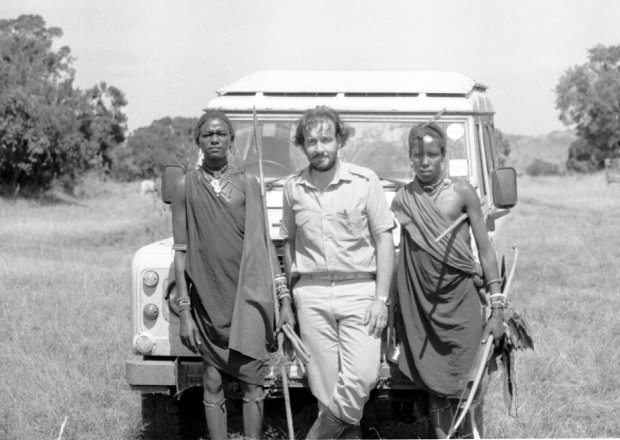
Apart from some ICIPE support staff, the project employed and collaborated with a substantial number of Maasai villagers. In particular I recall a young Maasai teenager that has just undergone the “Emuratta” (circumcision) when we visited and he was working still clad in his dark tunic with the accompanying head-dress made of stuffed birds hunted with blunt arrows as it is traditional. He also carried his bow and arrows with him all the time to shoot any unaware birds to add to his collection. He had become the main nexus with the Maasai community as he was good in English.

Over the couple of nights we camped there, we listened to interesting stories. We learnt that traps suffered from animal damage and also from theft so they required frequent checking to make sure that they were operating to their full effect. The “trap rounds” were done by car as much as possible but walking was also involved and, often these resulted in meeting dangerous game.

It was not the lions that were most feared but buffalo. These animals, particularly the old and lone males also known as “Black Death” can be extremely dangerous, and it is believed that they are responsible for killing more big game hunters than any other animal in Africa so extreme care was taken and the Maasai usually accompanied the technicians for protection or at least “early warning” so that a suitable tree to climb could be found! We saw some rather wild-looking buffalo bulls but always -luckily- from the safety of the car.

The soil in the Rift Valley has a great content of volcanic ash and it is common to drive through it in several places in Kenya. However, nothing prepares you for the driving at Nguruman. The abundant and very fine ash behaves like water and in some places it can be over 50cm deep. The car made waves of dust and in deep areas 4WD was needed to go through while the ash splashed the windscreen covering it and impeding vision unless the wipers were full on. You would breath and eat lots of dust while you wished it was raining although this would only bring a different challenge!

We heard lion roaring in the distance every night but we were extra safe camping in the heart of a Maasai community as predators kept their distance. So, to see lions you needed to drive quite a distance towards the Loita hills and then the Maasai Mara but that was not the purpose of our trip.

I do remember a story one of the project drivers told us while seating by the fire enjoying a Tusker beer. Some time back, when the project was still an idea, he was driving through the Nguruman woodlands when he caught a glimpse of red near the road. He went to investigate and found a piece of Shuka, the Maasai traditional tunic. Nearby he spotted its owner, dead and showing signs of having been mauled by a lion.

Wearily moving around he noted that the grass and bushes around the spot showed signs of a great fight. Eventually, a few metres farther he found a speared young male lion, also dead. Two dead braves were all that remained to show for the long-term enmity between Maasai and lions!


[1] See: https://bushsnob.com/2018/09/10/lake-magadi/

[2] Dransfield, R., Brightwell, R., Kyorku, C. & Williams, B. (1990). Control of tsetse fly (Diptera: Glossinidae) populations using traps at Nguruman, south-west Kenya. Bulletin of Entomological Research 80: 265 – 276.

[3] Buffalo urine was also used if available.


A vet in Maasai land

“… Engai (the Maasai God – Ed) had three children to whom he gave three gifts. The first received an arrow to make his living by hunting, the second a hoe to dig the land and grow crops, and the third a stick to use in herding cattle. This third son, whose name was Natero Kop, was the father of the Maasai, who have since that time been the proud keepers of cattle.” [1]

Maasai Mara bridge going to T Mara copy

When I arrived to work at Intona Ranch, I did not know much about the Maasai, apart from having seen them walking in Nairobi with their unmistakable attire and, later, during my first trip to Intona with Alan. At the time, Billy Konchellah was about twenty years old and getting ready to become a world sport idol by winning the 800 metres world title twice (1987 and 1991) and becoming, I guess, the most famous Kilgoris-born citizen.

Later, as I traveled to and from the Transmara I got to know the Maasai better. As soon as they learnt that I was a “Daktari wa mifugo” [2], my prestige among them instantly improved and, as soon as I arrived to Intona they would bring any sick animal they would have.

As I mentioned before, Intona was given to Joe Murumbi, the son of a Maasai lady, as homage for his distinguished career in Kenya politics. He was a father figure in the area and he had many visitors, many of them Maasai. Most came by foot and on the way to the main house they all stopped to look at the cattle, their main interest. In particular they spend an inordinate amount of time observing the nice-looking Boran cattle a novelty we brought into Intona from Northern Kenya for our trials and I already narrated what happened to some of the latter when some unscrupulous Maasai liked them too much! [3]

Boran heifers earbags Intona 100 nn test copy

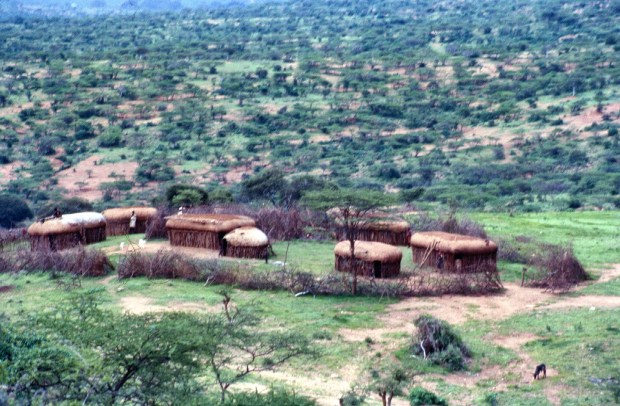
I also visited their dwellings known as manyattas [4] when called to check sick animals and I still feel the dung smoke in my nostrils at entering a dark manyatta for a visit. With no other ventilation than the entrance door, there was dense smoke as we sat down to talk while sharing a gourd of milk with the house owners. Occasionally I also participated in some of their ceremonies when my presence in Intona coincided with them.

Manyatta copy

I inherited a strong dislike of flies from my father who fought a lifelong war against flies. He always had a fly swatter at hand but when he did not, he would catch them with one hand by placing it open and about 20cm from the fly and then sweeping it fast to catch it. He would then kill it by throwing it against the floor! I inherited this ability and became as good as him!

As flies bred freely in the cattle dung around the manyattas they were extremely abundant and annoying. As I did not have a swatter I defended myself by catching them with my hand to the amusement of my hosts that just ignored them or used a fly whisk to scare them away. So, on a lighter note I am proud to say that I had ample opportunity to demonstrate my fly-catching skills in Maasailand and once, with one move of my hand, I caught twenty-seven of the pests! This feat, regrettably, did not enter the Guinness and, frankly, it was more a consequence of the amount of flies rather than my skills!

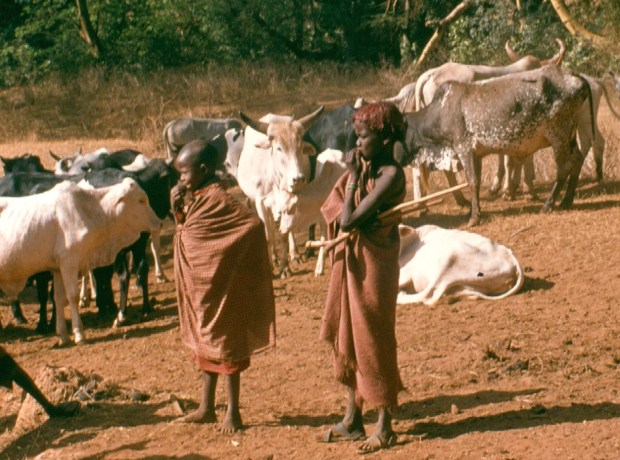
The Maasai are well known for their ancient enmity with lion -that yesteryear they would kill to reach adulthood- as well as for drinking the blood of their cattle on special circumstances. However, what I remember them for was their amazing relationship with their cattle and how much they love them and cared for them. Regardless of the number of animals owned, each one has a name and ancestry and rarely they would part from them.

One of their tales says that at the beginning of time the Maasai did not own any cattle and that one day God called Maasinta, the first Maasai, and asked him to build a large enclosure. One the latter was completed God said that the early the following day he would fill it with something called cattle and Maasinta must stay very silent. In anticipation, Maasinta went to the enclosure and waited. Suddenly there was loud thunder and cattle of all shapes and colours started to descend.

Although Maasinta just managed to keep silent, his Dorobo [5] companion woke up with the commotion and when he saw what was happening he proffered a loud cry. Thinking that Maasinta had shrieked, God stopped the flow of cattle and asked Maasinta if all the cattle that he had given him were not enough so he would stop sending anymore and this is the reason that the Maasai love cattle so much!

As I mentioned before, they brought animals for me to examine. Although sometimes I could get to a diagnostic and recommend a treatment, others they brought animals that, regardless of how much I checked them, I could not find anything wrong with them. When I told them so, usually a discussion ensued during which the owner (through an interpreter, usually Tommi, my Maasai herdsman) would protest bitterly as he claimed that the animal was not well and eventually he would leave shaking its head and rather upset at how little I knew!

cropped-cropped-t-mara-maasai-treating-their-cattle-kilai.jpg

Maasai and JC with Land Rover

The author (centre and starting to loose hair!) with Maasai visitors.

Almost invariably the same farmer would bring the same animal back the following day with a clear clinical case of acute diarrhea, pneumonia or trypanosomosis that required immediate attention. I would then treat the animal and a happy Maasai would leave with his animal after reminding me that it was the same animal of the day before! Luckily not many came and I was not embarrassed very often!

I spent many hours with them just watching our cattle in Intona and through Tommi I got an insight of what they were saying. In short, they would note every detail of each animal and comment about it. Some liked the absence of horns of the Boran animals while others argued against it!

The coat colours were also discussed hotly. Our Boran were predominantly brown and, while some thought that this was a good colour, others preferred others such as white, black or barred. The arguments prolonged for a time I did not have so I needed to excuse myself and continue with my work while they continued arguing for a long while longer, the same way we would do while watching a sports cars show!

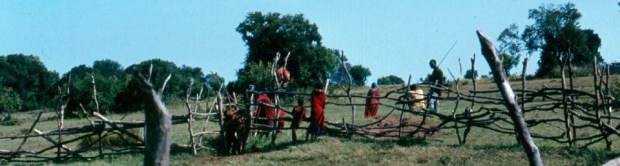
The true highlight was to visit their manyattas to look at their cattle. The best time to do this was in the late afternoons when the cattle returned from the day grazing to the safety of the thorny enclosure to spend the night away from four- and two-legged predators.

It will all start by greeting the owners that were usually delighted and proud to host us when they learnt that we had come to see their animals. After a while of talking with the herders you would start hearing bells in the distance that some emblematic member of the herd such as a preferred ox or cow would wear around their necks.

maasai herdboys copy

Maasai children looking after livestock.

Cattle tracks M Mara 1 copy

Maasai cattle highway.

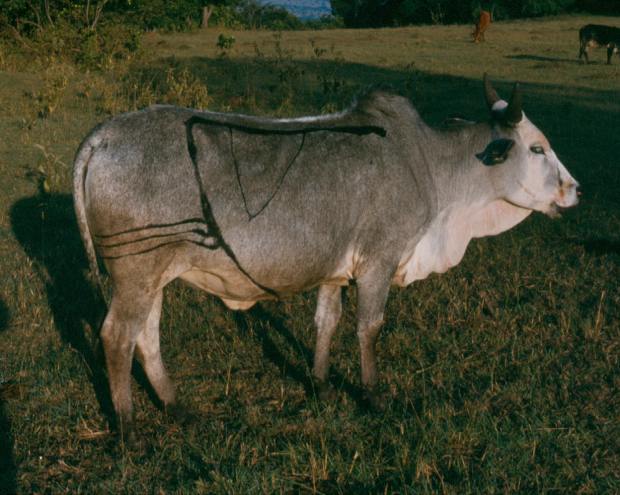
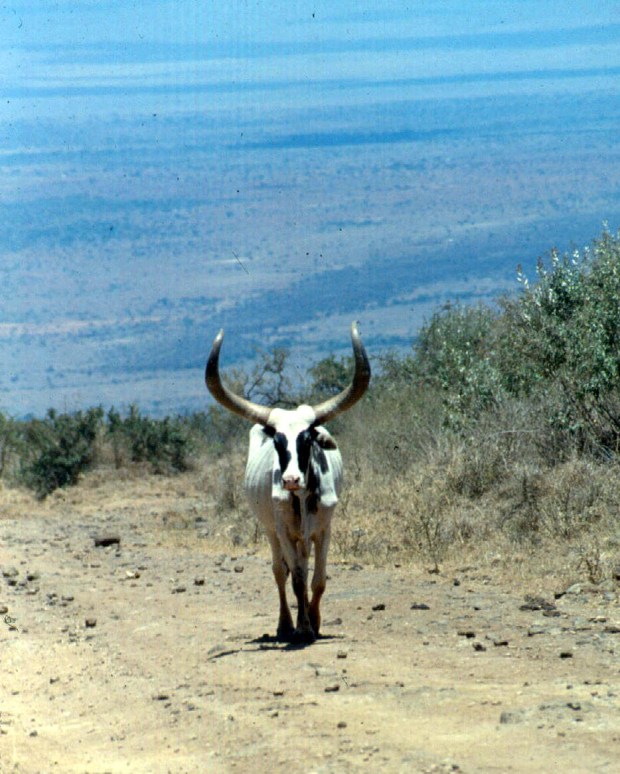
The first bellowing indicated that the herd was close and soon you could smell them well before their arrival. They soon appeared among the dust in the dry season or stopping to get the last mouthfuls of juicy grass during the rains. The animals were of many colours but sometimes they reflected the preference of their owner and a colour would predominate. The stripped and grey ones were spectacular, particularly the latter when heavily branded.

maasai-cow-kilai-6-41-13-pm

There were also different horn shapes and sizes, from the rather large ox horns to the rather unusual “scurred” horns only attached by the skin that moved loosely as the animal walkscattle magadi... back road ngong copy

Keeping on the side, not to interfere with this daily ritual, I watched as the docile animals entered the enclosure under the careful scrutiny of the owners -both men and women- that apart from the sheer pleasure of seeing their favourite animals- checked for signs of trouble (the same I would miss when consulted!).

They will follow the progress of those that were sick, check for any newly-born calves, usually carried by the herdsmen as they were not able to walk at the speed of the adults. After all was checked the time would come for closing the thorn-bush gate and start with comments and praise of some particular animals that are special to the owners.

Gradually and gently the animals started finding their resting places inside the kraal and soon they would lay down to rest and chew their cud and eventually spend the night protected from lions and other predators that surely would look for a come to have a look for a chink in the manyatta’s armour to snatch the unaware animal.

These were among the best moments I spent in Kenya. I really felt fulfilled, realizing that I had come a long way from my former cattle work in Uruguay. I still long to return!

According to their oral history, the Maasai originated from the lower Nile valley north of Lake Turkana (Northwest Kenya) and began migrating south around the 15th century, arriving in a long trunk of land stretching from what is now northern Kenya to what is now central Tanzania between the 17th and late 18th century.

The Maasai are among the best known Africans internationally due to their residence near the many game parks of the African Great Rift Valley, and their distinctive customs and dress. There is even a theory that because their hair arrangements mimic the Roman helmets and that they wear a “toga-like” attire and a short assegai resembling the Roman sword, they had some Roman influence from some lost legions from Egypt.

While I worked in the Transmara, I met two of the people that were studying several aspects of the Maasai culture.

Fr. Frans Mol used to spend time at his Mission near Lolgorian where I found him and had a chance to talk to him, albeit briefly. I learnt that he had a great liking for the Maasai people and that he had been working as a missionary for the Mill Hill Church(?) for over 20 years at the time I met him [6].

He was fluent in the “Maa” language and got to know their cultural ways. Although he preached Christianity in several Maasai districts (Kajiado, Transmara, Laikipia and Narok), he also devoted his time to put his knowledge on paper and wrote a few books on the Maasai [7].”

Another character I knew that had great experience on the Maasai ways was a lady known in the Maasai Mara as Jacqueline. At the time we met her close to the Oloololo escarpment, in July 1982, she introduced herself as a French anthropologist that had come to the area to study the Maasai, fell in love with one of them and stayed behind.

Later on I learnt that she was Jacqueline Roumeguère-Eberhardt and that she had occupied important positions of research in France and carried out groundbreaking investigations in Southern Africa on the Venda, Tsonga, Shona, Lozi, Bushmen, apart from her on-going studies on the Maasai.

IMG_4476

Before her death in 2006 Jaqueline amassed a wealth of knowledge on the people she studied and she produced many scientific papers, books and films in both English and French and interestingly she was involved in an interesting event when in 1978 she caused lots of excitement among the anthropologist community by claiming that she had found hominid that dwelled in thick Kenyan forests. She called them “X” and documented a number of encounters with them by Kenyans. Although she wrote a book about this discovery [8]. However, her finding was doubted by scientists and she failed to lead an expedition to find them and they were not seen again!

In her obituary [9] published by the … it says: ‘ …Despite their cultural differences – and the presence of eight other wives – Jacqueline Roumeguere-Eberhardt claimed that she and her husband got along famously: “Every time I’m with him I learn something new about human nature and problem solving,” she told an interviewer. All the same, standards had to be maintained, and, while living the life of a tribeswoman, she never went out without applying her red Chanel lipstick and nail polish.’

Although I am not able to say anything about the first issue, I can confirm that she was always elegantly dressed and looking great when we met her in the Maasai Mara bush although I cannot swear about the make of the lipstick!


[1] Ole Saitoti, T. and Beckwith, C. (1986). Maasai. Elm Tree Books/Hamish Hamilton Ltd. Eds. 276p.

[2] Veterinarian in Ki-Swahili.

[3] See: https://bushsnob.com/2014/07/19/the-cattle-are-gone/

[4] “Manyatta is the name always used for these Maasai villages, but the correct term is “engang.” Manyattas were built especially for the warriors with their mothers and girl-friends while the engang was the family dwelling.” From: Ole Saitoti, T. and Beckwith, C. (1986..). Maasai. Elm Tree Books/Hamish Hamilton Ltd. Eds. 276p. I use manyatta as this is the word I used at the time of the story.

[5] Hunter-gatherer groups of Kenya and Tanzania associated with the Maasai.

[6] Father Moll retired at 70 on 3 December 2002 after working 44 years in Kenya.

[7] Some of the books are: Maa, a dictionary of the Maasai language and folklore: English-Maasai (1978); Lessons in Maa: a grammar of Maasai language (1995) and Maasai language & culture: Dictionary (1996).

[8] Roumeguère-Eberhardt, J. (1984). Les hominidés non identifiés des forêts d’Afrique. Robert Laffont Ed.

[9] https://www.telegraph.co.uk/news/obituaries/1518217/Jacqueline-Roumeguere-Eberhardt.html Consulted on 27 May 2019.


Spot the beast 57

See if you can spot this one. Please, do not look too much if you fail to find it in a few seconds…

IMG_4634 copy

This one is really a different “Spot” as it is quite clear that we have a terrapin in front of us. However, have a good look at it.

I did not notice anything strange until my son, said “look at the terrapin doing Yoga”!

IMG_4635 copy

It was rather hot in Roma so the beast was sunning one leg at a time at leisure!

Intona fun

There were a few years of work at Intona where we achieved some good scientific results. We managed to immunise cattle against theileriosis, the main cattle killer in the region and this resulted in keeping animals under relaxed tick control regimens as opposed to applying toxic chemicals two times per week as it was formerly done!


The trials required hard work not only for Alan and me but for the herdsmen that had the day to day responsibility of keeping activities going all the time. Although the work was demanding, we also found time for entertainment. We often went to the Migori River to try our luck at fishing although neither the Maasai nor the Kikuyu (or me) like to eat fish so we maintained a strict catch and release approach. In “Memories – A fishing trip” I described the most dramatic of these fishing outings but there were many others.

We also had some other fun that included the already described spear throwing (Javelin throwing), game driving and also walking around the farm. A great tour was the drive towards the back of Intona where you would meet the Migori river. This was one of the boundaries of the ranch. In that general area a large herd of buffalo grazed in the meadows before getting into the riverine woodlands to spend the night.

This herd was resident in the ranch and, to my amazement and concern, the cattle herd would intermingle with them while grazing! This buffalo herd did not show any aggressive behaviour towards our animals or the keepers, although the latter paid them great respect and kept a wide berth. When it was time for the cattle to start their return walk to the safety of the kraal/boma they would separate from the buffalo and start their walk following the loud whistling of the herdsmen.

By the river it was always enjoyable to spot the silvery-cheeked hornbills, large birds with large bony beaks flying over the river returning to their sleeping tree after foraging in the forest. The Transmara also had a special bird called the African blue flycatcher (Elminia longicauda), greyish below but bright blue on its dorsal part, including its head that has a small crest. Watching it its colour fluctuates with the light between blue and cyan, a magnificent sight. It also has the habit of constantly fanning its tail in a very attractive fashion. Although a common resident at Intona, it was a rare bird, always worth finding.

Walking about would take a purpose when Robin was around! He and Janet, his late wife, were very keen in collecting orchids from the tree islands. Because of the old and aggressive male buffalo that lurked inside the tree islands this was a rather risky endeavour, as we needed to enter the forest in search of the plants as well as climbing the trees to get them. Luckily, one of the young herders would do that for us!

Intona view 1 copy

The tree islands where we looked for orchids.

When Joe learnt that we were going to do this, he designated his gardener as our “angel guardian” and ordered him to march with us carrying a fire siren to scare the buffalo away from the places we would visit. I always felt sorry for the poor man, as the contraption was a rather large metal frame with the siren mounted on it, looking like a large hand-cranked blacksmith’s bellows.

It was immediately apparent that the gardener knew what he was doing the moment he started turning its large handle. The pneumatic siren would then respond gradually with a grave sound that, after the machine gained momentum and the handle increased its speed, will get into a full loud siren, just like the old fire engines used to do before the new more ‘innovative” multi-tone electronic ones were introduced.

Luckily, we did not find buffalo during the few times we pursued this rather hazardous sport with a rather meagre floral reward. However, I still remember my neck hairs standing up when we heard crashing noises coming from the wooded islands preceding the sudden appearance of animals scared to death! In particular the very scared warthogs would rush out of their siesta places or burrows. A particularly hairy encounter took place when a large male came straight at us luckily veering off at the last second. A very lucky escape as these animals carry large tusks and can produce severe injuries.

Intona also hosted smaller animals and these were usually found at night. Although mongooses and hyenas were usually seen, there were others like genets, bush babies and African hares among others. To see the hares dazzled at the car lights reminded me that in Uruguay we would shoot them or even catch them while they remained stunned. We would later pickle them and enjoy their tasty meat. So, I decided that night “hare-catching” was worth a try.

I then managed to sell the idea to my companions, the herdsmen, as a different (and potentially tasty) way of spending our free time! “If we drive out after dinner, we may be able to kill a few hares” I said to my herdsmen and I added “The trick is that you dazzle them with the car lights and then you get out of the vehicle and walk slowly and silently in the dark towards them until you get close enough to grab them”. I assured them that they would be good eating as well!

The idea was accepted but the reply included that we should take one of the Maasai herdsmen as he would be the only one capable of finding the way back to camp after a while driving cross-country on the ranch! So we did and that is how Thomas also came on that venture as well as the fishing trip above.

Eventually the team assembled a moonless Saturday evening and we set off armed with “rungus“[1] to stun the unlucky hares. We started after dinner and drove slowly searching for either the hares themselves or eyes in the darkness. It was soon apparent that looking for “eyes” was a fruitless exercise as the latter belonged to a number of different animals but no hares were detected.

Like this we bumped into topis, zebras, impalas, hyenas and white-tailed mongooses, among other beasts. It was clear that we would have to bump into them and hope that they would be dazzled by our headlamps!

impala sep 86 cropped

Impala like this were among the eyes we saw.

After a while, a suitable hare was spotted and eventually it stopped its run and looked at us. The “hare-catchers” jumped out as planned while I kept the car with the beam pointed at the hare. Despite our efforts, the hare must have caught movements in the dark and soon took off. The empty-handed catchers returned to the car and we continued our search until another hare was dazzled and off they jumped again. This time one of them went too close to the beam and his shadow interfered with the hare that also took off.

The hunt was proving more difficult than I anticipated so I decided to join the hunters for the next hare. It did not take too long to appear. I left the car running with the lights on and the four of us, two from each side, started stalking the prospective victim. I had my eyes on the hare so, when I heard a shout that I did not understand I was surprised and even more so when Mark, one of the hunters, rushed by me screaming “buffalo!, buffalo!” I did not wait and rushed to the car as fast as I could.

Thomas, the first to see the buffalo and responsible for the first screams, beat us to the car by a good margin and, luckily managed to open the back door fast, in time for all of us to jump in seconds later, ending up in a pile of hard-breathing bodies, still with the door open. Gradually we managed to talk and we all burst out laughing, releasing our fear while Mark explained that they have bumped on a few buffalo that, luckily and equally scared, run away!

I never saw anything and, as soon as we were able to move, we unanimously decided to abandon our hare chasing and return to the camp under Thomas’ guidance that, despite the encounter, still retained his bearings! It was when I turned the car around that the buffalo came to view. It was no other than the resident herd and we were lucky that we did not encounter the few large males that were also in the ranch.

The unanimous comments of the car occupants was that they were all in favour of continuing with their “hareless” diet of ugale (white maize polenta) and cabbage!


[1] In Ki-Swahili, a wooden club with a thick end, similar to the knobkerrie of South Africa.