Zimbabwe

Lord of the (dead) flies

While living in Maputo (Mozambique) we rented a house that came with a gardener, as it is usually the case very in these places. His name was Erasmus and he was a very easy-going and religious young man. Often in the afternoon we were regularly treated to a choir of holy hymns when he and the afternoon security guard sang together. We later learnt that they were at the choir at the same church and they were rehearsing. I must admit that -as it is the norm in Africa- they sang very well.

The house was built in an area of Maputo liable to flooding and, perhaps because of the humidity and heat, we had a serious problem with flies. The latter became an issue during the rainy season, despite us keeping all rubbish in sealed containers that were removed regularly.

After some search we found the solution: a flytrap, a transparent plastic contraption that, when filled with a smelly solution, would attract flies to it where, unable to escape, they would die.

cropped-dscn9926-copy.jpg


In consultation with Odette, our housemaid, the trap was placed by the kitchen door with the objective of intercepting the flies before getting into the house. The siting was an instant success as, after a few days, flies began to get trapped. Then we confronted a problem: the smell! It gradually increased as more flies accumulated and soon Odette started to make remarks about the fedor[1] that started to emanate from the offending trap.

After a couple of days of putting up with the stink, Odette moved the trap away from the house without opposition as, despite being of small complexion, she was clearly in charge of the household personnel by virtue of being the employee closest to us.

The trap stayed in the new location, close to the security guards’ changing quarters, for a few days until they staged a “mini demo” to protest about the stench and Odette agreed to hang it far away, under a casuarina tree where its smell did not interfere with anyone.

Peace restored, the contraption continued to hammer the flies but soon it filled to near bursting point and it became less effective as no more flies would be able to get in anymore. So, Odette stroke again! She asked Erasmus to empty it. Poor old Erasmus had no option but to accept Odette’s request, being her sidekick.

The above background to this saga has been reconstructed afterwards talking to the various participants and witnesses as at the time I still had working duties.

I was at home when I heard a strange noise in the garden and went out to investigate. I saw Odette overseeing Erasmus work from a prudent distance. Erasmus -looking quite sick- was busy emptying the trap while pausing frequently to move away and take deep breaths of pure air while trying to keep his lunch down! Eventually, the job was done and Erasmus started to look his normal self while Odette looked rather amused! I am sure that it was probably his toughest assignment ever.

It was a very quiet Erasmus that walked past after completing the cleaning and that got into the toilet. It was too evident that he needed a long shower to be allowed on public transport to get back home!

After the operation, the trap was not cleaned again, a decision that I suspect followed some hard bargaining between Erasmus and Odette. In 2013 I retired and we left Maputo so the flytrap was packed away and it disappeared from our memories. Since then we have commuted between Uruguay, Argentina and Zimbabwe, avoiding the winter as much as possible.

Harare, being at about 1,500m of altitude has an extremely pleasant climate and it is almost fly- and mosquito-free for most of the year but some flies start to appear just before the rains and their numbers increase when it gets wet. Last year (2016) , the rains started on time and the flies were more numerous than normal.

A consensus was reached between my wife and Stephen -our caretaker- that preventive action was indicated to keep the flies in check. So, lo and behold, the infamous flytrap re-appeared! I immediately remembered Erasmus and felt sorry for Stephen but kept quiet…

This time, as experienced users and with the benefit of hindsight, we placed the trap far from all forms of human and pet habitation and positive results did not take long as the trap had not lost any of its effectiveness. Flies came in in numbers, again probably from the whole of our neighbourhood and, as it happened in Maputo, after about a week, it was obvious that a cleanup was needed.
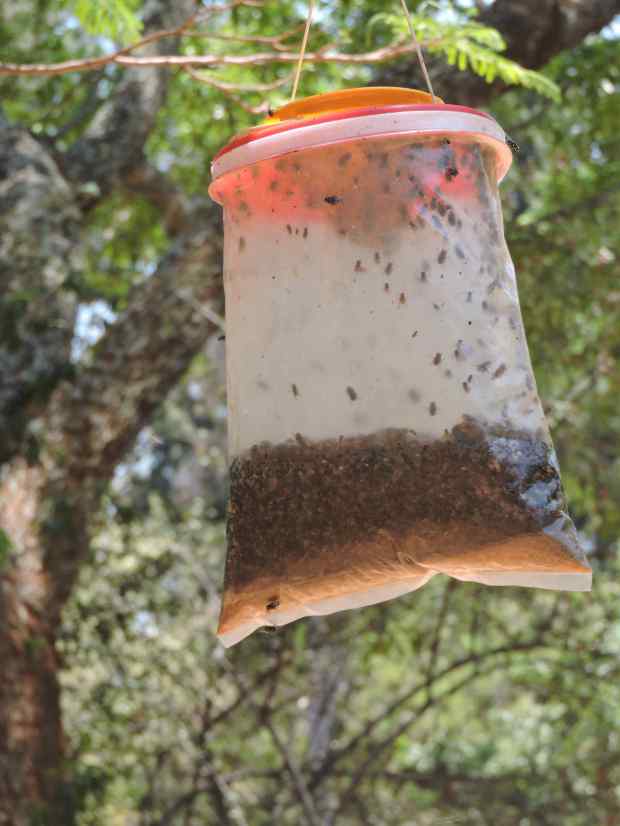
dscn9924-copy

My thoughts immediately went to Stephen and I was totally taken by surprise when my wife asked me to do the cleaning! “What about Stephen?” was my immediate response. “He is going to the rural area tomorrow, to prepare the land for planting” was her reply. I found this as a very suspect situation and I even thought that Erasmus had intervened in a long-distance revenge!

So it was the trap and I! I decided to take the only course of action left to me: my often practiced procrastination to see if I could last until Stephen’s return and delegate the task to him. To my regret I failed as some flies were spotted in the kitchen despite my efforts to kill and hide the corpses.

So, like Erasmus before me, I braved the cleanup. I have to confess that I had an advantage over Erasmus as my training and practice as a veterinarian had exposed me to a variety of emanations from decomposing nature. I also found a good face mask (from the times of the flu pandemic scare!) that I decided to wear, apart from rubber gloves.

When I believed I was ready, I went for it! Remembering Erasmus, I refrained from eating prior to the event. I unhooked the trap from the tree without major problems and I sprayed its contents with insecticide to kill the flies that were still alive inside. Emptying it was not as easy as it looked. Being lazy I tried to do it without removing the lid but this was not possible. Opening it became inevitable.

img_2744-copy

This action created a blast of malodorous miasma that hit my covered nostrils at full blast. The smell nearly knocked me off my feet and I decided that it was time for a pause to think (read “to keep all my innards in their right places”). At that stage I remember poor old Erasmus again as even the photographer used a powerful zoom to take the shots shown!

The pause worked and I managed to empty the trap from its burden and re-charge it with fresh water and powder so that it could continue functioning. I was quite happy to set it up again as I knew that the next cleanup would fall on Stephen and it would be my time to watch!

After hanging the newly-charged contraption I needed to dispose of the fly bodies by burying them as recommended to prevent any flies’ eggs from hatching. As an added precaution I also sprayed the fly mass with an insecticide and buried them deep.

The procedure over, I was triumphant for a while, until flies started to come towards me, mistaking me for the trap (now clean and smell-less) as I must have stunk badly although I was unable to smell anything at the time and for a while afterwards. Flies still followed me into the house when I entered to have a badly needed shower.


[1] Stink in Portuguese.

Spot the beast 17

As easy as it is beautiful. This “beast” was seen cruising on the grass looking for prey.

DSCN8015 copy.jpgFrankly, I thought it would be easier to spot!

?

?

?

However, here it is the creature for you, a harmless Spotted bush snake (Philothamnus semivariegatus) seen at Hippo Pools Wilderness camp by the Mazowe river in the Umfurudzi Park of Zimbabwe.

dscn8005-9-25-00-am-copy

dscn8018-copy

These snakes are harmless and very beautiful!

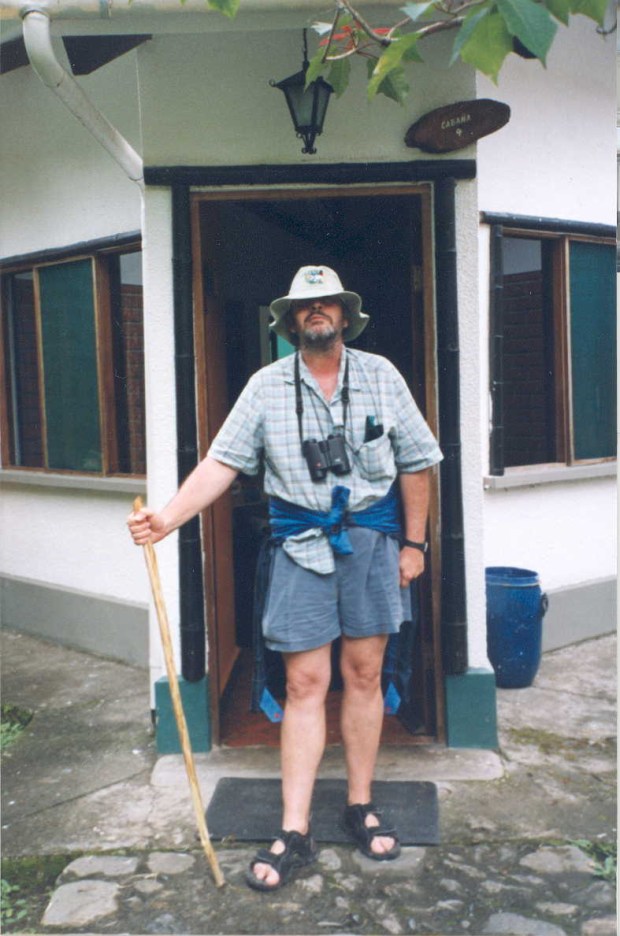
Hairy binoculars

Eyeglasses are essential for observing wildlife, particularly birds. I really believe that these optical aids make the difference between a good and a bad wildlife experience and I am amazed when I see people visiting wildlife parks without them after having travelled many thousand kilometres to do so.

For a long time I used mediocre binoculars until one day my friend Roger -a reader of this blog- showed me his Leica binoculars and I realized what German optical quality meant. He also told me that once he had a problem with his binoculars and the company immediately came to the rescue and even upgraded his binoculars to compensate him for having had a problem.

So, following his example, as soon as I could, I proudly bought my own Leica Trinovid 10X32 BN 8×32, rubber-coated and waterproof down to five metres. To use them added a new dimension to my game watching and I enjoyed them from the first use as they were easy to calibrate and use. For a while until I noticed the flaw…

To my dismay, I realized that the unthinkable had happened with my marvelous piece of optics. Somewhere inside their rubber-shielded-sealed right ocular lens system there was a hair, more precisely an eyelash, presumably of German origin!

yungas-rio-selva-2004-2-copy

Bushsnob in Coroico, near La Paz, Bolivia. The hairy binoculars are round his neck…

You will not be able to fathom my disappointment! At Leica in Germany they were horrified when I reported the find and they offered immediate assistance. However, at the time we were living in La Paz, Bolivia and there was no official Leica representative that I could contact to mend the problem. The alternative of sending them to Germany meant being “binocularless” for a while, something far from ideal.

As the problem was manageable, I decided to continue using my hairy binoculars for a couple of years. Having spotted the intruder, now I saw it more often but it did not really interfere with my vision so I was able to use the instrument. Some time later, when transferred to Rome, I could send them via courier for a free fix, as per their lifelong guarantee with all expenses paid. So, as soon as I could, I sent them to Germany.

About a week later, I got an e-mail confirming that the now eyelash-free binoculars were ready and that they had been sent by courier back to me to arrive the next day. It was a very pleased me that went to the courier office at the FAO building as I was anxious to get them back.

I was so excited that I was there even before the courier office opened! When I managed to get in, the binoculars had not yet arrived and I was told to come back in the afternoon as the delivery was expected by late morning. Disappointed, I went back to my office until it was time to return.

I knew, by looking at the face of the courier employee, that there was a problem before she spoke. “Sir, we have a problem. Unfortunately our van carrying all parcels for today was robbed and your parcel is one of the ones lost”. My heart sunk and, although I heard that the Police was investigating the event , bla, bla, bla… I was sure of the final outcome so I thanked her and walked away, distraught.

Back in the office I called Germany and my technical contact went mute for a long while. Then I said that the parcel should have been insured but, surprisingly, he was quite cagey about it and I had the impression that it was not![1] In desperation I told him that I had an imminent bird watching trip to Uganda and that I needed them badly.

Luckily my plead worked and he offered to send me a replacement immediately, item that I got next day. I checked it and it was -luckily- hairless this time and I have enjoyed their great clean optics ever since.

p1100623-copy

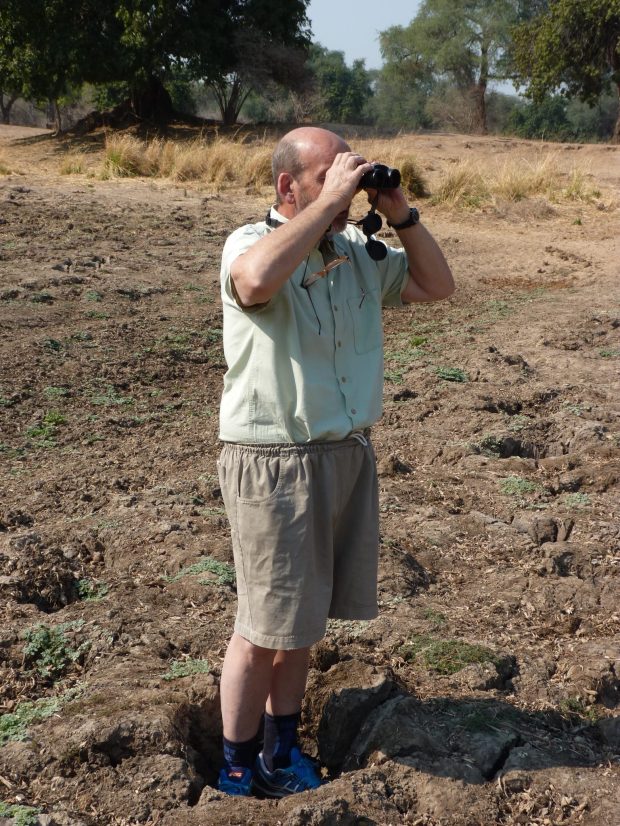
Bushsnob with hairless binoculars. Of course the only visible difference is the ageing of the user!!!


[1] I still do not know if the parcel was insured or not!

Spot the beast 16

The rain offers numerous blogging opportunities on the “spot the beast department”! Here is another one for you to find (Only look at the next picture below if you cannot find it!)

DSCN9914 12.17.44 PM copy

?

?

?

?

?

?

?

?

?

DSCN9912 12.17.44 PM copyIt was difficult but it was spot on in the center of the picture! It had a sad expression also!
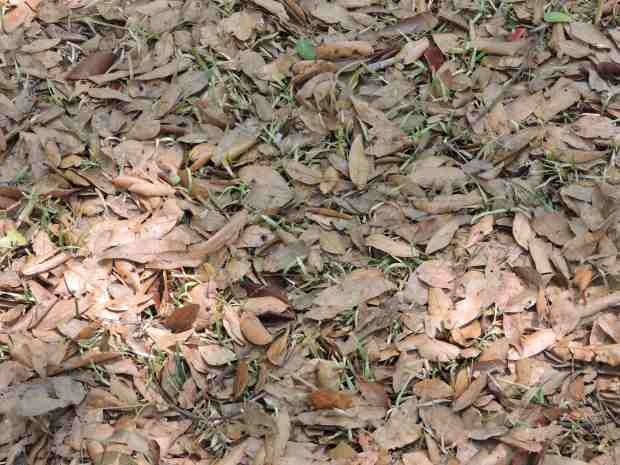
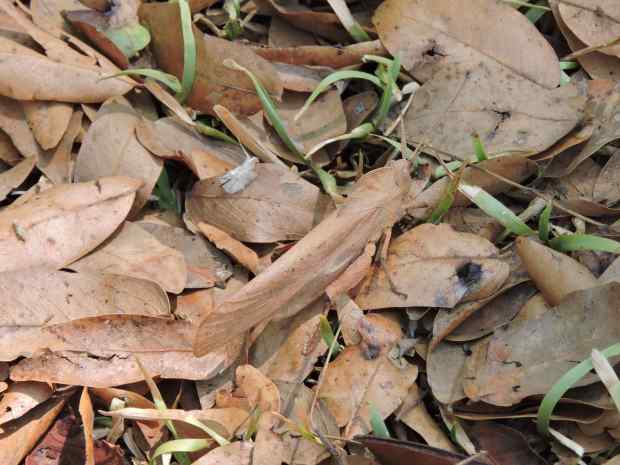
It is the flap-necked chameleon (Chamaeleo dilepis) the most common sub-Saharan chameleon.

Of least concern according to the International Union for the Conservation of Nature, I have the impression that their numbers are declining, at least in urban Harare. Some attributed this to the proliferation of security electric fences that, apparently, can kill them.

The flap-necked chameleon lays 10-40 eggs in a hole dug in soil. The latter take an amazing 10–12 months to hatch! A very long time if we compare it with other animals such as the Nile crocodile that takes 90 days! To watch the hatching of the perfectly formed and miniature young is simply amazing.

Luckily, this rainy season we have found a few so the situation may not be as bad or the frequent electricity cuts had yielded some benefits!

Spot the beast 15

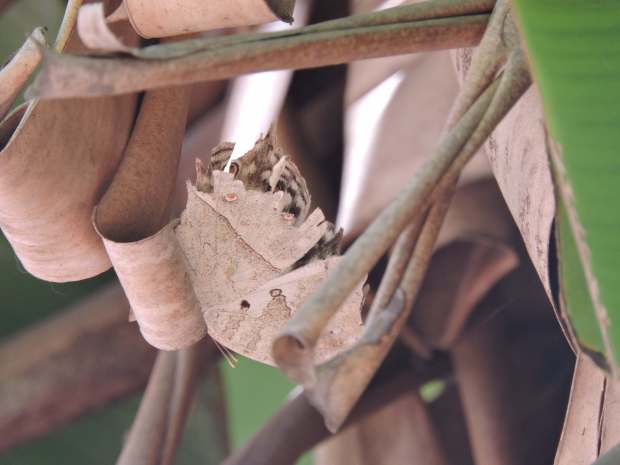
While walking on the dried leaves of the Msasa trees (Brachystegia spiciformis) also known as zebrawood, I came across this “beast”. I spotted it because it moved. Can you see it?

dscn9941-copy

OK. I agree that it was tricky so here you have a larger version.

dscn9942-copy

Spot the beast 13

Following on the subject of the earlier post, here you have another cryptic creature for you to find:

dscn9978-copy

It is hard but possible… Below I show it to you.


dscn9976-copy

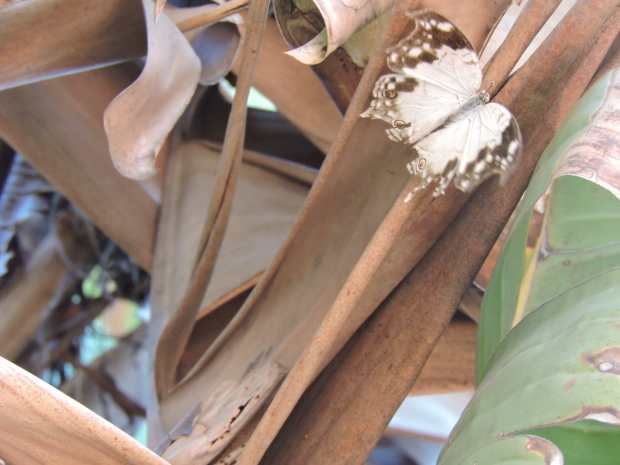
The fact that its wings were in tatters adds to its camouflage. For obvious reasons it did not open its wings very often so it was tricky to get a good shot. However, this is what I could do:

dscn9981-copy

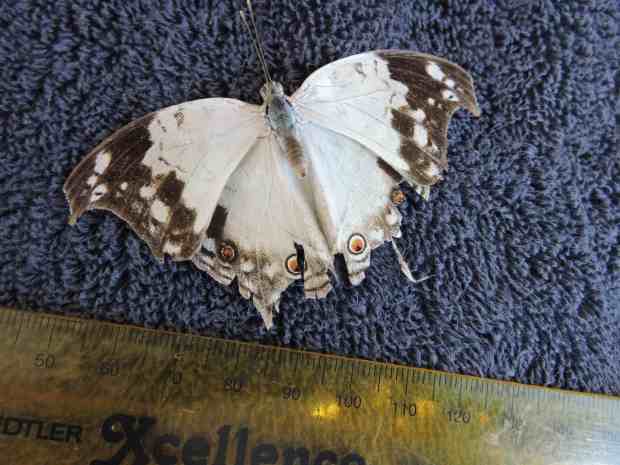
I believe it to be a Clouded mother-of-pearl (Protogoniomorpha anacardi nebulosa).

After a few attempts and with patience I caught it and, after having it inside the house for a while, eventually it landed on a towel and it settled down. With the patience I do not have and moving very slowly, I managed to get a better picture with a ruler! Wingspan about 7 cm.

dscn9985-copy

It disappeared soon after.


The water elephant

For hundreds of years humanity has discovered and classified the organisms that inhabit our planet. However, even today we continue to find new species. These are not tiny insects but fish, reptiles, birds and mammals, some even very large!

In 2004, while we were working there, United States scientists discovered a new species of monkey in the jungle of the Madidi National Park in Bolivia. The ape, of the group of the marmosets, was placed in the genus Callicebus. Following a novel initiative, its species naming was the result of a contest in Internet won by the Golden Palace Casino. This institution paid U$S 650,000[1] for the name Callicebus aureipalatii that -in Latin- means Golden Palace![2]

So far in 2016 several new species have been found. Some of them are small animals that can be considered difficult to see. However, this is not the case of the seven-metre long Black Whale defined as a new species this year. The finding is so recent that it still does not have its scientific name![3]

In addition, there is a new shark called Ninja lantern shark (Etmopterus benchleyi), found in the sea near Costa Rica in 2015.[4] Again, United States scientists studying aboard the Spanish research vessel Spanish B/O Miguel Oliver, discovered it. The species name refers to Peter Benchley, author of the novel Jaws.[5]

So far we have dealt with the amazing animals that have been discovered. But what about those animals suspected to exist but that we have not yet found? Cryptozoology is the study of animals -“cryptids”- that are believed to exist. The example that comes immediately to mind is “Nessie” the Loch Ness “monster” in Scotland that, despite a long search, continues to be the epitome of the elusive creature.

dscn5491-copy

However, other instances exist of other beasts that had been seen but never confirmed. One of them is supposed to dwell in the Belgian Congo (now Democratic Republic of Congo) and the information comes from a professional hunter called R.J. Cunninghame. This experienced hunter became world famous when he shot dead a hippo that attacked the then US President Theodore Roosevelt while on safari in East Africa in 1909.

A Frenchman named Le Petit told Cunninghame about Water Elephants that he saw in 1907 during his five-year stay in the Congo. Le Petit saw them for the first time while traveling through the river in the wetlands between Lake Leopold II (now Lake Mai-Ndombe) and Lake Tumba.

The first time he saw just a head and a neck that appeared on the water surface. His companions, natives of the place, told him that what he had just seen was a Water Elephant. Later he saw the animals again. This time they were five and he allegedly watched them for about a minute. He described them as between 180-240cm tall with relatively short legs and curved backs, elephant-like.

elephant-poilu-du-zaire

The water elephant by artist and writer Philippe Coudray. Reprinted with permission of the author.

Their heads were ovoid and elongated with a short trunk of about 60cm in length (tapir-like), but no tusks were seen. Their skin reminded him of hippo skin but it was darker. They walked with an “elephantine” gait that left footprints in the sand with four separate toes. This was the last time they were seen as they quickly disappeared into deep water. His fellow local companions reaffirmed Le Petit that the animals were common in that area and that they spent much time in the water, like hippos.

Interestingly, in the same general area another animal is reputed to exist, known as the Mokele-Mbembe, a creature believed by cryptozoologists to have a prehistoric look similar to “Nessie”. Although several expeditions have searched this area of the Congo, none have found it or the Water Elephant.

However, the Water Elephant existence came to the fore again when in 2005 a pilot flying over Lake Tumba apparently spotted them again. The animals seen would fit the description of Le Petit!

Not many scientists believe that a beast of this size can still be unknown to science. However, the Congo region -like Bolivia and others- has surprised us earlier with the discovery of other interesting creatures. You may also think that what Le Petit saw were African Forest Elephants (Loxodonta cyclotis), considered as pygmy elephants for quite some time but now as small specimens of L. cyclotis. This is unlikely for an experienced observer.

Le Petit’s description would fit that of the Moeritherium if the latter had been taller than its estimated one metre height.[6] Philippe Coudray, who I thank for his permission to use his picture of the Water Elephant, theorizes that elephants regarded as extinct -such as the Water Elephant- could still exist. He bases its reasoning on the finding of a tusk with a reverse curvature to normal elephants in 1904 in Ethiopia. The fact that the tusk was not fossilized would indicate that the animal did not live so long ago. The cryptid species postulated would be smaller than a prehistoric elephant known as the Deinotherium.

During our safaris we have seen elephants with weird-looking tusks.

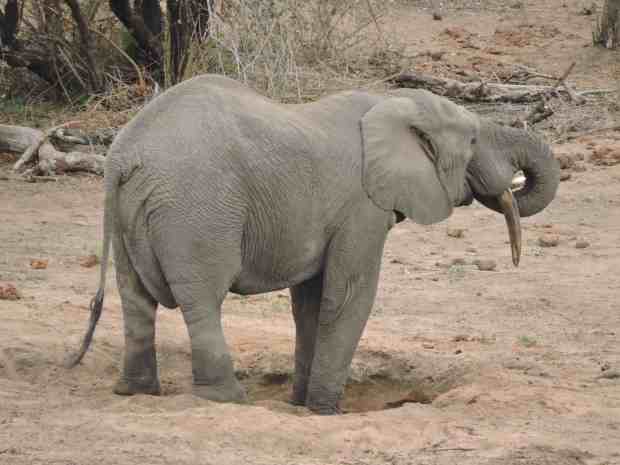
THis year, while visiting the Kruger National Park, we spotted an elephant with one of its tusks pointing downwards so these tusks are still on live elephants! It reminded me of the Deinotherium-like cryptid!

dscn9919-7-02-44-pm-7-01-05-am-copy-12-58-08-pm

Did the Water Elephant ever exist or what Le Petit saw were the smaller forest elephants? The area of Congo where they could be is still difficult to access so a final solution to the mystery may yet take a long time. In the meantime we can only wait.


[1] Donated to the Madidi National Park.

[2] http://www.nbcnews.com/id/7493711/ns/technology_and_science-science/t/internet-casino-buys-monkey-naming-rights/#.V7brlZN97-Y

[3] http://www.livescience.com/55623-new-species-black-whale-in-pacific.html

[4] http://www.oceansciencefoundation.org/josf/josf17d.pdf

[5] https://es.wikipedia.org/wiki/Etmopterus_benchleyi

[6] http://carnivoraforum.com/topic/9742488/2/

Note: This post is a translation and adaptation of an article published in the Spanish on-line Muy Interesante magazine. If interested see: http://www.muyinteresante.es/naturaleza/articulo/el-elefante-de-agua-y-otros-animales-que-no-sabemos-si-existen-721474540407

Nota: Este artículo es una traducción y adaptación de uno publicado en la revista Muy Interesante. Si tiene interés vea: http://www.muyinteresante.es/naturaleza/articulo/el-elefante-de-agua-y-otros-animales-que-no-sabemos-si-existen-721474540407

Horn-borer moths

One of the advantages of being a “safari veteran” apart from a bushsnob is that I am now able to enjoy what I found, even the small things that were overlooked while seeking large game. The years of long game drives and walks, some of them starting very early and with freezing temperatures, are a thing of the past. Apart from seeing a pangolin in the wild, I have few wishes left about finding new beasts.

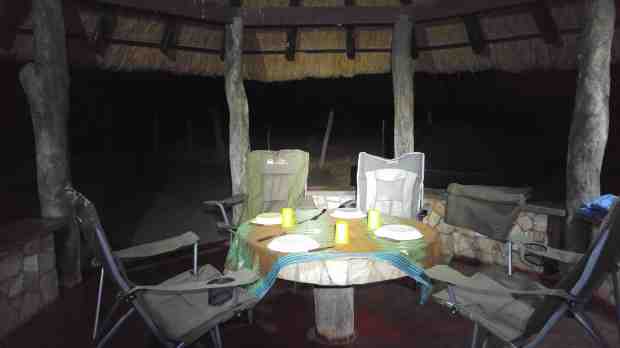
At Ngweshla Picnic site, Hwange National Park, you are allowed to camp and have the site for yourself from 18:00 to 06:00. During the day you share it with picnic site users but there is still plenty of room for everybody. Although rather unique, this is a good arrangement as most of the day you are game-watching away from the site and the camp attendants keep the camp tidy and the toilets sparkling at all times!

20160803_184901-copy

The site has seen better days and, as a consequence, it has a rather “porous” fence that would, if the animals wished, allow them to mingle with the campers, a rare occurrence though. The site entrance has been “decorated” with many animal bones. Although it is debatable whether these are suitable for the purpose, I find the skulls, useful to explain various issues regarding wild animals to our visitors.

The more recent antelope and buffalo skulls on display still had their horns and, as it is common if Africa, most showed little brown tubes protruding from them. I had seen this phenomenon many times before but I never followed its origin in detail. A short search educated me that the Horn-borer moths (Ceratophaga vastella) were responsible.

The larva of this moth, related to the one that upsets us by eating our woolies, are able to digest keratin and, although there are reports of them entering the horns of live animals, it is generally accepted that they only penetrate the horns post-mortem.

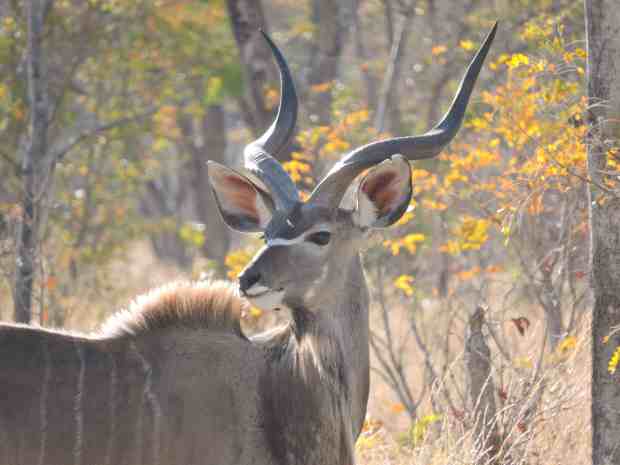
dscn9992-10-35-21-pm-copy

A nice and “mothless” Greater kudu bull.

The protuberances on the horns are the cases of the larvae that the latter built using their own faeces. The cases protect the soft insects from predators and the climate until they pupate and emerge as adults to fly away and colonize new horns.

Ceratophaga vastella, known as a detritivore[1], is widespread in the Afro-tropic ecozone[2]. Thus far there are 16 described species in the genus, with 12 found in Africa. The larvae are cream-coloured and bulky, with a brown head and tip of abdomen. The adult moth is a typical tineid[3], having a conspicuous tuft of yellow hair on the head.

Whenever an animal dies or is killed it will eventually be consumed by the killers and/or depredators including various mammals such as hyenas and jackals, birds such as vultures and others, fly maggots and ants until only bones, horns and hooves are left. The horn-borer moths are one of the last participants turning the carcasses to dust.


[1]An organism that feeds on and breaks down dead plant or animal matter, returning essential nutrients to the ecosystem.

[2] One of Earth’s eight ecozones. It includes Africa south of the Sahara, the southern and eastern fringes of the Arabian Peninsula, Madagascar, southern Iran and extreme southwestern Pakistan, and the islands of the western Indian Ocean.

[3] Moths of the Tineidae family, also known as fungus moths includes more than 3,000 species, unusual among Lepidoptera as most feed on fungi, lichens, and detritus. Apart from the clothes moths, which have adapted to feeding on stored fabrics, others feed on carpets and the feathers in bird nests. 


Bug get together

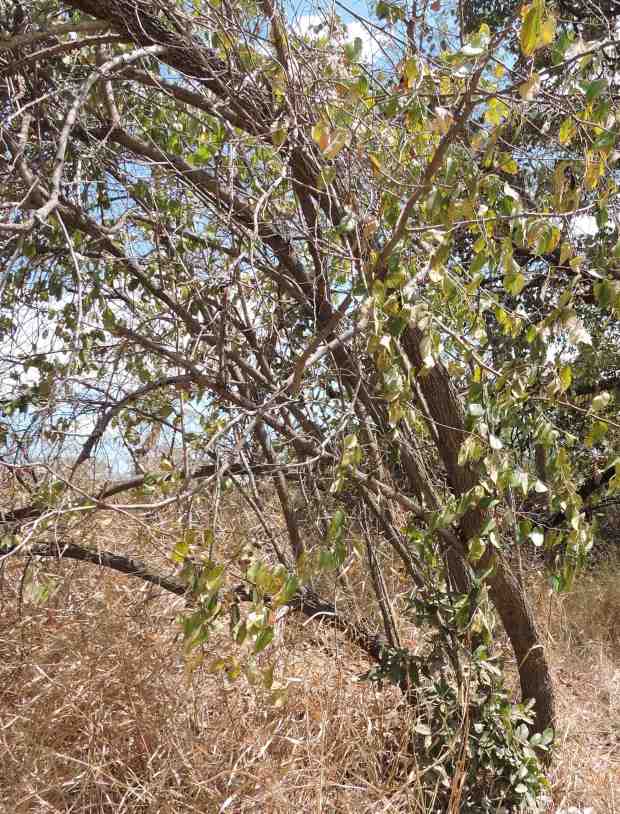
It was during a “pit stop” while returning from Mana Pools National Park to Harare in August when we found an interesting beetle aggregation. As usual, it was my wife who detected the “funny-coloured leaves” on the tree.

dscn9993-4-47-19-pm-copy

The tree where the bug meeting was taking place. The bugs are the darker spots on the right.

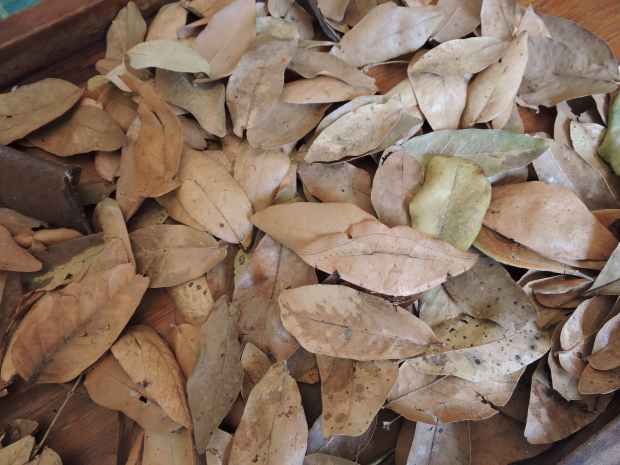
We had a good look at the tree and took a few leaves and fruits from it to see if we could identify it. We also took pictures and videos of the insects as it was a really interesting find. Later, after some time we decided that the tree was a Buffalo-thorn, Ziziphus mucronata. Thinking that the finding was interesting, I followed it up and consulted the experts.

I sent pictures to the Biosystematics Division of the Agriculture Research Council-Plant Protection Research Institute in South Africa from where I got a very helpful response the following day! Luckily, they agreed with our tree identification and clarified that the beetle was in fact a bug of the Plataspidae family and not a beetle.

As expected, to positively identify a bug through photographs is not really possible. However, the creatures’ identity was narrowed down to either Brachyplatya testudonigra or B. rubromaculatus. However, more important than the identification was the fact that the bugs were swarming, not a common phenomenon.

Things then turned a bit more scientific when I tried to get more information on swarming and learnt that Sithole and Oelofse (no date) described the rather unusual swarming of the green stink bug, Piezodorus purus. The latter was observed in several areas of the Kruger National Park but their aggregation reached large numbers at the Mooiplaas area where the bugs became a nuisance for the park personnel living there.

I also learnt that there is actually a stink bug considered to be a delicacy! This beast, aptly named the edible stink bug (Encosternum delegorguei) found in northern South Africa and Zimbabwe, does swarm during years that the conditions for such event are right (Stiller, personal communication). If interested, Nelwamondo (2015) gives very interesting information on this species.

Sisterson (no date) mentions insect aggregation in general as a phenomenon that obeys to three main reasons:

  • environment: e.g. low temperature and/or low humidity forcing the bugs to migrate searching for better conditions,
  • mating strategy: it seems that although swarming could be positive by allowing weak females (after debilitating winters) to be able to mate with multiple males, it can also create confusion among active seeking males that would spend energy chasing each other in addition to the females) and,
  • defensive strategy: aposematic[1] insects aggregate. It is believed that they do so to become more obvious and, in this way, better deter predators.

The aggregation pheromone is responsible for this behaviour that, although it can be used in pest control it can also have deleterious effects on some attractive insects such as butterflies as their aggregation sites get degraded with the risk of their number diminishing below critical levels.

The behaviour observed in the Green Milkweed locusts (Phymateus viridipes) reported earlier in this blog[2] was probably migratory as they were not feeding on the cacti. However, feeding is another reason for insect aggregation. Stiller (personal communication) mentioned that he has observed leafhoppers swarm on the trunks of trees, that are probably their feeding plants and the pest Bagrada hilaris, can occur in very large numbers on feeding plants.

The introduction of the bean plataspid, Megacopta cribraria, into the United States in October 2009 has attracted considerable research on this bug as it has become a pest of soybean in Georgia and South Carolina (Poplin and Hodges, 2015). These researchers mention the overwintering congregation of the bugs on buildings as a possible nuisance, a similar situation as the one described above that took place in the Kruger National Park.

It is interesting how a rather casual observation of a cup of coffee stop during a road trip could develop into a motivating investigation on the aggregation behaviour of insects. Of course, after all the reading and writing, I still do not know the exact nature of the bug but I learnt something about the biology of the plataspids, a group of insects I totally ignored.

Acknowledgements.

The assistance of Elizabeth Grobbelaar and Michael Stiller of the Agriculture Research Council-Plant Protection Research Institute of South Africa was critical in checking the identity of the bugs.

References

Nelwamondo, V. (2015). Edible stinkbug. SANBI – Zoology systematics. Accessed on 15 October 2016. http://www.sanbi.org/creature/edible-stinkbug

Poplin, A. and Hodges, A. (2015) Bean Plataspid: Megacopta cribraria (Fabricius) (Insecta: Hemiptera: Heteroptera: Plataspidae). Document EENY527, Department of Entomology and Nematology; UF/IFAS Extension, USA.

Sithole, H. and Oelofse, J. (no date). Accessed on 15 October 2016. https://www.sanparks.org/docs/parks_kruger/conservation/scientific/interesting_facts/mooiplaas_insect_oubreaks_2006.pdf)

Sisterson, M. (no date). Insect Aggregations; The Phenomena Itself, Why It Occurs, And Its Implications To Us. Accessed: 15 Oct 2016. http://www.earthlife.net/insects/aggregat.html


[1] brightly coloured and/or toxic insects

[2] https://bushsnobinafrica.wordpress.com/2016/01/31/spot-the-beasts/

Spot the beast 12

I was not planning to blog today, Sunday. However, there are no rest days for Nature so I found this creature in the garden and took a picture for you to find it. This time it is not very difficult…

scn9945-copy-2I am sure that you spotted it but, just in case I give you a close-up.
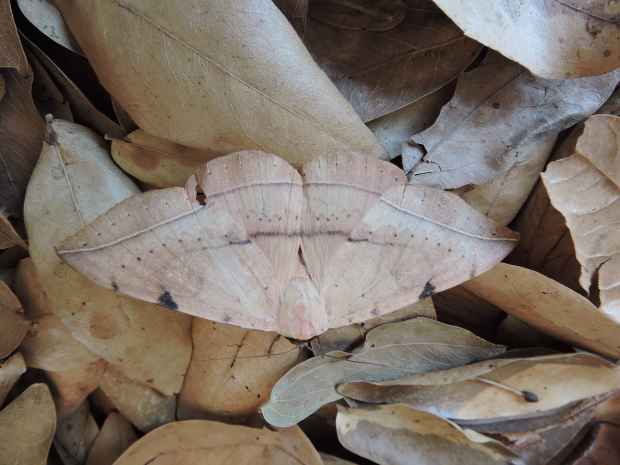
scn9948-copyIt is (I believe) a Red Tail moth (Hypopyra capensis), a common moth of Southern Africa that has a cryptic upperside that blends very well with dead leaves this time of the year.
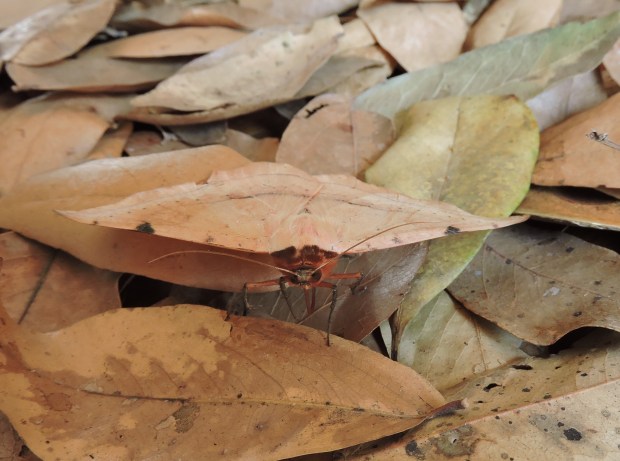
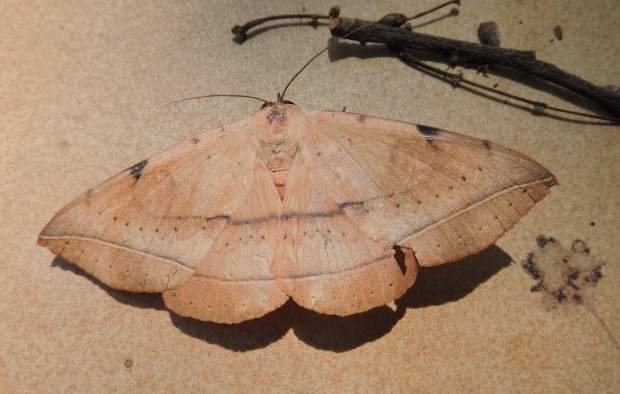
Its under-wings and abdomen, however, are bright orange-red hence its common name.

scn9944-copy

As I try not to handle them, I thought I would not able to show you its underside as it flew away. Luckily it decided to land on the floor of the patio for a while where I could photograph it under direct sunshine and the underside colour can be seen, even from above!

scn9951-copy

The larvae of this beautiful large moth of about 70mm wingspan feed on false-thorn (Albizia) and its range goes up to equatorial Africa.[1]


[1] Picker, M., Griffiths, C., and Weaving, A. (2004). Field Guide to Insects of South Africa. Struik Nature. pp366.