By chance I bumped into this beast yesterday. I wonder if you can identify it.

?
?
?
?
?
?
?
?
?
?
?
?
?
?
?
?
?
?
?

It is a very dark immature mantis, as usual looking rather fierce. Below a few more pictures of the beast for you to enjoy.


By chance I bumped into this beast yesterday. I wonder if you can identify it.
?
?
?
?
?
?
?
?
?
?
?
?
?
?
?
?
?
?
?
It is a very dark immature mantis, as usual looking rather fierce. Below a few more pictures of the beast for you to enjoy.
A different “Spot” provided by my son. The find took place while he was SCUBA diving in Tenerife. See if you can spot it.

?
?
?
?
?
?
?
?
?
?
?
?
?
?
?
?
?
?
The video clearly shows that it is a sole that lost its nerve and swam away rather fast. A nice sight.
The advent of the rains in our farm in Salta brings, like every year, an explosion of life. Today’s beast is not very common but rather spectacular (if you can find it…). At the bottom I include more pictures and videos of it for you to appreciate its beauty.

?
?
?
?
?
?
?
?
?
?
?
?
?
?
?
It was an Imperial moth (Eacles imperialis) first described by Drury in 1773, clearly being too obvious to be missed!

This moth is one of the largest and most stunning of the Imperial moths. It is found from Canada to Argentina. Both larvae and adults are highly variable in coloration. They have a wingspan ranging from of 80 to 174 mm, the females being larger than the males.
Their immature instars feed on pines, oaks, maples, sweetgam and sassafras trees. Adults emerge before sunrise and mate after midnight and the females lay eggs singly or in small groups on both sides of leaves. Both sexes do not feed and are short-lived.
Some more pictures and videos below:


I found these moths a couple of years back and observed that they responded in this way to the touch. I filmed them as I found the behaviour interesting. I imagine that this behaviour could be useful the moths to survive while mating and laying eggs?
Checking my files I found this beast, one of my favourites. I am sure you will find as it is rather obvious.

?
?
?
?
?
?
?
?
?
?
?
?
?
?
?
?
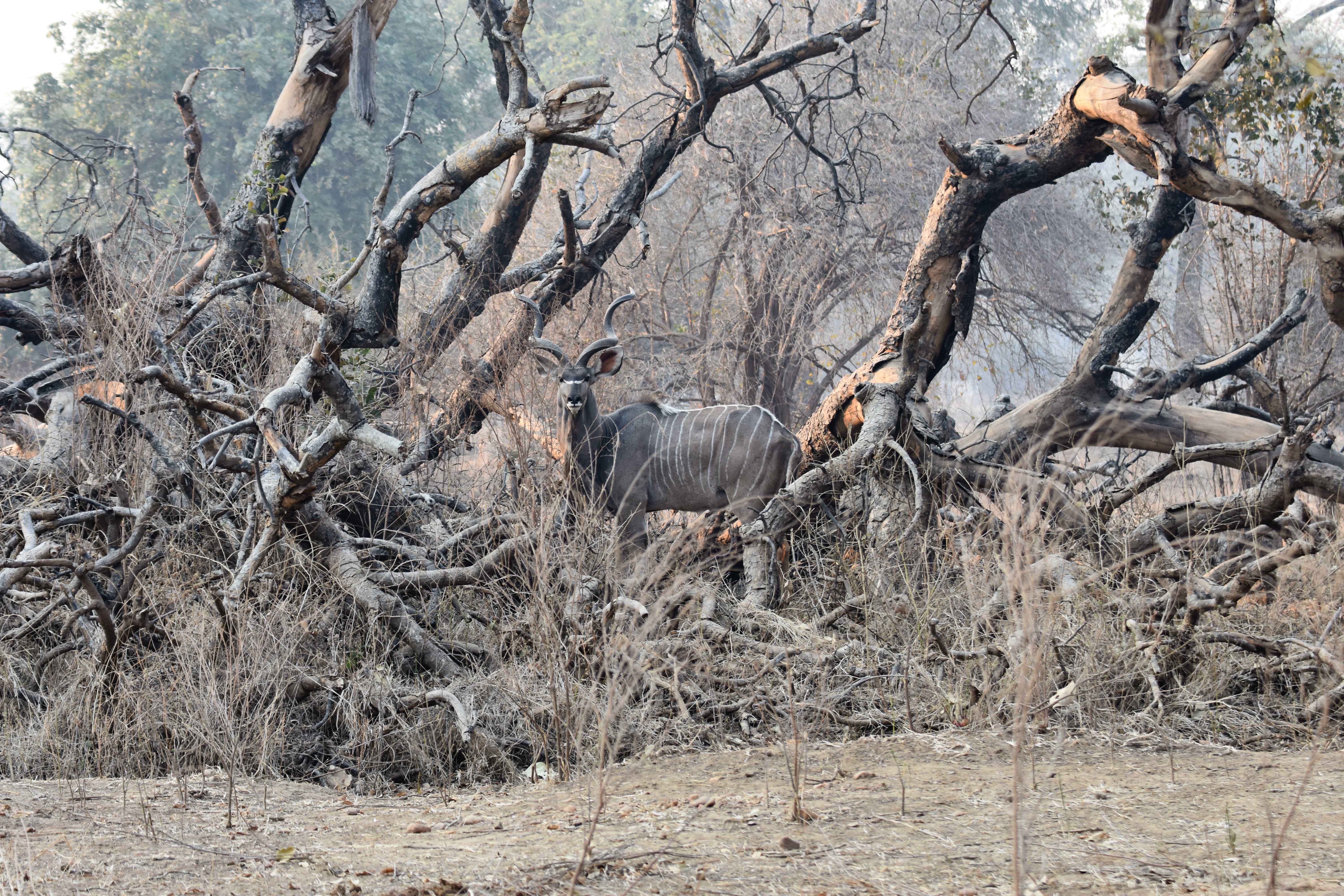
This “Spot” was just an excuse to show you how well this beautiful Greater Kudu male blended in the extremely dry environment of Mana Pools National Park in Zimbabwe.
While working on my next Ethiopian post that I promise will be interesting, I present you with this beast to see if you can find it. I must confess that it was difficult even for me to see it a few days after taking the shot!

?
?
?
?
?
?
?
?
?
?
?
?
?
?
?

More pictures to give you a better idea of this moth:


On the road and without time to write the few final posts on Ethiopia, I present you with my last contribution for 2020 (although for some of you may be already the first of 2021) with my best wishes for the New Year during which I expect we will all avoid Covid!
Anyway, I found this at the garden and here it is. It seems straight forward but…

?
?
?
?
?
?
?
?
?
?
?
?
?
?
Clearly, the ladybird was too obvious and a distraction! The real hidden beast is this small bluish-gren moth, a real delicate creature, well camouflaged among the leaves.

Finally, after nine months at the farm, Covid 19 cases have decreased in Salta Province (Argentina) and travel restrictions were lifted, although still maintaining the usual precautions.
For a change of scene, we headed for the “Valles Calchaquíes” a string of valleys that go through Catamarca, Tucumán, Jujuy and Salta Provinces. Although I will probably expand on this in future posts, we are now at a place called Payogasta and in the garden of the hotel Mabel found this beast while checking the identity of some of the plants there. So, if it is a tricky “spot”, it is not my fault this time as she found it and took the pictures!

To the left of the yellow flower, there is a toad that was busy catching flies, its whitish mouth gives it away. It is raining in Payogasta, a very dry area. Because of this, a lot of animals usually not seen are now active, including the toads.
To change a bit, I offer you a rather different “spot” today.
One of the main attractions of Mana Pools National Park in Zimbabwe (apart from the river, the light, the various campsites, the wild dogs, the elephants, the lions and I stop there naming just a few!) is to be able to walk through the park despite it holding the Big 4 (sadly the rhino is no longer there).
While walking is a great way to explore the park you must be careful as, often, you do not see the animals until you are too close for comfort and you need to be prepared to respond appropriately. This is one of the cases that seems incredible until it happens to you.
Imagine that you are walking there now, what can you see?

?
?
?
?
?
?
?
?
?
?
?
?
?
?
?
?
What look like tree trunks, suddenly become legs and they start moving!

You had just disturbed the siesta of a large elephant and it is coming your way!

You realized that it is a bull elephant but the most important thing at that time is to back down slowly and start taking pictures through a zoom lens!
While trying to catch up with the next post about our time in Ethiopia, I present you with this beast captured in the video below. These are frequent visitors in our garden now that the jasmine is flowering. Nice beast but what is it?
Is this what you believe you saw?
At first I also thought I had seen a small hummingbird of the various species present at the farm. However, it was really too small for a bird.
A more careful look reveal it to be a moth that also drinks nectar!
The beast is a day-flying moth in the family Sphingidae described by Jacob Hübner in 1819. More specifically it is known as a Titan sphynx moth (Aellopos titan), a species described by by Pieter Cramer in 1777 [1].
The genus Aellopos occurs from the United States through Central America and down to Argentina and Uruguay in South America. It has a wingspan between 55 and 65 mm and it is dark brown with a distinctive wide white stripe across the abdomen.
The larvae of this moth feed on seven-year apple (Casasia clusiifolia), bottombush (Cephalanthus occidentalis) and white indigoberry (Randia aculeata) among others. They pupate in shallow underground chambers. The adults are around throughout the year in tropical areas, feeding on nectar of various flowers by rolling out their long proboscis, estimated at twice the length of their bodies.
They are fascinating insects to watch as they buzz rather loudly while moving actively between flowers. They are capable to beat their wings up to 70 times per second and they can fly at speeds of up to 20 kph. Their oversized and rather menacing eyes are meant to look like those of a bird so, do not feel bad if when you saw the video you did think it was a hummingbird as I also did!
Having given you difficult assignments before, today I give you a relatively easy one…

?
?
?
?
?
?
?
?
?
?

I hope you found it easily as I expected. What I am not sure of is whether you are familiar with this rather large moth known as the Black Witch moth (Ascalapha odorata), an interesting beast in the way that it elicits fear in some parts and good luck in others!
Named by Linnaeus in 1758, the Black Witch is found from the southern United States to Argentina. The adults feed on overripe fruits while the earlier instars feed on legumes’ leaves such as Acacia species. The female of this moth is one of the largest in the American continent reaching up to 17cm (the one illustrated below was about 16 cm). The males are paler and smaller.
The Black Witch was already known by the peoples of America well before Linnaeus. They associated this moth with death and bad luck with names that meant butterfly of the land of the dead, death’s butterfly, and terror’s butterfly. It is believed to bring death in North American, Mexican and some Caribbean cultures and if one of these flies into a house, it is considered bad luck and most likely killed.
In some parts of Mexico, people joke that if one flies over someone’s head, the person will lose his hair. I was in Mexico and have lost my hair but I did not see the moth…
Closer to our present home, in Paraguay, the moth is wrongly associated with Dermatobia hominis as there is a mistaken belief about the moth urinating over their human “victims” and thereby inoculating their eggs, which then develop into maggots under the skin of the victim. In parts of Argentina it is known as the “pirpinto de la yeta” that could be translated as “bad luck’s butterfly”.
These beliefs have influenced the genus name Ascalapha. It comes from Ascalaphus, the custodian of the orchard of Hades who was the god of the dead and king of the underworld in Greek mythology. Ascalaphus was turned into an owl by either Demeter or Persephone (Hades’ consort) because of his misdeeds [1].
In the Bahamas they are know at the “money moths” as it is believed that if they land on you, you will get money, the same as in Texas if one lands outside your house. Just yesterday Carolina, a good friend, told me that she recalls her grandmother telling her that these moths brought good luck to the family that finds them.
They are not common at our farm in the Yungas of Salta but it makes some appearances attracted to the lights, resembling the bats that often fly around at night with which they are also mistaken. They seem to lose their bearings, and some have remained in our house for several days -despite our attempts at returning them to the outside- until they move off or just die.
Although the dorsal side of their wings look dark brown and almost black, its colours change depending on the angle of the light. On close inspection they can reveal areas of iridescence, mainly purple and pink, crossed by a whitish bar in the females. The small, comma-shaped green/pale blue surrounded by an orange line on each forewing are diagnostic of the species.
While we had not seen it, the larva is large (up to 7 cm) green and dark brown/black. Black Witch moth pupae were placed in the mouths of victims of the novel “The Silence of the Lambs” although in the movie they were replaced by death’s-head hawkmoth pupa.
[1] See: https://en.wikipedia.org/wiki/Ascalaphus_(son_of_Acheron)


